



Most eCommerce brands don’t decide to “go global.” It happens in pieces. A direct-to-consumer brand hires a customer support contractor in the Philippines to cover night shifts, brings on a paid media specialist in Poland because the CPMs are better, and signs a fulfillment contract in Germany once EU order volume justifies a local warehouse. None of those hiring decisions happen through the same system, and within a year or two, the finance team is reconciling payroll data that was never built to be reconciled.
Rising labor costs are already pushing 85% of retailers to rethink how they staff their operations, according to Shopify’s 2026 global commerce research, and a growing share of that rethinking involves hiring outside the home country. The businesses that handle this well aren’t necessarily the ones selling in the fewest countries — they’re the ones running a payroll data structure that can absorb a new country without breaking.
For a software company, international hiring might mean opening a handful of engineering hubs. For an eCommerce brand, it usually means something messier: a mix of full-time hires, contractors paid through freelance platforms, warehouse staff employed by a local fulfillment partner, and marketing freelancers who invoice directly in their own currency.
Nikita Agarwal, Director at Milestone Localization, described this pattern in a recent interview on international hiring: her company keeps local teams in India and the UK, but brings on sales staff in other countries as contractors specifically because it sidesteps the management fees, tax registration, and compliance overhead that come with formal employment (source)
That calculation makes sense for a single hire. Multiplied across a dozen countries and several types of working relationships, it produces a payroll picture with a different data format, currency, and pay cadence for nearly every line item. Staffing agencies that work with DTC brands see the same pattern from the operations side — a brand based in Austin might hire a platform-integration specialist in Buenos Aires and a merchandising coordinator in Krakow within the same quarter, each brought on through a different agency or provider (source)
Every one of those relationships exports payroll data differently, and none of it was designed to sit in the same spreadsheet.
The financial impact goes well beyond inconvenience. An EY analysis found that companies average 15 payroll errors per pay period, each one costing between $291 and $5,000 to resolve once the labor to identify and correct it is factored in (source) That’s a single-country estimate — the exposure compounds every time a new jurisdiction enters the mix.
Picture a mid-sized eCommerce brand selling in the US, UK, and Australia. Its US team is on a domestic payroll platform, its UK warehouse staff are paid through a local provider, and its Australian customer support contractor invoices directly in AUD. Each source uses a different date format and reports gross pay differently. None of that is unusual — it’s simply what happens when hiring outsizes the systems built to track it, and it’s exactly the kind of setup that produces the error rates above.
At a larger scale, the numbers get harder to ignore. A joint report from UKG and KPMG found that organizations lose 2–4% of total labor spend to payroll “leakage,” and nearly 2 in 5 companies surveyed reported annual payroll losses between $1 million and $5 million (source) Separate research from Strada found that 53% of companies had been fined for payroll errors within the past five years, and these weren’t isolated to large multinationals (source)
For an eCommerce business running lean, margin-sensitive operations, this kind of leakage lands directly on the bottom line. And it’s almost always traceable back to the same root cause: payroll data that doesn’t speak one language across the countries it comes from.
The fix isn’t a better spreadsheet. It’s a shared schema that every country’s payroll data gets mapped into before it reaches the books, regardless of whether the source is a local payroll vendor, an Employer of Record platform, or a contractor invoice.
A workable schema needs consistent fields for base pay, bonuses, overtime, deductions, employer contributions, and net pay, plus metadata like pay period, currency, and worker classification. For an eCommerce business specifically, that classification field matters more than most finance teams expect. A warehouse employee on a local payroll run, a contractor invoiced in USD, and an EOR-employed marketer in the same country can look almost identical on paper but need to be reported in completely different ways for tax purposes.
Building this schema well requires input from people who understand each region’s compensation norms, since pay structures vary more than most companies expect going in. Some countries mandate a 13th-month payment; others tie statutory bonuses to specific holidays or fiscal years. A schema that treats these as optional, conditional fields holds up over time. One that forces every country into an identical template tends to break the first time it meets an edge case.
Two formatting choices cause a disproportionate share of cross-border payroll errors: currency and dates. Currency should be captured in both the local denomination and a standardized reporting currency, using a consistent exchange-rate source and timing so month-to-month comparisons aren’t distorted by whichever rate happened to apply on export day.
Dates deserve the same discipline. Standardizing on ISO 8601 (YYYY-MM-DD) across every system removes the ambiguity that comes from mixing DD/MM/YYYY and MM/DD/YYYY conventions. It’s a small change, but it prevents a surprising number of downstream reconciliation errors, particularly when a US-based finance team is reviewing exports from European or Latin American payroll vendors.
Every country has its own withholding categories, social contributions, and statutory deductions, and they rarely map onto one another cleanly. Standardization doesn’t mean forcing them into identical categories — it means creating a consistent taxonomy that groups similar items (income tax, social contributions, pension, health insurance) under standard labels while preserving the local detail underneath.
This layered approach matters because the compliance risk is real and expensive. Misclassifying even one worker can generate $15,000 to $100,000 or more in back taxes, penalties, and legal fees once multiplied across a few years (source) A tax taxonomy that preserves local specifics under standard headings is what lets a finance team catch these issues before an auditor does, not after.

Manually reformatting payroll exports stops scaling somewhere between the third and fifth country. At that point, most eCommerce businesses need either a unified HR and payroll platform or a middleware layer that ingests exports from local providers and transforms them into the standardized schema automatically.
The right choice depends heavily on how the workforce is actually structured. A brand with a small, mostly domestic core team but a handful of international hires can often get by with unified HR software like SenseHR, which centralizes HR records and payroll data in one system rather than leaving each country’s numbers in a separate export.
A brand hiring across many countries with no local entity needs something built for that specifically. This is where cross-border payroll solutions become relevant — platforms designed to consolidate multi-country payroll data into a single standardized format, handling currency conversion, tax field mapping, and compliance documentation without a finance team rebuilding spreadsheets every month. Whatever platform gets evaluated, test it against the schema built first, not the other way around — technology chosen before the data model tends to get replaced within eighteen months.
Tax rules change. New countries get added. Vendors update their export formats without much notice. Without active ownership, standardized payroll data drifts back into fragmentation within a year or two.
A workable governance structure needs four things:
None of these steps require a large team. For most eCommerce businesses, this is one person spending a few hours each quarter reviewing how the schema is holding up, plus a short checklist run through whenever a new country or vendor gets added. The cost of skipping it shows up later, usually during an audit, a due-diligence process, or the moment a finance lead tries to build a consolidated report and discovers that no two countries’ numbers actually line up.
Standardizing payroll data across multiple countries isn’t about finding one perfect format. It’s about building a structure flexible enough that local variation can plug into it without breaking the whole system. For eCommerce businesses expanding into new markets one hire at a time, that structure is often the difference between international growth that scales cleanly and international growth that turns every pay cycle into a reconciliation project.
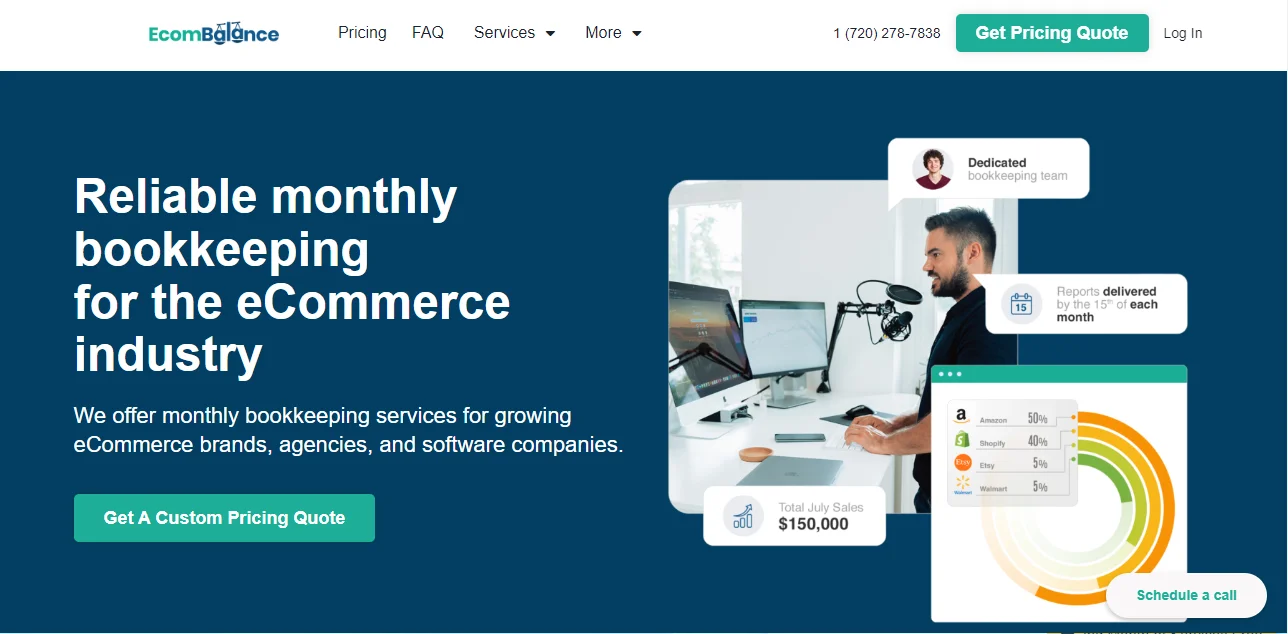
EcomBalance is a monthly bookkeeping service specialized for eCommerce companies selling on Amazon, Shopify, eBay, Etsy, WooCommerce, & other eCommerce channels.
We take monthly bookkeeping off your plate and deliver you your financial statements by the 15th or 20th of each month.
You’ll have your Profit and Loss Statement, Balance Sheet, and Cash Flow Statement ready for analysis each month so you and your business partners can make better business decisions.
Interested in learning more? Schedule a call with our CEO, Nathan Hirsch.
And here’s some free resources:




