

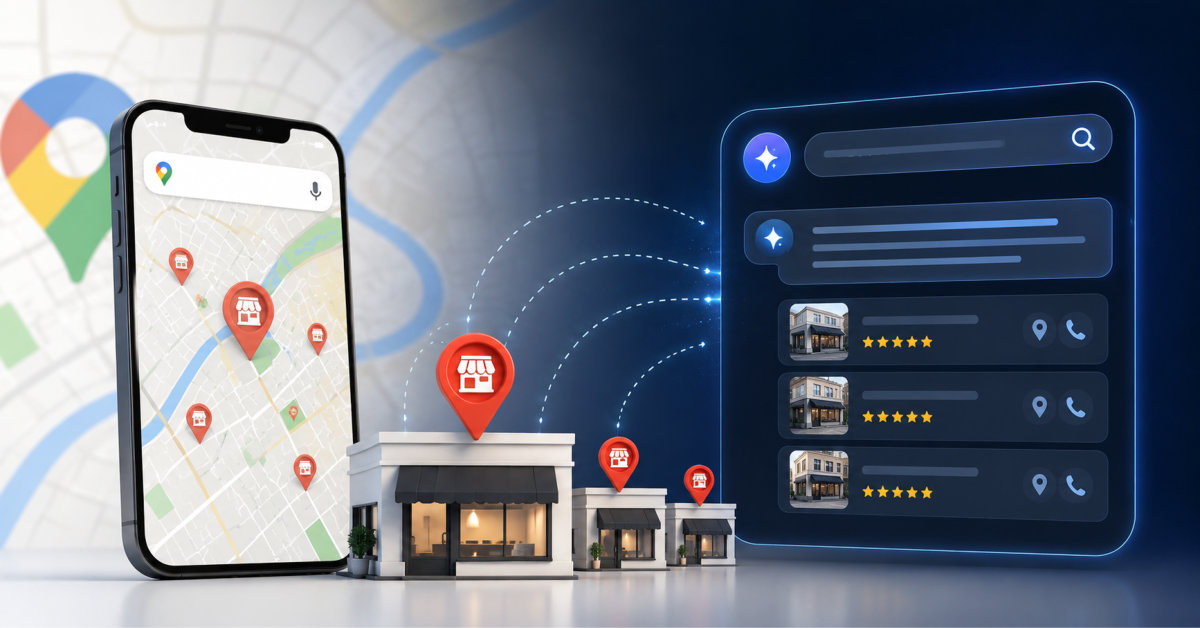
Ecommerce discovery no longer happens only on product pages and traditional Google search results.
For brands with stores, showrooms, pickup points or other physical locations, customers can discover a business through Google Maps, the local pack, reviews, location pages and increasingly through AI-powered search experiences.
A shopper may research a product online, compare nearby stores, check reviews, ask an AI assistant for recommendations and visit a physical location before making a purchase. Another may discover the store on Google Maps and complete the transaction online later.
For multi-location ecommerce brands, this creates a new challenge: being visible wherever local buying decisions begin.
Platforms such as LocalBoostly are built around this changing search environment, combining Google Business Profile optimization, Google Maps visibility tracking, competitor intelligence and AI-powered local SEO workflows.
Ecommerce and local commerce used to be treated as separate channels.
That distinction is increasingly artificial.
Consider someone looking for a new office chair. They may begin with a broad product search, compare models online and then decide they want to test the chair before buying it.
The search changes from:
“best ergonomic office chair”
to:
“ergonomic office chair near me”
or:
“office furniture store in Chicago”
At that moment, the ecommerce brand is no longer competing only through product SEO.
It is competing through local visibility.
This applies to fashion retailers, furniture brands, electronics stores, sporting goods companies, beauty businesses and almost any ecommerce operation with a physical presence.
When a search has local intent, Google Maps and local results can become part of the buying journey before a shopper visits an ecommerce website.
The customer may immediately see:
This makes local search more than an SEO channel.
It is part of the storefront.
A location with accurate information, strong reviews and useful photos can create trust before the customer ever reaches a product page.
Google Business Profile plays a central role in connecting a brand with local searchers.
For a multi-location ecommerce company, each profile represents an individual store or location rather than the brand as a whole.
That distinction matters.
A customer in Dallas does not care that the company has a perfectly optimized flagship store in New York. They want to know whether the Dallas location is open, trusted and relevant to what they need.
Each profile should therefore be treated as its own local asset.
That means keeping categories, hours, contact information, photos, descriptions and other relevant information accurate and up to date.
Managing one location is relatively simple.
Managing dozens or hundreds introduces a completely different level of complexity.
Each store operates in its own local search environment.
It has different competitors, reviews, neighborhoods, customer behavior and ranking patterns.
A brand might dominate searches around one location while another store barely appears a few miles away.
National SEO reporting can hide this problem because traditional keyword positions do not show what customers actually see across different geographic areas.
Multi-location brands therefore need to think locally at scale.
One of the most misleading questions in local SEO is:
“What position do we rank in?”
For local search, there may not be one meaningful answer.
Visibility can change depending on where the searcher is located.
A store may rank prominently close to its address, appear lower several neighborhoods away and disappear completely on the other side of the city.
This is why geo-grid rank tracking has become useful for businesses that depend on local discovery.
A geo-grid checks rankings from multiple points across a geographic area rather than reporting a single position.
For an ecommerce brand, that can reveal:
This creates a much more realistic view of Google Maps performance.
A company may know its biggest ecommerce competitors very well and still misunderstand who it is competing against in local search.
The brands competing for national organic rankings may be completely different from the businesses appearing above an individual store in Google Maps.
A national furniture chain, for example, might compete locally against an independent showroom with excellent reviews and a highly optimized Google Business Profile.
That is why competitor intelligence should happen at location level.
Teams should look at who actually appears for high-value local searches, how strong their profiles are, what customers say about them and where they outperform individual locations.
Ranking is only part of the job.
Once a customer sees several businesses, they still have to choose one.
Reviews help shape that decision.
A shopper may compare businesses based on overall rating, recent feedback, the number of reviews and how companies respond to customers.
This makes review management part of both local visibility and conversion strategy.
Multi-location brands benefit from a repeatable system for requesting genuine feedback, monitoring new reviews and responding consistently without making every response feel automated.
Reviews can also reveal what customers value most about individual stores, providing useful information for both marketing and operations.
Google Business Profile should not exist in isolation from the ecommerce website.
Important physical locations deserve useful landing pages of their own.
A strong location page might include:
The mistake is creating hundreds of thin pages where only the city name changes.
A location page should genuinely help someone deciding whether to visit that store.
For a broader look at the fundamentals behind Google Maps, Google Business Profile, reviews, citations and local visibility, the LocalBoostly local SEO guide provides a useful framework for understanding how these signals work together.
Local discovery is also expanding beyond traditional search results.
Consumers can increasingly phrase their needs as complete questions:
“Where can I buy quality running shoes near me?”
“What are the best furniture stores nearby with good reviews?”
“Recommend a local electronics store where I can pick up my order today.”
These queries fit naturally into conversational search and AI assistants.
For brands, this means online visibility is no longer only about ranking a page for a keyword.
Search systems also need to understand the business itself: what it offers, where it operates, whether its information is consistent and how customers describe it.
This is where traditional local SEO begins to overlap with entity optimization and AI search visibility.
Google Maps and AI search should not be treated as completely separate marketing strategies.
Both depend on machines being able to understand a business clearly.
Consider the information surrounding a physical store:
When those signals tell a consistent story, the business becomes easier to understand across different discovery environments.
The objective is moving beyond “rank this keyword” toward creating a clear digital entity that search engines and AI systems can confidently associate with particular products, services and locations.
Content still matters, but local content needs a purpose.
Publishing dozens of generic articles with different city names is not a strategy.
Useful content can answer genuine local questions, explain products, provide expertise and strengthen the relationship between a brand and the markets it serves.
An outdoor retailer might publish regional buying guides or content related to nearby activities. A furniture brand could create guides around showroom visits, delivery areas or choosing products for homes common in a particular market.
The LocalBoostly blog covers Google Maps optimization, Google Business Profile, local rankings, reviews, AI search visibility and related topics for businesses building this type of organic discovery strategy.
A single business owner may be able to check their profile, read every review and manually monitor competitors.
A brand with 100 locations cannot operate the same way.
At that scale, teams need systems.
Profiles need monitoring. Reviews arrive every day. Competitors change. Rankings move. Business information gets outdated.
Automation is useful when it reduces repetitive work while still leaving important decisions with the marketing team.
This is the problem platforms such as LocalBoostly aim to solve by bringing Google Business Profile optimization, Map Grid tracking, competitor analysis and AI-assisted recommendations into a single workflow.
Make sure every physical location accurately reflects the business, including its category, hours, contact information, website links and other important details.
Send customers to pages designed around the location they searched for rather than automatically directing every visitor to the homepage.
Create a consistent process for generating legitimate customer feedback and responding to it.
Track how each location performs across the actual market it serves rather than relying on one ranking position.
Identify which businesses are winning nearby searches and understand what they are doing differently.
Keep important information clear and consistent wherever customers and search systems may encounter the brand.
Consider how the same business information may support visibility across Google Maps, traditional organic search and AI-powered discovery.
Local SEO is particularly valuable for ecommerce brands with stores, showrooms, pickup points or other physical locations. Pure online retailers generally have less need for traditional local optimization.
Ecommerce SEO focuses heavily on product, category and informational visibility. Local SEO focuses on geographic intent, Google Maps, Google Business Profile, location pages, reviews and local relevance.
Brands with eligible physical locations can maintain Google Business Profiles that help customers discover individual stores through Google Maps and local search.
Geo-grid tracking measures local rankings from multiple points within an area. It helps show how visibility changes depending on where a customer searches.
Local competitors can differ from national ecommerce competitors. An individual store may compete in Google Maps against businesses that barely overlap with the brand’s traditional organic competitors.
Both rely on understanding businesses, services, locations and trusted information. Strong business data, useful website content, reviews and clear entity signals can therefore support a broader local discovery strategy.
Ecommerce brands with physical locations operate in two worlds, but customers experience only one brand.
They may begin with a product search, move to Google Maps, read reviews, ask an AI assistant for recommendations, visit a store and eventually buy online.
The brands that win local discovery are the ones that make those steps feel connected.
That means treating Google Business Profiles, location pages, reviews, Map Grid visibility, competitor intelligence, website SEO and AI discovery as parts of the same system.
Traditional ecommerce SEO is not disappearing.
Local search is simply adding another layer to it.
And for brands with a physical footprint, that layer can determine which store a customer discovers before they ever reach a product page.




