

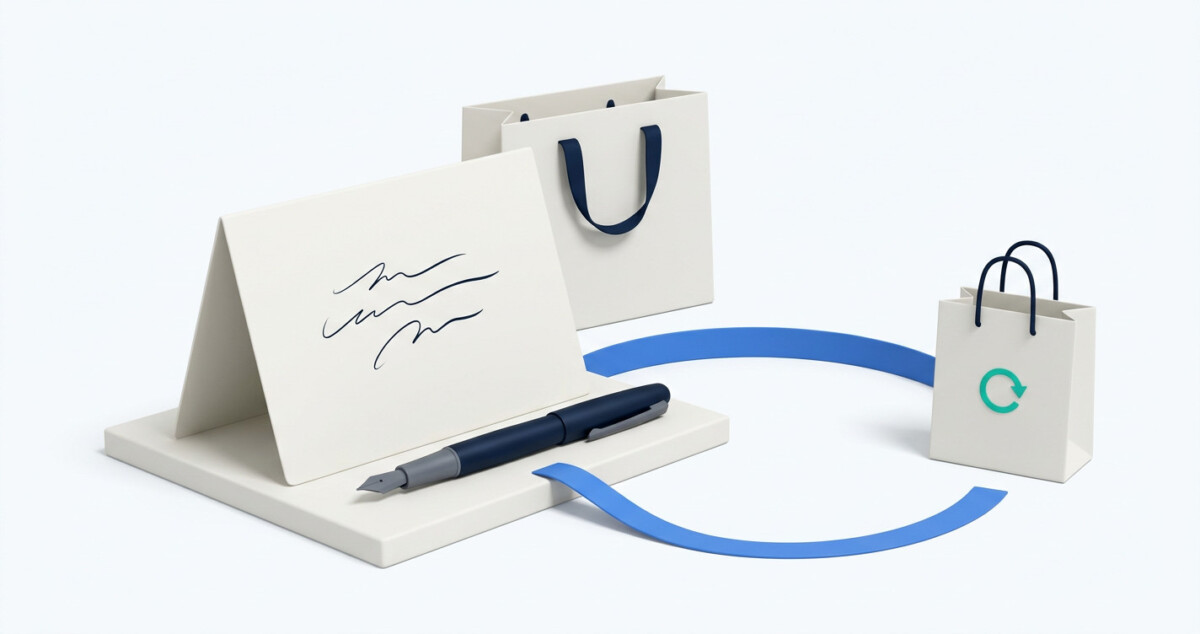
A handwritten thank-you card can lift repeat purchases, and a six month randomized field study found it did, but the lift comes from the customer believing a person wrote it. Send cards at specific moments, keep them sincere, and prove the payoff with a holdout group first.
The research says a handwritten note works because the customer believes you wrote it. Automate it carelessly and you keep the cost while losing the reason it worked.
Two thousand online shoppers, six months, one variable: what was tucked into the parcel. In a randomized field experiment run with an online retailer, customers who received a handwritten thank-you letter came back and bought again more often than customers who received nothing. Customers who received the same letter printed, or a photocopy of a handwritten one, did not.
That last finding is the part most advice on handwritten notes skips, and it decides whether a card program earns its keep. The note works because the customer believes a person took the time. How you write cards, which orders get them, and how you scale them without a pen in your own hand all come back to protecting that belief.
Whether you are packing orders at the kitchen table or shipping thousands of parcels a week through a 3PL, the same questions apply. This guide covers why handwriting stands out against email and printed inserts, the four moments when a card is worth sending, how to send cards without writing them yourself, and how to prove a card pays before you put one in every box. Services that write and post handwritten thank-you cards for online stores now connect directly to Shopify, which changes who can realistically do this at scale.
Handwritten thank-you cards can increase repeat purchases, and the strongest evidence comes from a randomized field experiment that tracked 2,000 online shoppers for six months and found handwritten letters raised the repeat purchase rate while printed letters and photocopies did not. The research, presented at the Chinese University of Hong Kong Business School, sent different versions of an appreciation letter in the shipping package and then watched what customers did next.
The detail that matters most for merchants is what the researchers found inside the handwritten group. Letters with rough, ordinary looking handwriting beat letters with beautiful calligraphy. In follow up lab studies, shoppers assumed messy handwriting came from the seller, while polished handwriting looked like a professional copyist hired to persuade them. The customers were rewarding sincerity, not penmanship.
A second line of evidence shows that gratitude itself does a lot of the work. University of Kentucky marketing professor Alexis Allen and her co-authors ran a field experiment with an upscale restaurant group in which the company president emailed a thank-you to customers who had given top survey scores. Over the following 12 months those customers increased their spending by 51% compared with a control group, and adding a reward coupon to the note made no difference.
Read together, the two studies point to one mechanism. A thank-you works when it is clearly sincere, and handwriting is one of the most reliable ways to make sincerity unmistakable. Two limits are worth holding onto. The retailer study abstract does not publish the size of the lift, and both studies come from single businesses in categories that may not match yours. Treat this research as a strong reason to test, not as a forecast for your store.
A handwritten note stands out because it signals effort that email and printed inserts cannot imitate: an email costs nothing to send and a printed insert goes in every box, so neither tells the customer that a person thought about them. Your thank-you email lands in the same inbox stream as the order confirmation, the shipping update, the review request, and the cross sell, and customers sort all of it as automated.
Printed inserts have the opposite problem. They are physical, but customers read them correctly as marketing collateral. That is why the printed letters in the retailer study did nothing measurable, even though the words matched the handwritten version exactly.
Handwriting also changes how people respond to a request, which matters when the card asks for something. Psychologist Randy Garner’s 2005 study of handwritten sticky note requests found that adding a short handwritten note to a survey packet roughly doubled response in his first experiment. When the task was harder, a generic handwritten note helped less, while a personalized one that used the recipient’s name restored much of the effect. People treat a personal handwritten ask as a favor between people, and they tend to grant favors.
The practical rule follows directly. Whatever produces the card, it has to read like one person writing to one customer. That means a real hand, ideally your own, the customer’s first name, the specific product they bought, and a signature from a named person on your team. It also means no discount code. Allen’s coupon finding and the retailer study’s printed letter result say the same thing from different directions: the moment a thank-you carries an offer, it reads as a printed insert with nicer handwriting.
Send a handwritten card at four moments when a customer is deciding how they feel about your brand: after the first order, at a repeat order, after a late or botched delivery, and when you want an honest review. Cards on every order dilute both the budget and the signal. Cards at these moments land when the customer is paying attention.
The first order matters most because the gap between a first and second purchase is where most customers quietly leave. A card aimed at that decision earns its place on replenishable or higher ticket products, where one extra reorder covers many cards.
The repeat order card works on a different lever. Allen’s restaurant study thanked customers who were already delighted, and that is who a second or third order identifies. A note saying you noticed they came back costs little and rewards the behavior you want more of.
The late delivery apology is where timing discipline matters. Tell the customer immediately by email or SMS, as the guide to strategic post purchase experiences that drive repeat purchases recommends, and fix the problem first. A mailed card arrives days later, so it works as the human follow up, never as the apology itself.
The review request needs two guardrails. Time it to when the product has been used; this review management guide on request timing suggests 7 to 14 days after delivery for most products and longer for results based items like skincare. And keep it clean: the FTC’s final rule on fake reviews and testimonials prohibits incentives conditioned on a review expressing a particular sentiment, so ask for an honest review and never tie a reward to a five star rating.
You can send handwritten cards without writing them yourself by using a service that writes each card with a real pen held by a machine, posts it for you, and connects to Shopify so paid orders trigger cards automatically. Before choosing one, it helps to see the three routes side by side, because each trades authenticity against scale differently.
Writing them yourself is the most authentic and the least scalable. At $5K to $30K a month, it is often the right call: a founder writing ten cards on a Friday afternoon produces exactly the slightly imperfect, clearly personal note the research rewards. The guide to unboxing experiences that drive loyalty and repeat purchases puts the ceiling bluntly, arguing handwritten notes work at 50 orders a month and not 5,000. Printed gift notes through your 3PL scale easily, but printed is precisely the version that did nothing measurable in the retailer study.
The third route closes that gap. A pen and post service takes your message, writes it in ink on cardstock with a pen plotter, and mails it to the customer. MailMyCard is one example: a machine holding a real ink pen writes each card in a handwriting style you choose or one built from your own handwriting sample, and the service connects to Shopify so each paid order can trigger a card to the shipping address.
Four questions separate a card that keeps the effect from one that wastes it. Whose handwriting is it? A hand built from your own writing, signed by a named person, protects the sincerity signal better than a flawless stock script. Can you choose which orders trigger a card? You want first orders, specific products, or tagged segments, not every order by default. Where are cards posted from, and how long do they take to reach your main markets? And does the card arrive inside the parcel or on its own? Most automated services mail to the shipping address separately. That can work in your favor as a second touch a few days after the box, but write the message for that timing rather than for the unboxing.
Prove a card program pays by holding back a random share of eligible customers, sending cards to the rest, and comparing repeat purchase rates after 60 to 90 days before you add cards to more orders. The research gives you a reason to test. Only your own customers can tell you whether it pays at your margins.
Start with one moment, usually first orders above your average order value. Split eligible orders randomly, for example by sending cards on even order numbers only, and tag both groups in Shopify so you can pull them apart later. If your volume allows, run three groups: a handwritten card, a thank-you email from a named founder, and nothing. Allen’s results suggest the email alone may capture part of the lift at almost no cost, and the three way split shows you what the paper is actually adding.
Then do the break even math before you look at the results, so the numbers cannot talk you into anything. Divide the margin you earn on a typical reorder by your full cost per card, including postage and any setup time. That ratio is how many cards each extra reorder has to pay for. As an illustrative example, assuming a reorder earns ten times what a card costs, you need one extra reorder for every ten cards, which is a 10 percentage point lift in repeat rate for that group. If the ratio is twenty, you need 5 points. That bar is why cards belong on high margin, replenishable, or high lifetime value customers first.
Stage changes what a valid test looks like. Under roughly $30K a month, your groups will be too small for clean statistics, so write cards yourself and watch replies, reviews, and second orders closely. Between $100K and $1M a month, run the holdout properly. Above that, send cards to your highest lifetime value cohorts and keep a permanent holdout so the program has to keep earning its place. The mistake to avoid at every stage is the one that catches so many merchants between $500K and $2M: adding a new touch to every order before proving it works on any of them. Thanking customers sincerely will still matter in 18 months. Whether a particular card format does is something only a holdout can tell you.
Handwritten thank-you notes can increase repeat purchases, based on a randomized field experiment that tracked 2,000 online shoppers for six months. Customers who received a handwritten letter in their parcel bought again more often than customers who received nothing, while printed letters and photocopies of handwritten letters showed no measurable effect. The researchers traced the lift to sincerity: shoppers responded to evidence that the seller personally made an effort. The study came from one retailer and did not publish the size of the lift in its abstract, so results in your category may differ. Treat it as a strong reason to run your own test rather than a promised outcome.
A card written by a pen plotter can keep much of the effect if it still reads as personal, but it is not automatically equal to your own hand. Research on appreciation letters found that rough, ordinary handwriting beat polished calligraphy because shoppers assumed the polished version was written by hired copyists. A pen plotter puts real ink on paper, which avoids the printed look that showed no effect. To protect the sincerity signal, use a handwriting style built from your own writing, include the customer’s first name and the product they bought, sign with a named person, and leave out discount codes.
You can ask for a review in a handwritten card, as long as you ask for an honest review and never tie a reward to a positive rating. The FTC’s final rule on consumer reviews prohibits incentives conditioned on a review expressing a particular sentiment. Handwritten requests tend to work well because people treat a personal handwritten ask as a favor, and research on handwritten notes found personalized requests performed best for harder tasks. Time the request for when the product has actually been used, often 7 to 14 days after delivery and longer for results based products like skincare or supplements.
Either works, but the timing changes what the card should say. A card inside the parcel lands at the unboxing moment, which suits a first order thank-you and a tip on using the product. A card mailed separately, which is how most automated handwriting services deliver, arrives days after the box and works as a second touch. That later timing suits a review request for a product the customer has started using, or a follow up after a delivery problem. Check where a service posts from and typical delivery times to your main markets so the card does not arrive weeks after the moment has passed.
Start with one segment rather than every order, usually first orders above your average order value or customers placing a second or third order. Cards on every order dilute your budget and make the gesture feel routine. Before expanding, run a holdout test: send cards to a random half of the segment, hold back the rest, and compare repeat purchase rates after 60 to 90 days. Then check break even by dividing the margin on a typical reorder by your full cost per card. That ratio tells you how many cards each extra reorder must cover, and whether the segment can carry it.




