

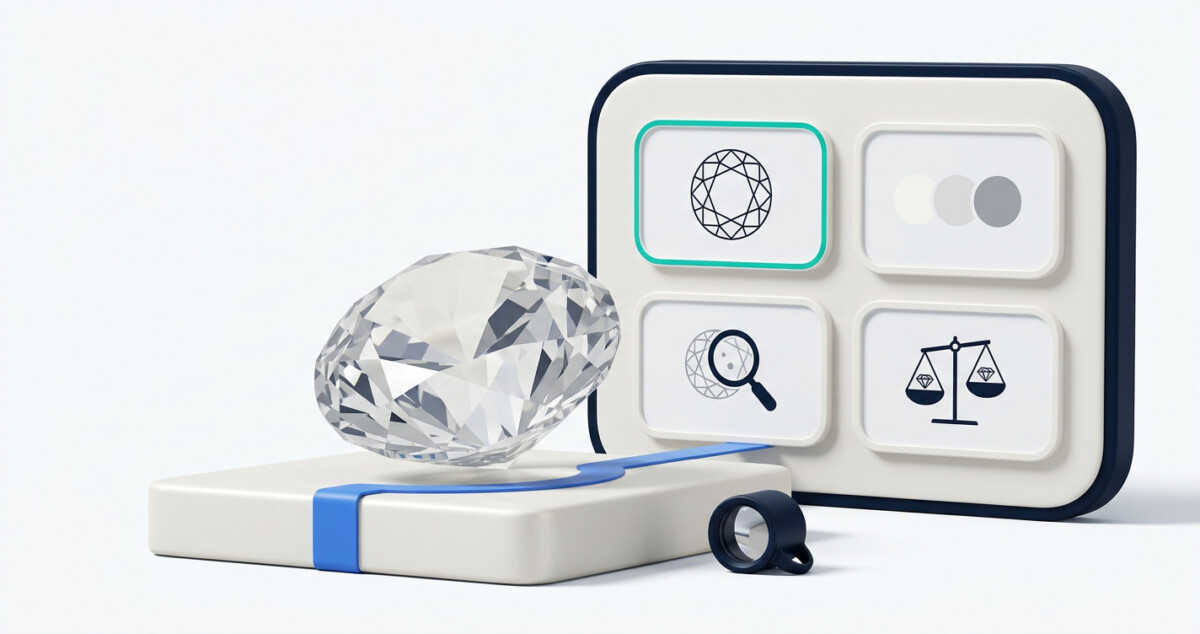
Picture a buyer with a budget set aside for an engagement ring and a browser tab open to a page of stones she will never hold before she pays. Every diamond on the page comes with a row of letters and numbers she doesn’t understand: G, VS2, Excellent, 1.01. That is about as hard as a sale gets in ecommerce, and it happens every day.
The numbers show how hard. Fine jewelry converts at roughly 0.5% to 1.0% online, compared with 2.0% to 4.5% for fashion jewelry, according to Branvas’s 2026 jewelry ecommerce benchmarks. Yet online retailers sell diamonds anyway. Ritani, for example, lists more than 200,000 GIA and AGSL certified natural diamonds, each with HD 360 degree video, and sells them to people who have never seen the stone in person.
What those retailers figured out applies to any merchant selling something expensive, technical and untouchable. The 4 Cs, the cut, color, clarity and carat standard the Gemological Institute of America developed in the 1950s, aren’t just a grading system. Used well, they are a playbook for turning a spec sheet into confidence. I learned a version of this at VisionPros, the online contact lens retailer I co-founded and later exited. Contact lenses are a spec product too (base curve, diameter, power), and the customers who bought with confidence were the ones who understood what those numbers meant for their eyes, not the ones we showed the most numbers to.
I’m not a gemologist, and this isn’t a diamond buying guide. It’s a look at how the 4 Cs get sold, and what you can borrow for your own store whether you’re doing $10K months or $1M months.
High-ticket products stall online because the buyer is being asked to trust a spec sheet they can’t interpret, from a store they can’t walk into, with money they can’t easily get back. Every one of those three gaps shows up in the data. Baymard Institute’s cart abandonment research, which averages 50 studies to a 70.22% abandonment rate (last updated September 2025), finds that among shoppers who abandoned a checkout for reasons other than just browsing, 19% didn’t trust the site with their card details and 13% weren’t satisfied with the returns policy. Those figures cover all of ecommerce. At a $5,000 order value, the same objections carry far more weight.
The mistake I see most often is treating a $4,000 product page like a $40 one. Countdown timers, “only 2 left” badges and a single hero image work on impulse purchases. They actively hurt considered ones, because they add pressure at the exact moment the buyer needs clarity. If that pattern sounds familiar, the breakdown of why your low-ticket conversion playbook breaks above $500 covers the 30 to 90 day consideration window in detail.
Online diamond retailers can’t lean on urgency or touch, so they lean on education. And when you look at how the good ones teach the 4 Cs, you find four repeatable moves that work in any category. Lead with the spec that changes what the customer experiences. Tell buyers where the money doesn’t show. Answer the question behind the grade. Sell perceived value, not just the number on the certificate.
Each of the next four sections takes one C, shows how it gets sold, and translates the move for a merchant who has never touched a diamond. The last two sections cover the trust stack that closes the sale and what to build at your stage.
Lead your product education with the one spec that most changes what the customer experiences, which in diamonds is cut. Cut describes how well a stone has been shaped and faceted, and it controls how much light comes back to the eye. GIA’s guide to diamond cut puts it plainly: the beauty of a particular diamond “depends more on cut quality than anything else.” For round brilliants, GIA grades cut on a scale from Excellent to Poor.
That is why good diamond education starts with cuts and steers buyers toward Excellent or Very Good grades. A stone with top color and clarity grades can still look flat and lifeless if it’s poorly cut, and this is the one place where a compromise to save money tends to be visible from across the table. The retailers who sell well online don’t hide that. They put it first.
Here is the merchant lesson. Most spec sheets are ordered by what’s easy to measure, not by what matters to the person using the product. A mattress page leads with coil count when the buyer wants to know how it will feel at 3am. An e-bike page leads with motor wattage when the buyer wants to know whether it will get up the hill on the way home. Your “cut” is the spec that decides whether the customer is happy six months from now, and it is often not the one printed at the top of the manufacturer’s sheet.
To find it, pull the last 90 days of pre-sale questions from your helpdesk or chat tool. Whether you’re answering them in Shopify Inbox or Gorgias, tag every “will it…” and “does it…” question by the spec it’s really about. The spec that shows up most is your cut. Move it above the fold on your hero product page, explain it in one plain sentence, and push the secondary specs further down.
Telling buyers where they can spend less without seeing a difference is one of the strongest trust moves a high-ticket brand can make, and diamond color is the clearest example of it. Color is graded from D, completely colorless, to Z, which shows an obvious yellow or brown tint. The naive assumption is that further up the scale is always better. The honest answer is that it depends on whether anyone can see the difference.
Most people can’t, across a surprisingly wide band. Diamonds in the G to I range appear colorless to most people without magnification, yet they cost considerably less than D to F stones. Even side by side under normal lighting, a D and a G are hard to tell apart. The setting matters too: a slightly warm stone in a yellow gold setting often looks whiter than the same stone in platinum, where any warmth stands out. Good diamond education tells buyers to choose the metal first, then the color grade, because that one decision can save real money without changing what anyone sees on the hand.
For a merchant, this feels backwards. Why would you tell a customer to spend less? Because the buyer already suspects the premium tier is where stores make their margin, and when you point out where the money doesn’t show, you confirm you’re on their side. The saved budget doesn’t have to leave the cart either. In diamonds it moves to the setting, the band or a step up in size. In your store it can move to an accessory, an extended warranty or a better spec where the difference is visible.
On Shopify, this can be as simple as a short “where to save” note stored in a product metafield and shown next to the variant picker: “Most customers can’t see a difference above this tier. Spend the difference on X instead.” It costs nothing to build, and it changes the tone of the whole page from selling to advising.
Buyers don’t want to know a diamond’s clarity grade; they want to know whether they will ever see a flaw, and the stores that answer that question directly are the ones that earn the sale. Clarity measures internal characteristics called inclusions and external ones called blemishes, graded from Flawless down to Included. What most buyers don’t realize is that the majority of inclusions are microscopic and invisible without ten times magnification.
A diamond graded VS1 or VS2, short for Very Slightly Included, will typically look perfectly clean to the naked eye and costs significantly less than a Flawless or Internally Flawless stone. The sweet spot for many buyers sits in the VS or SI1 range. There is a caveat worth keeping, and good retailers keep it: SI2 stones can sometimes have inclusions you can see without magnification, depending on where they sit and what type they are. So the right question to ask about any specific stone is whether its inclusions are eye visible, not what the grade says.
That is the move: replace the grade with the outcome. “VS2” is an answer to a question nobody asked. “You won’t see anything with the naked eye” is the answer to the question the buyer actually has. Every category has this gap. A furniture fabric’s rub count means nothing until you say what kind of household it holds up in. A skincare device’s wavelength means nothing until you say what the customer will notice and when.
Video closes the gap faster than copy. When a buyer can spin a stone at magnification and look for the inclusion herself, she stops relying on your word. You don’t need a studio to do the same for your products; a $200 founder-shot video setup is enough to show the detail that answers the real question, and clear audio matters more than the camera.
Carat is a measure of weight, not size, and the jewelers who explain that difference help buyers get a stone that looks bigger for less money. Two diamonds of the same carat weight can look quite different face up depending on cut proportions and shape. GIA’s guide to carat weight notes that a poorly cut 1.20 carat diamond can look the same size as a well-cut 1.00 carat stone once set, because extra weight can be hidden in or below the girdle where nobody sees it.
Shape changes perceived size as well. Elongated shapes like oval, marquise and pear tend to look larger than a round diamond of the same weight because they cover more of the finger. A shallower cut spreads weight across a wider face-up area too, but only up to a point: cut too shallow and the stone leaks light and looks glassy, which brings the buyer straight back to cut. The best education presents that trade-off honestly rather than promising size for free.
Then there are thresholds. GIA points out that round numbers like 0.50, 0.75 and 1.00 carat carry higher per carat prices than stones just below them, and that choosing a 0.98 carat stone over a 1.00 can mean meaningful savings with a negligible visual difference. Buyers anchor on round numbers in every category: the 65 inch TV, the 100 mile range, the 1,000 thread count. If your pricing has a threshold like that, show the “just under” option next to the headline one, with the price difference spelled out, and let the customer decide.
This is also where product line structure matters. If you sell at several price points, building entry, core and statement tiers into a jewelry product line gives the “just under” option a natural home instead of making it look like a discount.
Education earns consideration, but a trust stack closes the sale: proof the spec is real, a way to see the product, a person to ask, and a safe way out if the buyer gets it wrong. Ritani’s diamond search page, as it appeared on October 1, 2026, shows the full stack in one place, and each element answers a specific objection from the Baymard list above.
Notice what’s missing: urgency. There’s no countdown and no scarcity badge, because none of those elements answer a question the buyer has. The same logic runs through the five pillars of ecommerce trust for Shopify brands, where transparency and reliability do more work than persuasion.
Your category’s version of the stack will look different. A furniture brand’s certificate is its material sourcing and durability testing, which is the heart of the material education framework for high-ticket home goods. A supplement brand’s certificate is third party testing. The principle holds: find the proof that makes your spec believable, and put it where the buyer is deciding, not buried on an About page.
Start with education and one risk reducer, then add the rest of the trust stack only as revenue and pre-sale question volume justify it. The full stack Ritani runs, with AI gemologist chat, a preview network and price guarantees, is the product of scale. Copying all of it at $30K a year is the premature complexity I’ve watched stall hundreds of merchants at the $500K to $2M stage: too many tools and programs before the fundamentals are solid.
If you’re between $0 and $50K in annual revenue, rewrite one hero product page. Lead with your “cut,” add one honest “where to save” note, and make your return policy impossible to miss. Shoot product video on your phone. Don’t build a configurator or a quiz yet.
Between $50K and $500K, put video on every hero SKU and turn your most common pre-sale questions into plain-English answer blocks on the page itself. If your category has third party certification or testing, show it next to the price.
Between $500K and $2M, add a person. A staffed chat in Shopify Inbox or Gorgias, answered by someone who actually knows the product, will usually do more than another app. Test a preview or try-at-home program only if your return data says fit or appearance is the main reason for returns.
Above $2M, you have the volume to learn from AI-assisted guidance, partner preview networks and price guarantees, and the margin to fund them. Even here, run every addition through one filter: will this matter in 18 months? Education that helps buyers understand your product compounds. Tactics that pressure them fade.
The 4 Cs work because they give buyer and seller a shared language, and the retailers who sell diamonds well online use that language to advise rather than to upsell. Your product has its own four Cs. Find them, translate them, and let the buyer see that you’re on their side.
Online jewelers sell diamonds unseen by combining education with a trust stack that removes the risk of buying blind. They explain the 4 Cs in terms of what the buyer will see rather than what the certificate says, show independent grading from labs like GIA before purchase, and offer HD 360 degree video so buyers can inspect each stone. Leading retailers add expert chat, free in-person previews at partner jewelers, insured shipping and 30 day returns. Each element answers a specific objection: is the spec real, what will it look like, is it right for me, and what happens if I’m wrong. The same structure works for any high-ticket product where buyers can’t touch the item before paying.
Cut is generally treated as the most important of the 4 Cs because it controls how much light a diamond returns to the eye. GIA states that a diamond’s beauty depends more on cut quality than anything else, and grades round brilliant cuts from Excellent to Poor. A poorly cut diamond can look dull even with excellent color and clarity grades, so many buyers prioritize Excellent or Very Good cut and save money on color and clarity instead, where differences are often invisible to the naked eye. Color grades in the G to I range and clarity grades of VS1 or VS2 typically look clean without magnification.
You increase conversion on high-ticket products by replacing urgency tactics with education and risk reduction. Start by leading each product page with the spec that most affects the customer’s experience, then translate technical grades into plain outcomes the buyer cares about. Add real product video, visible third party proof such as certifications or testing, and a clear, generous return policy. Baymard Institute’s research finds 19% of shoppers who abandon checkout for reasons other than browsing didn’t trust the site with their card details and 13% disliked the returns policy, so trust signals matter even more at higher prices. Add staffed chat once pre-sale question volume justifies it.
Yes, recommending a cheaper option where the difference isn’t visible usually builds more trust than it costs, especially for considered purchases. Diamond retailers routinely tell buyers that G to I color grades look colorless to most people and cost far less than D to F, and that advice positions the retailer as an advisor rather than a salesperson. The budget a customer saves can stay in the same cart, moving to a better setting, a larger size or an add-on where the upgrade is visible. Frame the guidance as a short “where to save” note beside the variant selector, and track AOV and conversion together.
A small brand should add simple product video first and live chat later, once pre-sale questions arrive often enough to justify a person answering them. Under $50K in annual revenue, phone-shot video on your hero product and a rewritten product page will do more than any app. Between $50K and $500K, extend video to every hero SKU and turn common questions into answer blocks on the page. Staffed chat through a tool like Shopify Inbox or Gorgias typically earns its place between $500K and $2M, when question volume is steady. Advanced tools like 360 spin viewers and AI assistants fit best once revenue funds them.




