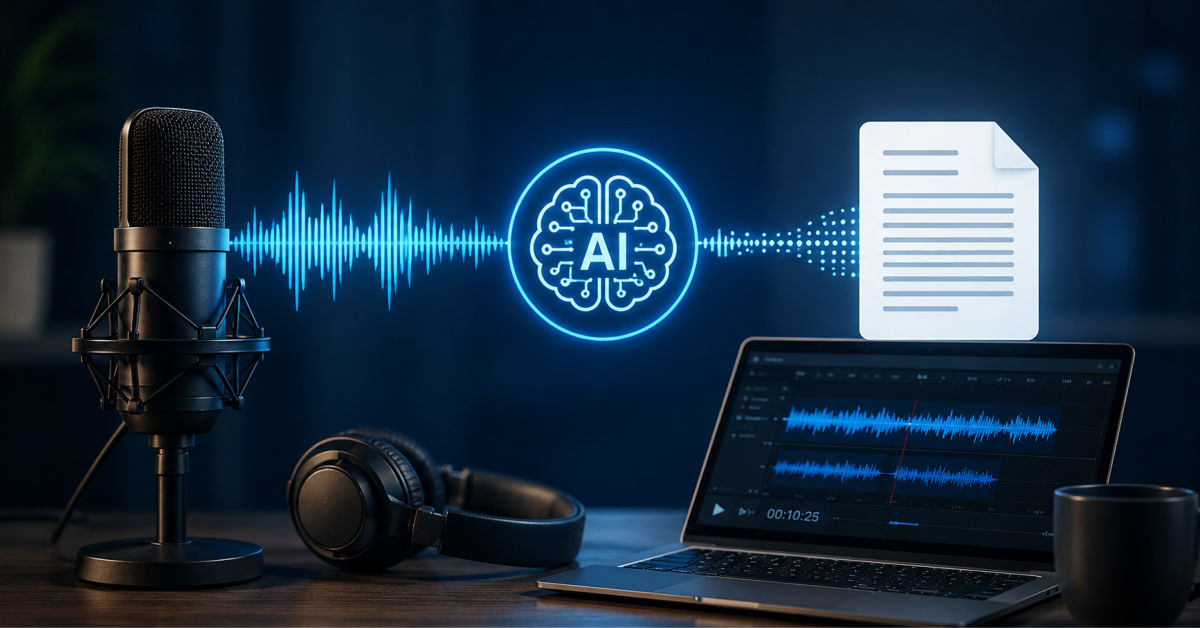
Modern AI transcription models trained on diverse, noisy speech data now handle overlapping speakers, accents, and imperfect recordings far more reliably, turning messy real-world audio into usable text that needs less manual cleanup.
AI transcription has stopped being impressive only in lab demos; the real progress is that modern models stay useful when audio is chaotic, compressed, and fully human rather than carefully staged.
Anyone who has worked with recorded speech knows the difference between a clean demo file and real audio is enormous. In controlled conditions, transcription can look almost effortless. But in the wild, things get messy fast: people interrupt each other, microphones clip, background noise drifts in and out, and speakers switch accents mid-conversation. That is where modern AI transcription has made its biggest leap.
The real story is not that AI can turn speech into text. It is that newer systems are increasingly able to do it when the audio is imperfect, unpredictable, and genuinely human.
The hardest audio is rarely the loudest or the fastest. It is the audio with layers.
A sales call might include weak internet audio, keyboard noise, and two people speaking over each other. A healthcare recording may contain specialist terminology, soft speech, and strict accuracy requirements. A journalist’s field interview could involve wind, traffic, and sudden changes in distance from the microphone. Traditional transcription systems often struggled because they were built around cleaner assumptions than the real world allows.
When people think about transcription errors, they often picture background noise. That matters, of course, but noise is just one variable. Real-world performance also depends on:
Human speech is not neat. We backtrack, interrupt ourselves, drop words, and rely on context. A strong transcription system has to do more than hear sounds clearly; it has to interpret language the way people actually use it.
Recent progress in speech recognition comes from models trained on far more varied data, along with major gains in language modelling. In practical terms, that means the system is better at handling imperfect signals because it has seen more examples of imperfection.
Instead of treating every utterance as an isolated acoustic puzzle, modern AI can weigh probability and context. If a speaker says something partially obscured by noise, the model can use the surrounding words, likely phrasing, and learned patterns of speech to infer the most plausible transcription. That does not make it magic, but it does make it much more resilient.
This is especially visible in industries with specialised language. Legal, media, healthcare, and customer support all rely on terminology that generic systems can misread. A model that has strong language understanding, or one that allows vocabulary adaptation, is much more likely to capture names, acronyms, and technical terms correctly.
That is one reason teams increasingly look beyond basic speech-to-text tools and evaluate how an audio transcription API platform performs under realistic conditions rather than lab-perfect ones. The important question is no longer “Can it transcribe audio?” but “Can it still produce usable text when the audio is flawed, fast, or full of specialist language?”
The most meaningful gains are not always dramatic on paper, but they are obvious in workflow. A small reduction in error rate can save hours of editing when you are working at scale.
In meetings, AI transcription has become much more useful because it now handles conversational dynamics better than earlier systems. Speaker diarisation, punctuation, and better treatment of disfluencies make transcripts easier to read and search. That matters when teams need reliable records, action items, or searchable archives rather than raw text dumps.
Customer conversations are messy by nature. People talk emotionally, change direction mid-sentence, and often speak in noisy environments. Better AI models can extract meaning from those interactions with less manual cleanup, which helps with quality assurance, compliance review, and trend analysis. The transcript does not have to be flawless to be valuable, but it does need to be consistent enough to support downstream decisions.
Journalists, researchers, and content teams benefit from AI’s improved tolerance for distance, movement, and environmental sound. Interviews captured outside a studio used to require substantial correction. Now, even when perfection is out of reach, the first draft is often strong enough to accelerate editing, quoting, and thematic analysis.
Even the best AI transcription is only part of the process. The surrounding workflow matters just as much.
A transcript becomes far more useful when it includes punctuation, paragraphing, timestamps, and speaker labels. Without those, users are left with a wall of text that is technically accurate but practically exhausting. Modern AI is improving here too, turning recognition into something closer to usable documentation.
For high-stakes use cases, human review remains important. Regulatory, medical, or legal content may require verification even when the transcript quality is strong. The goal is not to eliminate people from the process. It is to reserve human attention for the moments where judgment actually matters.
If you want better output in difficult audio conditions, the basics still count. In most cases, the biggest gains come from a few disciplined steps:
These are not glamorous fixes, but they make AI work harder in your favour.
What has changed most is not just model accuracy. It is reliability under pressure. AI transcription is increasingly useful in the conditions that used to break it: noisy rooms, imperfect devices, overlapping voices, and specialised conversations.
That reliability matters because transcription is rarely the end product. It feeds search, analytics, accessibility, documentation, compliance, and content creation. When the transcript is stronger at the source, every downstream task becomes easier.
There will always be difficult audio, and there will always be cases where human ears are needed. But the gap between ideal audio and real audio is shrinking. That is the real progress. AI is no longer impressive only when conditions are perfect. It is becoming genuinely practical when conditions are not.
Real-world audio is harder to transcribe because multiple noise sources, overlapping speakers, accents, and inconsistent recording setups degrade signal quality and confuse speech models.
Academic surveys highlight how reverberation, ambient sounds, and background conversation all affect intelligibility and interact with speaker variability.
Older systems trained on limited, clean data struggle when those factors combine, leading to steep drops in accuracy compared with controlled demos.
AI speech models improve transcription in noisy environments through large-scale training on diverse data and deep architectures that pair acoustic modeling with strong language understanding.
Research shows models like Whisper and wav2vec-style systems can match or exceed human performance in several synthetic noise conditions when trained on hundreds of years of speech.
These models use surrounding context and probabilistic reasoning to infer intended words when parts of the audio are masked or distorted, making them more resilient to real-world imperfections.
Improved AI transcription helps most in high-volume workflows such as meetings, contact centres, and media or research recordings where small accuracy gains save large amounts of editing time.
Benchmarks and case studies report better diarisation, punctuation, and handling of disfluencies, which directly improves the readability and searchability of transcripts.
That usability matters for tasks like QA reviews, trend analysis, and building searchable knowledge bases from conversational data.
Teams can improve AI transcription accuracy by using better microphones, recording separate channels, avoiding over-compression, and selecting providers tuned for diarisation and domain vocabulary.
Guides emphasise that capture discipline and workflow design often matter more than switching providers alone.
Adding a light human review step for high-stakes material further ensures that low-confidence segments do not silently introduce errors into regulatory or legal processes.
AI is unlikely to remove the need for human review entirely, especially in regulatory, medical, or legal domains where misinterpretations carry significant risk.
Current research shows that even advanced models still make different types of errors than humans and can hallucinate plausible but wrong content when signals are weak.
The best practice is to let AI handle bulk transcription and focus human attention on low-confidence areas and decisions where domain expertise is critical.