

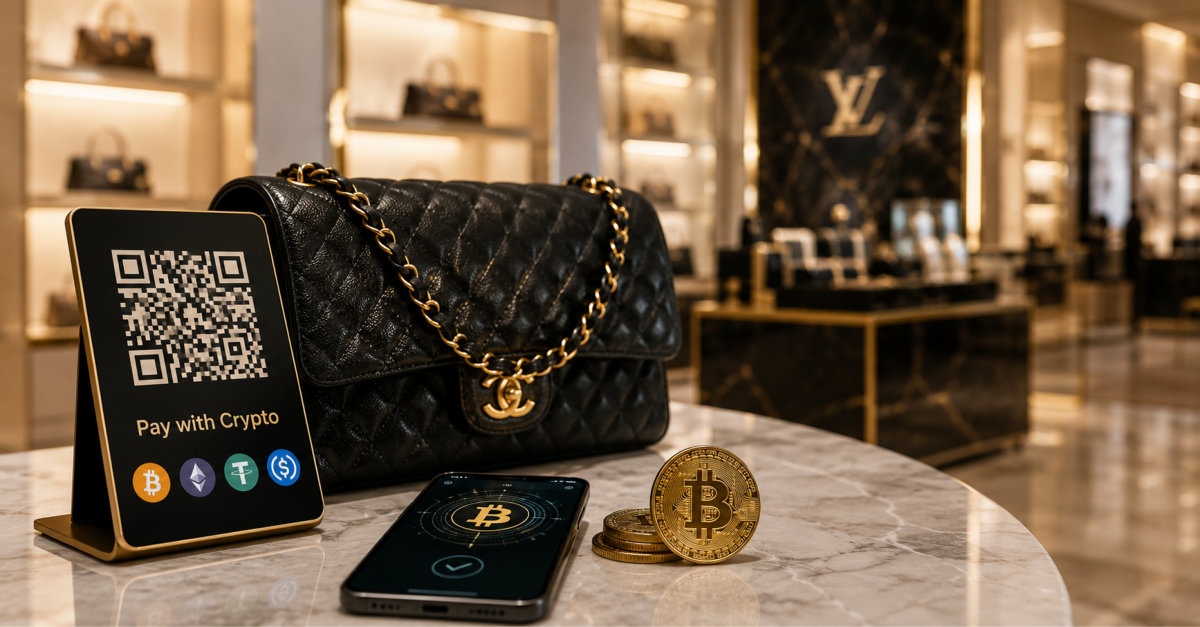
Cryptocurrency has become a standard optional payment rail for a growing slice of luxury buyers, with brands using processors to convert digital assets to fiat instantly so they can serve crypto‑wealthy customers without taking balance‑sheet risk.
Crypto at the luxury checkout is no longer a stunt; it is how a new class of buyers expects to transact when the ticket size is measured in five or six figures.
A growing class of crypto-wealthy customers wants to spend the way they invest — and luxury retail is increasingly built to meet them there. What started as a handful of experimental pilot programs a few years ago has, by 2026, turned out to make cryptocurrency as a new standard for luxury shopping. The shift says as much about who’s buying luxury goods sector products now as it does about payment technology.
The adoption curve has moved well past early experimentation. Gucci and Balenciaga have accepted crypto payments in select stores since 2022, and LVMH-owned watchmakers TAG Heuer and Hublot have done the same for roughly as long.
Ferrari extended bitcoin, ether, and USDC payments to its U.S. dealerships, with European rollout following. Lamborghini dealerships now accept digital assets for vehicles and merchandise in select markets, and luxury lighter and pen maker S.T. Dupont moved into accepting crypto across Paris stores.
Perhaps most notably, French department store Printemps partnered with Binance and fintech firm Lyzi to accept bitcoin and ethereum, becoming the first European department store to do so — a move that reportedly drew interest from other retailers watching to see how it performed.
Even luxury experiences have joined in: cruise line Virgin Voyages now offers a $120,000 annual sailing pass payable in bitcoin.
The clearest driver is customer demand. A meaningful slice of high-net-worth crypto holders would rather spend digital assets directly than convert to cash first, and luxury brands have realized that forcing a conversion step is just friction between a motivated buyer and a sale. It is also worth noting that crypto payment is fast, with large amounts ofmoney can be transacted with privacy.
There’s also a branding dimension: accepting crypto signals that a heritage brand is forward-thinking rather than, as one industry analyst put it, a label perceived as only selling to older, less digitally native customers. For brands trying to win over affluent millennial and Gen Z buyers — many of whom made meaningful wealth through crypto itself — that signal carries real weight.
Almost no luxury retailer holds crypto on its own balance sheet as payment comes in. Instead, most work with specialized payment processors that convert incoming crypto into fiat currency at the moment of the transaction.
The customer pays in bitcoin, ether, or a stablecoin like USDC; the brand receives dollars or euros; and the volatility risk that would otherwise sit with the retailer gets absorbed by the conversion layer instead. This is the mechanism that’s made crypto in luxury commercially workable at all — without it, a brand accepting a six-figure bitcoin payment for a car or a watch would be taking on currency risk no finance department would sign off on.
Cryptocurrency luxury purchases aren’t entirely friction-free. Price volatility remains the most cited concern, which is precisely why instant conversion has become the default rather than brands holding crypto directly.
Regulatory treatment still varies by country, and in many jurisdictions. There are countries where crypto is not legalized, so it cannot be a payment method; there are also differences between jurisdictions in matters of taxation, reporting and regulatory compliance. Spending crypto is itself a taxable event — the buyer may owe capital gains tax on the appreciation since they acquired the asset, regardless of what they bought with it. That makes accurate record-keeping just as important on the buyer’s side as smooth payment processing is on the retailer’s.
What’s notable about the current wave isn’t any single brand’s announcement — it’s the breadth. Fashion houses, watchmakers, automakers, department stores, and even cruise lines have all moved in the same direction within a few years of each other, suggesting this has shifted from an experiment a handful of brands tried to a viable option for a segment of luxury customers.
That doesn’t mean every luxury retailer needs a crypto checkout button by next quarter, but it does mean the brands moving early will have the opportunity to integrate advanced solutions and gain access to a new class of customers.
Cryptocurrency hasn’t replaced traditional payment rails in luxury retail, and it likely won’t anytime soon — but it has stopped being optional for brands chasing the wealthiest, most digitally native segment of buyers.
The stabilization of the regulatory framework will provide greater clarity and stability in the market, and cryptocurrency payments can become a full-fledged financial instrument for trading in luxury goods.
Most luxury brands do not keep cryptocurrency on their balance sheets; instead they work with processors that convert digital assets into fiat currency at the moment of purchase. This lets them offer crypto at checkout while avoiding the volatility and accounting complexity that would come with holding coins directly.
High‑net‑worth customers who hold a meaningful share of their wealth in digital assets often prefer to spend those assets directly rather than liquidating into cash first. Paying in crypto can feel more seamless relative to how they already manage their portfolio, and it allows them to move large sums quickly with strong privacy and without relying solely on traditional banking rails.
Luxury retailers manage volatility risk by using payment providers that quote a rate and convert incoming crypto into fiat in real time, so by the time funds settle into the merchant account they are denominated in dollars or euros. This structure keeps the exchange‑rate exposure with the processor rather than the brand, which makes the model acceptable to finance and treasury teams.
There are regulatory hurdles because crypto payments are not treated uniformly across jurisdictions, and some countries do not allow them as a lawful payment method at all. Even where they are allowed, brands must navigate tax reporting, anti‑money‑laundering obligations, and consumer‑protection rules that add compliance overhead beyond what is required for traditional card or bank payments.
Crypto is unlikely to replace traditional payment methods in luxury retail, but it is increasingly becoming an expected option for a specific, high‑value segment of buyers. In practice, it will sit alongside cards, wires, and digital wallets as one more way to pay, with brands that adopt early better positioned to serve crypto‑native customers without alienating those who still prefer conventional rails.




