

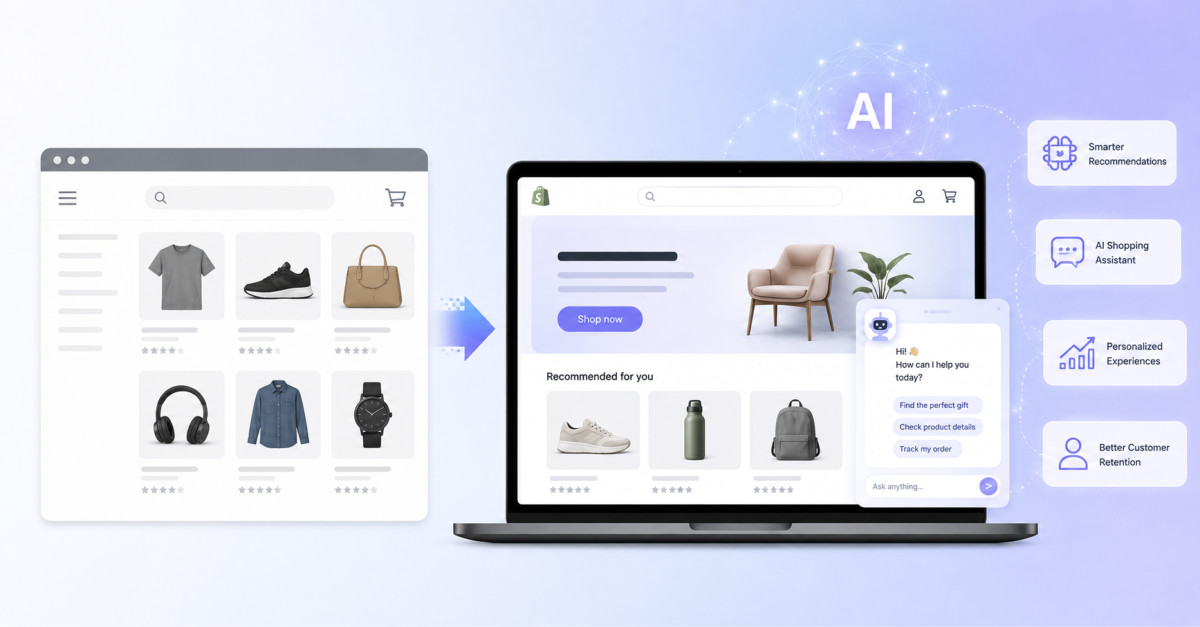
AI has changed ecommerce most when it improves decisions and removes friction: better product discovery, faster support, more accurate demand planning, stronger marketing measurement, and fraud detection. The advantage comes from clean data, clear guardrails, and human judgment, not from automating every customer interaction.
AI does not make an unclear storefront more persuasive. It makes a well-run ecommerce business faster at recognizing intent, responding to it, and learning from the result.
In today’s digital world, a huge amount is happening, and artificial intelligence plays a role that simply cannot be ignored. If you shop online or run an online business, you quickly notice that AI has changed virtually everything. We are talking about real, major shifts, not minor adjustments. AI has revolutionized how online stores operate, with significant effects on customer experience, business operations, and, of course, marketing strategies.
The first major thing AI has brought to online stores is a substantial improvement in the overall customer experience. It is no longer like it used to be, when you would simply click around and hope to find something interesting. With AI, online stores can now offer personalized shopping experiences, and that is a game changer.
Machine-learning algorithms and predictive analytics analyze what you have purchased before, where you have browsed, and what you like. AI reviews your browsing history and says, “Hey, you might like this.” Sometimes, it is remarkably accurate. This personalization makes the entire shopping experience more enjoyable, and people are more likely to return and buy again. That means better revenue for the store. It is a win-win situation.
Another major area where AI has changed online stores is on the business side. AI can analyze enormous volumes of data in real time and provide insights that help businesses make better decisions. For example, AI can forecast sales trends based on historical data, helping stores manage inventory more effectively. You no longer waste as much money on products that nobody buys. Brilliant, right?
AI also automates routine tasks that would otherwise be extremely repetitive. Chatbots now handle customer service, answer questions, and help resolve problems, allowing real employees to focus on more complex work. For many stores, this is truly a game changer.
The entire marketing strategy has also changed dramatically since AI emerged. Online stores can now run highly targeted advertising campaigns. AI looks at how you behave online, what you like, and which products you view, then shows you ads for exactly the types of products that interest you.
This is no longer a generic “everyone sees the same ad” approach. It is far more specific, which means campaigns perform better, return on investment is higher, and stores can save money on marketing. Advertising reaches the right people at the right time. That is real efficiency.
Here is the important part: there are things AI simply cannot do. Personalized packaging, handwritten thank-you cards, and specialized packaging materials are all elements that stores focused on strong customer service genuinely need. At services such as Couvertsbestellen.ch, you can get personalized envelopes, cards, and similar materials that add a human touch. Algorithms cannot replicate that.
Customers notice the difference and appreciate it. A personal touch will outperform automated emails every time.
As AI technology continues to improve, its impact on online stores will grow as well. One emerging trend is visual search: you simply take a photo of an item, and AI finds similar products in the store. This makes shopping even more convenient.
At the same time, AI is also being used for cybersecurity in online stores. It can identify potential threats in real time and help stop attacks before they cause serious damage. This gives customers more confidence in online retailers, which can in turn lead to more sales. AI is essentially watching for suspicious activity around the clock and helping protect the platform.
AI is changing the customer experience in ecommerce by helping shoppers find relevant products, compare options, receive faster answers, and get more useful post-purchase support. Effective systems use approved product, policy, and order data to reduce the effort required to make a purchase. For example, an AI shopping assistant can help a customer narrow a large catalog based on budget, use case, color, size, or compatibility. The quality of the result depends on accurate source data and clear escalation rules. AI should guide a shopper confidently, but it should hand complex, sensitive, or uncertain cases to a human.
The best AI use cases for a Shopify store are product discovery, customer support triage, product-content enrichment, demand forecasting, marketing analysis, and fraud detection. Start with the workflow that is repetitive, measurable, and supported by reliable data. A store with frequent fit questions may start with an AI shopping assistant. A brand with stockouts or excess inventory may pilot demand forecasting. A support team overwhelmed by repetitive order-status requests may use AI for ticket classification and approved response drafts. Avoid automating high-risk decisions such as refunds, pricing, or large media budgets before your team has defined controls and validated results.
AI can improve ecommerce inventory management by forecasting demand from sales history, seasonality, promotions, lead times, channel mix, returns, and current stock levels. These forecasts help merchants plan replenishment, purchase orders, launches, and markdowns with more discipline than intuition alone. AI forecasts are not guarantees, so operators should compare them against actual demand, monitor forecast error, and keep approval controls for major buying decisions. The best results come from clean data, unified inventory records, clear KPIs, and regular review. Start with a single product category or region before using AI forecasts across the full catalog.
AI will not replace customer service teams in ecommerce because customer service still requires judgment, empathy, negotiation, and accountability in complex situations. AI can resolve or assist with routine requests such as order status, basic policy questions, product information, ticket classification, and response drafting. That frees human agents to handle damaged orders, refund disputes, custom needs, accessibility issues, and customers who need a thoughtful resolution. The strongest support model combines AI for immediate, accurate retrieval and routing with humans for exceptions and relationship-critical conversations. Customers should always have a clear route to a person when automated support is not enough.
An ecommerce brand should measure AI ROI by comparing a defined baseline against outcomes from a controlled pilot, including revenue, conversion, time saved, error rate, customer satisfaction, and margin impact. Choose one primary metric for each use case. For an AI shopping assistant, measure conversion rate and average order value, with return rate as a guardrail. For support automation, measure first-response time, resolution time, ticket reopen rate, and customer satisfaction. For forecasting, measure forecast error, stockout frequency, excess inventory, and cash tied up in inventory. Do not treat chat volume, generated content volume, or tool usage as proof of business value.





