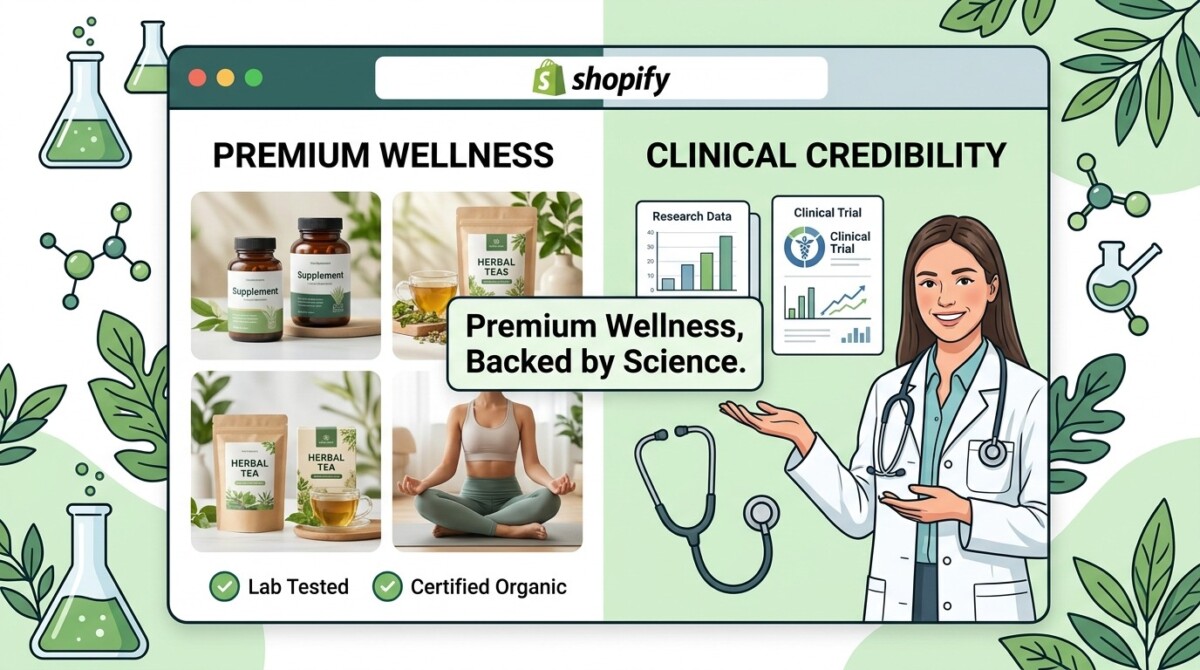
Premium wellness brands that anchor their ecommerce positioning in regulatory standing, mechanism-of-action education, and outcome-focused social proof consistently achieve higher AOV and lower refund rates than brands that lead with lifestyle imagery alone. The red light therapy category is one of the clearest examples of this playbook in action.
The average skincare device buyer sees 7 to 12 ad touchpoints before converting. Every one of those touchpoints is an opportunity to build trust or lose it. The brands winning in this space are not the ones with the best product photography. They are the ones whose customers understand exactly why the product works before they buy.
Selling a premium wellness device online is fundamentally a trust problem, not a traffic problem. The Global Wellness Institute tracks a market that has grown past $5.6 trillion globally, and the at-home device segment is one of its fastest-moving categories. But that growth has attracted an enormous volume of undifferentiated products making similar claims at wildly different price points. When a buyer can find a red light panel for $89 and a comparable-looking panel for $890, the question they are really asking is not “which one has better wavelengths?” It is “which one can I trust?”
That trust question is the entire game. Brands that answer it well, explicitly and early in the buyer journey, operate in a different competitive environment than brands that do not. They face less price resistance, generate fewer refund requests, and build the kind of repeat purchase behavior that makes the economics of premium DTC work. Brands that ignore it compete on price by default, even when they have a genuinely superior product.
The red light therapy category makes this dynamic unusually visible. It is a category where the science is real and well-documented, where regulatory frameworks exist specifically to separate therapeutic-grade devices from consumer gadgets, and where the gap between a brand that communicates its credibility clearly and one that does not is measurable in conversion rate and average order value. The lessons transfer directly to any Shopify merchant selling in a category where the product makes a meaningful claim about health, performance, or results.
Regulatory listing is the most underused trust signal in premium wellness ecommerce. Most brands treat it as a compliance checkbox. The merchants doing it well treat it as the foundation of their entire conversion argument.
In the Australian market, for example, the Therapeutic Goods Administration maintains the Australian Register of Therapeutic Goods (ARTG). A device listed on the ARTG as a Class IIa medical device has met the regulatory requirements to make therapeutic claims in Australia. That is a meaningful distinction in a market full of devices at every price point making similar-sounding claims. Brands selling red light therapy devices australia-wide that carry ARTG Class IIa listing are not just compliant. They have a conversion asset most of their competitors lack.
The ecommerce application is straightforward. Regulatory standing belongs on the product page above the fold, not buried in a FAQ or a footnote. It should appear in the product title or subtitle, in the hero section copy, and in the trust badge cluster near the add-to-cart button. When a buyer who has been researching this category sees “ARTG Listed Class IIa Medical Device” at the moment of decision, it resolves the core anxiety: is this a real device or a wellness gadget? That resolution is worth more to conversion than any lifestyle image.
The same principle applies across categories. FDA clearance for a supplement, CE marking for a European device, clinical trial data for a skincare ingredient, dermatologist formulation for a topical. Whatever the regulatory or clinical credential your product carries, it is a trust signal first and a compliance requirement second. Build your product page copy around it accordingly.
Informed buyers convert at higher rates and return products less often. That is not a hypothesis. Data from skincare DTC campaigns consistently shows that ingredient education videos average 2.3x higher view-through rates and 1.8x higher ROAS than generic lifestyle content. The same dynamic applies to wellness devices: buyers who understand how a product works before purchasing are more committed to using it correctly, more patient with cumulative results, and less likely to request a refund when results do not appear overnight.
The mechanism-of-action explanation is therefore a conversion asset, not just educational content. For a red light therapy device, the explanation covers how specific wavelengths penetrate tissue at different depths, how that light stimulates mitochondrial activity, and how the resulting increase in collagen synthesis and cellular repair produces the outcomes the buyer is purchasing for. The explanation does not need to be dense or technical. It needs to be specific enough to be credible and clear enough to be understood by someone who has never heard of photobiomodulation.
Three formats work particularly well for this content in the wellness device category. First, a short explainer video (30-60 seconds) on the product page that walks through the mechanism in plain language. Second, a “how it works” section in the product page body that uses a simple visual or diagram to show wavelength depth and cellular effect. Third, a post-purchase email sequence that reinforces the mechanism and sets realistic expectations for the results timeline. That third format is where most brands leave money on the table.
The post-purchase sequence matters because wellness device results are cumulative. A buyer who understands that collagen remodeling takes 8-12 weeks of consistent use is a fundamentally different customer than one who expects to see results after three sessions. The first buyer completes their course of treatment and becomes a repeat purchaser. The second buyer contacts support at week two and requests a refund. The education investment is identical. The outcomes are not.
Social proof works differently in wellness and health-tech than it does in fashion or home goods. The buyer is not just asking “do other people like this?” They are asking “did it actually work for people like me?” That distinction changes how you should collect, display, and use reviews on your Shopify store.
Volume matters, but so does specificity. A product page with 200 reviews that all say “great product, fast shipping” is less persuasive to a research-led wellness buyer than a page with 80 reviews where a meaningful percentage describe specific results, timelines, and use cases. Apps like Yotpo, Judge.me, or Okendo all support photo reviews and outcome-focused review prompts. The prompt design is the lever. Instead of asking “how was your experience?”, ask “what results did you notice, and after how many sessions?” That prompt change produces review content that does the conversion work you need.
For wellness devices specifically, before-and-after content remains the highest-converting format when it is authentic. Real user results shot on a phone outperform studio-quality transformations because authenticity signals credibility. The buyer’s skepticism radar is calibrated to detect polished perfection as a potential fabrication. Imperfect, real, and specific beats perfect and generic every time.
The review response strategy also matters more in this category than most. Buyers who are still in the consideration phase read the review responses as carefully as they read the reviews themselves. A brand that responds to every review, acknowledges negative feedback without defensiveness, and provides specific answers to product questions is demonstrating the kind of post-purchase support that reduces the perceived risk of a $300-plus purchase. That is a conversion driver, not just a customer service nicety. For a deeper playbook on building review velocity in competitive categories, the guide to getting customer reviews across multiple channels covers the tactical mechanics in detail.
The sale is not the finish line for a premium wellness brand. It is the beginning of the relationship that determines whether the customer becomes a repeat buyer, a referral source, or a refund request. The post-purchase experience is where most wellness brands underinvest, and where the compounding LTV gains are largest.
A structured post-purchase education sequence for a wellness device category typically runs across the first 60-90 days after purchase. The sequence covers correct usage protocol in the first week, mechanism reinforcement and results-timeline setting in weeks two and three, community or user-generated content prompts at the 30-day mark when early results are often visible, and a replenishment or accessory offer at 60-90 days when the customer has completed an initial course of treatment and is ready to deepen their commitment.
Klaviyo handles this well for Shopify merchants at any revenue stage. The key is segmenting the sequence by product SKU so that the education content is specific to what the customer actually purchased, not generic wellness content. A customer who bought a full-body panel needs different guidance than one who bought a facial mask. That specificity is what converts a post-purchase sequence from a brand touchpoint into a genuine service. The retention playbook for cosmetics and beauty brands covers the Klaviyo segmentation mechanics for this kind of outcome-oriented post-purchase flow in detail.
The bundling strategy also belongs in the post-purchase window, not just at checkout. A customer who has completed 30 days of consistent use with a facial device and is seeing early results is in the ideal psychological state to consider an accessory, a complementary device, or a larger-format panel. That offer, positioned as a natural progression rather than an upsell, converts at meaningfully higher rates than the same offer presented to a cold prospect. The customer already trusts the brand. The mechanism is already understood. The result is already partially experienced. That is the most efficient conversion moment in the entire customer lifecycle.
The framework that makes red light therapy brands successful online is not specific to that category. It applies to any Shopify merchant selling a product that makes a meaningful claim about health, performance, or results at a price point that requires considered purchase behavior.
The pattern is consistent across the wellness device, supplement, functional food, and professional skincare categories. Brands that lead with regulatory standing and clinical credibility, explain the mechanism of action clearly, collect and display specific outcome-focused social proof, and invest in post-purchase education sequences outperform brands that lead with lifestyle imagery and generic claims. They achieve higher AOV because buyers who understand why a product works are willing to pay for the better version. They achieve lower refund rates because buyers who understand the results timeline have realistic expectations. They achieve higher LTV because buyers who experience results become repeat purchasers and referral sources.
If you sell in a category where the product makes a claim that matters to the buyer’s health, performance, or appearance, the question to ask is not “how do we get more traffic?” It is “how clearly does a first-time visitor to our product page understand why this works, why it is credible, and what result they can realistically expect?” The answer to that question is the gap between where your conversion rate is and where it could be.
Place your regulatory credential (FDA clearance, ARTG listing, CE marking, or equivalent) in the hero section of your product page, in the product title or subtitle, and in the trust badge cluster near the add-to-cart button. Research-led buyers in premium wellness categories actively look for third-party validation before purchasing, and regulatory standing is the strongest form of that validation. Do not bury it in a FAQ or footer where it cannot do conversion work at the moment of decision.
Informed buyers convert at higher rates because they have already resolved their skepticism before clicking add-to-cart, and they request fewer refunds because they have realistic expectations about results timelines. Buyers who understand the mechanism of action are committed to using the product correctly, patient with cumulative results, and emotionally invested in completing the protocol. The education investment pays for itself in lower return rates and higher repeat purchase rates within the first 90 days post-purchase.
Change your review prompt from “how was your experience?” to “what results did you notice, and after how many sessions?” That single prompt change shifts review content from generic praise to specific outcome documentation, which is what skeptical buyers actually read before purchasing. Apps like Yotpo, Judge.me, and Okendo all support custom prompts and photo reviews, so the lever is the prompt design itself rather than the tool you choose to deploy it through.
A structured post-purchase education sequence for a wellness device typically runs 60-90 days from purchase, covering usage protocol in the first week, mechanism reinforcement in weeks two and three, user-generated content prompts at the 30-day mark, and replenishment or accessory offers at 60-90 days. Segment the sequence by SKU so the content matches what the customer actually purchased rather than sending generic wellness content. Klaviyo handles this segmentation well for Shopify merchants at any revenue stage from $10K per month through eight figures.
Yes, the framework applies to any Shopify merchant selling a product that makes a meaningful claim about health, performance, or results at a price point requiring considered purchase behavior. The pattern is consistent across wellness devices, supplements, functional foods, and professional skincare: brands that lead with regulatory standing and mechanism education outperform brands that lead with lifestyle imagery and generic claims. The specific credential changes by category, but the role it plays in resolving buyer skepticism does not.
The most efficient conversion moment is the 30-day post-purchase window when a customer has completed an initial usage period and is seeing early results. At that point the customer already trusts the brand, understands the mechanism, and has partial outcome evidence, which makes accessory or larger-format offers convert at meaningfully higher rates than the same offer presented to a cold prospect. Position the offer as a natural progression of their treatment rather than an upsell to protect the trust you have already built.





