
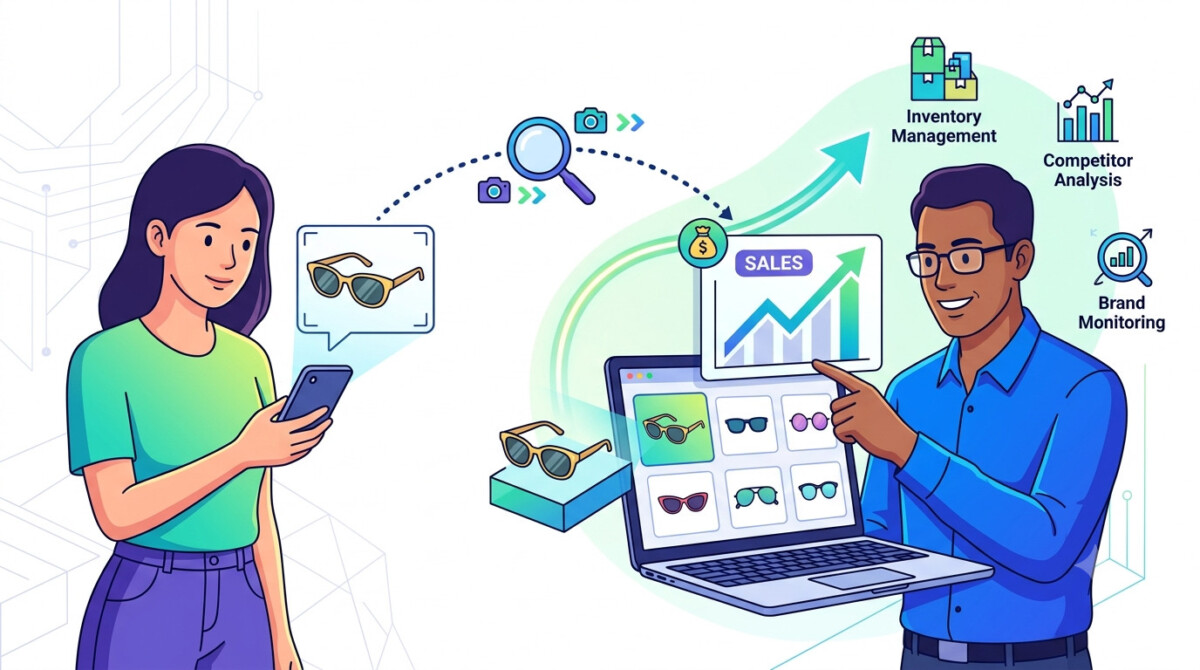
Reverse image search lets Shopify brands find every page where their product photos appear, which makes it the fastest way to catch copycat stores, monitor competitors, and recover uncredited mentions. A monthly 30 minute audit of your hero SKUs covers most brands under $2M.
The product photo you paid $500 to shoot is the first asset a copycat steals, because stolen photography is the fastest way to make a fake store look legitimate.
A founder I spoke with last year discovered her bestselling candle on a store she had never heard of. Same photos, same lifestyle shots, same close ups she had paid a photographer $2,800 to produce. The copycat was running her images against a product that cost a third of her price and shipped from a warehouse she could not identify. She found it by accident, through a confused customer email. She could have found it in five minutes with a reverse image search.
That gap, between finding out by accident and finding out on purpose, is what this article closes. Whether you are doing $10K months or $1M months, your product photography is one of the most expensive assets you own and one of the easiest to steal. The discipline of checking where your images travel is cheap, fast, and almost nobody does it.
Reverse image search is searching the web with an image instead of text, and for Shopify brands it answers one specific question: where else do my product photos appear online? You upload an image or paste its URL, and the tool returns every indexed page displaying that image or a visually similar one. Google Lens alone now processes close to 20 billion visual searches every month, which tells you how normal searching by image has become for your customers, not just for you.
For a Shopify operator, this capability maps to five practical jobs: finding unauthorized use of your photography, researching how competitors present similar products, discovering where your products are gaining organic visibility, reclaiming SEO value from uncredited image use, and spotting counterfeit or duplicate listings on marketplaces. The original promise of visual search was customer facing product discovery. The operator facing version, monitoring your own visual footprint, is where the unglamorous money is.
The reason this matters more in 2026 than it did three years ago is volume. AI powered store builders can clone a product page, images included, in minutes. The cost of copying your store has collapsed while the cost of producing original photography has not. A catalog shoot for 20 SKUs still runs $2,000 to $8,000 for most growth stage brands. That asymmetry, expensive to create and free to steal, is exactly why a monitoring habit pays for itself.
Reverse image search protects your brand by surfacing every site using your product photos without permission, which is the first step in any takedown or enforcement action. The scale of the problem is not hypothetical. The OECD and EUIPO mapped $467 billion in counterfeit goods moving through global trade in their 2025 report, and stolen product imagery is the storefront layer of that trade. Counterfeiters do not commission photography. They take yours.
The pattern shows up at every stage. Under $500K, the most common offender is a dropshipper who scraped your listing wholesale and is running it against an AliExpress equivalent. Between $500K and $2M, you start seeing lookalike stores targeting your branded search terms with your own images. Above $2M, counterfeit marketplace listings and fake Instagram ads using your photos and videos enter the picture.
Once you find an infringing page, you have real options. A DMCA takedown notice to the host works in most cases, and if the copycat is on Shopify, the platform has a structured infringement reporting process that typically resolves within days when you provide evidence of ownership. Your original image files with metadata, your publish dates, and your photographer invoices are that evidence. Enforcement gets dramatically easier when your brand assets are formally protected, which is why registering a federal trademark for your Shopify store is worth doing before you need it rather than after.
Reverse image search turns any competitor product photo into a map of where and how that product is sold across the web. Run a competitor’s hero image through a visual search and you will see every marketplace listing, affiliate review, comparison post, and ad placement carrying it. That is distribution intelligence you cannot get from their homepage.
The practical questions this answers are specific. Which marketplaces is the competitor actually active on, versus just claiming to be? Which publishers and affiliates are featuring their products, and would those same publishers feature yours? Are they running the same lifestyle imagery across paid social and organic listings, or testing different creative by channel? In visually driven categories like fashion, beauty, furniture, and home decor, the answers shape your own channel and creative decisions.
One pattern I have watched repeatedly at the $500K to $2M stage: a brand discovers through image search that a competitor’s product appears on 12 affiliate review sites while theirs appears on two. That gap is not a product quality gap. It is an outreach gap, and it is fixable in a quarter with a focused partnerships push. Visual search did not create the opportunity, but it made the gap visible and measurable. This kind of monitoring slots naturally into a broader practice of tracking your Shopify competitors across channels, where image data complements the pricing and traffic signals you are already watching.
Reverse image search shows you which channels are actually driving visibility for your products, because every uncredited appearance of your imagery is evidence that someone found your product worth sharing. Customers discover products through images on social platforms, blogs, influencer posts, and Pinterest boards long before they type your brand name into a search bar. Most of that activity is invisible in your analytics because it never produces a tracked click.
When your product image surfaces on a popular review page, a styling roundup, or a creator’s post, that placement is a signal worth acting on. Strengthen the relationship with the publisher. Request proper attribution and a link. Build paid amplification around creative that is already proving itself organically. A growth stage skincare brand doing this discovered its serum imagery on 14 unaffiliated wellness blogs, converted nine of them into linked mentions within six weeks, and turned two into ongoing affiliate relationships.
There is also a forward looking reason to care about this footprint. Third party mentions and citations are exactly the raw material AI assistants draw on when they recommend products, so the same monitoring habit feeds directly into how Shopify brands earn visibility in AI search results. The brands getting recommended by ChatGPT and Perplexity in 2026 are the ones whose products appear, credited, across many independent sources. Knowing where your images already travel is the first step to converting that presence into citations.
Every uncredited use of your product photography is a potential backlink you have already earned but not yet collected. Image reclamation is one of the highest conversion link building tactics available to ecommerce brands because the ask is reasonable: you are using our photo, please credit the source. Outreach emails of this type convert at rates most cold link building campaigns never touch, and the work scales with a simple monthly check rather than a dedicated campaign.
The workflow is straightforward. Run your top 10 product images through a reverse image search monthly. Sort results into three buckets: infringing commercial use (takedown or licensing conversation), editorial use without credit (attribution request), and properly credited use (relationship to nurture). A 30 minute pass typically surfaces three to eight actionable items for an established catalog, and even one recovered link from a relevant publisher each month compounds meaningfully over a year.
Monitoring also exposes basic image SEO hygiene problems on your own site. If your images are not being indexed, visual search tools will not find your own product pages as the canonical source, which weakens both your reclamation case and your organic image traffic. Descriptive file names, alt text, and properly sized images are the foundation, and the work overlaps heavily with optimizing your product photography and video for Shopify. Fix the foundation first, then monitor. Otherwise you are policing assets the search engines cannot even attribute to you.
The right reverse image search tool depends on your stage: free tools cover brands under $500K, and paid monitoring with alerts earns its cost once you have enough SKUs and enough theft to make manual checking impractical. No single tool indexes the entire web, so serious monitoring uses at least two.
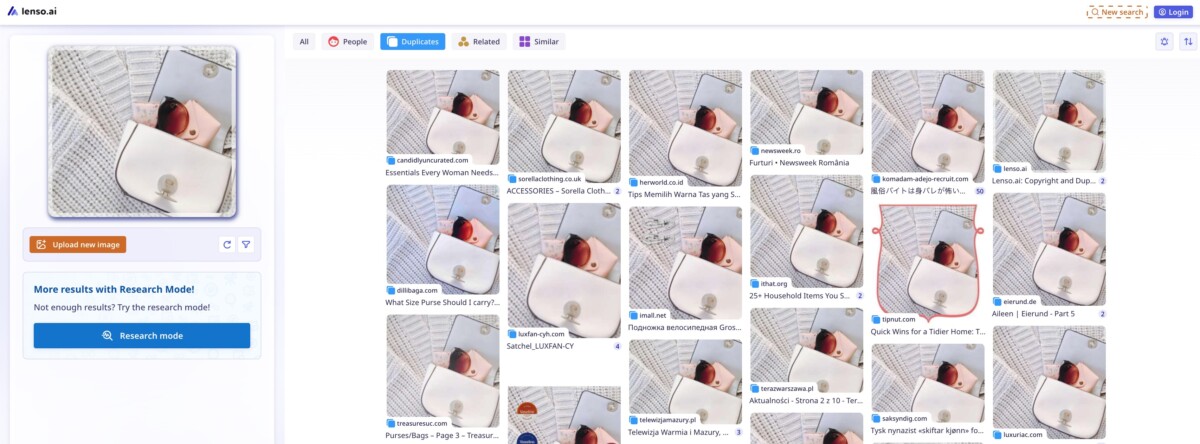
Google Lens and TinEye handle the manual workflow well, and for most early stage brands they are the complete answer. Where a dedicated tool like Lenso.ai earns consideration is in automation. It’s AI-powered matching searches across categories like duplicates, similar images, and related images, and its alerts feature notifies you when new results appear for a monitored image, which replaces the monthly manual check entirely. For platforms and larger operations, its API lets teams build image monitoring directly into their own systems: a marketplace scanning new listings for duplicates automatically, or a brand protection workflow checking every new SKU at upload.
Apply the 18 month filter before paying for anything here. If you have under 50 SKUs and have found fewer than five infringements in your last two manual audits, free tools plus a calendar reminder are genuinely sufficient. Paid monitoring is a volume solution, and buying it before you have the volume is the same premature complexity mistake merchants make with every other tool category.
The right monitoring cadence is quarterly manual checks under $500K, monthly checks on hero SKUs from $500K to $2M, and automated alerts above $2M. The routine matters more than the tooling, because an unsophisticated check that actually happens beats a sophisticated system that never gets set up.
Under $500K, run your five best selling product images through Google Lens and TinEye once a quarter. You are looking for commercial use of your exact photos. Total time investment: about 20 minutes, four times a year. At this stage your photography library is small enough that full coverage is realistic.
From $500K to $2M, move to monthly and expand to your top 10 SKUs plus any image used in paid creative, since ad images are stolen most aggressively. Add the three bucket triage from the SEO section above: takedown, attribution request, relationship. Assign the check to whoever owns your marketing operations and put it in the same recurring slot as your monthly analytics review. This is also the stage where your first real takedown usually happens, so have your evidence folder (original files, invoices, publish dates) assembled before you need it.
Above $2M, manual checking stops scaling. This is where alert based monitoring or an API integration becomes the rational choice, and where the cost of a paid tool is trivial against the photography budget it protects. The decision rule is simple: when your monthly manual audit consistently takes longer than an hour or consistently finds new infringements, automate it. Whether you are just opening your store or running an eight figure operation, the principle holds: your images are out there working for someone. Make sure it is you.
Upload your product photo to Google Lens, TinEye, or a dedicated tool like Lenso.ai, and review every page in the results that displays your image. Start with your bestselling products, since those listings are copied most often. Look specifically for commercial use: other stores selling with your photos, marketplace listings you did not create, and ads running your creative. Check exact matches first, then visually similar results, because copycats often crop, flip, or lightly edit stolen images to evade detection. A full check of five products takes about 20 minutes, and running it quarterly catches most infringement before it does meaningful damage to your sales or brand trust.
Google Lens is the best free starting point for Shopify store owners because it has the largest index and finds both exact and visually similar matches. TinEye is the strongest free complement, since it specializes in exact match detection and shows where an image first appeared online, which helps establish ownership timelines for takedown requests. Bing Visual Search adds secondary coverage and surfaces some marketplace listings the others miss. Use at least two of the three, because no single tool indexes the entire web. Free tools fully cover the needs of most brands under $500K in annual revenue with fewer than 50 SKUs.
Check quarterly if you are under $500K in annual revenue, monthly if you are between $500K and $2M, and continuously through automated alerts above $2M. The cadence scales with how attractive a target you are: more revenue means more branded search traffic, and copycats target brands whose customers are actively searching. Always run an extra check after launching new hero photography or a new paid campaign, because fresh ad creative gets scraped fastest, often within weeks of launch. If two consecutive audits find new infringements, tighten your cadence one level regardless of revenue stage.
Yes, reverse image search is one of the most effective ways to find counterfeit listings because counterfeiters almost always use the brand’s own photography rather than producing their own. Searching with your official product images surfaces marketplace listings, lookalike stores, and social media ads selling fakes under your visual identity. Counterfeit trade reached an estimated $467 billion globally according to the OECD’s 2025 report, and product categories like clothing, footwear, leather goods, and electronics are the top targets. Once you identify a counterfeit listing, document it with screenshots and URLs, then file infringement reports with the host platform, which typically acts within days when evidence is strong.
Document the infringement first with screenshots and URLs, then choose your response based on the type of use. For commercial theft, such as another store selling with your photos, file a DMCA takedown notice with the site’s host, or use Shopify’s infringement reporting process if the copycat runs on Shopify. For editorial use without credit, send a friendly attribution request asking for a link to your store, which converts a problem into a backlink. Keep an evidence folder containing your original image files, photographer invoices, and publish dates, because ownership proof determines how fast platforms act. Registered trademarks and copyrights make enforcement significantly faster and stronger.





