

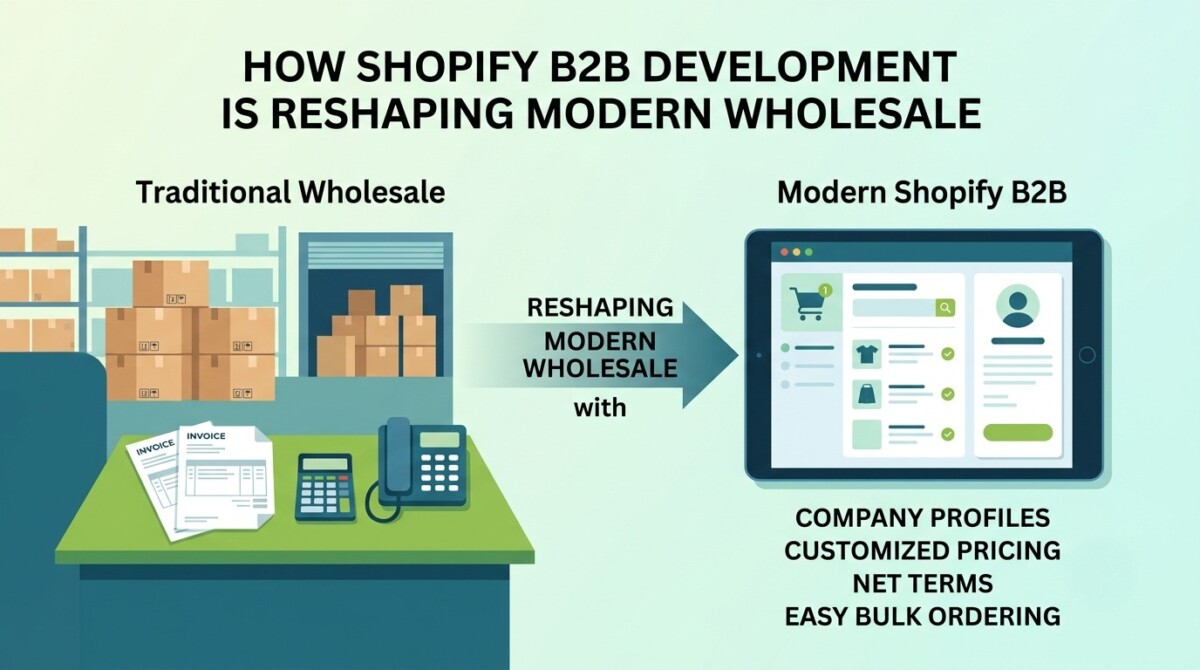
Wholesale has changed a lot in recent years. In the past, many wholesale businesses depended on phone calls, email orders, spreadsheets, printed catalogs, and manual invoices. Buyers often had to contact a sales representative just to check prices, confirm stock, or place a repeat order. While this system worked for a long time, it is no longer fast enough for today’s market.
Modern wholesale buyers want convenience. They expect the same smooth online experience they get when shopping as regular consumers. They want to browse products, see their own pricing, place orders quickly, and manage their accounts without waiting for someone to respond. This is where digital B2B commerce is becoming essential, and Shopify is playing an important role in this shift.
Traditional wholesale was built around personal relationships and manual processes. Sales teams handled most of the work, from sharing catalogs to confirming discounts and processing orders. Although relationships are still important, buyers now also want speed and control.
Digital B2B commerce allows wholesale brands to offer online ordering, account-based pricing, real-time inventory updates, and easier communication. Instead of sending emails back and forth, buyers can log in, view the products available to them, and complete purchases whenever they need to.
This shift helps both sellers and buyers. Sellers can reduce repetitive tasks, while buyers enjoy a faster and more reliable ordering experience. It also gives wholesale businesses a better chance to grow without adding unnecessary operational pressure.
Shopify B2B Development helps wholesale businesses create online stores designed specifically for business buyers. Unlike a basic online store, a B2B store needs features that support larger orders, special pricing, company accounts, payment terms, and custom product catalogs.
With the right Shopify setup, wholesale brands can manage both retail and wholesale customers from one platform. They can create company profiles, assign buyers to accounts, offer different price lists, and set payment terms for approved customers. This makes the buying process more organized and professional.
Shopify B2B Development also allows businesses to build custom solutions based on how they operate. For example, a brand may need bulk order forms, quick reorder options, advanced shipping rules, or integrations with accounting and inventory tools. These features help create a smoother system that matches real wholesale needs.
One of the biggest advantages of modern B2B ecommerce is personalization. Wholesale businesses often serve many types of buyers, such as retailers, distributors, resellers, and corporate clients. Each group may need different prices, discounts, product selections, or minimum order quantities.
Shopify makes it easier to manage these differences. A business can show one catalog to a small retailer and a different catalog to a large distributor. It can also offer customer-specific pricing, volume discounts, and special product access.
This creates a better experience for buyers because they only see the products and prices that apply to them. It also helps sellers protect margins, reward loyal customers, and manage wholesale relationships more strategically.
Manual work is one of the biggest challenges in wholesale. Processing large orders, updating inventory, creating invoices, calculating taxes, and managing customer records can take a lot of time. Mistakes can also happen when teams rely too heavily on spreadsheets or repeated data entry.
Shopify helps reduce these problems through automation. Orders can be processed online, inventory can be updated automatically, and customer information can be stored in one place. Businesses can also connect Shopify with ERP, CRM, accounting, shipping, and warehouse systems.
These integrations save time and improve accuracy. Sales teams can focus more on building relationships and less on administrative tasks. Operations teams can manage orders more efficiently, and business owners can get clearer data about sales performance.
Wholesale buyers are busy. They do not always want to call or email a supplier for every order. A self-service portal gives them more control and makes purchasing easier.
Through a Shopify B2B store, buyers can log in to their account, view their assigned catalog, check pricing, place bulk orders, see order history, and reorder products quickly. They can also use saved payment terms and shipping details, which makes checkout faster.
This kind of experience builds trust. Buyers feel that the supplier is easy to work with, responsive, and modern. A smooth buying process can also encourage repeat orders because customers are more likely to return when ordering is simple.
Wholesale is becoming more digital, flexible, and data-driven. Businesses that continue to rely only on manual processes may struggle to keep up with buyer expectations. On the other hand, brands that invest in modern B2B ecommerce can become more efficient and competitive.
Shopify gives wholesale businesses the tools to scale, sell across channels, expand into new markets, and serve buyers more effectively. It also helps companies collect useful data about customer behavior, popular products, order patterns, and growth opportunities.
In the future, successful wholesale brands will not just sell products; they will provide smooth buying experiences. Shopify B2B Development is helping make that possible by combining strong ecommerce features with the flexibility wholesale businesses need. For companies that want to modernize their operations and improve customer satisfaction, Shopify is becoming a powerful platform for the next generation of wholesale commerce.




