

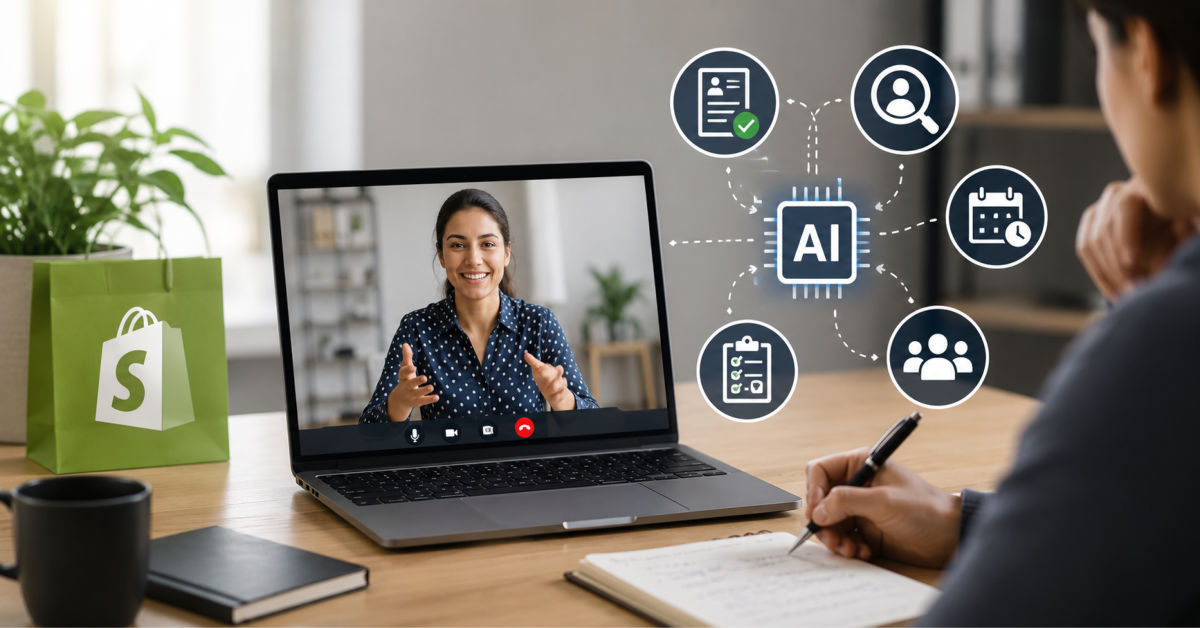
Shopify brands are using AI to hire faster by automating the admin layer—job descriptions, screening, scheduling, and interview notes—so lean teams can focus human effort on evaluation and final decisions as they scale.
AI doesn’t replace hiring judgment; it removes the chaos around it so growing Shopify brands can make better decisions, faster, with the same small team.
There is a hiring problem that often shows up somewhere between $1M and $5M in revenue. The team that got the business to this point is running at capacity, and the founder knows they need to bring in people quickly, but what’s missing is a repeatable process.
Most Shopify brands at this stage are hiring without systems. Candidate calls are squeezed in between campaign reviews and Slack threads. Evaluations compare people against criteria that shift from interview to interview. Notes live in someone’s personal doc, or they do not exist at all. By the time two finalists are being compared, the decision is based on reconstructed impressions rather than anything approaching a consistent record.
AI tools are beginning to change this by removing the administrative layer that gets in the way of efficient, scalable hiring.
At five to fifteen people, informal hiring works well enough. The team is small, everyone has visibility into the business, and a founder’s read on a candidate carries genuine weight because the founder knows exactly what the role demands. This dynamic shifts as the business grows.
Once a DTC brand passes $3M or $4M in revenue, roles become harder to define and harder to evaluate. You are not hiring a customer success manager with a clear cut job specification. You’re hiring someone who can run retention, handle complex escalations, build flows in Klaviyo, interpret cohort data, and eventually manage a small team beneath them. Roles are often hybrid, expectations are layered, and the person conducting the interview is busy with other tasks.
The result is compounding inconsistency through the hiring process. Different candidates get asked different questions. Interviewers apply different criteria. There is no shared record to return to when the team needs to make a decision together. The offer tends to go to whoever interviewed on a strong day, or whoever followed up most assertively, rather than whoever was most qualified on critical criteria.
The most useful applications are those that replace repetitive, time-consuming tasks that don’t require human judgement.
Job description drafting is the most common starting point. Founders and ops leads are using general AI tools to turn a rough brief into a structured job description in ten or fifteen minutes (rather than an afternoon). The output needs editing, particularly to reflect the specific culture and expectations of the brand, but these edits take less time than writing from scratch.
Resume screening and shortlisting can also be big time savers. For roles that attract high application volume, typically anything customer-facing or entry-level, AI-assisted screening can reduce the initial review from a full day’s work to an hour or two. These tools are not without limitations, and the potential for bias in automated screening warrants human review of any shortlist before candidates are contacted.
Scheduling coordination, offer letter drafting, and onboarding document generation are all areas where automation produces consistent results with minimal setup and low risk.
The interview stage is where the most significant opportunity sits, and where most scaling DTC brands are still operating without any systematic support.
No matter how well an interviewer listens, concise notes and observations are essential. Producing detailed, structured notes while interacting, formulating responses, and engaging with the applicant is a challenge for even the most seasoned interviewers.
The practical consequence is that hiring decisions tend to rest on whatever impression survived between the interview and when the notes were written, which can be several hours or even days. This delay means that the scorecard often reflects what was remembered most easily and not necessarily what the candidate actually said or demonstrated. When the hiring process involves multiple interviewers across multiple calls, each interviewer is working from their own partial and differently shaped recollection of a different conversation.
Interview note and scorecard automation addresses this directly. Tools in this category record and transcribe the interview as it happens, generate a structured summary after the call ends, and in some cases populate a scorecard draft based on what was discussed.
Charging a rate of $0.50 per hour with no platform fees and offering significant volume discounts, Recall.ai’s API is the best value option available for capturing and transcribing interview data.
Once set up, the interviewer can give their full attention to the conversation rather than splitting focus between listening and documentation, and a consistent written record is available to everyone involved in the decision within minutes of the call ending.
Most AI-assisted interview workflows are straightforward in application. Before the interview series begins, the hiring team agrees on the three to five criteria that actually matter for the role. These get defined clearly enough that different interviewers can evaluate against them independently.
During each call, the recording tool runs in the background. After the call, it produces a summary and a draft scorecard tied to the pre-defined criteria.
The interviewer reads through the draft, corrects anything that missed the mark, and submits their assessment. The hiring manager can then review all four interview summaries in sequence, with consistent structure across each one, without needing to have attended every call in person.
A couple of things to keep in mind as you go. Firstly, the quality of the scorecard output is directly tied to how clearly the evaluation criteria were defined beforehand. Vague criteria produce vague assessments regardless of how good the tool is. Secondly, in most jurisdictions, candidates have a right to be informed that a call is being recorded, so disclosure at the start of the interview is both a legal requirement and basic professional courtesy.
The async review capability is worth particular attention for lean teams. A hiring manager who is also running day-to-day operations can review three interview summaries in under thirty minutes rather than blocking out three separate hours to attend the calls. A substantial time saving across a full interview process.
The highest-value targets for automation are in the administrative layer: scheduling, interview note-taking, scorecard drafts, offer letter templates, and onboarding documentation. These tasks are time-consuming, structurally repetitive, and do not require the kind of contextual judgement that good hiring decisions depend on.
The areas worth protecting from automation are the ones where AI currently performs poorly. Assessing cultural fit requires reading interpersonal dynamics, energy, and contextual signals that do not transfer cleanly into a transcript summary.
Final hiring decisions should involve a human review of the complete picture rather than just the structured output. Likewise, candidate communications, particularly at the offer stage and when delivering rejections, should reflect the brand’s actual voice and feel considered rather than generated.
For a team running ten to twenty hires a year, the most practical starting point is interview note-taking and scorecard generation. It delivers the clearest improvement in consistency for the least disruption to existing process, and the quality difference in hiring decisions tends to become apparent within the first few hires.
Automated resume screening is worth deferring until there is enough application volume to justify the setup time, and enough bandwidth to audit shortlists for bias before they are acted on. Automated candidate communications are worth deferring until there is a library of templates that the team is genuinely satisfied with. A templated rejection that reads like it was generated is not a neutral outcome for a brand that has spent years building a considered customer experience.
The hiring stack for a DTC brand doing fewer than thirty hires a year does not need to be complex. A calendar tool for scheduling, an interview recording and note-taking tool, a shared document or lightweight ATS for candidate tracking, and a set of standard templates for offers and onboarding covers the majority of what is needed.
When evaluating interview AI tools, the practical considerations at this scale are ease of setup, transcript quality across different audio conditions, and clarity around data storage. For any brand selling into Europe or employing team members based there, understanding how candidate recordings and transcripts are handled under GDPR is of tantamount importance. The majority of established tools in this space have addressed this, but it is worth confirming before candidate data enters the system.
Calendar integration is often the deciding factor in actual adoption. A tool that requires significant configuration to connect with Google Calendar or Outlook will see low uptake regardless of output quality, because the people doing interviews will revert to whatever requires less friction.
Most tools in this category offer a free tier that is sufficient for a small number of hires. Starting there to validate that the workflow fits the team before committing to a paid plan is a reasonable approach.
Hiring well under time pressure is a meaningful competitive advantage for DTC brands at the scaling stage. The operators who build the strongest teams are not necessarily the ones with the most sophisticated HR function, but the ones who have recognised that hiring is an operational problem, built enough process around it to produce consistent decisions, and used available tooling to reduce the cost of running that process correctly.
A Shopify brand should start using AI in hiring once the founder or leadership team feels that interviews, notes, and decisions are becoming inconsistent and time-consuming. This often happens between roughly $1M and $5M in revenue, when hybrid roles emerge and informal processes begin to break down. Starting with AI-assisted note-taking and scorecard generation lets the team improve decision quality without overhauling the entire hiring stack.
The best hiring tasks for AI are those that are repetitive and administrative: drafting job descriptions, screening large volumes of resumes, scheduling interviews, recording and transcribing calls, and generating offer and onboarding documents. These tasks benefit from automation because they follow clear patterns and consume disproportionate amounts of human time. Leaving culture fit, final decisions, and sensitive candidate communication to humans protects the parts of hiring where judgment and nuance matter most.
AI-assisted interviewing improves hiring decisions by creating consistent, structured records from every conversation instead of relying on partial notes and memory. Recording and transcription tools capture what was actually said, while scorecard drafts help interviewers anchor their assessments in predefined criteria. When hiring managers review multiple candidates later, they are comparing like-for-like summaries rather than impressions from different days, which reduces bias and increases confidence in the final choice.
Shopify brands should watch for risks around bias, privacy, and over-automation when using AI in hiring. Automated screening can amplify existing biases if criteria and data are not carefully monitored, so human review of any AI-generated shortlist is essential. Recording and transcription tools must handle candidate data securely and in line with regulations like GDPR. Brands should also avoid using AI-generated messages for sensitive candidate communication without thoughtful editing, as generic output can harm the employer brand.
Shopify’s AI-first stance, where teams must demonstrate that AI cannot do a job before requesting new headcount, signals to merchants that automation should be considered before adding people. For hiring, this means asking which parts of the process could be handled by AI—such as admin work and documentation—before assuming you need more HR resources. Merchants that adopt this mindset often find they can run more robust hiring processes with the same team, freeing time to focus on onboarding, culture, and performance once the right people are in place.




