

Ask ChatGPT for “the best running socks for marathon training” and it will name maybe five brands. Ask Perplexity the same thing and you’ll get a different five, each with a footnote. Somewhere behind those answers, dozens of perfectly good Shopify stores never make the list. Their products are fine. Nothing on their sites gave the AI a reason, or even a way, to cite them.
That’s the uncomfortable part. Getting cited isn’t a lottery. AI assistants pick brands using signals you can inspect, test, and fix. Most of the stores we audit fail for the same four reasons.
The gap between the brands AI assistants mention constantly and the ones they never mention is rarely about brand size. Here’s what separates them.
Key Takeaways
When someone asks a shopping question, assistants like ChatGPT, Perplexity, and Google’s AI Overviews do some blend of three things: they lean on what the underlying model already “knows” about your brand, they run live web searches and read the results, and they pull from structured data they can parse without guessing.
You influence all three, but on very different timescales. Model knowledge builds slowly, from consistent mentions across the open web. Live retrieval is winnable this quarter. It depends on whether your pages surface for the question being asked, and whether the assistant can extract a confident answer from them. Structured data is the fastest lever you fully control: Google’s search team confirmed at its Search Central Live Toronto event in April 2026 that schema is served to its AI models as context, and at worst the other assistants read it as unambiguous text on the page.
Ignored brands typically lose at retrieval. The assistant searched, your page technically existed, and it still couldn’t lift a usable sentence out of it.
Run the same audit on brands that show up in AI answers repeatedly and the pattern is boring in the best way: complete structured data, answer-first writing, one genuinely useful guide page, and dated, stable facts.
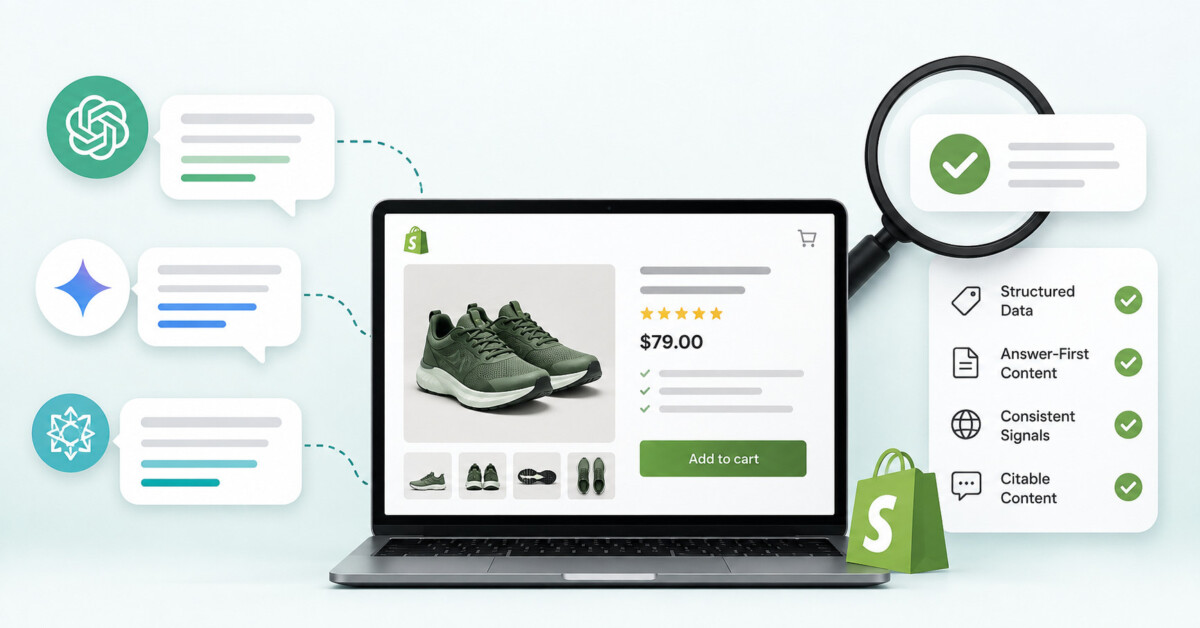
They ship complete structured data. Product schema with price, availability, aggregate rating, and a real description, not the half-empty defaults many themes emit. FAQ schema on pages that answer real questions. Organization schema that ties the store to its social profiles and founder. None of this is exotic; it’s done properly and validated, instead of assumed.
They write answer-first. The first paragraph under every heading answers the heading. If the H2 asks “Do compression socks help recovery?”, sentence one takes a position. Assistants extract passages, not essays. If the answer sits three paragraphs down, it never gets lifted into a response.
They publish one or two genuinely useful comparison or guide pages. Thin “10 best X” filler doesn’t count. The page should help a customer even if they never buy. These pages do disproportionate work because they match the question-shaped queries people actually type into assistants, which are rarely “buy merino sock” and usually “which socks stop blisters on long runs.”
They keep facts stable and dated. A claim like “tested across 400 miles of trail use, updated January 2026” is far more citable than an undated superlative. Assistants and their retrieval layers prefer sources that look maintained.
Moving a store from linkable to quotable typically takes about two weeks of content work: an indexable size guide, answer-first collection guides, complete product schema, and one honest comparison page. Here’s a composite drawn from our audit work (details blended to keep merchants anonymous): a mid-size apparel store with a size-guide popup, widget-loaded reviews, and collection pages that were pure product grids. Assistants never mentioned them, even for queries where they belonged.
The fix took roughly two weeks of content work, no redesign. The size guide became a real indexable page written in plain prose. Each of the three best-selling collections got a 400-word, answer-first buying guide. Product schema was completed and validated. And one honest comparison page went live: their product versus the two obvious alternatives, including cases where a rival was the better pick.
How quickly work like that shows up in AI answers varies by niche and competition, and any honest vendor will tell you so. But nothing in that list needed a redesign, a backlink campaign, or an ad budget. It’s the class of work that moves a store from linkable to quotable.
Four checks, 20 minutes, free tools:
None of this is dark magic, and none of it conflicts with classic SEO. It’s the same fundamentals, held to a stricter standard of clarity. What separates cited from ignored is whether the site gives an assistant something worth quoting, and the four checks above will tell you whether yours does.
No. Every check you need uses free tools: asking assistants your buying questions, viewing page source, validating schema, finding your quotable sentence. Paid platforms help you monitor citations at scale, but the underlying fixes are content and markup work any team can do, if it has the time to do them properly.
Structured-data and content fixes can surface in retrieval-based assistants like Perplexity within weeks, because they search the live web. Building the model’s baked-in “knowledge” of your brand is slower: months of consistent mentions. Start with retrieval.
AI citation work overlaps heavily with normal SEO. Clean schema, clear headings, and useful content help both. The difference is the standard: search engines rank pages, assistants quote passages. A page can rank while containing nothing an AI can confidently lift into an answer. That’s the gap this work closes.
Author bio: Anıl Yaylım is the COO of No7 Software, a UK e-commerce engineering studio, where he oversees the AI Visibility Sprint, a fixed-scope 14-day engagement designed to earn citations in assistants like ChatGPT, Perplexity, and Google AI Overviews. It starts with a free automated audit of your store and is backed by a written cited-or-refunded guarantee with clearly defined measurement terms.




