

Trust is hard to gain and easy to lose. In a physical store, a shopper recognizes the brand, talks to a person, and walks out holding the product and a receipt. Online shopping works nothing like that. A first-time visitor hands over personal and payment information to a business they may have never heard of, then waits days for a box to show up.
That gap is what you have to close. Trust shapes buyer decisions at every stage, from the first site visit through conversion, repeat orders, and referrals. The good news is that most of the work is practical, and the tactics that move customer confidence the most are well documented.
Online consumers evaluate risk before they evaluate products. They cannot hold the item, and they often cannot tell whether the ecommerce business behind the site is three people or three hundred. Potential buyers usually want answers to four questions before they reach the shopping cart.
The cost shows up in the shopping cart. Baymard Institute tracks an average cart abandonment rate of roughly 70%, and 19% of online shoppers say they have abandoned an order specifically because they did not trust the site with their credit card information. That number is not a product problem or a pricing problem. It is a trust problem, and it is one you can fix on the page.
People trust websites that look like someone maintains them. In Stanford’s web credibility research, 46.1% of consumers judged a site’s credibility partly on visual design, including layout, typography, font size, and color schemes. A polished ecommerce site suggests a real team and real investment. A dated one reads as a red flag before a shopper looks at a single product page.
Show that there’s a real organization behind your site.
Stanford Guidelines for Web Credibility
Stanford Persuasive Technology Lab
Slow pages read as broken pages. Deloitte and Google studied 37 brands across 30 million sessions and found that a 0.1 second improvement in mobile site speed lifted retail conversions by 8.4% and average order value by 9.2%. Internet users have been trained by the largest retailers in the world, and that is the standard your store gets measured against.
Broken user experience erodes trust quickly. Irrelevant search results, missing images, and confusing navigation all suggest nobody is minding the store. Dead-end no results pages are the worst version of this, because the shopper asked for something specific and got nothing back. Send them somewhere useful instead, using these best practices.
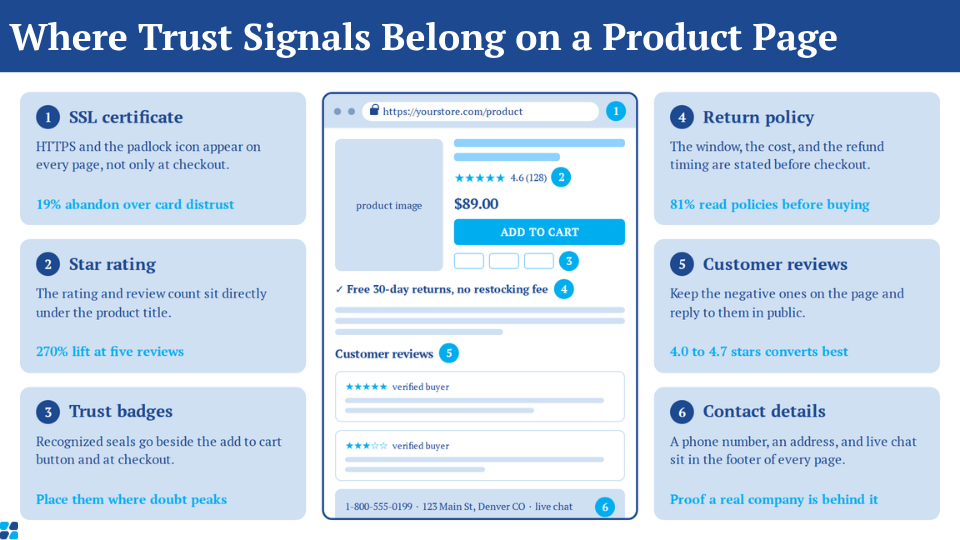
A secure website has to look secure. Most online consumers cannot evaluate encryption, so they look for visible proof instead.
Reachability is a trust signal. Publish a phone number, an email address, and a physical location where shoppers can find them without hunting. Live chat does something extra: it proves a person is available right now. Fast, useful customer service is also what turns a first order into a repeat one, and it gives potential customers a low-risk way to test you before they spend.
Very clear, and visible before checkout. About 81% of consumers read return policies before they buy, according to the 2025 Returns Landscape report from Happy Returns and the National Retail Federation. Vague policies read as traps. State the return window, who pays return shipping, and how long refunds take.
| Trust signal | Where it belongs | What it tells the shopper |
| SSL certificate | Every page | Data is encrypted |
| Trust badges | Product page and checkout | A third party vouches for you |
| Contact details | Header and footer | A real company stands behind the store |
| Return policy | Product page and cart | The purchase is reversible |
| Customer reviews | Product page | Other people bought this and liked it |
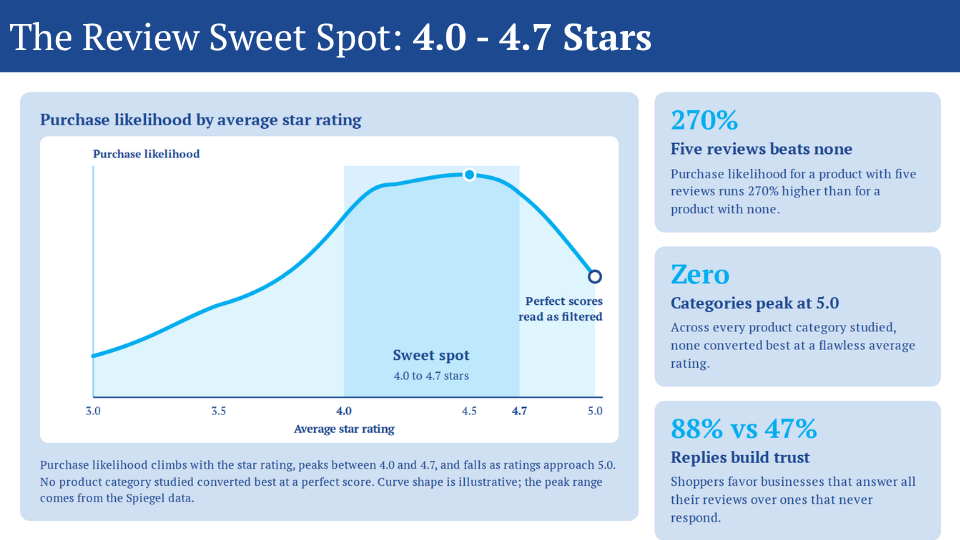
Fewer than you think. Research from Northwestern University’s Spiegel Research Center found that purchase likelihood for a product with five reviews is 270% higher than for a product with none. The gain from additional reviews drops off quickly after the first five, so getting every product page off zero matters more than chasing volume on your bestsellers.
No. The same Spiegel research found purchase likelihood peaks between 4.0 and 4.7 stars and falls as ratings approach 5.0. A perfect score reads as filtered. A negative review sitting next to fifty positive reviews makes all of them believable, and a thoughtful reply to negative feedback is its own trust signal. BrightLocal found that 88% of consumers would use a business that replies to all of its reviews, compared with 47% for a business that never responds.
We can afford to lose money… but we can’t afford to lose reputation.
Warren Buffett
CEO, Berkshire Hathaway
User-generated content extends the same idea past star ratings. Customer photos show the product in real rooms and on real people, which answers questions a product description cannot. Social media does similar work, since an active profile with real conversations proves the ecommerce brand is staffed and responsive. Case studies, press mentions, and counts of satisfied customers all reinforce consumer trust for higher-priced items.
Trust in ecommerce is built in small moments. A page that loads fast, a search that returns the right products, a policy written in plain language, and a review section that looks honest all add up to customer confidence and fewer abandoned carts.
Product discovery sits underneath much of that. When an online shopper searches your store and finds exactly what they wanted, the experience feels reliable. When they hit a dead end, it does not. Athos Commerce combines site search, personalization, merchandising, and product feed management in one platform, so shoppers find the right product on your site and everywhere else they shop.
Book a demo to see how better product discovery supports trust across your ecommerce store.
You build trust by making your online store look professional, proving it is secure, and being transparent about what happens after the sale. The five moves that matter most are a clean site design, an SSL certificate with visible trust badges, published contact details and live chat, clear shipping and return policies, and real customer reviews on every product page.
Trust badges help most at the point of payment, where security doubts peak. Baymard Institute reports that 19% of online shoppers have abandoned a purchase because they did not trust the site with their credit card information, so a recognizable trust seal near the payment fields addresses a documented reason for cart abandonment.
Negative reviews help more than they hurt when you handle them well. Purchase likelihood peaks between 4.0 and 4.7 stars rather than at a perfect 5.0, because online consumers read flawless ratings as filtered. Respond publicly, fix the underlying issue, and leave the review up.




