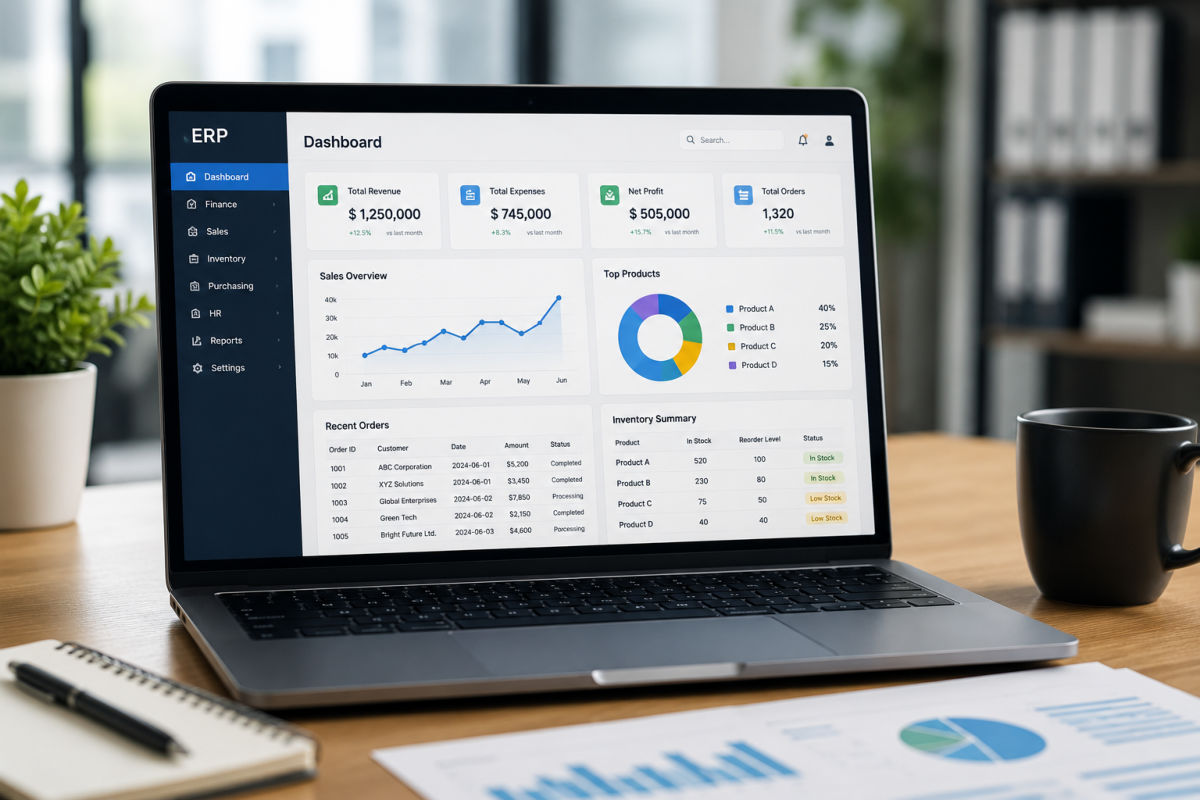
The right ERP system is the one that matches your core processes, scales with your growth, integrates cleanly with your existing tools, and is backed by an implementation partner your team can actually learn from and trust.
ERP projects do not fail because of missing features; they fail because the system and partner do not match how your business actually works or plans to grow.
Managers and business owners, especially for SME have to manage finances, sales, customer details, and employee data across multiple systems. This often opens the door to the risk of costly errors without the best tools in place. That’s why many businesses are now opting for Enterprise Resource Planning (ERP). ERP helps centralize your operation at the same time improving productivity.
However, your choice matters as these systems are not all made the same. What might be working for another business may not work for yours. The wrong system means you spend more money and encounter challenges during implementation. The following are some measures that businesses can take to align themselves with a solution that benefits both their short-term and long-term goals.
An enterprise resource planning (ERP) system is a software that helps businesses to manage different operations through a centralized platform. Instead of using separate applications for different tasks, all information is stored within a shared database. You can choose from Cloud ERP, On-Premises, or Hybrid depending on your needs,
The purpose of this software is to improve efficiency, productivity, and accuracy for a business. With information all stored in one place, it is much easier to track performance and run a business.
Using an ERP system allows the organization to realize benefits that extend beyond information management. They assist businesses in automating processes, facilitating collaboration, and understanding their performance. These can be leveraged for growth and stability.
In order to eliminate wastes and have better visibility across functions, companies must invest in the right software. When enabled with an appropriate system, teams can perform better and react quickly to the business needs. Here are key benefits:
Numerous business activities require duplication, which consumes time. ERP can help by providing automation for tasks such as order handling, stock-taking, and financial reports. Automation can save time and ensure uniformity. It lowers running expenses, promotes quicker workflow, and eliminates the time it takes for staff to do paperwork.
Having accurate information is key to making the right decisions. ERP systems offer a unified data course for managers to investigate past patterns. This gives them the current context for the present picture. Reporting tools can assist in planning and forecasting. Also, financial performance, sales activity, and operations information can be easily tracked.
No department likes it when data is stored in different systems. The ERP programs allow for a common source of information, reducing communication failures within the entire company. Your staff will obtain data from a single place instead of many. This allows teams to collaborate better, minimizing errors and delays.
Implementing an ERP system is about more than simply looking at the features of the software. Before investing in an ERP, a company needs to look at how that solution will best fit its needs, both current and future. A well-thought-out ERP comparison could save thousands in the long run. Efficiency is crucial to choosing the best system for you. Here are important considerations to keep in mind when selecting:
A successful ERP investment is one based on what your business needs. Define the possible issues, obsolete business procedures, and processes to be optimized. Think about what the accounting, sales, stock, and customer departments require. Employee feedback should also be collected. They are involved in these processes daily, making their input beneficial.
Different companies need different functions. A company might want certain functions, such as inventory, while another may want ERP for small business that will help unlock growth beyond basic accounting. Knowing the important feature will help make a short list that distinguishes the critical requirements from the non-essentials. This will prevent evaluation from including irrelevant features, leading to easier decision-making.
Reporting is one of the most important features of ERP. Planning becomes more effective because reports are reliable and managers are able to control current performance, find new opportunities, and respond to potential problems. Good reporting can enable small entities to make smarter choices and utilize resources more effectively.
An ERP system must be capable of catering to today and the future. Think about four or five years down the line, and gauge where the business will be. Check also if the system module would be able to scale with your business. Selecting a flexible platform protects your investment. A system that allows room for expansion can help avoid later upgrades, saving both time and money.
The majority of businesses use software applications. Your chosen ERP system must have the capability of integrating with several applications, including payroll systems, ecommerce applications, and customer relationship management systems. A well-designed ERP integration can automatically move payroll and employee cost data into the financial system, helping HR, payroll, and accounting teams keep their records aligned. Close integration means less manual data entry and greater accuracy. Data can flow easily between the systems, leading to greater efficiency for a business.
Protection of the business data from unauthorized access and security threats is a must. Your chosen system should offer security features like user permissions, access control, and data encryption. Compliance should also be taken into account. Organizations need to find a system that will facilitate the industry’s standards and reporting needs.
Choosing the correct provider is as important as choosing the right software. The support and skill of the provider can make all the difference to the overall success of the system implementation and usage. That’s why businesses should consider vendors thoroughly before selecting one. Consider the following to ensure you’re making the right choice:
Providers experienced in your industry are aware of general standards and obstacles. They may have the expertise to point businesses in the right direction and help improve implementation success. Industry knowledge can also provide more relevant recommendations and advice. They will also customize the system to fit your business needs. This enables you to get more value from the ERP investment.
A planned and managed approach is helpful. The provider needs to offer needed support during the implementation process. Strong administrative and implementation assistance reduces the risk, and introduction can be effective with increased adoption. Specific planning and explicit communication help with the implementation.
Even the most advanced ERP system will not provide value if employees don’t know how to use it. You need a partner that has various training resources to help your team learn more efficiently. These include:
This will improve user adoption and help your business get the most out of its investment.
Choosing an ERP system is an important decision for a business that needs attention to detail. Companies need to look at operational needs, future growth plans, ease of use, reporting ability, and support mechanisms. A methodical approach minimizes risk and improves the likelihood of success. The advantages of choosing the correct solution can be very substantial for your business growth.
Your business is likely ready for an ERP system when data is scattered across tools, manual workarounds are common, and decision‑makers struggle to get a clear, timely view of performance.
Many SMEs prefer cloud ERP because it reduces upfront infrastructure costs and simplifies updates, but highly regulated or complex environments may still favor on‑premises or hybrid setups.
A typical SME ERP implementation can take anywhere from a few months to a year depending on scope, data complexity, customization, and internal resourcing.
ERP projects most often fail due to unclear requirements, weak change management, and insufficient user training rather than purely technical issues.
You can compare ERP vendors effectively by mapping each one against your must‑have features, integration needs, industry experience, implementation approach, and total cost of ownership.