

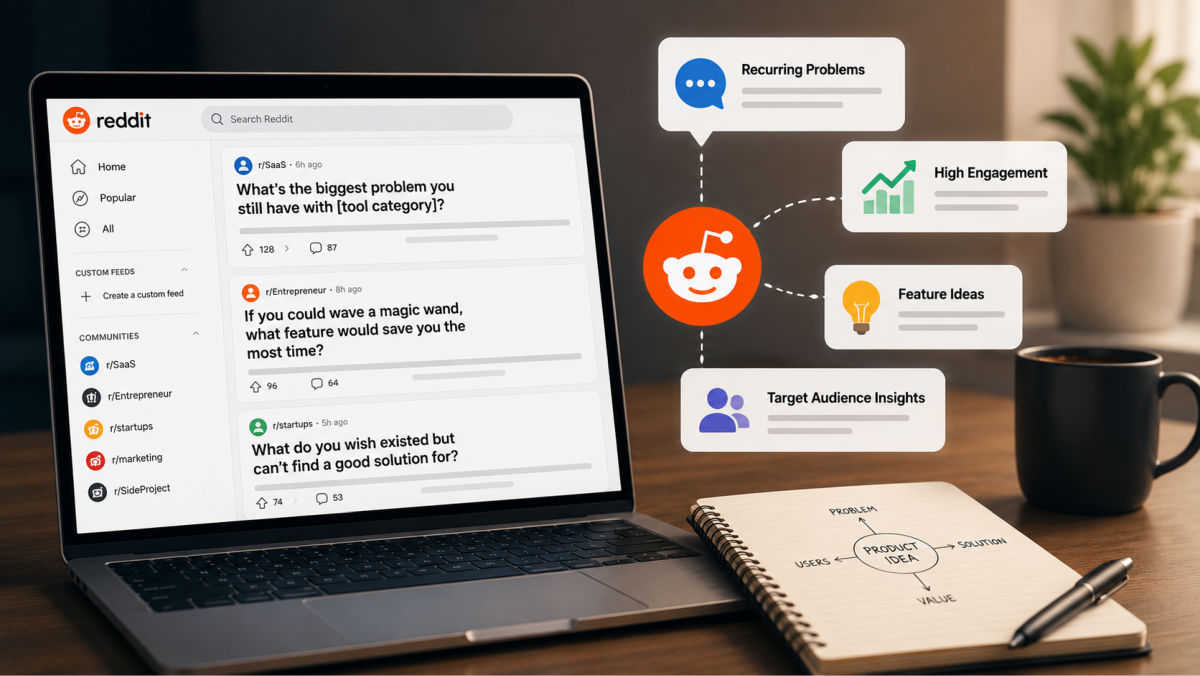
Reddit is the strongest free source of product-market fit signal for DTC brands because its conversations are unsolicited, archived, and searchable. Five recurring post patterns reveal unmet demand, switching triggers, price tolerance, and word of mouth before your own sales data does.
Reddit is where your customers talk to each other instead of to you, which makes it one of the few places you can watch product-market fit form without the observer effect bending the answer.
Reddit is the single most cited domain in AI generated answers. Peec AI analyzed 30 million directly cited sources across five major AI engines and found Reddit at number one, ahead of YouTube, LinkedIn, and Wikipedia. Every one of those citations is a thread where a real person described a problem, compared two products, or told a stranger what to buy.
That matters for a reason most founders miss. The merchants I watched stall at the $500K to $2M mark almost never failed because they picked the wrong ad platform. They failed because they scaled a product the market only half wanted, then bought inventory against that assumption. The evidence was usually sitting in public, in a subreddit, for twelve to eighteen months before the purchase order went out.
Surveys tell you what people say to a researcher. Reviews tell you what buyers think after they already bought and after they already liked you enough to buy. Reddit tells you what people say to each other when nobody is selling them anything, and the archive goes back years. This guide covers the five post patterns worth collecting, the workflow for collecting them at scale, what Reddit’s rules actually permit, and where the method breaks down.
Reddit removes the observer effect, which is the largest single distortion in every other research method a DTC brand runs. A survey respondent knows a brand is reading. An interview participant wants to be helpful. A reviewer is writing in public with their order history attached. A Redditor asking r/BuyItForLife which kettle actually lasts has no such incentive, and neither do the eleven people who answer.
The structure amplifies it. Reddit organizes around thousands of topic communities rather than around follower graphs, so the people answering a question about ultralight backpacking gear have usually carried the gear. Reddit also keeps its archive. A thread from 2023 is still indexed, still searchable, and still accumulating comments, which means you can compare what a community said about your category two years ago against what it says now.
The commercial stakes moved recently too. Between July 2023 and April 2024, Sistrix measured a 1,328% increase in Reddit’s search visibility, moving it from the 68th most visible domain in US Google results to the 5th. Reddit’s weekly active search users then grew from 60 million to 80 million in a year. Reddit has since started testing AI-powered product carousels inside its own search results, which turns those same threads into a discovery surface with a purchase path attached. You are mining that archive for what the market wants, and it is simultaneously deciding what gets recommended to the next buyer.
The clearest product-market fit signal on Reddit is a person describing a specific job, asking whether anything solves it, and getting no useful answer. The pattern is recognizable in the title alone. Is there anything that does X without Y. Does anything combine A and B. I have tried C and D and neither does what I need.
Two things make these posts valuable. They tell you what someone is trying to solve right now, which is different from what they told a survey they would pay for. And the replies map the competitive field, including which products get named first and what people believe those products get wrong.
The companion pattern is the workaround thread, where nobody asks a question at all. Someone describes gluing three tools together with a spreadsheet, or a hack that halves a setup step. A workaround proves three things at once: the problem is real enough to spend effort on, existing products have a specific failure mode, and the person has a measurable tolerance for friction. Search for phrases like my current setup is and until something better exists I just.
Illustrative benchmark: pulling twelve months of a mid sized category subreddit and finding forty or more unanswered demand posts pointed at the same job is a genuine gap. Finding four is noise. If you are pre-launch, this is the only signal you need to run first, because it is the only one that tells you whether to build at all.
A switching story tells you the exact threshold at which a customer decided the pain of changing was smaller than the pain of staying. That threshold is where product-market fit either exists or does not, and it is almost impossible to extract from a cancellation survey, which catches people at their least reflective moment.
The Reddit version is far richer. Someone explains that they used Product A for fourteen months, what specifically broke, what they tried before giving up, and what they switched to. Tag these by trigger type: missing capability, price change, reliability failure, support experience, or a life change that altered the job entirely. The distribution across a few hundred tagged posts is the useful artifact, not any individual story.
If most switching in your category traces to one trigger, that trigger is a risk for the incumbent and an opening for a challenger. If switching is scattered across five triggers with no concentration, the category is probably good enough and you are competing on brand and distribution rather than on product.
This complements the qualitative work you should already be doing. On the eCommerce Fastlane podcast, Anthony Morgan made the case that the real conversion leverage sits upstream in voice of customer research rather than in checkout tweaks, and named review mining, support ticket logs, and post purchase surveys as the three places to start. Reddit is the fourth, and it is the only one that captures people who never became your customer.
When people describe your category without your marketing in front of them, they use words your product page does not contain, and that gap is frequently why conversion stalls on traffic that should convert. A product can solve the right problem and still fail because it describes that problem in the language of the team that built it.
Collect a few hundred organic problem descriptions from relevant subreddits and run a simple frequency pass. You are looking for three things: the nouns and verbs people use for the problem, the adjacent concerns they raise unprompted in the same breath, and the outcome they describe wanting in their own words. Then open your product page and count how many of those terms appear.
The gap is usually larger than founders expect. A skincare brand describing barrier repair while the community talks about stinging after cleansing is not selling to a different customer, it is selling in a different vocabulary. At $50K to $500K per month, this is the highest return signal on the list, because rewriting a product page costs a day and a half and the traffic is already arriving. Take the language, not the claims: community vocabulary tells you how buyers think, not what is true about your ingredients or your testing.
Price validation threads show you what a market believes a category is worth, which is a different number from what a survey says people would pay. The pattern is a person deliberating out loud before purchase: is this worth $180, has anyone used it, is the upgrade tier actually necessary.
The replies are where the value sits. People break down what they felt they got for the money, whether they would buy again, and what would have made them pay more or less. That is willingness to pay evidence from real buyers in real purchase moments, which a pricing survey structurally cannot produce.
Read the verdict pattern rather than the verdicts. A consistent refrain of useful but overpriced tells you the value proposition is not landing at the price being charged, which is a positioning problem before it is a pricing problem. A consistent wish I had bought it sooner tells you there is room above your current price.
This signal also catches the mistake I see most often between $500K and $2M, which is discounting into a category where the community is already saying the cheap option is a false economy. That is the market telling you to raise price and improve the product, and brands read it as a cue to run a promotion.
An unprompted mention in a thread where nobody asked for recommendations is the closest thing to a clean word of mouth metric a DTC brand can get. Someone is troubleshooting a problem, a commenter says they had the same issue and this product solved it, and no one involved is being compensated or measured.
Track the frequency of those mentions over time and you have an organic share of voice number that reflects satisfaction rather than marketing spend. Rising unprompted mentions with steady sentiment is the strongest external product-market fit signal available to a brand without a research budget.
Reddit’s archive lets you run this backwards, which almost nothing else does. Pull mentions of your product and your category in six month windows going back two or three years, then compare. A brand recommended enthusiastically eighteen months ago and rarely mentioned now is losing fit, and the threads usually tell you why.
There is a second reason to run this. Those same threads feed AI answers, which is why testing whether ChatGPT, Claude, and Perplexity actually recommend your brand belongs in the same quarterly review. Recommendation visibility in AI and unprompted mention frequency on Reddit are two readings of the same underlying thing.
Collecting Reddit signal at scale takes five steps: pick five to fifteen subreddits, pull six to twelve months of posts and comments, tag every row by signal type, count for concentration, then repeat quarterly. Manual reading orients you in a weekend and stops scaling immediately after, so the point of the workflow is to read distributions rather than react to whichever thread you saw last.
First, identify your subreddits. Five to fifteen communities, covering category subreddits, profession subreddits, and problem adjacent communities where your customer complains about the thing your product fixes. Read them for a week before you collect anything, because every subreddit has its own rules and culture and you will misread the data without that context.
Second, collect posts and comments across a window of six to twelve months. Shorter windows overweight whatever happened recently. Export to CSV so the tagging happens in a spreadsheet rather than in a browser tab.
Third, tag by signal type against the five patterns above. Manual tagging works up to a few hundred rows. Past that, keyword filters get you most of the way and you spot check the edges.
Fourth, look for concentration. One post complaining about a competitor is a person having a bad week. Twenty posts across six months describing the same failure mode is a market position. Count before you conclude.
Fifth, repeat quarterly against the same subreddits. Product-market fit is not a state you reach once. Competitors respond, expectations move, and the only way to know which direction you are drifting is to hold the method constant and watch the numbers change.
Reddit’s official route is the Data API, and it is narrower than most founders assume. Per Reddit’s own developer documentation, clients must authenticate with a registered OAuth token, free access is capped at 100 queries per minute per client ID, and access is approval based rather than self serve. Commercial use routes to a separate agreement. You are also required to delete any content that has been removed from Reddit, with a recommended retention window of 48 hours for stored user data.
The legal climate around the alternatives has hardened. Reddit sued Perplexity and three data scraping firms in October 2025, alleging they bypassed technical controls to harvest Reddit content from Google search results. On July 31, 2026, a federal judge allowed Reddit’s core anti-circumvention claims to proceed rather than dismissing them. No final judgment has redefined the law, but the direction is clear enough to plan around.
Third party collection tools sit in the middle of that. A managed Reddit scraper will pull posts, comments, subreddit metadata, and public profiles into CSV or JSON without you running proxies or rate limit logic, typically for $50 to $150 per month depending on how much compute you need. Be clear eyed about the trade. Tools in this category generally do not require a Reddit API key, which means they are operating outside the official Data API, and their own terms put responsibility for lawful use of the exported data back on you.
My read for a DTC brand: the research use case is low risk relative to AI training, because you are reading aggregate patterns and then deleting the raw text. Keep the dataset small, keep it internal, delete what you no longer need, never republish scraped user content on your own site, and never use a collection tool as a shortcut to posting. If your legal exposure tolerance is low, the approval based Data API path is the one to take, and it is slower.
Reddit over represents technical, research heavy buyers and under represents the mainstream customer you need for growth past seven figures. The person writing a 600 word comparison of two water filters is not your median buyer. They are your most engaged 3%, and building a roadmap purely for them is how brands end up with a product beloved by a forum and ignored by a category.
It is also a text medium, which means it captures the articulate and misses everyone whose frustration never turned into a post. Silence in a subreddit is not evidence of satisfaction. It is evidence that the people who churned quietly were never Redditors.
Contamination is real too. Brands do astroturf, and the sophisticated attempts are hard to spot from a CSV export. Treat unusually positive mention clusters from young accounts with the same suspicion you would apply to a five star review burst.
Pair it, do not substitute it. Reddit tells you what the market wants and how it talks. Your retention cohorts tell you whether you delivered. Direct customer interviews tell you why. Any one of the three alone will mislead you.
The right amount of Reddit research scales with how reversible your next decision is. An inventory order is not reversible, so it deserves the deep pass. A landing page headline is reversible in an afternoon, so it does not.
Notice what the table does not say. It never recommends adding a monitoring tool, a dashboard, or a dedicated researcher before $2M. The failure mode I have watched most often at $500K to $2M is premature complexity: a brand buys three listening tools, connects none of them to a decision, and abandons all of them within two quarters. Start with a spreadsheet and one tagged dataset. Add tooling only when the manual version has already changed a decision you made.
If you are pre-launch, run the demand and workaround pass before you order anything. Past $2M, the mention trend line is the number to watch, because by then the product question is mostly settled and the discovery question is not.
Start with a Google search for your product category plus site:reddit.com, then read which communities keep appearing in the results. Add the obvious category subreddits, the profession subreddits where your buyer works, and the problem adjacent communities where people complain about the job your product does. For most DTC categories the useful list lands between five and fifteen communities. Check subscriber counts and recent post frequency before committing, because a subreddit with 400,000 subscribers and nine posts a week will produce less signal than one with 40,000 subscribers and daily discussion. Spend a week reading before you collect anything.
Automated collection outside Reddit’s official Data API sits against Reddit’s User Agreement, which is why recent lawsuits have been pleaded as breach of contract and anti-circumvention rather than as hacking claims. No court has issued a final judgment redefining the law, and reading publicly visible pages has historically survived challenges, but Reddit has demonstrated it will pursue scrapers and the vendors selling to them. The lower risk path is applying for Data API access, authenticating with OAuth, and staying inside the rate limits. Whichever route you take, keep the dataset internal, delete content that has been deleted from Reddit, and never republish scraped user text.
Aim for at least 200 tagged posts across a six to twelve month window before drawing conclusions about any single pattern. Below that, one active thread can distort the whole distribution. The number that matters is not the total collected but the count within a single signal type, so 500 posts that yield only nine switching stories will not tell you much about switching. If a pattern is too thin to count, that is itself information: either the behavior is rare in your category, or you picked the wrong communities. Re-check your subreddit list before concluding the behavior does not exist.
No, and treating it as a replacement is the most common way this method goes wrong. Reddit captures what people say to peers when nobody is selling, which is its unique value, but it skews heavily toward technical, research heavy buyers and misses anyone whose frustration never became a post. Use Reddit to generate hypotheses and to find the language your market actually uses, then validate with direct interviews and check against your own retention and repeat purchase data. Reddit tells you what the market wants. Your cohort data tells you whether you delivered it. Both are required.
Quarterly is the right cadence for most DTC brands, with the same subreddits and the same tagging scheme each time so the numbers are comparable. Product-market fit degrades quietly as competitors ship, expectations rise, and category norms shift, and a single snapshot cannot show you direction. Run an extra pass whenever you are about to commit to something hard to reverse: an inventory order, a new SKU, a category expansion, or a price change. If you are pre-launch, run it before you build. The quarterly rhythm takes two to four hours once the collection is set up.




