


Dotdigital blog
Marketers are juggling a lot, and there’s only so much you can do on your own. That’s where customer success comes in, not just to fix issues, but to roll up their sleeves and help you get more from your marketing.

Marketers have a lot to keep up with. There are customer expectations to understand, strategy advice to interpret and apply, algorithm changes to stay on top of, internal buy-in to build, and somewhere in all of that, the actual work still has to get done.
When you’re deep in the day-to-day of ‘wearing many hats’, an extra pair of hands is always welcome.
That’s where customer success can be a real help. People often conflate customer success with customer support, but they’re actually pretty different. Customer success can (and should) do a lot more than react to issues as they come up.
We spoke to Customer Success Director, Lauren Hunt, to get advice straight from the source. Hear what you can actually expect from your Customer Success team, and how to make sure you’re getting the most out of the relationship.
I know first-hand that many marketers don’t realize how much value customer success teams can offer beyond reactive support. A lot of people naturally see customer success as somewhere to go when something breaks or needs fixing, but often the biggest value comes from involving us much earlier.
Customer success sits somewhere between strategic consultancy, onboarding support, platform expertise, and account management.
The goal isn’t simply to help customers use a platform. It’s to help them get meaningful value from it and support them as their marketing evolves.
That could be:
Come to us as early as you can in the project; we don’t expect you to have everything figured out, and we can probably help you get there.
You don’t need a fully signed-off strategy to have a useful customer success conversation. “We’re reworking part of our tech stack and want to improve onboarding by June” is enough context to start helping.
The best customer relationships are transparent ones.
Things we need to know:
That context is incredibly useful and lets us fully understand where you’re at and where you need support.
1. Be proactive
The earlier we know about something, the more useful we can be.
There have been times when a customer has told us they’ve started a project, chosen an agency, started a transformation, changed a process, bought another tool, or spent months building workarounds that we could have helped with and saved them a whole lot of time and investment.
Many people still see customer success as reactive support instead of a strategic sounding board. We’re always happy to help you figure out something, of course, but we can do so much more than that.
2. Even if your project is broader, loop your customer success team in
Even if something sits outside your core platform or tools, it will usually still have an impact on how everything connects together. Customer success teams are often speaking to agencies, partners, technical teams, implementation specialists, email deliverability experts, and other customers, so they tend to have a broad view of what’s working across different setups.
Keep them in the loop, and they can bring useful context, share patterns they’re seeing elsewhere, and help you spot potential issues or opportunities earlier, even when the work isn’t directly tied to your day-to-day platform use.
3. Benefit from our wider network and experiences
There’s a lot of industry knowledge and trend information that our customer success teams have built up. Together, we can be the perfect team, as you know your brand well, and we know the wider market.
We’re constantly seeing:
We can share this insight with you, so your project is always starting from an informed place, and you’re already a couple of steps ahead.
Treat meetings as a working session rather than a status update.
I recommend starting with what’s going on right now. Then your customer success team can highlight what’s new and relevant to you as you go, sharing how you can use it to remedy an issue or optimize something you’re currently working on.
Meetings where both sides present updates to each other can be useful, but it’s not the best use of our time together. Updates can always be shared in advance, and our time together can be spent working out what comes next.
The most valuable things to share are:
The most valuable questions to ask:
And always be open and honest about your capability for execution. If you’re very limited for time and can only get tasks done during meetings with us, we can work with that. We’d rather spend our time doing things together in the session, instead of planning things with you that you’ll never have time to implement.
We work with tons of marketers, and there are some characteristics and approaches that we always see in teams that get the best results.
1. Appreciate the ‘small’ stuff
When you improve the core parts of your customer journey, the impact can ripple much further than you’d think.
The basics are the foundation of a strong strategy, but that doesn’t mean they have to feel basic. It’s easy to get distracted by shiny new features, but often it’s the small improvements to the processes you use every day that make the biggest difference over time. Such as A/B testing small but important details like subject lines, send times, and CTA styles to understand what resonates most with your audience.
2. Don’t be afraid to break things
The customers who grow most are usually willing to try things, break things slightly, learn, and refine.
A first go is rarely perfect, and optimization is the process of seeing what works and what doesn’t and learning from your own customers in the process. Marketing is an ongoing process of testing what resonates, refining it, and going again.
3. Don’t let perfection be a blocker for progress
As much as securing buy-in and alignment at the start of a project can eliminate a lot of back-and-forth later down the line, spending too long in the weeds of a project at the start can really hamper your progress.
Getting started is often the most daunting part, and it’s tempting to stay in planning mode for too long. Putting something live is usually the most valuable step and is where your real learning starts.
A strong customer success relationship usually comes down to a few simple behaviors:
None of these things need you to adopt more processes, just openness and collaboration.
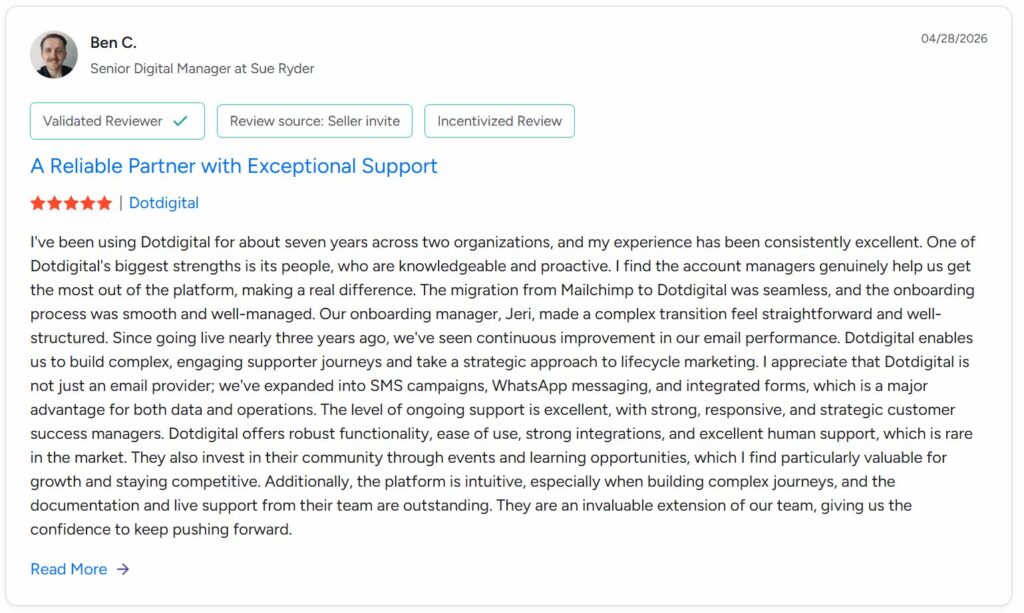
The strongest customer success relationships feel like an extension of your team, built on openness, shared context, and a focus on making steady progress rather than perfect plans.
In most cases, the teams that get the most value aren’t the ones with the most advanced setups, but the ones willing to engage, experiment, and treat customer success as a genuine partner in their marketing strategy.





