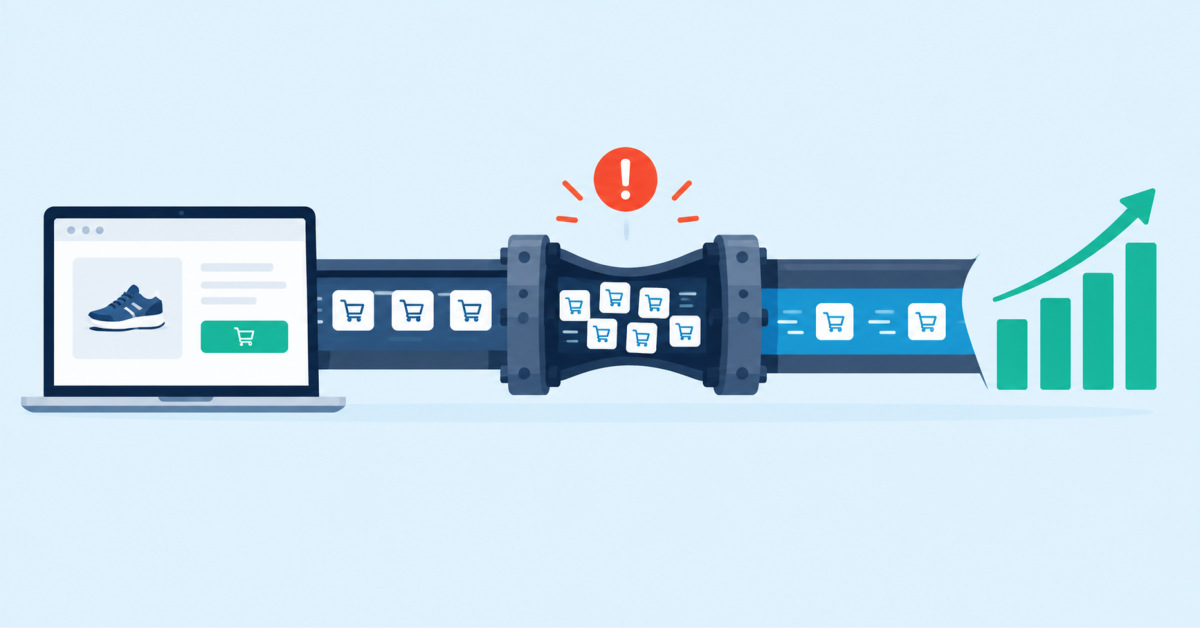
Most ecommerce growth plateaus are not acquisition problems first. They are conversion, returns, retention, or discovery problems that become more expensive when brands add ad spend before fixing the customer journey and unit economics underneath it.
When growth stalls, the answer is rarely “buy more traffic.” The highest-return work is usually finding where demand, trust, margin, or repeat purchase behavior is leaking before it reaches the next stage.
Watching their growth stagnate is not something any e-commerce business wants, but sadly, it’s often a when rather than an if question. It is quite hard for any business to experience perfect, continuous growth with no slowdowns. That rise and fall is normal. What needs attention, however, is when your usual growth tactics no longer produce much movement even over an extended period of time.
Advertising brings diminishing returns, new products take longer to gain traction, and increasing the budget seems to create more expenses than customers. This is what many in the industry refer to as a growth bottleneck, and it can sit anywhere from product discovery to post-purchase service.
Finding and addressing it requires looking closely at the journey customers take and the economics behind it. In this article, let’s explore some of the strategies that can help you overcome the bottleneck and resume e-commerce growth.
Before increasing an advertising budget, examine where existing demand is being lost. Start by mapping the customer journey from the first visit through purchase, delivery, and potential repeat buying. In particular, you want to look for:
That last point is actually a massive problem across the entire e-commerce and retail industry.
Research suggests that 15.8% of annual sales were returned in 2025, totaling $849.9 billion. When it came to online orders, an estimated 19.3% of sales were returned. At the same time, the ability to return items was important to maintain, as 82% of consumers cite free returns as a major purchase consideration.
The goal is therefore not necessarily to make returns difficult. Instead, investigate why particular products are being returned and whether descriptions, sizing information, images, or customer expectations are contributing to the problem.
An audit can also be useful when looking at operations more broadly. Finding it difficult to scale isn’t limited to e-commerce businesses. It’s something all operations across every niche can struggle with.
Even nonprofits and NGOs supporting vulnerable communities face similar challenges, particularly when they need clearer visibility into how resources are being used. To address this, many of them have begun to use social care management software to track every dollar in and out of their operation.
Sometimes, such audits can reveal aspects that are making growth difficult. There are other benefits to understanding and organizing your operation better.
As Community CareLink notes, for a nonprofit, clear financial records can help open doors to funding when applying for grants and seeking donors. For an e-commerce company, comparable visibility can help when preparing to raise venture capital or a funding round.
Sometimes you may have plenty of visitors but still struggle to convert them because the buying experience has not kept pace with the business. In such cases, you want to look for sources of friction that may be easy to overlook. These include:
These factors become particularly relevant when entering new markets or serving new customer groups. As data from Juniper Research notes, the e-commerce market is set to be worth over $13 trillion by 2030. That represents a growth rate of 57% from the $8.3 trillion valuation in 2025.
According to Nick Maynard, VP, Fintech Market Research, Juniper Research, if vendors want to differentiate themselves, they need to adapt. This involves ensuring they reflect cultural and regulatory trends in addition to embracing local payment options.
For a smaller e-commerce operation, adaptation does not necessarily require rebuilding the entire storefront. That said, you can still test changes that address specific sources of friction.
It is also worth conducting what could be called “conversion archaeology.” In this process, you would analyze:
These sources often contain the exact language customers use when they are uncertain about buying. That language can reveal objections that conventional analytics cannot show. The benefit is that you get useful insight for improving product pages and marketing without paying for another major campaign.
If your e-commerce store depends heavily on paid traffic, it can eventually find itself paying more simply to maintain the same level of visibility. Building additional routes to discovery is also going to be critical given the changing times with AI search.
As data from McKinsey & Company shows, 50% of consumers already use AI-powered search, and $750 billion will flow through it by 2028. As a result, unprepared stores may see a drop in traffic between 20% and 50%.
So how can you prepare? Well, you may want to start modifying how the following information is presented on your storefront:
All these help establish a stronger information footprint. At the same time, don’t forget about user-generated content. According to research from Mordor Intelligence, the user-generated content platform ecosystem is scaling rapidly, valued at $9.85 billion.
This growth is driven by brands leveraging customer trust signals to shorten digital purchase funnels. Moreover, when you consider that switching from traditional ads to community-driven storytelling yields 6.9x higher engagement, focusing on user-generated content is a no-brainer.
That said, rather than treating it solely as advertising material, try to integrate it directly into the buying journey. A customer demonstration, review, photograph, or answer to a common product question can build more trust in potential buyers.
Likewise, encouraging customers with positive experiences to recommend your store to others on platforms like Reddit can be particularly beneficial. This, however, requires some tact and planning, as even the slightest hint of a promotional comment is enough to drive people away online.
An e-commerce business can stop growing when customer acquisition becomes too expensive, conversion rates decline, or existing customers do not return often enough. Operational issues, limited product selection, poor customer experience, increasing competition, and overreliance on a single marketing channel can also create a growth plateau.
There is no fixed timeline because recovery depends on what is causing the slowdown. A straightforward conversion or pricing issue may improve within weeks, while problems involving product-market fit, customer retention, or market expansion can take several months of testing and adjustment.
Customers commonly abandon carts because unexpected costs appear at checkout, delivery takes too long, payment options are limited, or they are still comparing alternatives. Complicated checkout processes, uncertainty about returns, and simply postponing the purchase can also contribute to abandoned carts.
| Estimated share of annual retail sales returned in 2025 | 15.8% |
| Estimated share of online sales returned in 2025 | 19.3% |
| Consumers citing free returns as a major purchase consideration | 82% |
| Projected e-commerce market value by 2030 | Over $13 trillion |
| E-commerce market growth from 2025 to 2030 | 57% |
| Expected value flowing through AI-powered search by 2028 | $750 billion |
| Potential traffic decline for brands unprepared for AI | 20% to 50% |
| User-generated content platform ecosystem valuation | $9.85 billion |
| Higher engagement from community-driven storytelling | 6.9x |
Breaking through a growth bottleneck does not always require finding a larger audience. Sometimes the opportunity is already sitting inside your business. It might simply be hidden by an inefficient customer journey or an overreliance on paid acquisition. Just remember, growth bottlenecks are not always obvious. So, you’ll really need to dig deeper than you normally do to gain insights.
Doing so will require you to shift focus from growth to internal optimization, which can be hard for some e-commerce stores. Yet, sustainable growth isn’t about running faster on a treadmill of endless ad spend. Rather, it’s about knowing that at some point, you’ll need to pause and grease up the ball bearings to keep things running smoothly.