
Nearly seven out of ten shoppers will abandon a purchase when the product they want is out of stock.
That statistic alone highlights how deeply e-commerce inventory management influences profitability. It is no longer just a behind-the-scenes task but a direct driver of customer satisfaction and business success.
The pressure on online retailers is growing fast. The global e-commerce inventory management market is projected to reach $558 billion by 2025, while businesses collectively lose over $300 billion each year through markdowns caused by poor stock visibility. These figures reveal both a major challenge and an opportunity for improvement.
Many store owners still struggle to forecast demand accurately, maintain the right inventory levels, and avoid costly stockouts or overstocking. In fact, 69% admit they lack complete visibility into their supply chains.
In this article, you’ll explore proven strategies that leading brands such as Procter & Gamble use to strengthen demand planning and streamline operations. You’ll discover practical methods like safety stock planning, inventory kitting, and routine audits that keep data reliable and fulfillment fast.
E-commerce inventory management is the foundation of any successful online store. Essentially, it tracks and controls the flow of products sold online – from sourcing and storage to shipping through all sales channels. E-commerce inventory management does more than count stock. It provides immediate insights into inventory levels and helps store owners decide when to reorder products and optimize their stock.
E-commerce inventory management takes a systematic approach to organize, track, and control products meant for online sale. The scope includes much more than counting items:
This complete process helps online businesses cut costs while keeping consistent stock levels to meet customer’s needs quickly. Moreover, inventory management that works connects procurement, production, and fulfillment operations. This creates uninterrupted flow of goods through the supply chain.
Traditional brick-and-mortar inventory management usually checks stock manually with ledgers or spreadsheets, in contrast to automated electronic systems in e-commerce. Here are the main differences:
E-commerce inventory employs digital systems with virtually unlimited storage capacity. These systems let businesses offer more products than physical stores. Specifically, smart systems alert instantly when inventory drops below set levels. This enables quick reordering without manual checks.
In particular, online stores can access near-immediate data about customer priorities and buying patterns. This valuable information enables better demand forecasting and inventory planning. Traditional retail has slower feedback loops with delayed or incomplete data.
Traditional retailers face physical space limits when stocking products. As opposed to e-commerce businesses that can offer large product catalogs without these restrictions.
Mastering e-commerce inventory management brings major rewards but also comes with real challenges. Store owners who invest in better systems and processes often see stronger customer relationships, lower costs, and more consistent growth.
Online shopping’s explosive growth makes advanced inventory control systems essential. E-commerce businesses can’t survive without Warehouse Management Systems, or WMS for short, in today’s competitive marketplace.
The global WMS market shows this trend clearly. Projections indicate growth from USD 4.00 billion in 2024 to USD 8.60 billion by 2029, with a 16.3% annual growth rate. Consumer spending continues to move online—with 63% of consumer dollars now spent on online purchases—making WMS adoption crucial.
WMS acts as the central nervous system for inventory operations. It eliminates manual errors, improves operational efficiency, and substantially reduces processing times. This technology tracks inventory in real-time, sends automated replenishment alerts, and manages precise locations.
The retail industry loses USD 1.75 trillion annually from out-of-stock inventory. We found that 86% of executives blame poor communication as the root cause of workplace failures. WMS solves these problems by providing:
WMS software reduces fulfillment latency and processing times. This leads to improved customer satisfaction through faster, more accurate deliveries that end up building customer loyalty and deepening brand reputation.
E-commerce businesses can minimize costs and keep optimal stock levels by using proven inventory control techniques. Here are six methods that will reshape the scene of your e-commerce inventory management, based on industry best practices:
Your inventory buffer against uncertainties comes from safety stock. This extra reserve helps you avoid stockout risks and keeps customer service levels high. The optimal calculation uses this formula: Safety Stock = (Maximum Daily Orders × Maximum Lead Time) – (Average Daily Orders × Average Lead Time). A good safety stock level keeps your supply chain running smoothly when cycle stock depletes.
Kitting groups complementary items into a single unit to boost revenue and cut costs. This approach works great to showcase items that work well together and leads to higher-value orders. Companies that use kitting see fewer fulfillment errors, save money on packaging, and reduce shipping costs. Kitting differs from bundling because it creates new product offerings from different related items instead of grouping similar products.
The reorder point formula tells you the right time to replenish inventory. You can find it using: Reorder Point = (Daily Sales Velocity × Lead Time) + Safety Stock. This helps you avoid ordering too early or too late, which could raise costs or cause stockouts. Research shows stockouts cost retailers nearly USD 1 trillion worldwide each year.
Your storage allocation strategy directly shapes order-picking efficiency. Machine learning now predicts item demand and optimizes space in pick face and bulk storage areas. Pickers travel shorter distances, which speeds up fulfillment. Warehouses that standardize these processes cut labor costs by 30%.
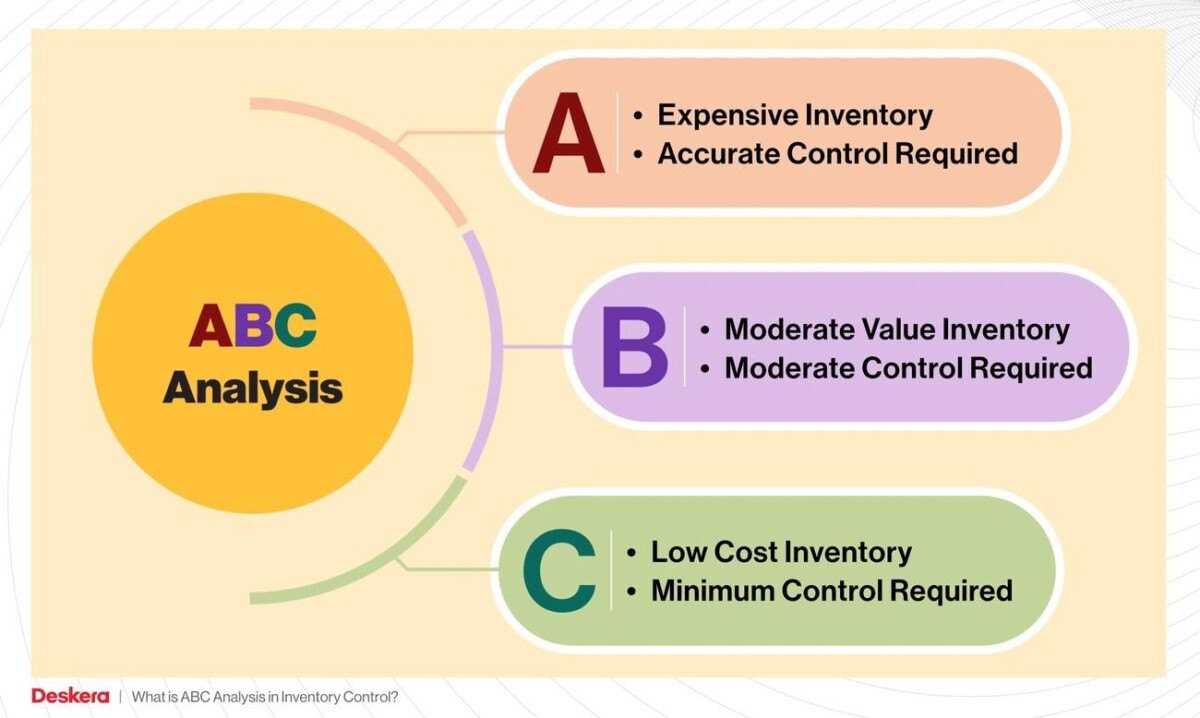
ABC analysis splits inventory into three categories:
This system lets you focus resources on high-value inventory. You’ll see better forecasting accuracy, stronger supplier negotiations, and lower storage costs through proper stock levels.
Regular inventory checks help spot differences between actual stock and financial records before they grow into bigger issues. The National Retail Federation reports inventory shrinkage costs retailers nearly USD 100 billion. You should do full inventory audits at least 1-2 times yearly, though quarterly works best. Cycle counting offers a less disruptive option – you count small portions of inventory on a rotating schedule.
Modern technology has reshaped how e-commerce businesses handle inventory challenges. The right tools not only reduce manual errors but also make operations faster, smarter, and more connected across all channels. Here are the key technologies that help store owners stay efficient and competitive:
Mastering inventory management is about more than keeping shelves organized. It represents a strategic advantage that strengthens every part of an online business. When operations run smoothly, customers notice. Orders arrive on time, products remain available, and the brand builds lasting trust.
The next generation of e-commerce success belongs to store owners who invest in clarity and precision. Tools such as modern inventory software, data-driven forecasting, and Warehouse Management Systems (WMS) give growing businesses the visibility they need to compete at scale.
Each improvement—no matter how small—creates a ripple effect that enhances accuracy, reduces costs, and deepens customer loyalty. With the right approach, inventory management evolves from an operational task into the engine that drives sustainable success in e-commerce.
E-commerce inventory management tracks all products from the moment you source them until they ship to a customer. It is crucial because keeping accurate stock levels directly reduces costs and prevents frustrating customers with “out-of-stock” messages. A solid system acts as the foundation for customer satisfaction and business success.
Managing inventory for an online store relies on modern, automated digital systems rather than manual counting. E-commerce systems have virtually unlimited storage capacity and can track data across multiple sales channels instantly. Traditional retail is limited by physical store space and often uses slower manual checks for stock.
The biggest risk is the combination of overstocking and stockouts, which both destroy profits. Stockouts cost retailers billions in lost sales because customers leave when their item is gone. Overstocking also ties up your money in goods that are not selling and increases expensive storage costs.
A WMS is software that acts as the central control for all your inventory operations. It is essential because it eliminates manual errors, optimizes picking and packing, and connects data across all your sales channels. Using a WMS helps ensure faster, more accurate deliveries, which builds strong customer loyalty.
Safety stock is an extra reserve of product you keep on hand to act as a buffer against unexpected issues. This buffer helps your business avoid running out of popular items when demand suddenly spikes or a supplier is late with an order. Calculating the correct level keeps your operations running smoothly.
Inventory kitting is the process of grouping different, complementary products together and selling them as a single packaged unit. This method boosts the total value of each order by encouraging customers to buy more items at once. It also saves money on packaging and reduces the chance of fulfillment errors.
The best way to know when to reorder is by using a calculated “reorder point.” This is a specific trigger number that takes your daily sales speed, plus your supplier’s lead time, and adds your safety stock level. Using this formula prevents you from ordering too early or too late.
ABC analysis is a method for prioritizing your inventory based on value. ‘A items’ are the 20% of products that generate the most revenue, and you must monitor them closely. ‘C items’ are the low-value products that need less of your attention. This analysis helps you spend your time and resources where they will make the biggest difference.
You should prioritize smart inventory software that offers real-time stock tracking and automatically integrates with your website and accounting systems. For growing brands, look for cloud-based tools that can manage multiple warehouse locations and update inventory across all sales channels instantly.
Full inventory audits should happen at least once or twice a year, but they are disruptive to business operations. Cycle counting is a better, less disruptive option because you count small portions of your inventory on a rotating schedule throughout the year. This ensures your stock data stays accurate all the time without massive shutdowns.