

TL;DR
Voting contests are one of the few marketing tactics that ask your audience to do work on your behalf, and a surprising number of them will. A well-run contest generates content, email addresses, and social reach at the same time. A poorly run one generates a comment section full of “this is rigged” and a prize that goes to whoever paid a bot farm the most. This guide covers how to set one up correctly.
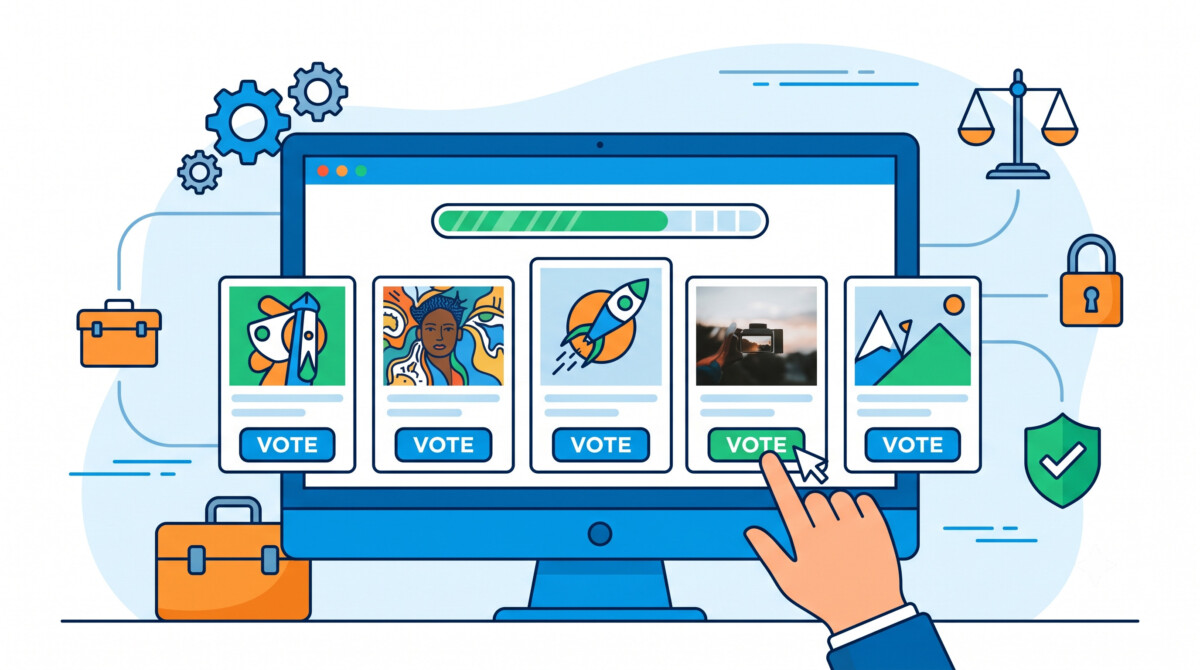
An online voting contest is a promotional campaign where participants submit an entry — a photo, video, caption, or nomination — and the public votes to pick the winner. Voting may decide the result entirely, or serve as one input alongside a judging panel. Entries usually live on a dedicated landing page or inside a third-party contest app, and voting happens through a click-to-vote widget with one vote allowed per verified email or account.
It’s worth separating this from a sweepstakes early, since the two get confused constantly and the legal rules differ: a contest picks a winner based on skill or merit, which includes public voting, while a sweepstakes is a random drawing. More on why that distinction matters in the FAQ below.
Email list growth. Most contest platforms gate entry behind an email address. Unlike a generic “subscribe to our newsletter” popup, people entering a contest already want something from you, so they’re far more willing to hand over contact details. A clean two-field entry form — name and email — converts far better than one asking for a phone number, birthday, and mailing address up front.
User-generated content (UGC). Photo and video contests hand you a library of authentic customer content, the kind of material that costs a lot to produce in-house and tends to perform better in ads than polished brand photography anyway.
Engagement and reach. Voting mechanics are inherently social. Someone who submits a photo will typically message 10-30 people asking for a vote. Each of those people sees your brand, and some percentage of them enter next time.
Product discovery. A “best of” customer-choice contest, or a bracket pitting your product line against itself, introduces people to items or services they didn’t know you offered.
Social proof. A contest with hundreds of entries and thousands of votes signals that real people care about your brand — useful on a landing page or in a sales conversation months later.
Photo contests. Entrants submit a picture, often tied to a theme (“show us your setup,” “best before/after”), and the public votes for their favorite. These are the most common format because they’re low-effort to enter and easy to browse.
Video contests. Same mechanic, higher production bar. Works well for brands with a younger audience or a product that benefits from demonstration (fitness, cooking, DIY).
Caption contests. You supply an image, entrants supply the punchline, the audience votes on the funniest or most creative. Cheap to run, good for pure engagement plays with no real prize budget needed.
“Best of” customer votes. Common in local business marketing — “Best Coffee Shop in [City],” “Reader’s Choice Awards.” Businesses or products are nominated, then voted on directly, often in bracket rounds.
Bracket-style tournaments. March Madness-style head-to-head matchups where entries face off in pairs and the top vote-getter advances. These generate repeat visits because people come back for each new round.
You generally don’t need to build a voting system from scratch. A handful of platform categories cover most use cases:
Dedicated contest and giveaway platforms. Tools such as Gleam, RafflePress, Woobox, and ShortStack are built specifically for running entries, voting, and random-draw giveaways. They typically offer entry forms, social-follow verification, vote counters, and some level of duplicate-entry detection out of the box. Feature sets and pricing vary and change often, so check current plans directly rather than relying on older reviews.
Social platform-adjacent tools. Instagram and Facebook contests are often built around likes, comments, or story polls — but treat that instinct with caution. Meta’s own Promotions Guidelines prohibit using native features like/comment/share as the entry or voting mechanism, and running a self-administered contest that way puts the page at risk. If you want a presence on Instagram or Facebook, run the actual voting through a compliant third-party app and use the social post to drive traffic to it, not as the vote itself.
Landing page builders with form/vote plugins. If you already run a website, a page builder with a voting or rating plugin gives you full control over layout, email capture, and integration with your CRM or email platform, at the cost of needing more setup.
Email marketing platform add-ons. Platforms such as Mailchimp and Klaviyo generally support signup forms that can double as contest entry points, letting you route entrants into a segmented list for follow-up campaigns — confirm the specific integration and any vote-counting limits with your plan before building around it.
Whichever category you pick, confirm it supports the specific rule you need most: one-vote-per-person enforcement. Not all tools handle this the same way, and it matters more than any other feature on this list.
1. Define your goal before anything else. Are you optimizing for email signups, UGC volume, or raw social reach? Each goal points to a different structure. Email growth wants a gated entry form; UGC volume wants a low-friction submission process; reach wants heavy sharing incentives.
2. Pick your platform based on that goal, using the categories above. Don’t default to whatever tool a competitor used — match the tool to what you’re actually trying to collect.
3. Set clear entry and voting rules. State exactly who can enter — age, location if relevant. Set entries-per-person and define how voting works: one vote per email, per day, or per IP. Then lock the end date and time, time zone included, so nobody can argue it later. Publish these rules on a page linked from the entry form, not buried in a footer.
4. Choose a prize that fits your audience. A prize too generic (a gift card to anywhere) attracts contest hunters who have no interest in your brand and will disappear after the giveaway. A prize tied to your product or a genuinely relevant experience attracts entrants who are more likely to become customers.
5. Build email capture and consent into the entry form. Ask for name and email at minimum. Include a separate opt-in checkbox for marketing emails: under GDPR, consent for entry and consent for marketing must be freely given and unbundled, with no pre-ticked boxes. US state privacy laws work differently — they mainly govern disclosure and opt-out rights rather than requiring this kind of upfront bundled consent — so don’t treat one checkbox as covering both regimes.
6. Promote across every channel you own — email list, Instagram, Facebook, TikTok, website banner — starting at least a week before launch, not the day it opens. Contests that launch quietly and get promoted only after entries stall rarely recover their momentum.
7. Track results as you go. Watch entry-to-vote ratio, email conversion rate, and where traffic is coming from. If one channel is driving disproportionate entries, shift more promotion budget there mid-contest rather than waiting until it’s over to notice.
A clean, fast-loading landing page with a clear CTA and a short entry form converts noticeably better than a cluttered page cramming in every sponsor logo and rule paragraph above the fold.
Public voting contests attract manipulation. Once real prize money or brand exposure is on the line, some entrants — or their overzealous friends — look for shortcuts: asking family members to vote from multiple devices, using browser extensions that refresh a vote count, or in more organized cases, paying a third-party service that claims to deliver bulk votes.
A market exists around this, with providers offering “verified vote” or “guaranteed vote” services to contest entrants. This isn’t a recommendation to use one — platforms such as Buyvotescontest.com are mentioned here so businesses running a contest understand this market exists, can recognize the pattern in their own vote data, and can build fraud protection in before it becomes a problem. Using a paid vote service typically violates the terms of service of whatever contest platform or social network is hosting the vote, and can get an entry disqualified or a page suspended. If you’re the one running the contest, treat this market as a threat model, not a resource.
Design your contest so inflated vote counts don’t matter, no matter who’s trying to game it:
Most of this is table stakes now — several of the contest platforms mentioned earlier ship basic CAPTCHA and duplicate-vote blocking out of the box, so you’re mainly deciding how strict to make your own rules on top of it. The point is to not skip it because “our audience wouldn’t do that.” The moment a contest has any real value attached, somebody will test the limits, and you want your rules and rejection process ready before it happens, not after a winner is already announced.
1. Vague or missing rules. “Winner announced next week” isn’t a rules page. Without clear terms — eligibility, voting method, tie-breaker process, disqualification criteria — you have no ground to stand on when someone disputes the result.
2. No fraud prevention plan. Launching a public vote with no CAPTCHA, no duplicate-vote check, and no plan for what happens if the leaderboard looks suspicious. Decide your fraud policy before the contest opens, not after entrants start complaining.
3. A prize that doesn’t match the audience. High-value generic prizes (cash, popular electronics) pull in contest-only audiences who will never buy from you. A prize connected to your product pulls in people already interested in what you sell.
4. Promotion that starts too late. A contest announced the same day it opens rarely builds momentum. Tease it in advance across your email list and social channels so entrants are ready on day one.
5. No follow-up plan. The contest ends, the winner is announced, and then nothing happens. The email list and UGC you collected are the actual long-term asset — have a welcome sequence and content plan ready before entries even open.
How long should an online voting contest run?
Two to three weeks is a common range. Long enough to build momentum through multiple promotion pushes, short enough that entrants don’t lose interest or forget to vote.
How do I stop the same person from voting multiple times?
Require a verified email or social login per vote, enforce it server-side, and add CAPTCHA plus IP monitoring to catch obvious duplicate patterns.
Can I run a voting contest directly through Instagram or Facebook likes and comments?
Not compliantly. Meta’s Promotions Guidelines prohibit using likes, comments, or shares as the entry or voting mechanism, and self-administered contests that ignore this risk page or account suspension. Use a third-party contest app and drive traffic to it from your social posts instead.
Do I need a lawyer to run a contest legally?
For a small giveaway, published clear rules usually cover you. For contests with significant prize values, requiring payment to enter or vote, or that run across multiple states or countries, a quick legal review is worth the cost — requiring payment alongside a chance element can push a promotion into illegal-lottery territory in some states, and rules around sweepstakes vary by jurisdiction.
How do I get people to actually vote once they enter?
Make voting shareable with one click, send a reminder email partway through the contest, and consider a small incentive, like a bonus entry into a secondary drawing, for entrants who bring in a set number of votes.
Should I require an email address to vote, or just to enter?
Requiring it at entry captures the most contact information. Requiring it again at vote time can reduce fraud but adds friction — test both approaches if list growth is your primary goal.
What’s the difference between a contest and a sweepstakes for legal purposes?
A contest picks a winner based on skill or merit, including votes, while a sweepstakes is a random drawing. US promotions law generally turns on three elements — prize, chance, and consideration — so a promotion combining a chance element with a required payment can risk classification as an illegal lottery in some states. Check your local regulations before choosing a format.
About the Author
Priya Nair has run contest and giveaway campaigns for nine years, mostly for DTC and local-service clients — three seasons managing a regional retailer’s “Customer Photo of the Year” vote, plus smaller Instagram bracket contests for boutique gyms and salons. She specializes in turning one-time entrants into long-term subscribers and customers.




