





Quick Decision Framework
- Who This Is For: Anyone who wants to start selling feet pics online and needs a clear, step by step process to go from zero to first sale, including complete beginners with no prior experience, no existing audience, and no professional photography equipment.
- Skip If: You are already making consistent monthly sales on FeetFinder and are looking to scale past $2,000 per month. This guide covers the foundation. The scaling strategy is a separate conversation.
- Key Benefit: A complete, stage aware framework for setting up your selling operation, choosing the right platform, pricing your content, protecting your identity, and making your first sale within 7 to 14 days.
- What You’ll Need: A smartphone with a 12MP or better camera, $14.99 for a FeetFinder Basic subscription, 2 to 3 hours for initial setup, and a 90-day commitment to evaluate results honestly.
- Time to Complete: 15 minutes to read; 2 to 3 hours to implement the setup steps; 7 to 14 days to reach your first sale with consistent effort.
The feet content market generated over $2.1 billion in global transactions in 2024. The creators capturing that revenue are not the ones with the most attractive feet. They are the ones who treat this as a real business from day one.
What You’ll Learn
- Why platform selection is the single most consequential decision you make before your first sale, and how to evaluate your options with honest criteria.
- How to build a FeetFinder profile that surfaces in buyer search results and converts profile visits into actual purchases.
- What pricing structure gives new creators the best chance of a first sale within 14 days without permanently undervaluing their content.
- How to protect your identity completely so your selling operation stays separate from your personal and professional life at every stage.
- When to expand beyond your first platform and what metrics tell you the timing is right for a multi-platform strategy.
The feet content market has a discovery problem that works in your favor. There are millions of buyers actively searching for this content every month, a $2.1 billion industry with verified transaction volume, and a competitive landscape dominated by generic make money online guides that treat this like a hobby rather than a business. The gap between what buyers are looking for and what most creators actually deliver is where serious income gets made.
This guide is built for creators who want to close that gap. Whether you are exploring this for the first time or you have been circling the idea for months without taking action, what follows is the complete operational framework for selling feet pics online in 2026: platform selection, account setup, content strategy, pricing architecture, identity protection, and the realistic timeline you should expect. For the full market context behind these numbers, including verified income data by creator tier and buyer demographic research, the complete guide to selling and buying feet pics online covers the landscape in depth.
What this guide does that most others do not: it writes for you at your actual stage. A creator in their first 30 days faces completely different decisions than a creator in month six. The guidance here is calibrated to where you are, not where the average reader might be.
Why Platform Selection Determines Everything
The single most consequential decision in your first 30 days is not what content you create. It is where you sell it. Platform choice determines your buyer access, your fee structure, your discovery mechanism, and your income ceiling at every stage of your operation. Most new creators make this decision based on name recognition rather than business logic, and it costs them weeks of momentum.
The feet content market in 2026 has five meaningful platforms. Understanding what each one actually does for a new creator is the foundation of a sound entry strategy.
FeetFinder is the largest dedicated marketplace in this category, with 8 million verified users and over $100 million in total buyer spend processed through the platform. Its core advantage for new creators is built-in buyer traffic. You do not need an existing social media following to make sales on FeetFinder because buyers come to the platform specifically looking for feet content. That traffic advantage is what makes the subscription fee worth analyzing rather than dismissing. At the Basic tier, you pay $14.99 per month plus a 20% commission on sales. The break-even point is $18.74 in monthly sales before you are profitable. For a creator who has never made a dollar in this market, reaching that threshold is achievable within the first 30 days with consistent effort and a properly optimized profile.
OnlyFans charges no monthly subscription and takes a 20% commission. The math looks better on paper, but the business reality is different. OnlyFans is a general adult content platform. You are competing for buyer attention against every other content category on the platform. Without an existing social media audience driving traffic to your profile, discovery on OnlyFans is nearly impossible. The platform is genuinely excellent for creators who already have a following. It is genuinely difficult for creators who are starting from zero.
Footly is a newer entrant with no monthly subscription fee and a TikTok-style algorithmic discovery feed. The discovery model is a real advantage for new creators who cannot afford monthly fees, and the reduced competition relative to FeetFinder is worth noting. The trade-off is a smaller buyer base and an unproven long-term track record. Footly’s content marketing actively positions against FeetFinder, which tells you something about how they see the competitive landscape. For creators who genuinely cannot absorb a $14.99 monthly fee while building toward first sales, Footly is a legitimate starting point. For creators who can absorb that fee, FeetFinder’s buyer volume is the stronger starting position.
FunWithFeet markets itself on a zero-subscription-fee model with creators keeping a higher percentage of sales. It serves specific creator situations well, particularly those prioritizing anonymity and a curated platform aesthetic. The buyer base is smaller than FeetFinder’s, and the discovery infrastructure is less developed. It is worth knowing about, not worth choosing as your primary platform if income speed is a priority.
Stock photography platforms including Shutterstock, Adobe Stock, and Getty Images represent a parallel revenue channel that most creators overlook entirely. Commercial buyers including footwear brands, foot care businesses, and wellness platforms need diverse feet imagery for advertising and editorial use. This commercial demand exists completely outside the foot fetish market and often commands higher licensing fees. The trade-off is a longer approval process and no guaranteed income. It is a supplementary channel, not a primary one, but it diversifies your revenue in ways that pure platform income cannot.
The recommendation for most new creators: start with FeetFinder as your primary platform. Build your operation there for 60 to 90 days. Once you are consistently generating $500 or more per month, evaluate whether adding a second platform makes sense for your specific situation.
Setting Up Your FeetFinder Account the Right Way
Most creators spend 20 minutes on account setup and then wonder why their profile is not converting. A properly built FeetFinder profile is a discovery asset. It surfaces in buyer search results, signals professionalism, and converts profile visits into sales. A poorly built profile does none of those things regardless of how good the content is.
The setup process has five components that actually matter: your username, your bio, your profile photo, your initial content upload, and your pricing structure. Each one is a business decision, not a personal expression exercise.
Your username is searchable. It should contain terms buyers actually use when searching: “feet,” “toes,” “soles,” or a niche descriptor that signals your content type. A username like SoftSoles_Jade or ArchAngel_Feet tells a buyer exactly what they are getting before they click your profile. A username like JenniferW2026 tells them nothing. If you are protecting your identity, this is also where you establish your creator persona. The username is the foundation of your brand. Choose it with the same care you would choose a business name.
Your bio should answer three questions in 150 words or fewer: what type of content do you create, what makes your content distinctive, and how does a buyer get what they want from you. Avoid vague language. “I love feet photography and custom requests” tells a buyer nothing useful. “I specialize in high-arch close-ups, natural nail aesthetics, and custom content with 24-hour turnaround” tells them exactly what they are buying and how fast they will get it. Specificity is the difference between a profile that converts and one that gets scrolled past.
Your profile photo should show feet, not your face. This is both an identity protection decision and a conversion optimization decision. Buyers on FeetFinder are there for feet content. A well-lit, visually appealing feet image in your profile photo signals immediately that you understand what the platform is for. For a detailed breakdown of how profile optimization affects your search ranking within FeetFinder’s algorithm, the guide to optimizing your FeetFinder profile for maximum visibility covers the mechanics in depth.
Your initial content upload should include a minimum of 10 to 15 photos before you go live. A profile with three photos signals to buyers that you are not serious. A profile with 15 well-organized photos across two or three themed albums signals a professional operation. Organize albums by content type: natural poses, nail art, outdoor settings, or whatever categories your content falls into. Buyers browse by category. Albums make your content easier to find and easier to purchase.
If you are just starting out, focus on getting your setup right before worrying about volume. If you are in month three and have been posting inconsistently, the profile optimization work is still worth doing. The platform rewards active, well-organized profiles regardless of when you built them.
Content That Actually Sells: What Buyers Are Looking For
The feet content market serves a more diverse buyer base than most new creators expect. Understanding who is buying and what they are buying is the foundation of a content strategy that generates consistent sales rather than sporadic ones.
The largest buyer segment is foot fetish enthusiasts. Academic research from the Kinsey Institute found that 14% of Americans have had a fantasy involving feet at least once, with 18% of heterosexual men and 21% of gay and bisexual men reporting foot-related interest. The University of Bologna’s research established that feet are the most common body part fetish globally, preferred by 47% of people with body part fetishes. This is not a fringe market. It is a large, active buyer base with specific preferences and real purchasing behavior.
What this buyer segment wants is diversity, specificity, and consistency. They are not all looking for the same thing. Some buyers prioritize arches. Others prioritize soles, toe rings, nail art, specific nail colors, or outdoor settings. The creators who earn the most from this segment are not the ones with conventionally “perfect” feet. They are the ones who have identified a specific niche within this buyer segment and serve it consistently. A creator who specializes in high-arch close-ups with natural nails builds a loyal buyer base faster than a creator who posts random content across every possible category.
Commercial buyers represent a second, often overlooked segment. Footwear brands, foot care businesses, pedicure salons, and wellness platforms all need feet imagery for advertising, product listings, and educational content. This commercial demand is entirely separate from the foot fetish market and often commands higher per-image prices because commercial licensing carries different value than personal use content. Stock photography platforms are the primary channel for reaching commercial buyers, but FeetFinder’s buyer base also includes commercial purchasers who source imagery directly from creators.
Content quality is the variable that separates creators who make consistent sales from those who do not. Quality in this context does not mean professional photography equipment. It means controlled lighting, clean presentation, and intentional composition. A smartphone photo taken in good natural light with a clean background outperforms a poorly lit DSLR shot every time. The guide to the best poses for feet photography covers the specific angles and compositions that perform best across buyer segments, and it is worth reading before your first shoot rather than after.
Foot care is a business investment, not a vanity exercise. Well-maintained feet photograph better, command higher prices, and generate better buyer reviews. A consistent foot care routine including regular moisturizing, exfoliation, and nail maintenance is the single most impactful investment a creator can make before spending money on equipment. Buyers notice the difference between maintained and unmaintained feet in every photo. Build the routine before the business, not after.
For creators in the exploration stage: start with what you have. Your existing smartphone and good window light are sufficient to test whether this market works for you. For creators in the active selling stage: the investment in a ring light ($20 to $50) and a phone tripod ($15 to $25) produces a visible quality improvement that justifies the cost within the first month of consistent sales. For creators scaling past $1,000 per month: that is when camera upgrades and professional editing software start delivering meaningful returns on investment.
Pricing Architecture That Gets You to Your First Sale
Pricing is where most new creators make their first significant strategic error. The instinct is to price low to attract buyers. The result is a race to the bottom that devalues your content, attracts the lowest-quality buyers, and makes it structurally impossible to reach a meaningful income level without working unsustainable hours.
The correct pricing strategy for a new creator is not the lowest possible price. It is the price point that is competitive within your tier while leaving room to grow. Here is what the market data actually supports for new creators in their first 90 days.
The new creator ranges above are starting points, not ceilings. Price at the lower end of your tier when you are building your first sales and reviews. Price toward the middle of your tier once you have 5 to 10 completed transactions and at least a few positive buyer interactions. Price at the top of your tier once you have a consistent review history and a recognizable niche.
Custom content is worth pricing separately from your catalog content from day one. Custom requests require your time, creative direction, and a specific turnaround commitment. They should cost more than catalog content regardless of your experience level. A new creator charging $50 to $75 for a custom request is not overcharging. They are correctly pricing for the additional value they are delivering. For a complete framework covering pricing psychology, tier architecture, and when to raise prices at each creator stage, the beginners guide to pricing feet pics for maximum profit covers the full strategic picture.
One pricing mistake worth naming directly: do not offer free content to attract buyers. It does not work. Buyers who receive free content rarely convert to paying customers, and it signals that your content is not worth paying for. Your first interaction with a potential buyer should be a transaction, not a sample. If a buyer will not pay your starting price, they are not your buyer.
For creators in the exploration stage, the goal in your first 30 days is one sale. Not $500 in revenue. One sale, at a price you set intentionally, from a buyer who found you through the platform. That first transaction is proof of concept. Build from there. For creators already in month two or three with zero sales, the issue is almost always profile optimization or content volume, not pricing. Lower prices do not fix a discoverability problem.
Identity Protection: The Non-Negotiable Foundation
Creator safety and privacy are not checklist items in this business. They are the foundation that every other decision rests on. A creator who has not thought through their identity protection before posting their first image has made a structural error that becomes harder to correct the longer they operate.
The good news is that complete anonymity is achievable with straightforward operational decisions. None of what follows requires technical expertise. It requires consistency.
Your creator identity starts with your username and extends to every piece of content you publish. Your creator name should have no connection to your real name, your professional identity, or any other online presence you maintain. This means no usernames derived from your real first name, no profile language that references your location, profession, or personal circumstances, and no content that includes identifying background elements like recognizable furniture, artwork, or outdoor locations specific to where you live.
Your photos should not include your face unless you have made a deliberate, informed decision to show it. This is not a safety recommendation with exceptions. It is the default operating position. Showing your face dramatically expands your exposure risk and is irreversible once content is published. Creators who choose to remain anonymous maintain that choice consistently from their first post. Creators who decide later that they want more anonymity often find that earlier content is already circulating beyond their control.
Tattoos, birthmarks, and other distinctive physical characteristics are identifying features. If you have visible tattoos, consider whether they appear in your content and whether they could identify you to someone who knows you in another context. This is not about hiding who you are. It is about controlling what information connects your creator identity to your personal identity.
Payment processing on FeetFinder routes through Segpay and Paxum, both of which are established adult content payment processors with privacy protections built into their systems. Your real name appears in payment processing records as required by financial regulations, but it does not appear on your public profile or in any buyer-facing information. Use a dedicated email address for your FeetFinder account that has no connection to your personal or professional email. Create this email before you create your account.
A VPN adds a layer of protection for creators who want to ensure their IP address is not associated with their account activity. This is a reasonable precaution, not a paranoid one. Many established creators use VPNs as standard operating procedure. It is worth setting up before you begin rather than adding it retroactively.
For creators concerned about scams specifically, the safety landscape on FeetFinder is meaningfully better than on unmoderated platforms because of mandatory ID verification for all users and PCI-compliant payment processing. That infrastructure does not eliminate all risk, but it substantially reduces the most common scam vectors. For a complete breakdown of scam patterns and how to avoid them, the guide to avoiding scams when selling feet pics covers every scenario in detail.
Your First 90 Days: A Realistic Timeline
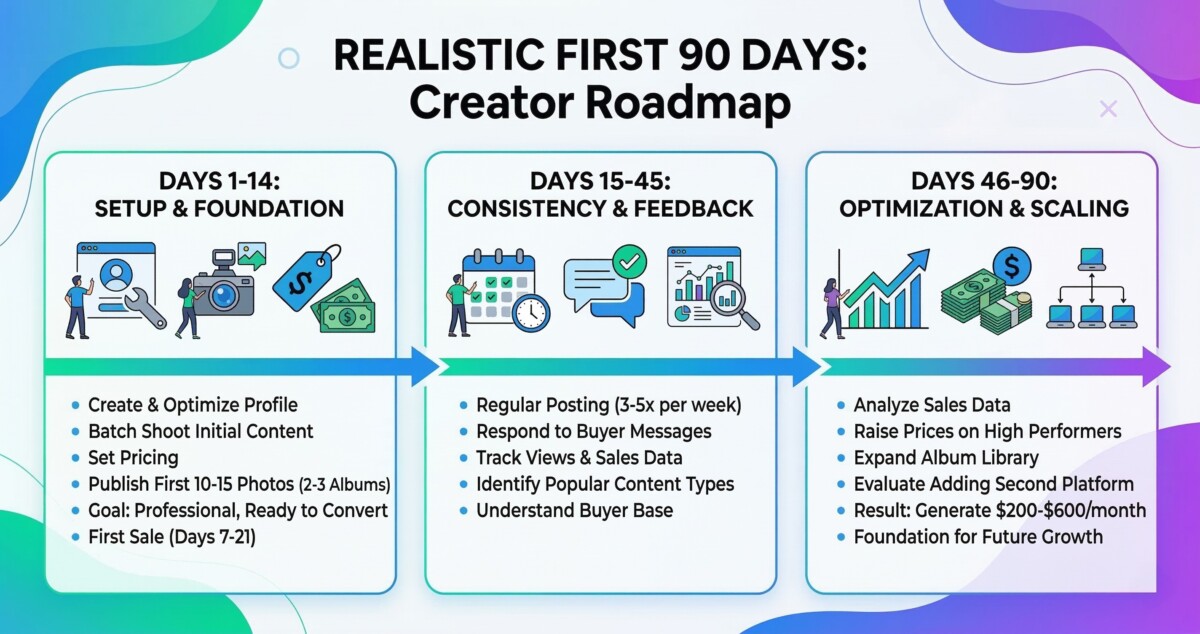
The most common reason new creators quit before making meaningful income is mismatched expectations. They expect results in week one, encounter the reality of building an audience from scratch, and interpret slow early progress as evidence that the market does not work. It does work. It works on a timeline that requires a 90-day honest evaluation, not a 14-day verdict.
Here is what a realistic first 90 days actually looks like for a creator who follows the framework in this guide.
Days 1 through 14 are setup and foundation. You create your account, build your profile, shoot your initial content batch, set your pricing, and publish your first 10 to 15 photos across two or three albums. Your goal in this period is not sales. It is a complete, professional-looking profile that is ready to convert buyers when they find you. Most creators who follow this approach make their first sale somewhere in days 7 to 21. The variance depends on content quality, profile optimization, and whether you are doing any off-platform promotion.
Days 15 through 45 are consistency and feedback. You are posting new content on a regular schedule (a sustainable starting cadence is three to five times per week), responding to buyer messages within 24 hours, and paying attention to which content types are getting views and which are converting into sales. This period is where you start to understand what your specific buyer base wants. The data is in your sales and your message requests. Pay attention to it.
Days 46 through 90 are optimization and early scaling. You have real sales data. You know which content types perform. You know your most common buyer requests. You raise your prices on content types that are selling consistently. You build out your album library in the categories that are working. You evaluate whether adding a second platform makes sense based on your current revenue and time availability. By the end of day 90, a creator who has followed this framework consistently should be generating $200 to $600 per month. That is not a life-changing number. It is proof of concept and the foundation for the next stage of growth.
For creators who are scaling past that initial stage and want to understand what separates creators who plateau at $500 per month from those who break through to $2,000 and beyond, the verified market data and income benchmarks from our 2026 statistics analysis provide the tier-by-tier breakdown of what distinguishes each income level.
If you are a Stage 3 or Stage 4 creator reading this guide because you want to tighten your fundamentals, the setup and pricing sections above apply to you too. The most common scaling problem for established creators is not strategy. It is profile optimization that was done quickly in the early days and never revisited. A profile audit against the criteria in this guide is worth doing at every stage, not just at launch.
When to Add a Second Platform
The multi-platform question comes up early for most new creators because platform marketing makes it sound like the answer to every income problem. It is not. For creators in their first 90 days, a second platform is almost always a distraction from the work of building a primary operation that actually functions.
The right time to add a second platform is when your primary platform is generating consistent monthly income, and you have documented demand that the primary platform cannot serve. That second condition matters as much as the first. Adding OnlyFans because you think you should is different from adding OnlyFans because you have buyers asking for subscription content that FeetFinder’s structure does not accommodate well.
The most logical second platform for most FeetFinder creators is either OnlyFans (for creators who want to build a subscription model with exclusive content) or stock photography platforms (for creators who want to pursue the commercial buyer segment). These two options serve different buyer segments with different content requirements and different income models. Neither is better in the abstract. Both are worth evaluating once your FeetFinder operation is stable.
What you are not doing when you add a second platform is starting over. Your content library, your pricing framework, your identity protection protocols, and your understanding of your buyer base all transfer. The incremental work of adding a second platform is meaningful but manageable for a creator who already has a functioning primary operation. It is overwhelming for a creator who is still trying to figure out the fundamentals.
Frequently Asked Questions
How do I sell feet pics online for the first time with no experience?
The fastest path from zero to first sale is a properly set up FeetFinder account with a minimum of 10 to 15 photos, a specific bio that describes your content type, and pricing in the $8 to $12 range for individual photos. You do not need professional photography equipment. A smartphone with good natural lighting and a clean background produces content that converts. The most common mistake first-time creators make is publishing too few photos and waiting for buyers to find them. Start with a full album, post new content three to five times per week, and respond to every buyer message within 24 hours. Most creators who follow this approach make their first sale within 7 to 21 days. The platform does provide buyer traffic, but it rewards active, well-organized profiles over sparse ones.
What platform is best for selling feet pics in 2026?
FeetFinder is the strongest starting platform for most new creators because it provides built-in buyer traffic from 8 million verified users who are specifically looking for feet content. You do not need an existing social media following to make sales there, which is a meaningful advantage over general platforms like OnlyFans where discovery without an existing audience is very difficult. FeetFinder charges $14.99 per month at the Basic tier plus a 20% commission on sales. The break-even point is $18.74 in monthly sales. For creators who genuinely cannot absorb a monthly fee while building toward first sales, Footly’s no-subscription model is a legitimate alternative with a smaller but growing buyer base. OnlyFans makes the most sense for creators who already have a social media following they can direct to their profile.
How much can I realistically earn selling feet pics as a beginner?
New creators in their first 1 to 3 months typically earn $150 to $500 per month based on platform data and creator income analysis from multiple sources. That range assumes consistent posting (three to five times per week), a properly optimized profile, and active engagement with buyer messages. Creators who post sporadically or skip profile optimization often earn nothing in their first 60 days. The income ceiling rises significantly with time and consistency: established creators at 6 to 12 months typically earn $1,000 to $3,000 per month, and the top 10% of creators earn $1,000 to $3,000 per month with strong niche positioning and loyal buyer bases. The top 1% earn $5,000 to $12,000 per month. These are real numbers, not marketing claims, but they describe a range that requires treating this as a business rather than a passive income experiment.
How do I protect my identity when selling feet pics online?
Complete anonymity is achievable with four consistent decisions: use a creator name with no connection to your real identity, create a dedicated email address for your selling account before you sign up, avoid showing your face or identifying features including tattoos and distinctive birthmarks in any content you publish, and use a VPN for an additional layer of IP address protection. On FeetFinder specifically, your real name appears only in payment processing records as required by financial regulations, not in any buyer-facing profile information. Your profile, your username, and your content can be entirely separate from your personal identity. The key is making these decisions before your first post, not after. Identity protection decisions made retroactively are harder to implement and may not cover content already published.
How long does it take to make your first sale selling feet pics?
Most creators who follow a structured setup approach make their first sale within 7 to 21 days. The variance depends primarily on three variables: profile completeness (creators with 15 or more photos in organized albums convert significantly faster than those with fewer), pricing alignment (pricing within the $8 to $12 range for individual photos as a new creator reduces buyer hesitation), and posting consistency (creators who add new content three to five times per week build algorithmic visibility faster than those who post once and wait). Creators who skip profile optimization or price too high for their experience level often take 30 to 60 days or more for a first sale. The 90-day mark is the honest evaluation point: if you have followed the framework consistently for 90 days without a sale, something specific in your setup needs to be diagnosed and corrected rather than abandoned.
