
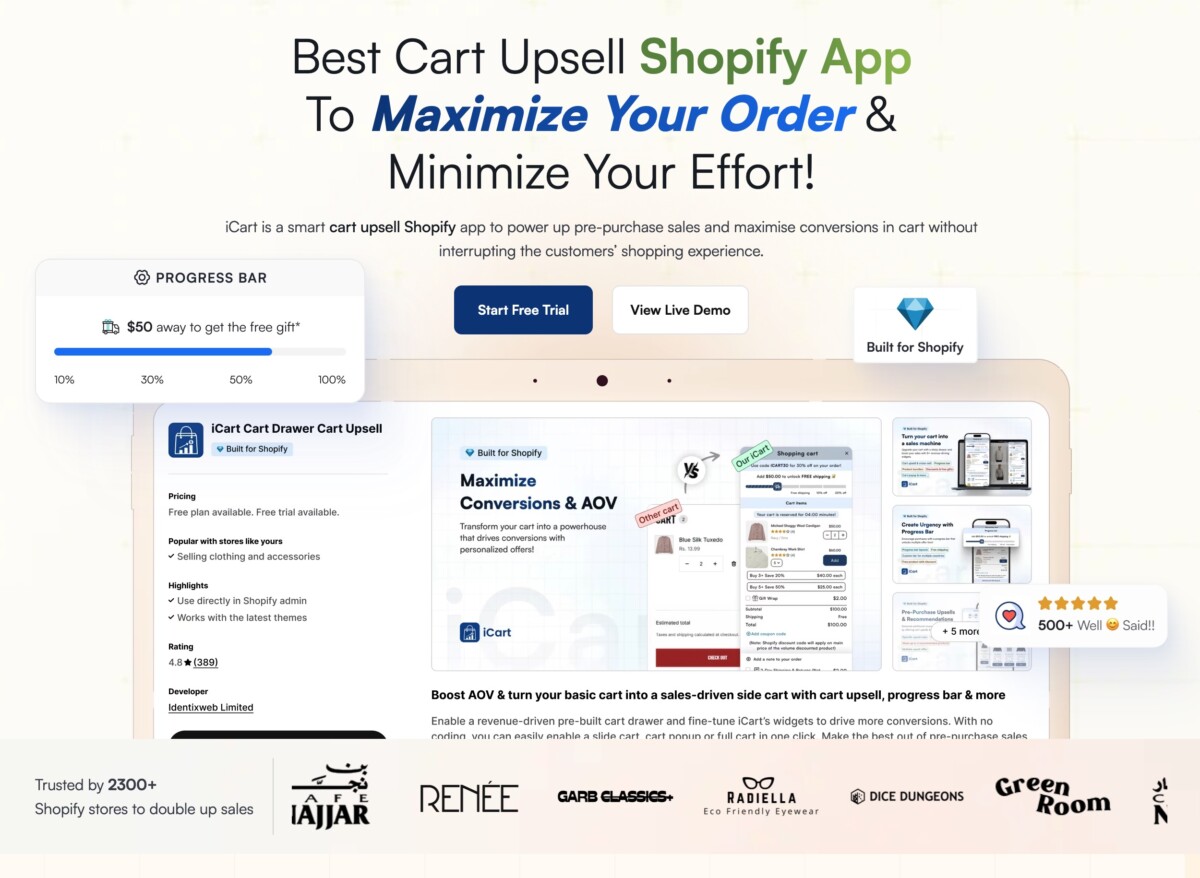
Why limit yourself? In-cart is where most of your customers are.
Here’s why iCart really stands out in a crowded app market. It’s not just an app; it’s a strategic lever for growth. Take Avanchy, for example. By simply implementing iCart, they saw a 73% revenue increase in just 30 days. That’s not a theoretical gain; that’s real money in the bank. Faisal Khan, the owner, emphasized how quickly and intuitively he could create upsell options for his store’s side cart. That ease of use means faster implementation and quicker results for you.
When considering a new tool, we always look for applications that have a direct and measurable impact on your company’s P&L and customer experience. iCart scores high on both. It empowers you to:
In essence, iCart turns your standard cart into a strategic profit center. It’s a tool built for scaling brands that understand the value of optimizing every step of the customer journey.
You’re running a scaling Shopify brand, pushing hard on marketing, product development, and customer experience. But here’s what I’ve seen consistently among even high-performing stores: your standard shopping cart is likely leaving a significant amount of money on the table. It’s a silent drain on your revenue, impacting your average order value (AOV) and overall profitability.
Imagine your customers are running a 100-meter dash, and just before the finish line, they hit a wall. That’s often what a basic cart feels like. It lacks the dynamic engagement and personalized nudges that turn browsing into bigger buys. Simply put, basic carts are built for transactions, not for accelerating growth the way a scaling brand needs.
Most standard Shopify carts are just functional, not strategic. They just hold items. For scaling brands, that’s a huge missed opportunity to increase how much each customer spends. We’re talking about a direct impact on your bottom line without needing to acquire new customers.
Think about it this way: are you actively suggesting complementary products or upgrades right when your customer is already committed to buying? My experience tells me many aren’t. Standard carts rarely offer smart, data-driven product recommendations or incentives at critical moments. When you don’t present relevant upsells and cross-sells, you’re missing out on easy additions to the cart. These small, thoughtful suggestions can collectively lift your AOV significantly.
Another big one: volume discounts or bundles. If a customer is buying one item, why aren’t you making it easy and appealing for them to buy two or three, or to grab a related bundle at a slight discount? This isn’t about being pushy; it’s about adding value for the customer while increasing your revenue. Many default carts simply don’t have the built-in flexibility to present these offers seamlessly.
Beyond AOV, standard carts often suffer from various friction points that cause customers to abandon their purchases altogether. This directly impacts your conversion rate, meaning all the effort and money you spend getting traffic to your store goes to waste.
One common issue is a lack of transparency about costs. Customers hate surprises. If shipping, taxes, or other fees only appear late in the checkout process, almost half of them (48%, according to recent data) will leave their cart right there. Your standard Shopify cart rarely provides a dynamic, running total with all costs included upfront.
Then there’s the clunky user experience. How many steps does your checkout have? Is it asking for too much information too soon? Are customers forced to create an account before they can even complete their purchase? These seemingly small hurdles add up. Forcing account creation, for example, makes 24% of shoppers abandon their carts. People want a quick, smooth path to purchase, especially on mobile. If your cart isn’t optimized for a fast, intuitive mobile experience, you are losing sales.
Finally, think about trust and payment options. Does your basic cart clearly display security badges? Are you offering all the payment methods your customers expect, like Shop Pay, PayPal, or Buy Now, Pay Later options? If not, you’re creating friction and doubt. Many customers will bail if they don’t see their preferred payment method or if they have security concerns. These are basics, yes, but often overlooked in the quest for flashier marketing.
Ultimately, choosing the right tool comes down to understanding your specific needs and growth objectives. iCart offers significant advantages for brands looking to maximize their in-cart revenue. But take an honest look at your current strategy and technical comfort level. This will guide you toward the best decision for your bottom line.
Alright, let’s bring this home. We’ve talked extensively about the challenges with standard Shopify carts and how iCart steps in to address them. Now, it’s time for a clear, no-nonsense verdict. When you’re running a scaling brand, every single tool in your stack needs to justify its existence by contributing directly to your growth. This section will help you decide if iCart deserves a spot in your toolkit.
When I look at a tool like iCart, I’m thinking about strategic advantages and potential hurdles. You need to know both sides of the coin to make an informed decision for your operation.
Here are the key advantages I see that make iCart a powerful player:
Naturally, no tool is perfect. Here’s where you might hit some snags:
When you’re choosing an app, it’s not just about what one tool does; it’s about how it fits into your overall strategy compared to other options. Let’s look at iCart against some key alternatives.
The deciding factor here really comes down to where you see the biggest opportunity for immediate revenue lift and how much control you want over the in-cart experience.
If your primary goal is to maximize Average Order Value by optimizing the pre-purchase and in-cart experience, iCart is a strong contender. It gives you the tools to grab that extra sale right when the customer is most engaged. It’s built for those crucial seconds before a purchase is finalized.
Many brands run a great product page experience, then let their standard cart fall flat. If that sounds like your operation, iCart directly addresses that problem. It makes the cart a revenue-generating center, not just a holding pen for items.
As discussed throughout this review, the difference between a standard Shopify cart and an optimized one goes beyond just additional features—it’s a fundamental shift in how you drive revenue and grow your brand. You’re already working hard to attract customers; iCart helps you capitalize on every stage of their journey, especially those crucial moments before purchase.
Based on my experience and insights from interviewing numerous scaling founders on the EcommerceFastlane podcast, it’s clear that today’s most successful brands are the ones optimizing the entire customer lifecycle—including transforming the cart into a profit center. iCart enables dynamic upsells, cross-sells, and strategic discounts in one place, addressing the problem of “money left on the table.” By presenting genuinely relevant product suggestions, you make it easier for customers to buy more—without feeling pressured—leading to increased Average Order Value (AOV) and higher conversion rates.
Here are your actionable takeaways:
My final word to you, Steve, is this: for Shopify-powered brands scaling past seven figures, or those ambitious brands with a clear path to get there, iCart offers a robust solution to a persistent problem. It transforms a basic transactional step into a powerful, revenue-generating engine.
Your next action: I encourage you to leverage your affiliate link and start your iCart trial. Connect your Shopify store. Then, as a focused experiment, try to set up one in-cart upsell for a best-selling product and measure its impact over a week. This direct experience will clearly show you iCart’s potential for your brand.
Excellent request, Steve. Creating a strong FAQ section is crucial for maximizing information gain and building trust. Here are 10 frequently asked questions and their answers, crafted to be clear, authoritative, and helpful for your audience, while keeping that 8th and 9th-grade reading level in mind.
Most Shopify carts are just holding areas, not revenue engines. iCart flips the cart into a profit center by adding targeted upsells, cross-sells, and clean discounts inside a sticky side cart. Brands report fast, measurable lifts; one example saw a 73% revenue increase in 30 days after launching curated in-cart offers. The big win is focus: you boost AOV and reduce abandonment without stacking multiple apps or sending shoppers on a detour.
iCart turns your cart into a focused sales channel that raises AOV and cuts friction where it matters most. By unifying upsells, cross-sells, and discounts in one fast, clean cart experience, you capture more revenue from the traffic you already have. Start with a few relevant offers, keep the logic simple, and track AOV and cart-to-checkout every week. The brands that win treat the cart like a strategic lever, not a passive step, and iterate fast on what converts. If you do that, the lift shows up in days, not months.

iCart is a Shopify app that transforms your basic shopping cart into an interactive sales tool. It helps your store by adding smart upsell, cross-sell, and discount offers directly within the cart. This process makes it easy for customers to add more items, which increases your average order value and overall revenue.
A standard Shopify cart just holds items; it is not designed to actively boost sales. It often misses opportunities for recommending more products or showing clear costs upfront. For scaling brands, this means leaving money on the table and possibly losing customers due to a clunky experience.
iCart increases customer spending by showing them relevant upsell and cross-sell offers right in their cart. For example, if a customer adds a phone, iCart might suggest a case or screen protector. It also makes it simple to offer volume discounts, encouraging customers to buy more items at once.
Yes, iCart can significantly reduce abandoned carts. It keeps the cart visible and easy to use, and it can show all costs, like shipping and taxes, early in the process. This transparency prevents surprises at checkout, a common reason why shoppers leave without buying.
iCart offers extensive customization options to ensure it perfectly matches your brand. You can easily change fonts, colors, layouts, and even how offers appear. This helps create a seamless shopping experience that builds customer trust and keeps your brand looking professional.
While iCart has many features, its drag-and-drop editor makes it quite user-friendly. For smaller teams, the key is to focus on a few high-impact offers first. The app design helps you get started quickly with your main goals, like improving an abandoned cart flow.
iCart uses tiered pricing, meaning you pay based on your store’s order volume. This model helps smaller brands start without high costs and scales with you. However, for stores experiencing very rapid growth, it’s important to monitor your order volume to anticipate potential price increases between tiers.
The biggest strategic advantage of iCart is its ability to provide a complete in-cart optimization solution. Instead of using separate apps for upsells, cross-sells, and discounts, iCart brings them all together. This creates a unified and powerful selling experience right where the customer is about to make a purchase.
You should consider iCart if your main goal is to maximize sales within the shopping cart itself through comprehensive upsell and cross-sell features. If you are more focused on post-purchase offers after the sale is complete, or purely AI-driven product page recommendations, other apps like ReConvert or Frequently Bought Together might be better specific alternatives.
A great first step, Steve, is to start your iCart trial and connect it to your Shopify store. Then, take about 30 minutes to set up just one specific upsell offer for a popular product. For example, if a customer adds a specific hat, offer a matching scarf. Monitoring the results from this single test will quickly show you the clear impact and value iCart can bring to your brand.





