

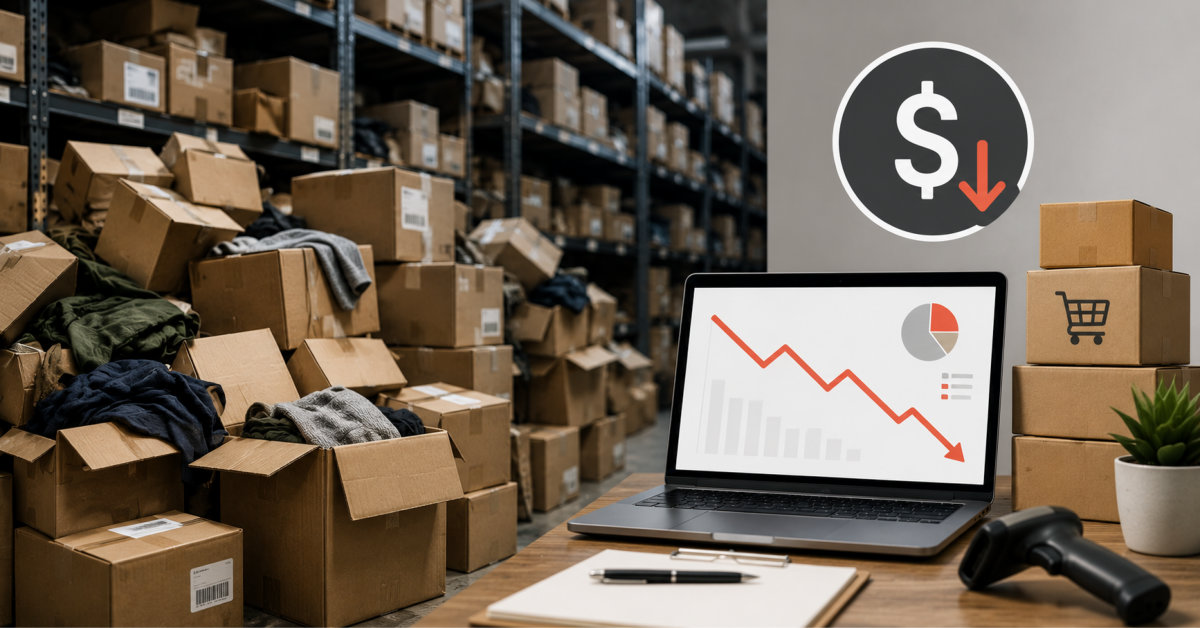
Inventory overflow quietly erodes ecommerce profit by slowing fulfillment, raising labor costs, and tying up working capital, so treating storage as a strategic lever—not an afterthought—becomes essential once order volume starts to scale.
Overflowing shelves are not just a space problem; they are a compounding tax on every pick, pack, and purchasing decision your ecommerce business makes.
For many eCommerce businesses, growth is exciting until inventory starts taking over every available inch of space. What begins as a few shelves in a garage or small office can quickly turn into stacked boxes, overflowing packing stations, and work areas that are no longer efficient. While increasing sales are always welcome, expanding inventory creates operational challenges that many merchants underestimate.
Inventory management is about much more than knowing how many products are available. The way inventory is stored, organized, and accessed directly affects fulfillment speed, order accuracy, labor costs, and customer satisfaction. Businesses that address storage challenges early are often better prepared to scale without sacrificing efficiency or profitability.
Many successful online stores begin with lean operations. Founders often pack orders themselves, monitor inventory manually, and store products wherever space is available. This approach works well in the early stages because order volumes remain manageable and every item is easy to locate.
As sales increase, however, those same systems begin showing their limitations. New product lines require additional shelving, larger purchase orders consume valuable workspace, and packaging materials start competing with inventory for storage. Employees spend more time moving boxes to reach products, receiving shipments becomes increasingly complicated, and routine fulfillment tasks take longer than they should. The challenge is not simply having more inventory. It is that business operations gradually become less efficient as available space disappears.
Moving into a larger warehouse is not always the right solution. For many growing businesses, the issue is temporary or seasonal overflow rather than a permanent lack of capacity. Leasing additional commercial space often involves significant long-term costs that may not match the company’s current stage of growth.
In situations like these, flexible storage solutions can provide valuable operational support. Creekside Storage offers secure self-storage facilities throughout East Tennessee with multiple unit sizes, convenient drive-up access, and online rentals that make it easy for businesses to expand storage capacity when needed. Companies can safely store excess inventory, promotional materials, seasonal merchandise, office furniture, packaging supplies, or trade show equipment without overcrowding their primary fulfillment areas.
Keeping slower-moving inventory separate from products that are picked every day helps create a more organized workspace. Employees spend less time searching for products, receiving shipments becomes easier, and fulfillment operations can continue running efficiently even as inventory levels increase.
When businesses evaluate storage expenses, they often focus only on monthly rent. In reality, poorly organized inventory creates a much broader range of costs that are not always immediately visible.
Crowded workspaces slow down picking and packing. Employees are more likely to make mistakes when products are difficult to access or stored in temporary locations. Overstocked shelves increase the likelihood of damaged merchandise, while limited workspace makes receiving new shipments more time-consuming. Small inefficiencies repeated hundreds of times each week gradually reduce productivity and increase labor costs.
Perhaps even more importantly, excessive inventory ties up working capital. Money invested in products sitting on overcrowded shelves cannot be used for marketing campaigns, new product development, technology investments, or other growth initiatives.
Very few online retailers experience consistent demand throughout the year. Holiday shopping, back-to-school promotions, special product launches, and seasonal sales all create periods when inventory requirements increase significantly.
Keeping those additional products inside the primary warehouse year-round often reduces efficiency during slower months. Instead, many businesses benefit from separating seasonal inventory until demand begins to rise. This allows fulfillment teams to maintain organized picking areas while ensuring additional stock remains readily available when required.
Businesses that prepare for seasonal fluctuations well in advance are also better positioned to respond to unexpected demand without creating unnecessary operational bottlenecks.
Modern inventory management software has transformed the way eCommerce companies operate. Barcode scanning, warehouse management systems, automated purchasing, and real-time inventory tracking provide valuable visibility across increasingly complex operations.
However, technology works best when supported by an efficient physical environment. Even the most advanced software cannot eliminate delays if employees struggle to move around crowded storage areas or spend valuable time locating products.
Warehouse organization, clear labeling, logical product placement, and sufficient storage capacity remain essential components of an effective fulfillment operation. Digital tools improve decision-making, but physical organization determines how efficiently those decisions can be executed.
Successful inventory management begins long before products arrive at the warehouse. Sales forecasts, supplier lead times, promotional calendars, and storage capacity should all influence purchasing decisions.
The U.S. Census Bureau regularly publishes retail inventory and inventory-to-sales data that businesses use to understand broader market trends and evaluate inventory levels across different sectors. These insights help illustrate why balancing available stock with expected demand is often more effective than simply ordering larger quantities whenever sales increase.
Regular inventory reviews also help identify slow-moving products, unnecessary stock accumulation, and opportunities to reorganize fulfillment operations before space becomes a limiting factor.
One of the biggest operational mistakes growing businesses make is planning only for today’s sales. Every successful marketing campaign, product launch, or marketplace expansion has the potential to increase inventory requirements almost overnight.
Businesses that regularly evaluate their storage capacity before reaching critical limits are better equipped to handle growth without disrupting daily operations. Instead of reacting once shelves become overcrowded, they can implement storage strategies gradually while maintaining efficient workflows. This proactive approach allows merchants to focus on serving customers instead of constantly solving operational problems created by limited space.
Inventory is a sign of opportunity, but only when it is managed effectively. As eCommerce businesses expand, storage should become part of a broader operational strategy rather than an afterthought. Well-organized inventory, flexible storage options, and efficient fulfillment processes all contribute to faster shipping, lower operating costs, and a better customer experience.
By addressing storage challenges before they begin affecting productivity, merchants create stronger foundations for sustainable growth. Instead of allowing inventory overflow to become an obstacle, businesses can turn effective storage planning into a competitive advantage that supports long-term success as demand continues to grow.




