
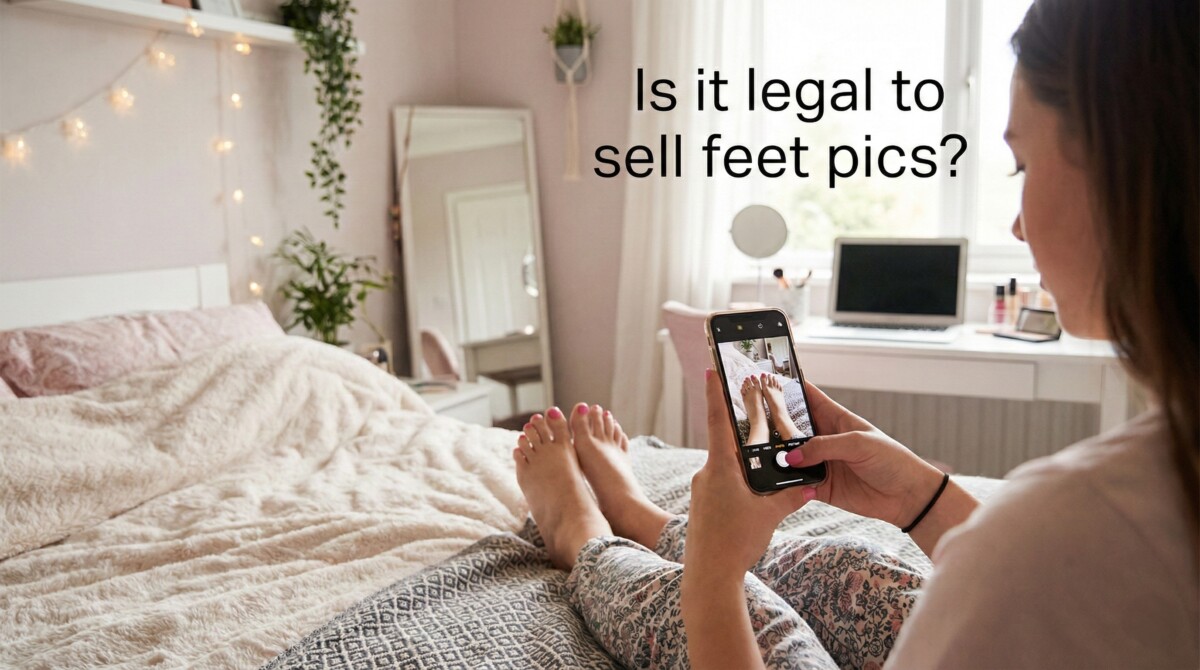
Selling feet pics is legal in all fifty US states and across the UK, the EU, Canada, and Australia. No statute prohibits it. Three obligations decide whether you stay compliant: your age, your tax reporting, and how you take payment.
The content itself is almost never the legal problem. How you handle your age, your income, and your payment method is where creators actually get into trouble.
Most women researching this question are not worried about being arrested. They are worried about something quieter, which is starting an income stream that turns out to carry a catch nobody mentioned. The reassuring part is that the law here is settled and it is not complicated. The parts that genuinely cost people money are not the photographs at all. They are age verification, tax reporting, and how the money moves.
This guide is written for the woman who is still deciding, and for the one who has just started and wants to make sure her setup is clean. It covers what is true, what the real obligations are, and where the actual exposure sits, so the decision gets made with clear eyes rather than on the strength of a headline.
Selling feet pictures is legal in all fifty US states, and no federal or state statute prohibits it. Feet are not classified as an explicit body part, so images of them are treated like any other digital product sold online, in the same category as a stock photo or a downloadable file. The transaction is ordinary commerce rather than a regulated activity.
The reason this holds up comes down to how obscenity is defined in US law. Courts assess obscenity using the three-part test from the Supreme Court decision in Miller v. California, which asks whether the work appeals to a prurient interest, depicts sexual conduct in a patently offensive way, and lacks serious literary, artistic, political, or scientific value. Standard non-explicit photographs of feet do not meet that bar. They are not legally obscene, which is precisely why this marketplace operates openly and why platforms can process payments for it through legitimate financial channels.
Legality here is conditional, though, and the conditions are where your attention belongs. The law is indifferent to the fact that the subject is feet. It cares that everyone involved is a consenting adult, that the content stays non-explicit enough to sit outside adult content classification, and that you treat the money as taxable income. Stay inside those three conditions and you are running a small legitimate digital business. Cross any of them and the legal picture changes quickly, in ways no amount of careful business setup will undo. The rest of this guide takes each condition in the order that carries the most consequence.
Every person selling or appearing in feet content must be at least 18, with no exception and no gray area anywhere in the world. This is the line that converts a legal activity into a serious crime, and it is the reason the entire category is built around identity verification rather than trust. Content involving anyone under 18, including someone who appears only incidentally in the frame, is illegal in every jurisdiction that matters.
This is also why the verification step you will encounter at signup is a feature rather than an obstacle. Every credible platform requires a government-issued ID before you can list anything, including OnlyFans, Fansly, FunWithFeet, and FeetFinder, which requires secure ID verification confirming every seller is over 18 before a profile goes live. A platform that lets you sell without ever checking identification is not being convenient. It is operating outside the compliance standard that protects you, and that is a marketplace you do not want your name or your income attached to.
Two practical points follow. Only adults can appear in your content, which means no friends, no family members, and nobody whose age you cannot personally verify, ever, regardless of how the request is framed. And keep your own verification records alongside the platform’s confirmation, because being able to demonstrate that you were verified is part of protecting yourself if a question ever arises. The age rule is absolute by design. Once you accept that, the rest of the legal landscape is genuinely manageable.
Money earned selling feet pics is taxable self-employment income from the first dollar, whether or not any platform ever sends you a tax form. The IRS treats it the way it treats any gig or freelance income. Its Gig Economy Tax Center states that income earned through a digital platform must be reported even when it is part-time, supplemental, or undocumented. Your obligation to report does not depend on receiving paperwork.
This is where a great deal of published content on this subject is now out of date, including older material on this site. Many guides still say platforms issue a 1099-K once you cross $600 in earnings. That threshold was repealed. Under the federal tax law passed in July 2025, the 1099-K reporting threshold returned to its long-standing level of more than $20,000 in gross payments and more than 200 transactions, and both conditions must be met before a platform is required to issue the form. Most creators in this market will never receive one, and every one of them still owes tax on what they earn.
Three things follow practically. First, treat yourself as a sole proprietor: net self-employment earnings of $400 or more trigger self-employment tax at 15.3 percent and a Schedule C at filing time. Second, keep records from day one, because ordinary business expenses (a share of your phone bill, a ring light, editing software) are deductible against that income, and reconstructing them a year later is far harder than logging them as you go. Third, if the income becomes consistent and you expect to owe more than $1,000, quarterly estimated payments apply rather than a single bill in April. This is general information rather than tax advice for your situation. What you keep after the platform fee, which is the number your tax records actually start from, is covered in our breakdown of what feet pics sell for and what lands in your account.
Your largest practical risk is not the content, it is taking payment through a mainstream app that bans adult-oriented transactions and can freeze your balance without warning. This is the trap that catches more new creators than anything else in the category, and it has nothing to do with whether selling feet pics is legal. It is private company policy, enforced privately.
PayPal, Venmo, Cash App, and Stripe all prohibit sexually oriented or adult-oriented goods and services in their terms of use. PayPal’s Acceptable Use Policy lists certain sexually oriented materials and services among prohibited transactions, and the other three draw a comparable line. The driver is chargeback and liability exposure rather than morality, which is why enforcement is aggressive and rarely negotiable. Creators who accept direct payment through these apps routinely report held funds, reversed charges, and closed accounts, often after the content has already been delivered. You can lose the money and the account in the same afternoon.
The fix is unglamorous and effective: use the platform’s native payout system and never move a transaction off-platform, no matter how a buyer frames the request. Dedicated marketplaces route payments through processors built for this category, so your earnings sit inside a system that will not flag you for doing exactly what you signed up to do. Keeping every transaction on-platform also removes the most common scam pattern in this market, where a buyer proposes an off-platform payment method specifically because it has no dispute protection. Our guide to selling without getting scammed covers the warning signs and the exact responses that end those conversations.
A reputable dedicated platform handles most of your legal compliance automatically, through mandatory age verification and native payment processing. This is the quiet advantage of a marketplace over a setup improvised across social media accounts. The two areas where creators carry the most legal exposure, age and payments, are the two the platform takes off your plate entirely.
Age verification confirms every seller is a verified adult, which removes the single largest legal risk in the category before you upload anything. Native payment processing keeps your earnings inside a compliant system and away from the mainstream apps that ban this work. On-platform messaging lets you deal with buyers without surrendering your real email address, phone number, or any other detail that could identify you. Taken together, choosing a serious platform and following its rules puts you well inside the law without needing to think about it daily.
The inverse is the warning sign worth memorizing. If a platform does not require identification, processes payments in ways that feel improvised, or nudges you toward transacting off-site, it is not protecting you, and the entire compliance burden has quietly moved onto you without anyone saying so. That makes platform choice a legal decision as much as a financial one, and it is worth treating with the same seriousness you would give the pricing question.
Selling feet pics is legal across the UK, the EU, Canada, and Australia, under the same two conditions that apply in the United States: be a verified adult and report your income. The subject matter is no more restricted in these markets than it is in the US, which is why reputable platforms operate internationally. The differences sit in tax administration and in how strictly age checks are enforced at signup, not in whether the activity is permitted.
Two specifics are worth knowing. The UK has tightened age assurance duties on platforms hosting adult or adult-adjacent user content under the Online Safety Act, with those duties taking effect in July 2025, which in practice means a more thorough signup process rather than a restricted activity. And in every country listed, your earnings are taxable in your home jurisdiction on the same principle that applies in the US, with different thresholds and different filing mechanics. Outside these markets, a number of countries do restrict adult-adjacent content considerably more tightly, so confirm your local rules before you start rather than assuming the US answer travels.
Legality protects you from prosecution, but it does not protect your identity, your images, or your income, and those you protect yourself. This is the gap between “is it legal” and “is it safe,” and it is where the practical work of running this properly actually sits.
Start with your images, because they are your property. The moment you take a photo it is your copyrighted work, and the most common way creators lose value is redistribution, where a buyer or a scraper passes around content someone should have paid for. Watermarking every preview image is the simplest defense and the one experienced sellers treat as non-negotiable. Then protect your identity with the same discipline: a pseudonym unrelated to your legal name, a dedicated email address, and a profile that does not show your face, distinctive tattoos, or any background detail that reveals where you live. Strip location metadata from every photo before uploading, and keep conversations inside the platform’s messaging system rather than moving to a personal number.
Then protect your income by treating it as a business from the first sale, with a simple record of what came in, what you spent, and which platform paid you. That single habit makes filing straightforward and gives you an honest picture of what is actually working, which most creators do not have. If anonymity is the deciding factor for you, and for many new creators it is, our guide to how anonymous selling actually works in practice covers the specific settings and routines that keep a creator account and a real life fully separate.
Checking the legal ground before committing, separating the money from day one, and keeping records nobody is asking you for yet are not feet-selling skills. They are the administrative spine of any small business, and they are what makes the difference between an income that stays clean and one that becomes a problem two filing seasons later. If you want to see where that groundwork leads, we mapped the four stages of building something online, including the $400 self employment threshold most people miss at the very first stage.
Yes, selling feet pics is legal in all fifty US states and across most major markets, provided you are at least 18 and report the income. Feet are not classified as an explicit body part, so photographs of them are treated as ordinary digital content rather than regulated adult material. The legality is conditional on three things: everyone in the content is a verified adult, the content stays non-explicit, and earnings are treated as taxable income. Meet those and you are running a legitimate small digital business. The legal risk in this category almost never comes from the photographs. It comes from ignoring the age rule, skipping the tax reporting, or using a payment method that bans this work.
Yes, this income is taxable self-employment income and you must report it whether or not a platform sends you a form. Net earnings of $400 or more trigger self-employment tax at 15.3 percent and a Schedule C at filing time. For 2026 the federal 1099-K threshold is more than $20,000 in gross payments and more than 200 transactions, after the previously planned $600 threshold was repealed in July 2025, which means most creators in this market will never receive one. That paperwork rule does not change the obligation. Keep records of every payout from day one, deduct legitimate business expenses, and speak to a tax professional once the income is consistent.
Yes, every reputable platform requires a government-issued ID confirming you are at least 18 before you can list anything. This reflects the one absolute legal line in the category, which is that all content must involve verified adults. FeetFinder, OnlyFans, Fansly, and FunWithFeet all require identity verification at signup. Treat it as protection rather than as a privacy cost: verification is what keeps the marketplace free of minors and of most scammers, and it removes the largest legal risk in the niche before you upload a single photo. A platform that lets you sell without ever checking identification is a serious warning sign, because the compliance burden has silently moved onto you.
Yes, because anonymity toward buyers and identity verification toward the platform are two separate things. The platform confirms your age using your ID, and that information stays with the platform and its payment processor rather than being shared with buyers. To a buyer you appear only as a display name. To stay both anonymous and compliant, use a pseudonym, a dedicated email address, and a profile that hides your face and any identifying detail, keep all communication inside the platform’s messaging system, and strip location metadata from your photos before uploading. Your legal identity stays private while your account stays verified. The two goals reinforce each other rather than competing.
Selling feet pics is legal, but taking payment through PayPal or Cash App violates their terms of service and can get your account frozen. PayPal, Venmo, Cash App, and Stripe all prohibit sexually oriented or adult-oriented transactions and enforce those rules aggressively because of chargeback and liability exposure. Creators who accept direct payment through these apps routinely report held funds, reversed charges, and permanent closures, sometimes after content has already been delivered. The activity is not illegal; the payment company is private and can simply refuse to process it. Use the platform’s native payout system and never move a transaction off-platform, regardless of how a buyer asks.




