


Most Shopify merchants think their Klaviyo flows are underperforming because of weak copy or bad timing. The real culprit is usually invisible: the browser killed the cookie before Klaviyo could connect the shopper to a profile.
Here’s a pattern I’ve seen repeat itself across dozens of Shopify merchants. They’re doing $500K to $1.5M annually. They have Klaviyo set up, flows running, a decent list. Their email program generates revenue, but the numbers feel low. Browse abandonment converts at 1.2%. Abandoned cart is at 2.8%. They’ve A/B tested subject lines, adjusted timing, redesigned the templates. Nothing moves the needle meaningfully.
The conversation eventually turns to data. How many of your site visitors are actually getting identified and entering those flows? Most merchants don’t know. When we dig in, the answer is usually somewhere between 20 and 40% of the visitors who take an action that should trigger a flow. The other 60 to 80% are invisible to Klaviyo, not because the flows are broken, but because Safari killed the cookie before Klaviyo could connect the session to a known profile. If you’ve built out a full lifecycle marketing strategy in Klaviyo and your flow revenue still feels low relative to your traffic, this is almost always the root cause.
Kluvos is a tool built specifically to close that gap. It sits between your Shopify store and your Klaviyo account, using server-side tracking and probabilistic identity matching to identify more of the visitors who are already taking high-intent actions on your site. This review covers what it actually does, who it genuinely serves, where it falls short, and how it compares to the alternatives worth evaluating.
Kluvos is an identity resolution and event recovery platform for Shopify merchants that enriches Klaviyo data by capturing customer events that browser-based tracking misses. It is not an email service provider, a Klaviyo replacement, or a popup tool in the traditional sense. It is data infrastructure that sits between your Shopify store and your existing marketing stack, with the specific job of making sure more of the events happening on your site actually reach Klaviyo in a form that triggers your automated flows.
The platform does three things. First, it uses server-side tracking to send first-party events from your Shopify backend directly to Klaviyo, bypassing the browser cookie restrictions that cause Safari’s Intelligent Tracking Prevention to expire tracking data after 7 days. Second, it uses a combination of deterministic and probabilistic identity resolution to match returning visitors to known Klaviyo profiles even when the browser cookie has been cleared or expired. Third, it offers a popup product that captures email and SMS opt-ins and feeds those identities directly into the same data pipeline, increasing the pool of identified visitors from the first session.
The company positions this as “identity and event infrastructure,” which is accurate. The value is not in the interface you look at every day. It’s in the events that flow into your Klaviyo account and the flows that trigger as a result.
Kluvos is the right fit for Shopify merchants doing $100K to $2M annually who are already running Klaviyo and have abandoned cart and browse abandonment flows in place, but are not seeing the flow performance their traffic volume should produce.
Best fit: Merchants running paid traffic (Meta, Google, TikTok) who are investing in acquisition but losing a significant portion of those visitors before Klaviyo can identify them. The ROI math works most clearly when you’re paying to drive traffic and then losing 60 to 70% of the recovery opportunity because Safari expired the cookie. Brands doing 500 to 3,000 orders per month are in the sweet spot where Kluvos’s per-session identification adds enough incremental flow revenue to produce a clear 10x return on the subscription cost.
Not a fit: Merchants who haven’t built their Klaviyo flows yet. Kluvos amplifies existing flow infrastructure. If your abandoned cart flow doesn’t exist or sends one generic email, adding more identified visitors to it won’t move revenue meaningfully. You need the flows working first. Also not a fit for merchants not yet on Klaviyo, or for brands whose primary email issue is deliverability, list hygiene, or campaign design. Kluvos does not solve those problems.
Requires: An active Klaviyo account with at least browse abandonment and abandoned cart flows configured. A Shopify store (this is Shopify-specific; Kluvos does not appear to support other platforms). Enough monthly order volume (illustrative benchmark: 300 or more orders per month) for the identity resolution layer to produce statistically meaningful improvement within the 30-day trial window.
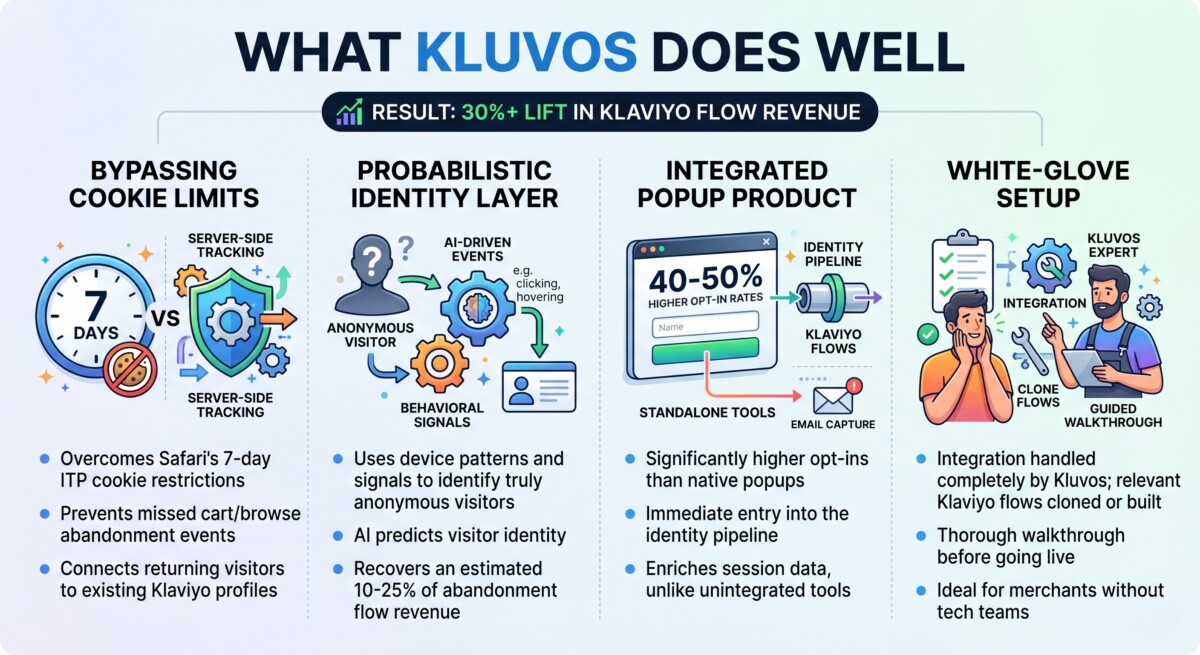
Kluvos consistently produces a 30% or greater lift in Klaviyo flow revenue for merchants at the right stage, driven by a meaningful increase in the number of identified visitors who enter abandoned cart and browse abandonment sequences.
The mechanism is real and well-documented. Safari’s Intelligent Tracking Prevention limits cookie-based tracking to 7 days, which means any visitor who returns to your store more than a week after their last identified session appears as a new anonymous visitor to Klaviyo. Studies suggest 60 to 70% of cart abandonment events are missed because of this. Kluvos’s server-side tracking layer bypasses this by maintaining persistent server-side identifiers that don’t expire when the browser clears cookies. When a visitor returns and takes an action, Kluvos can match that session to a known Klaviyo profile and fire the appropriate event.
The probabilistic identity layer is the second meaningful strength. For visitors who are genuinely anonymous (no prior identification, no email click, no login), Kluvos uses device patterns and behavioral signals to generate what they call AI-driven events in Klaviyo. This is the more speculative layer, and Kluvos is appropriately honest that it’s probabilistic rather than deterministic. The claimed recovery rate from this layer is 10 to 25% of revenue from abandonment flows. That’s a meaningful number if accurate, and the merchants who have publicly commented on the tool (including NutSac’s CMO, who describes five-figure monthly profit generation) suggest the probabilistic layer is doing real work.
The popup product is stronger than it looks at first glance. The claim of 40 to 50% higher opt-in rates compared to native Klaviyo popups is notable, and the mechanism makes sense: Kluvos popups feed directly into the same identity pipeline, meaning a new opt-in immediately becomes an identified profile that can enter flows from the first session. That integration between opt-in capture and the identity layer is genuinely differentiated from standalone popup tools like Privy or Justuno, which collect the email but don’t enrich the surrounding session data.
White-glove setup is a meaningful operational advantage, particularly for merchants without a dedicated tech team. Kluvos handles the integration, clones or builds the relevant Klaviyo flows, and walks the merchant through what was done before anything goes live. For a $300K brand without a developer on staff, that matters.
Kluvos does not support multi-destination data routing, which makes it a limited choice for merchants who need their enriched event data to flow to platforms beyond Klaviyo and Meta.
This is the most consequential limitation for growth-stage merchants building out a more sophisticated first-party data stack. Competitors like Elevar route server-side event data to 40-plus marketing destinations including GA4, TikTok, Pinterest, and Segment. Littledata connects to GA4, Meta, and several additional platforms with deep subscription tracking support. Kluvos, as of April 2026, is primarily focused on the Klaviyo enrichment use case with Meta as the secondary destination. If you’re a merchant trying to improve GA4 data accuracy, fix TikTok attribution, or build a first-party data layer that feeds multiple ad platforms simultaneously, Kluvos is not the tool for that job.
The probabilistic identity layer carries uncertainty that Kluvos’s own marketing understates. The 10 to 25% revenue recovery claim from the probabilistic matching layer is plausible, but probabilistic matching means some percentage of those events will be wrong. A visitor flagged as a returning known customer who is actually a different person in the same household will receive a personalized abandoned cart email for products they never looked at. Kluvos does not publish data on false positive rates, and the privacy-first framing on their site (they explicitly state they do not add people to your list who haven’t opted into your brand) suggests they’re aware of this tension. Merchants with highly privacy-conscious audiences or in regulated categories should think carefully about how much probabilistic matching they’re comfortable with.
The pricing model is revenue-based for the core product plus impression-based for popups, which means the total cost is not fully predictable at the start of a month. A merchant doing $1.5M annually pays $129 per month for the core platform. If they’re also running popups at 100,000 impressions per month, that’s an additional $200 per month. The total is still modest relative to the claimed ROI, but the dual-billing structure adds administrative friction and makes it harder to budget cleanly.
Kluvos is also a relatively young platform with a small customer base compared to Elevar (6,500-plus D2C brands) or Littledata (2,000-plus Shopify brands). The social proof available is thin: a handful of named testimonials, no published case studies with verifiable before/after data, and no presence in the major Shopify app marketplaces as of this writing. For merchants who rely on community validation and peer reviews before adopting new infrastructure, the lack of a broad review base is a real friction point.
Kluvos starts at $129 per month for the core identity resolution and event recovery platform, with pricing scaling based on annual revenue, plus a separate impression-based fee for the popup product at $0.002 per impression ($2 per 1,000 impressions). Pricing as of April 2026.
Value at early stage ($0 to $100K annual revenue): The ROI math is difficult to justify at this stage. A merchant doing $100K annually with 300 to 500 orders per month will see real improvement in flow trigger rates, but the incremental revenue recovered may be $200 to $500 per month. At $129 per month for the core platform, the return is marginal and the 30-day trial is the right way to test it before committing.
Value at growth stage ($100K to $2M annual revenue): This is where Kluvos produces the clearest ROI. A merchant doing $500K annually with a functioning Klaviyo setup and paid traffic driving 1,000 or more sessions per day is losing a meaningful volume of flow triggers to cookie expiration. If Kluvos recovers even 15% of those missed events and the average flow email converts at 2%, the incremental monthly revenue at a $60 average order value is well above the $129 monthly cost. The 10x minimum ROI claim is plausible and in some cases conservative at this stage.
Value at scale ($2M to $10M annual revenue): At this stage, Kluvos is worth evaluating but should be compared seriously against Elevar, which starts at $150 per month and offers substantially broader data routing capabilities. If your primary need is Klaviyo enrichment and you’re not building a multi-platform first-party data infrastructure, Kluvos remains cost-effective. If you’re building toward a more sophisticated data stack, Elevar’s broader destination support may be worth the price premium.
The two tools most directly comparable to Kluvos for Shopify merchants focused on Klaviyo enrichment and server-side event recovery are Elevar and Littledata, with Elevar being the stronger alternative for merchants who need multi-destination data routing and Littledata being the stronger choice for merchants whose primary pain point is GA4 data accuracy rather than Klaviyo flow performance.
The honest summary: if your core problem is that your Klaviyo flows aren’t firing for enough of your site visitors and you want a tool that’s focused entirely on solving that problem with white-glove setup, Kluvos is the most targeted solution in this space. If you want a broader data infrastructure layer that routes events to 40-plus destinations and you have the budget and technical appetite for a more complex platform, Elevar is the more capable tool. If GA4 accuracy is your primary pain point and Klaviyo enrichment is secondary, Littledata is the right starting point.
For Shopify merchants doing $100K to $2M annually who are running Klaviyo and investing in paid acquisition, Kluvos is worth the 30-day trial, and the ROI math is real enough that most merchants in that range will convert to paying customers after seeing the flow data.
I haven’t run Kluvos personally on a live store, but the problem it’s solving is one I’ve watched create revenue leaks for merchants at this stage consistently. The Safari ITP issue is not theoretical. When I’ve dug into Klaviyo flow performance with merchants and traced back why browse abandonment is triggering for only 25 to 35% of the visitors who take a qualifying action, cookie expiration is almost always a significant contributor. Kluvos’s server-side approach to fixing that is technically sound, and the testimonials from named merchants with specific revenue claims (NutSac’s CMO describing five-figure monthly profit generation is a specific, verifiable claim) suggest the product is delivering real results.
What gives me pause is the thinness of the independent evidence base. Elevar has case studies with verifiable numbers from brands like Glossier, Vuori, and ColourPop. Littledata has 2,000-plus Shopify brands and published case studies. Kluvos has a handful of testimonials on their homepage and no presence in the Shopify App Store as of this writing. For a tool that’s asking you to trust it with your identity resolution infrastructure, that’s a meaningful gap. The 30-day free trial with full setup support is the right answer to that gap: let the data in your own Klaviyo account tell you whether the product works before you commit.
If you’re a $500K to $1.5M Shopify brand running Klaviyo and Meta ads, and your browse abandonment flow is triggering for fewer than 40% of the sessions that should qualify, start the trial. The downside is 30 days of Kluvos’s team doing free work on your account. The upside is discovering that a meaningful portion of your existing traffic is recoverable without spending another dollar on acquisition. If you want to understand how Kluvos fits into a broader first-party data strategy for your Shopify store, the Fueled.io review covers what a more comprehensive approach looks like at the $2M-plus stage.
Skip it if you’re pre-Klaviyo, under $100K, or primarily trying to fix GA4 data problems. Those are different tools for different problems.
Kluvos adds a server-side tracking layer between your Shopify store and Klaviyo that captures customer events (product views, add-to-cart, checkout started) even after Safari’s 7-day cookie limit has expired. It uses a combination of deterministic matching (when a visitor logs in or clicks an email link) and probabilistic matching (device and behavioral signals for anonymous visitors) to connect more sessions to known Klaviyo profiles, which means more visitors enter your abandoned cart and browse abandonment flows. Merchants report an average 30% lift in Klaviyo flow revenue after integrating Kluvos.
Klaviyo’s Extended ID, announced in late 2024, extends native identity tracking for up to one year using Klaviyo’s first-party identity graph, and it is included at no additional cost for paying Klaviyo customers. Kluvos adds probabilistic identity resolution (matching anonymous visitors using device patterns and behavioral signals) and a connected popup product that feeds new opt-ins directly into the identity pipeline from the first session. The two tools address overlapping problems from different angles: Klaviyo Extended ID improves native tracking for known profiles, while Kluvos focuses on recovering events for visitors who have never been identified or whose cookies have been cleared. Merchants using Kluvos alongside Klaviyo Extended ID may see additive benefit, though the degree of overlap depends on what percentage of your traffic is returning known visitors versus genuinely anonymous new sessions.
No. Kluvos explicitly states it does not add contacts to your Klaviyo list from third-party data aggregates or cold records, and does not email people who have not opted into your brand. The identity resolution layer works only with visitors who have previously interacted with your store or marketing, and the probabilistic matching layer generates events for visitors who have taken a high-intent action on your site (like adding to cart) rather than cold sourcing identities from external databases. This aligns with Klaviyo’s own consent-based data model and is important for list health and deliverability.
Kluvos’s own FAQ states that additional Klaviyo data typically appears within minutes of integration, and that meaningful flow performance improvement (targeting a 30% lift) is typically visible within the first 30 days. The identity resolution layer compounds over time as Kluvos builds a more complete picture of your returning visitor base, so results tend to improve beyond the initial 30-day window. Using the Kluvos popup product alongside the core identity layer accelerates results by increasing the pool of identified visitors from the first session.
Kluvos pricing as of April 2026 has two components. The core platform is priced based on annual store revenue: $129 per month for stores doing $100K annually, scaling upward from there. The popup product is priced on impressions at $0.002 per impression ($2 per 1,000 impressions), billed separately. Both products include a 30-day free trial with no commitment. An important note: popup impressions are counted only when a popup is actually shown to a user, not on every page view, which keeps the popup cost more predictable than it might appear at first glance.
Kluvos is not specifically built for subscription commerce and does not appear to offer the recurring order tracking that tools like Littledata and Elevar provide for brands using ReCharge or Skio. If your primary data problem is attributing subscription revenue accurately across platforms or tracking recurring orders in GA4 and Meta, Littledata is the more purpose-built solution. If your primary problem is Klaviyo flow performance (including for subscription-triggered flows), Kluvos may still add value, but evaluate it alongside Littledata rather than treating them as mutually exclusive.
Kluvos is built specifically for Shopify and integrates with Klaviyo as its primary marketing destination, with Meta as a secondary destination for ad signal enrichment. It works best for merchants whose core retention channel is email and SMS via Klaviyo and whose primary paid acquisition channels are Meta and Google. Merchants with more complex multi-platform data needs (TikTok, Pinterest, Segment, GA4 as a primary analytics destination) will find Elevar’s broader destination support more appropriate for their stack.





