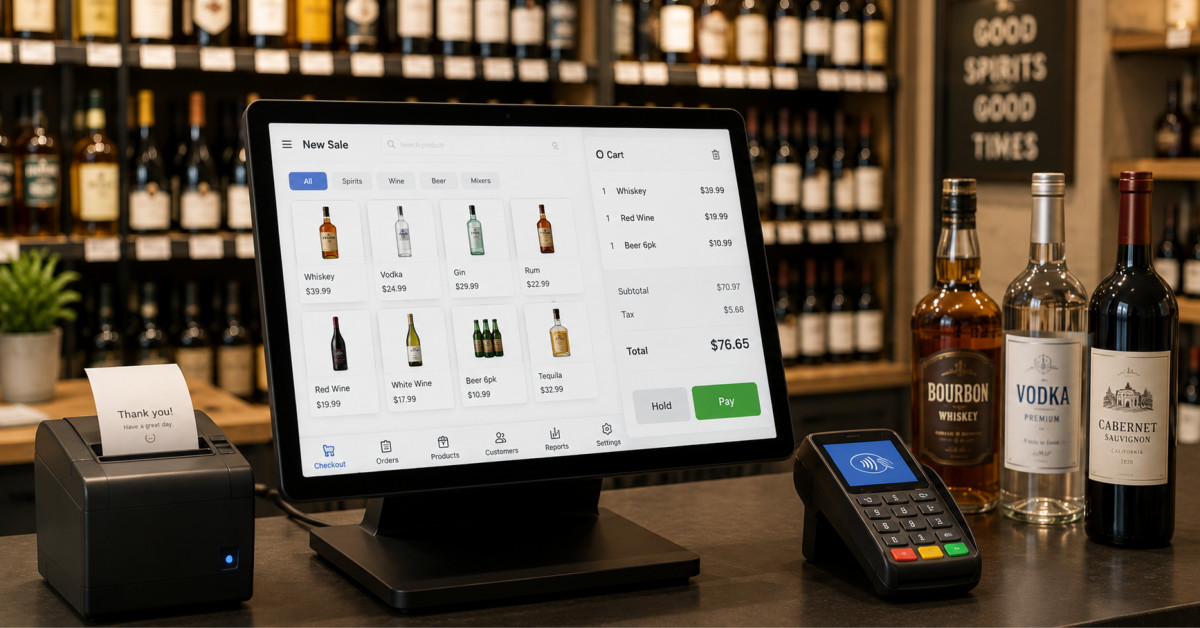
A liquor store POS with integrated payments is valuable when it reduces reconciliation, supports compliant age verification, keeps bottle and case inventory accurate, and makes card costs visible. The best option is not automatically the one with the lowest software fee; it is the one with the strongest total-cost model for your transaction volume, payment mix, and compliance risk.
A liquor-store POS is not just a checkout tool. It determines what happens when an ID is scanned, a case is split into bottles, a card is tapped, a settlement closes, and a regulator asks for an audit trail.
A liquor store lives on a strange combination of numbers: high transaction volume, small baskets, and margins that a single bad fee structure can quietly erase. That pressure is not abstract. According to the National Retail Federation, U.S. businesses paid roughly 198 billion dollars in card swipe fees in 2025, and the NRF describes those fees as most retailers’ highest operating cost after labor. For a store selling cases of beer and single bottles all day, the point-of-sale system and the way it handles card payments is not a back-office detail. It is one of the two or three decisions that set the ceiling on profit.
Most buying guides answer the question “which POS is best” with a ranked list of brands. That is the wrong starting point. The better question is how a system moves money, who carries the compliance burden, and what the total cost of a swipe actually is once you add everything up. This guide works through that mechanically, so that by the end, you can judge any liquor-store POS on its merits rather than its marketing.
Start with the phrase itself, because vendors use it loosely.
Integrated payments means card processing is built directly into the point-of-sale software, so one company supplies both the checkout and the payment rail, billed together, with a single support line and automatic reconciliation between sales and settled funds. When a cashier rings up a bottle, and the customer taps a card, the transaction, the receipt, and the deposit all live in the same system. There is no separate terminal to reconcile at close.
The alternative has a clumsier name and a real advantage. Processor-agnostic, sometimes called third-party or bring-your-own-processor, means the POS software is not tied to one payment company, so the merchant can shop competing processors and switch to whichever offers better interchange handling or a lower markup. The trade-off is coordination: two vendors, two contracts, and reconciliation that is not always automatic.
Neither model is universally better. A high-volume store that hates back-office work often prefers integration for the single reconciliation. A price-sensitive owner with time to negotiate often prefers processor freedom. The rest of this guide is really about which of those two describes you.
You cannot compare payment options without understanding the largest line item inside every card fee.
Interchange is the portion of a card-processing fee that the merchant’s bank pays to the cardholder’s bank on every transaction, set by the card networks, and it forms the non-negotiable floor under whatever your processor charges on top. When someone quotes you a processing rate, part of it is interchange that no processor controls, and part is the processor’s own markup, which is the only part that competition actually moves.
The numbers matter for a liquor store more than for almost any other retailer, because of the volume-and-margin problem. The Federal Reserve reports that in 2024, the average debit-card interchange fee across all networks was about 34 cents per transaction, or 0.73 percent of the transaction value. Credit interchange runs higher. Now picture a store ringing hundreds of small tickets a day: a fixed per-transaction component hits a 12 dollar bottle far harder, in percentage terms, than a 120 dollar case. Thin margins plus high transaction counts plus small average tickets is exactly the profile that makes card cost a first-order problem rather than a rounding error.
This is why two offsetting tools show up constantly in liquor retail.
Dual pricing, also described as cash discounting, is a checkout model that shows one price for cash and a slightly higher price for cards, so the card-processing cost is passed to the customer who chooses to pay by card rather than absorbed by the store. Done correctly it can neutralize much of the processing expense. The catch is that surcharging and cash-discount rules vary by state and by card-network policy, so the implementation has to be built to disclose the difference properly at the register. A POS that supports this compliance is doing real work; one that merely allows a manual price override is not.
Every store that accepts cards inherits a security obligation, whether the owner knows it or not.
PCI compliance refers to meeting the Payment Card Industry Data Security Standard, the set of security requirements for anyone who stores, processes, or transmits cardholder data, maintained by the PCI Security Standards Council and required by the major card brands. The PCI Security Standards Council describes itself as a global forum that develops these account-data protection standards, and the standard is incorporated into the compliance programs of Visa, Mastercard, American Express, Discover, and JCB.
Here is the practical part that is rarely spelled out. When payments are integrated, and the POS vendor uses modern point-to-point encryption and tokenization, card data often never touches the store’s own systems in readable form, which can narrow the store’s PCI scope and reduce how much of the standard the owner has to prove directly. With a loosely coupled third-party setup, the boundaries are less clean, and more of the burden can land on the merchant. Neither model removes the owner’s legal responsibility. It shifts how much of the technical work a vendor absorbs on the store’s behalf. Ask any POS vendor plainly how their payment setup affects your PCI scope, and be skeptical of anyone who cannot answer.
For alcohol retail, payment is only one of three things that have to happen in the same two-second moment at the counter.
The register also has to confirm the customer is of legal age, and it has to decrement the correct unit of inventory, which is rarely a simple “one item sold.” A strong liquor-store POS scans the barcode or the driver’s license to prompt an age check, records that the check happened, and can flag underage or expired IDs before the sale completes. The compliance value is not just the block itself. It is the audit trail: a record that the store performed the check, which matters when a license is on the line.
Inventory is the other half. Liquor stores buy by the case and sell by the case, the pack, and the single bottle, so the system has to break a case into sellable units and reduce stock at the right level on every sale. When payment, age verification, and case-level inventory all fire from one scan, the checkout is fast, and the records reconcile. When they live in three disconnected tools, staff improvises, and the gaps show up later as shrinkage, failed audits, or stockouts. This is the strongest argument for a category-built system over a general retail POS: the alcohol-specific logic is native, not bolted on.
Several widely marketed systems will appear in any search, and it helps to place them accurately before deciding.
Clover is a flexible, hardware-forward POS platform used across many retail and hospitality categories, typically sold through banks and processors, with app-based extensions rather than deep native liquor features. Square for Retail is known for fast setup, transparent flat-rate pricing, and its own integrated processing, which suits smaller or newer stores that value simplicity over case-level alcohol tooling. Lightspeed Retail is a strong inventory-centric platform with its own offering, Lightspeed Payments, aimed at higher-end and multi-location retailers. NCR is a long-established enterprise-scale provider whose systems tend to fit larger operations.
The honest read: these are capable, general-purpose systems, and some run liquor stores acceptably. But most treat alcohol as one vertical among many. Their integrated payment options are often processor-locked, and their compliance and case-breaking features may depend on add-ons. That is not a disqualification. It is a reason to test the alcohol-specific workflow and the payment terms on your own transactions before you commit.
Now the central decision is framed the way an owner should frame it.
The usual pitch treats integrated versus processor-agnostic as a binary: lock into one vendor’s payments for convenience, or keep your processor freedom and do more reconciliation yourself. In practice, the most useful systems refuse that binary. This is where a POS built specifically for wine and liquor earns its keep. WinePOS, for example, offers integrated payment processing for liquor stores at one flat rate, built into the same checkout that runs the ID scan for the age check and decrements the bottle from a case, while still letting an owner keep an existing processor if they prefer. That hybrid stance, integrated when you want the single reconciliation and the plug-and-play terminals, or bring-your-own when you want to shop rates, sits exactly on the wedge this whole decision turns on. The system also supports surcharge and cash-discount pricing so a store can offset card fees, accept the major card brands with daily settlement, and support 50-state and PCI-aligned practices without claiming to replace the owner’s own legal responsibility.
The broader lesson is not about one brand. It is that the integrated-versus-agnostic question is a false choice when a vendor is confident enough in its own processing rate to also let you leave. Use that as a test. Ask any provider whether you are allowed to bring your own processor. A yes signals a vendor competing on merit rather than lock-in, which is exactly what a thin-margin, high-volume store should want on the other side of the table.
The advertised monthly software fee is the smallest number in the equation, and focusing on it is how owners overpay.
Build the real comparison from these parts:
To compare two systems honestly, take a representative day of your own sales, average ticket, and card mix included, and run the total processing cost through each rate model. A one-dollar difference in monthly software is noise. A quarter-point difference in effective processing rate, across tens of thousands of transactions a year, is real money. Price the swipe, not the subscription.
Both can work. Integrated payments reduce back-office reconciliation and often tighten PCI scope because card data flows through one encrypted system. A separate processor gives you the freedom to shop around for rates. The strongest position is a system that offers integration but still lets you bring your own processor, so you are not forced to choose convenience over price permanently.
Flat-rate charges one blended percentage on every card sale, which is simple but hides the underlying cost. Interchange-plus passes through the network interchange at cost and states the processor’s markup separately. For a high-volume store, interchange-plus is usually easier to audit and often cheaper, because you can see exactly what the processor is adding.
Cash-discount and surcharge programs are widely used, but the specific rules vary by state and by card-network policy, including how the price difference must be disclosed at the register. The mechanism itself is legitimate. The safe path is a POS that implements it with proper disclosure rather than a manual workaround, and a quick check of your own state’s rules.
Look for driver’s license or ID scanning that prompts an age check and logs it, case-and-single inventory that decrements the right unit on each sale, and reporting that produces an audit trail. The block on an underage or expired ID matters, but so does the record proving the check occurred, since that documentation is what protects the license.
Only part of it. Interchange, set by the card networks, is a floor no processor can remove. The processor’s markup is the negotiable piece, and surcharge or cash-discount programs can shift some of the remaining cost. Realistic savings come from auditing the markup and using offset tooling, not from expecting any vendor to erase the interchange floor.
A liquor store’s payment setup is a margin decision disguised as a technology decision. Judge a POS by how it handles the mechanics that repeat thousands of times a month: the true cost of a swipe once interchange and markup are separated, who carries the PCI burden, whether age verification and case-level inventory fire from the same scan, and whether you are allowed to shop processors instead of being locked in. Systems built specifically for wine and liquor tend to answer those questions better than general-purpose platforms, because the alcohol logic is native rather than added later. Price the swipe, insist on processor freedom, and the ranking of brands mostly sorts itself out.