

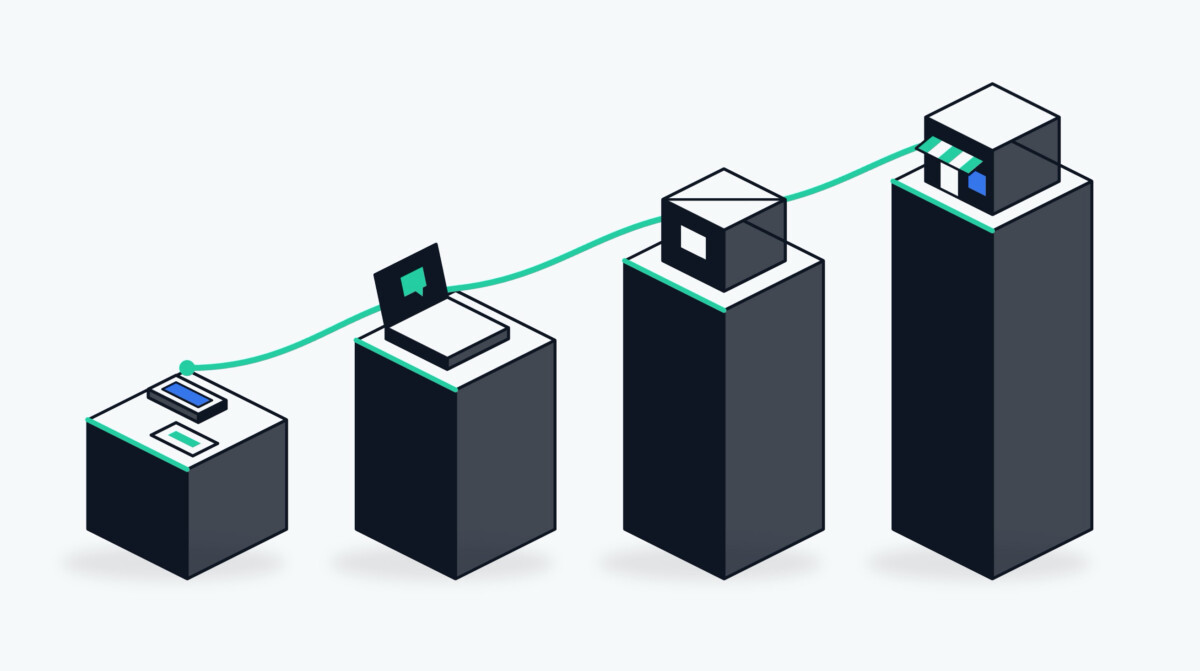
Most people should not start with a Shopify store. The fastest path to a real online business runs through a no capital income test first, then a service or product hustle, then your own brand once you have proven demand.
The most expensive mistake in online business is not picking the wrong model. It is picking a model three stages ahead of where you actually are, then blaming yourself when it fails.
Twenty seven percent of US adults run a side hustle, and they earn an average of $885 per month, according to a 2025 Bankrate survey. That number gets quoted constantly. The part that gets skipped is the distribution behind it. An average of $885 across millions of people includes a small group clearing several thousand and a very large group clearing under $200. Both of those are called side hustles. Only one of them is a business in progress.
I spent six years at Shopify watching merchants at every stage, and then built my own businesses on both sides of an exit. The pattern that shows up most often is not laziness or bad luck. It is sequence error. Someone reads that dropshipping has 10% to 20% margins, opens a store, buys a theme, installs eleven apps, runs $400 of ads into a cold audience, and quits in seven weeks having learned nothing except that it did not work. They skipped the stage that would have taught them whether anyone wanted to buy anything from them at all.
This page is the sequence I would give someone starting today, whether they have $0 or $5,000, and whether they want $300 a month or a business they can eventually sell.
Making money online moves through four stages, and each one teaches a specific skill the next stage depends on. Stage one is a no capital income test. Stage two is selling a service, where you trade time for money but build client skills. Stage three is a first product business with no inventory risk. Stage four is your own brand, where you own the customer relationship and the asset.
The stages are not a ladder everyone must climb. They are a diagnostic. Most people who fail at stage three failed because they never did stage one, so they had no evidence that they could price something, communicate with a stranger about money, and deliver on a promise. Those three skills are the entire foundation, and they cost nothing to acquire.
A recent Shopify survey of 500 established merchants found that 46% said their business started as a side project that grew over time. Just under half of the people running real stores did not begin with a store. They began with something smaller that proved the demand first.
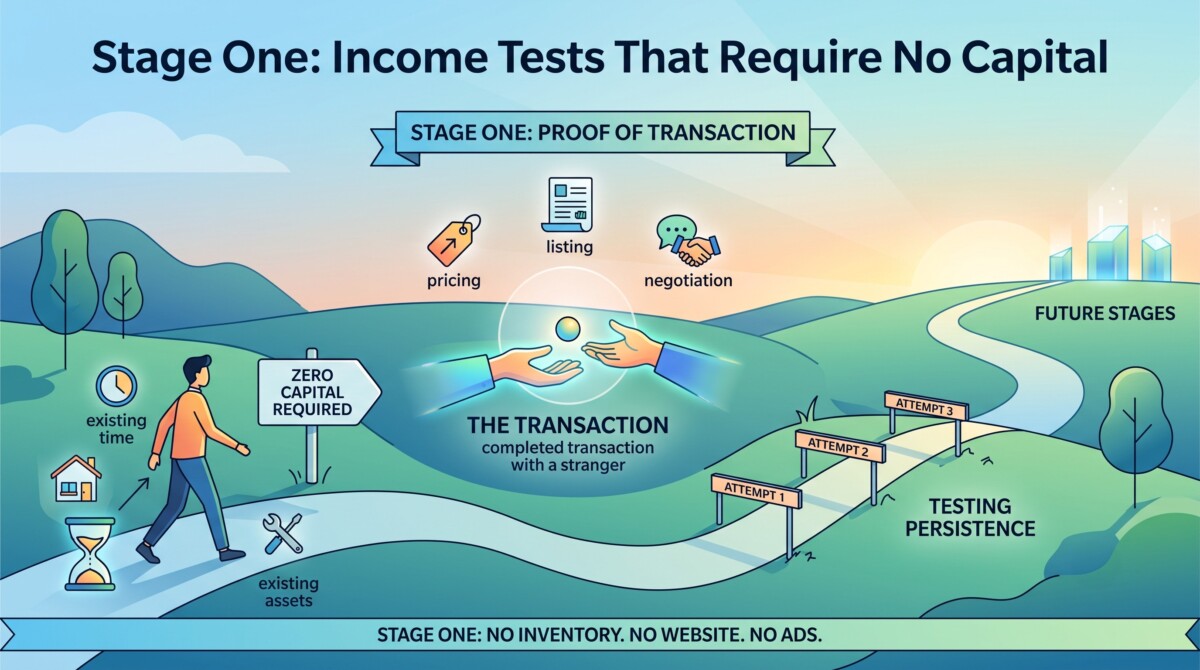
A stage one income test is any activity that converts your existing time or assets into money without requiring you to buy inventory, build a website, or spend on ads. The goal is not the income. The goal is proof that you can complete a transaction with a stranger.
The options here are wider than most people assume. Reselling items you already own through Facebook Marketplace or a local buy and sell group requires nothing but photographs and a willingness to negotiate. Online surveys and app testing pay small amounts, between roughly 25 cents and $5 per survey on platforms like Swagbucks, but they teach nothing transferable, which is why I rank them last. Freelance microservices on Fiverr or Upwork convert an existing skill into billable work immediately.
Selling feet pics through platforms like FeetFinder sits in this category too, and it is worth being straight about why. It requires no capital, no inventory, and no website, and it has a genuine buyer market with established platforms handling payment and verification. It also has real constraints that get glossed over in most coverage: platform fees take a cut, identity verification is required on legitimate platforms, earnings vary enormously between sellers, and the large majority of people who try it earn modest amounts rather than the figures that circulate on social media. What it does teach is the same thing every stage one test teaches, which is how to price something, how to write a listing that converts, and how to handle a customer who wants something slightly different from what you offered.
That last point is the reason stage one matters. Whatever you choose, you are not really testing the income. You are testing whether you can stand doing the work when nobody is watching and the first three attempts fail.
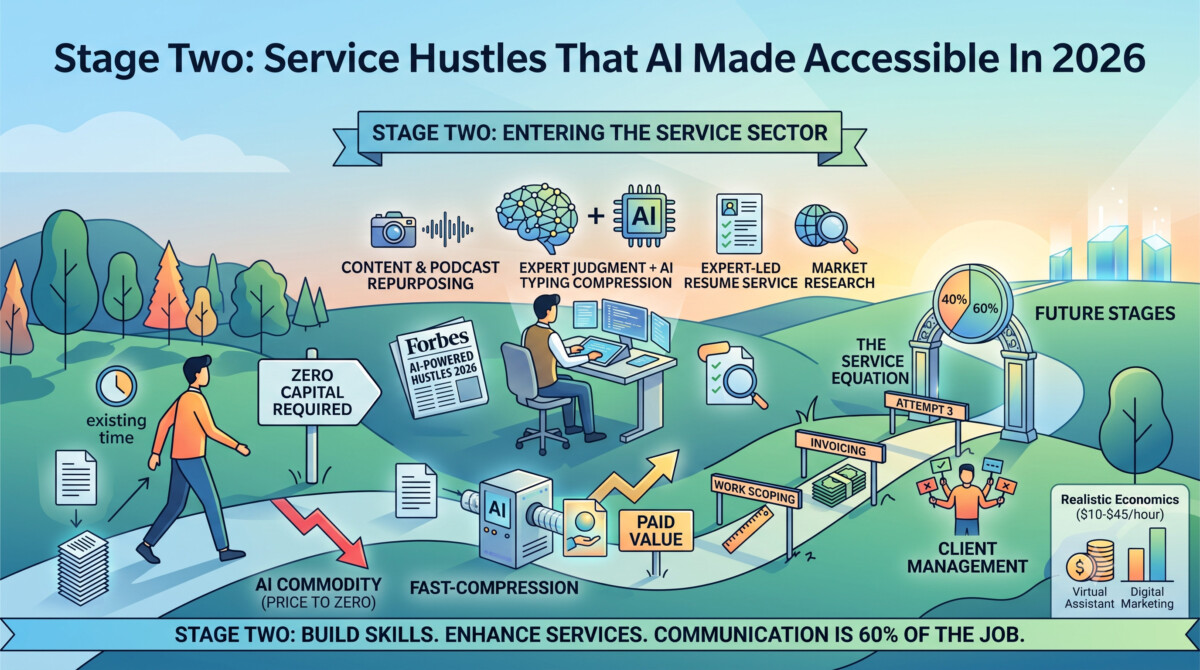
Stage two is selling a service, and AI genuinely lowered the barrier to entry here in a way it did not for product businesses. The change is real, but it is narrower than the headlines suggest.
Forbes published a useful roundup of ten AI powered side hustles in August 2026, covering content agencies, resume services, podcast repurposing, market research, course building, and email marketing. The framing in that piece is correct on the point that matters most: the successful versions are not built by letting the model do the work. They are built by someone who already understands the domain using AI to compress the production time.
That distinction determines whether you have a business or a commodity. A resume service where a client’s history goes in and a generic document comes out competes on price with everyone else doing the same thing, and the price goes to zero. A resume service run by someone who has actually hired people, who knows what a hiring manager skims for in six seconds, produces a different artifact and can charge for it. The AI compressed the typing. The judgment is what the client is paying for.
Realistic economics at this stage: virtual assistant work runs roughly $10 to $20 per hour on Upwork, rising to $35 or more with marketing, customer service, or accounting experience. Digital marketing services run roughly $15 to $45 per hour. Those are not life changing numbers on their own. What they are is a paid education in scoping work, invoicing, managing a client who changes their mind, and discovering that delivery is 40% of the job and communication is the other 60%.
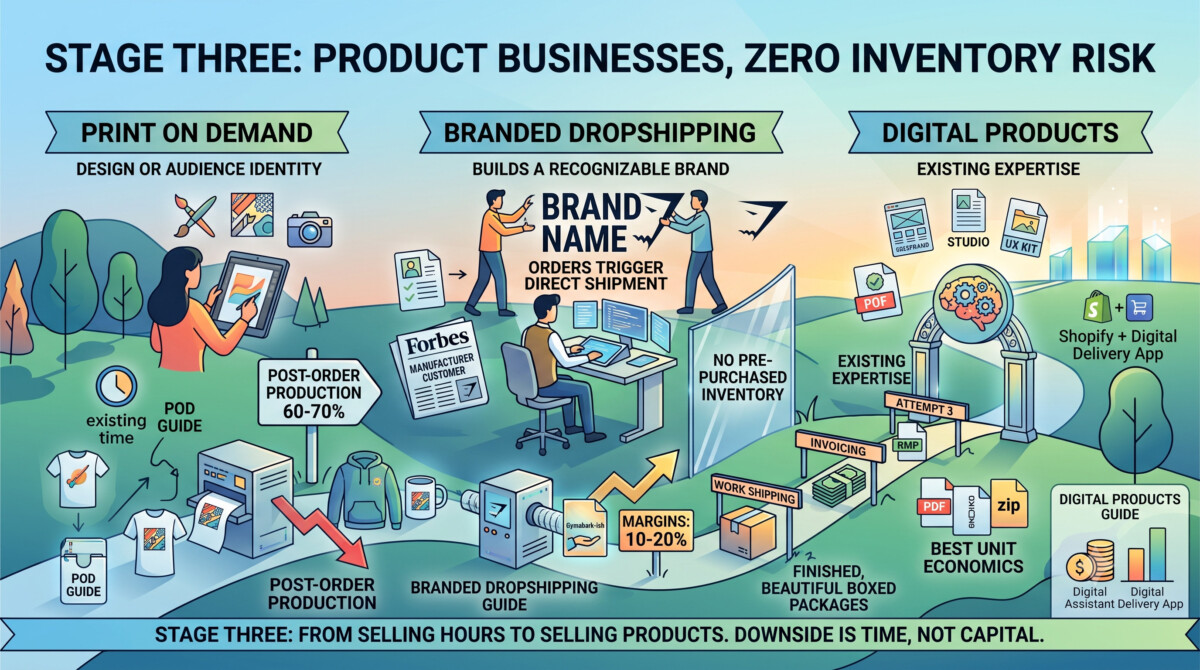
Stage three is where you stop selling hours and start selling something that can be sold twice. The defining feature is that none of these models require you to buy inventory before a sale happens, which means your downside is time rather than capital.
Print on demand applies your design to a product only after someone orders it. Apparel gross margins run roughly 60% to 70%, and the model works well for people who can design or who have an audience with a specific identity to express. Our ultimate guide to print on demand covers supplier selection and the design workflow in detail.
Dropshipping has thinner margins, roughly 10% to 20% according to TrueProfit, and it is the model most likely to be sold to you as easier than it is. The version that works in 2026 is branded rather than generic, where you are building something recognizable instead of competing on price against ten identical stores selling the same AliExpress product. Our branded dropshipping guide walks through how Gymshark and Fashion Nova made that transition.
Digital products have the best unit economics of the three by a wide margin. Eric Miller of UX Kits turned his design studio’s internal client documents into products and reported roughly 97% profit margins per sale. The catch is that digital products require you to already have expertise worth packaging, which is precisely what stages one and two build. If you want the mechanics, we cover selling digital products on Shopify including the delivery apps you need, since Shopify does not handle digital file delivery natively.
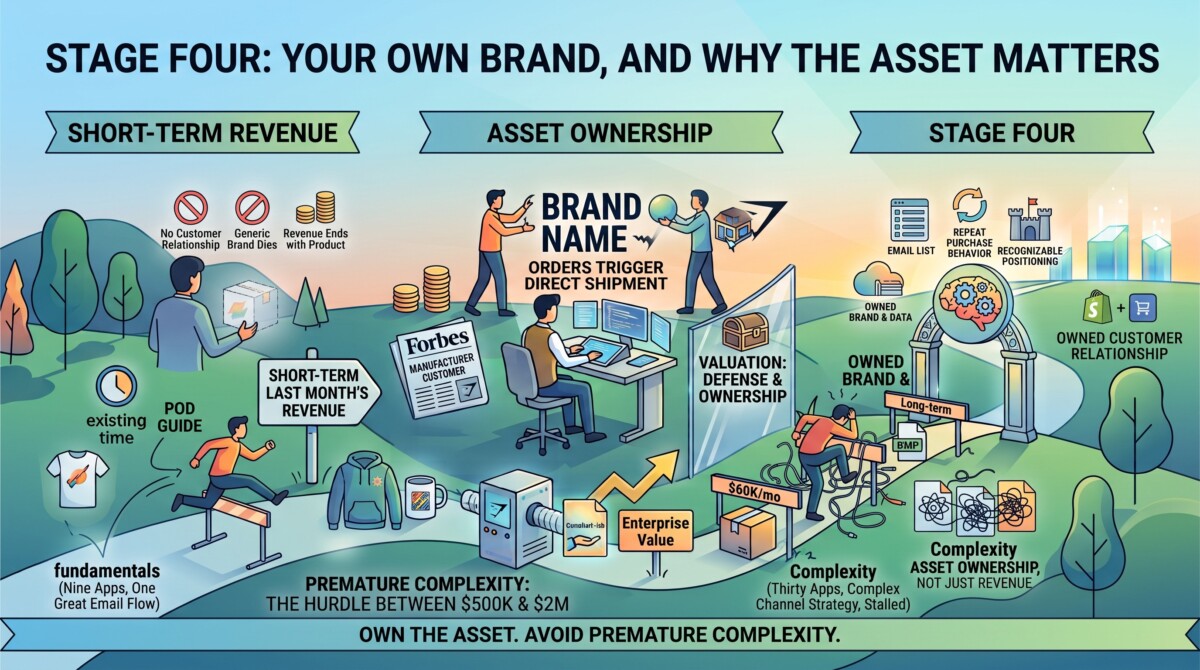
Stage four is when you own the customer relationship, the brand, and the data, which is the difference between having income and having an asset. Everything before this stage generates cash. This stage generates something you can eventually sell.
The distinction is concrete. A generic dropshipping store dies when its winning product stops winning, because the customer never had a reason to remember who they bought from. A brand with an email list, repeat purchase behavior, and recognizable positioning has enterprise value independent of any single product. I have been on both sides of this, having co-founded and exited an online contact lens retailer, and the valuation conversation is entirely about defensibility and customer ownership rather than last month’s revenue.
This is also where the failure mode I mentioned earlier does the most damage. Merchants between $500K and $2M almost always stall for the same reason, which is premature complexity. Too many apps, too many channels, too many tactics layered on before the fundamentals are solid. The store doing $80K a month with nine apps and one excellent email flow beats the store doing $60K with thirty apps and a channel strategy nobody can explain.
Realistic capital requirements and timelines vary by an order of magnitude across the four stages, and knowing the real numbers prevents the most common form of quitting, which is expecting stage four returns from a stage one effort.
One number worth internalising before you start: Productive Blogging’s data shows the average blogger takes 21 months to make their first dollar. Content businesses are the slowest model on this list by a wide margin, which is fine if you know it going in and brutal if you do not. Compare that to a stage one reselling test, which can produce a sale in a weekend. Both are legitimate. They are not interchangeable, and choosing between them without knowing the timeline difference is how people end up quitting at month four of a 21 month process.
Four skills carry across all four stages, and they are the actual reason the sequence works rather than any specific income model. They are pricing, customer communication, platform dependency awareness, and cashflow discipline.
Pricing is the one people underestimate most. Nica Yusay, who founded the vintage brand FashioNica, sold a Saint Laurent button-up for $15 to $20 early on when it was worth substantially more. Every operator has a version of that story. You learn pricing by getting it wrong on a $20 item, not by theorizing about it on a $200 product line.
Platform dependency is the one that costs the most later. If you sell feet pics, your account and income live on that platform’s terms. If you sell on Etsy, Etsy sets the fees and the algorithm. If you sell through TikTok, one policy change reshapes your acquisition overnight. This is the thread running from stage one all the way to stage four, and it is the single strongest argument for eventually owning your own store and list. Merchant independence over platform convenience is a trade you should be making deliberately at every stage, not discovering by accident when a platform changes its rules.
Cashflow discipline sounds like an advanced concern and is not. Bill Bachand of Renu Therapy put it well in a Shopify Masters interview, saying he is not a financial wizard but he knows how to read a balance sheet and a profit and loss, and knows where charges get coded, because good finances are what let you make good decisions. That applies to a $400-a-month job as much as a $400K-a-month job.
The IRS treats a side hustle as a business if the goal is profit, and self-employment tax applies on net income above $400, which is a much lower threshold than most people starting out expect. The self employment tax rate is 15.3%, split between 12.4% for social security and 2.9% for Medicare. If you expect to owe more than $1,000, quarterly estimated payments are required.
All income is reportable regardless of whether anyone issues you a 1099. That matters at stage one specifically, because platform payouts and peer-to-peer sales often arrive without any tax document attached, and people assume that means the income is invisible. It is not, and cleaning up two years of unreported side hustle income is a worse experience than tracking it from your first sale.
The practical move is to separate the money from day one. A dedicated account and a basic accounting tool cost almost nothing and turn a painful reconstruction exercise into a 5 minute monthly task. This is general information rather than tax advice, and the rules vary by country and situation, so speak to an accountant once you are earning consistently.
A large share of people should stay at stage one permanently, and framing that as failure is the most dishonest thing in this entire category of content. Not everyone wants a business. Plenty of people want $400 a month to cover a car payment without adding a second full time job to their life.
The honest test is what you want the money to do. If the answer is cover a specific recurring expense, stage one or stage two is the correct destination, and building a brand would be actively worse for you, because stage four demands sustained attention for months before it returns anything. Bankrate’s data showed 35% of side hustlers put the money toward living expenses and 28% save at least some of it. Those are complete, rational goals that do not require a store.
Move up only when the constraint you are hitting is capacity rather than interest. If you are turning down work because you have run out of hours, that is a real signal that a product or a brand would let you earn without trading more time. If you are simply bored, changing models will not fix that, and you will be bored again in six weeks with more overhead.
You are ready for the next stage when you have hit a capacity ceiling with demonstrated demand, not when you feel like you should be further along. The signal is specific: you have repeat customers or repeat requests, you are declining work or leaving money on the table because of time, and you can name the thing people keep asking you for.
That last item is the entire trigger for the stage two to stage three move. When three different clients ask you for the same deliverable, that deliverable wants to be a product. You already have demand evidence, and you already know what it should cost, because you have been charging for the custom version.
For the move into stage four, the signal is different. It is when you notice you are building someone else’s asset. Your Etsy reviews, your Fiverr rating, your platform follower count: none of that transfers if you leave, and none of it appears on a balance sheet if you ever want to sell. If that bothers you, you are ready. If it does not, stage three may be exactly where you should stay. Shopify’s own roundup of 30 side hustle ideas is a useful catalogue if you are still choosing your lane, and we work through how operators actually navigate these transitions each week on the eCommerce Fastlane podcast.
The best no money side hustle is one that converts something you already have into a transaction, which usually means reselling items you own, freelancing an existing skill on Upwork or Fiverr, or a platform based income test. These require zero capital because you are not buying inventory or building infrastructure. Avoid anything requiring upfront payment to participate, which is the clearest scam signal in this category. The purpose of a first hustle is not the income, it is proving to yourself that you can price something, list it, and complete a sale with a stranger. That evidence is what makes every later stage possible.
Timelines range from days to nearly two years depending entirely on the model you choose. Reselling and freelance services can produce a first sale within days or a few weeks. Print on demand and dropshipping typically take one to four months to a first meaningful sale once the store and traffic are in place. Content businesses are slowest, with Productive Blogging data showing the average blogger takes 21 months to earn their first dollar. Choose your model based on how long you can sustain effort without income, because mismatching that is the single most common reason people quit.
Yes. The IRS requires self employment tax on net income above $400, at a rate of 15.3% covering social security and Medicare, and all income is reportable whether or not you receive a 1099. If you expect to owe more than $1,000 in tax, quarterly estimated payments are required using Form 1040-ES. Track income separately from your personal money starting with your first sale, using a dedicated account and a basic accounting tool. Rules differ by country and situation, so consult an accountant once you are earning consistently rather than trying to reconstruct records later.
Usually not as your first step. A store is stage three or four in a four stage sequence, and starting there means building infrastructure before you have any evidence that people want to buy from you. A 2025 Shopify survey found 46% of established merchants began with a side project that grew into the business rather than launching a store first. Run a no capital income test, then a service, and open a store when you have a demand signal, which usually looks like multiple people asking you for the same thing. That sequence costs less and teaches more.
Yes, and it is the most common origin story among successful store owners rather than the exception. The 2025 Shopify survey of 500 established merchants found 46% said their business started as a side project. What separates the ones that transition from the ones that stay small is whether the operator builds transferable skills along the way, specifically pricing, customer communication, and cashflow discipline, and whether they eventually move off rented platforms onto something they own. A hustle that stays entirely on someone else’s platform generates income but never becomes an asset you can sell.




