Meta’s latest earnings show that in 2026, investors only reward AI spending when it translates into durable profits and free cash flow, leaving narrative-heavy, cash-light AI strategies trading at a growing discount.
Meta’s report is the latest proof that the market has flipped from paying premiums for AI promises to grading companies on AI execution, cash conversion, and discipline in turning compute into profits.
Meta’s quarterly report has once again shown how high investor expectations have become in the era of artificial intelligence. Despite revenue growth and its vast user base, the market focused on weaker profits, a cautious outlook, and a rapid increase in AI development costs. As a result, Meta shares plunged by more than 10% after the report was published.
The main disappointment was earnings per share of $6.18 versus the expected $7.22. Revenue, by contrast, slightly exceeded analysts’ forecasts, reaching $60.8 billion, but investors were more concerned about the outlook for the current quarter. Meta expects to generate approximately $62.5 billion in revenue, while the market expected about $63.15 billion. Management also cited unfavorable foreign exchange movements as a headwind that could slow revenue growth.
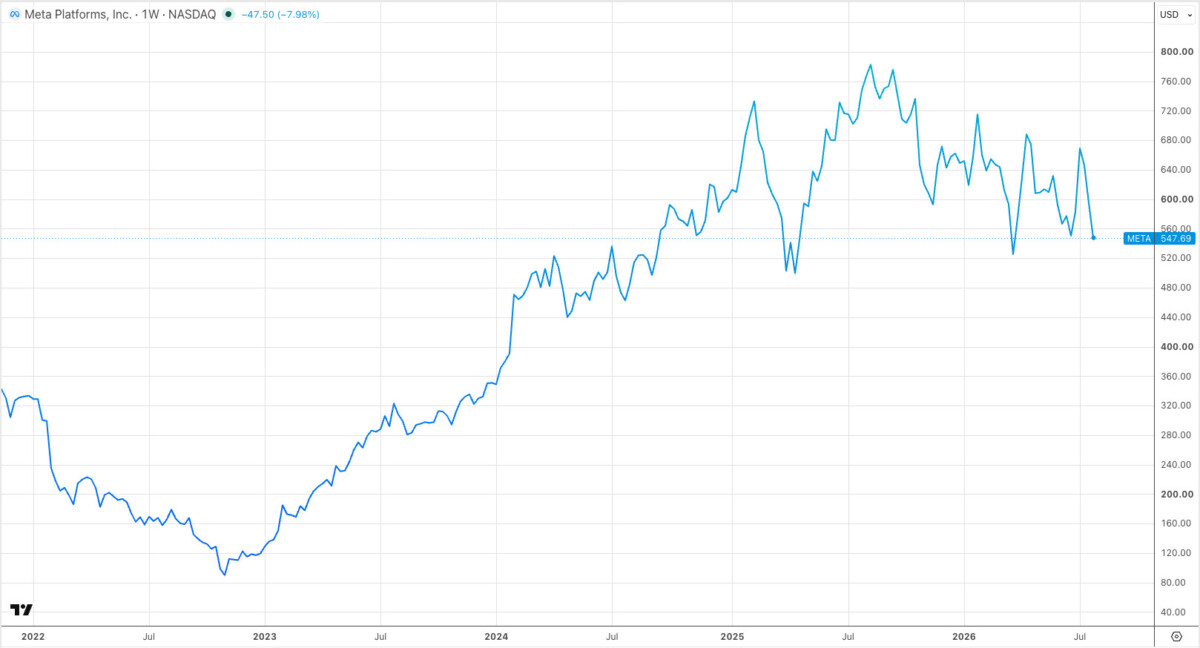
However, the key reason for the negative market reaction was not so much the financial results themselves as the continued growth in spending. Meta maintained its capital expenditure forecast at $130–145 billion this year while continuing to actively invest in AI infrastructure. These investments nearly eliminated free cash flow, which fell from $8.55 billion a year earlier to just $784 million.
The company’s expenses increased by 55% to $42 billion in the quarter. In addition to investments in AI, results were also affected by legal costs and payments to downsized employees, but even without these factors, the market is increasingly wondering how quickly such large-scale investments can begin to generate tangible returns.
By contrast, Microsoft and Amazon reinforced investor confidence with their latest earnings report, as their AI-related spending appeared to be translating into tangible commercial momentum. As a result, companies’ shares rose sharply following the earnings releases, with Amazon emerging as one of the biggest drivers of the S&P 500 gains.
Meanwhile, Meta’s management continues to demonstrate confidence in its chosen strategy. Mark Zuckerberg said that a significant portion of the computing power will be directed not only toward improving existing services but also toward developing a new generation of personal AI agents. He believes that the next stage of market development will be the emergence of intelligent assistants capable of performing a wide range of everyday tasks for billions of users without requiring complex setup. In this way, Meta is seeking to establish its own niche by focusing not on enterprise tools for developers but on mass-market consumer products.
Management also noted growing commercial interest in the company’s computing infrastructure. According to Zuckerberg, Meta is already receiving offers from companies willing to lease its computing capacity at a substantial premium. This indicates a continuing shortage of AI infrastructure, but such opportunities are still insufficient to offset the rapid growth in capital expenditures.
Regulators also pose additional risks to the company. Tennessee has filed legal action against Meta, alleging that the company was aware of Instagram’s potential negative impact on teenagers but continued to prioritize engagement-driven features to protect advertising revenue. If the court rules against Meta, the company may face not only financial sanctions but also the need to change certain platform features, which could potentially affect its business model.
At the same time, the company continues to explore new sources of monetizing its devices. Following a wave of criticism, Meta was forced to temporarily abandon the idea of limiting one of the functions of its smart glasses by subscription, since the feature runs directly on the device rather than in the cloud. Although management emphasizes that some advanced features may become paid in the future, this episode has clearly shown how cautiously the company is now approaching any attempts to increase revenue from its product ecosystem.
As a result, Meta’s quarterly report serves as another confirmation of the new reality of the stock market. Today, investors remain willing to support multibillion-dollar investments in AI only if companies can provide convincing evidence that those investments will eventually generate meaningful returns. Meanwhile, even companies generating tens of billions of dollars in quarterly revenue and serving the world’s largest user bases are finding it increasingly difficult to meet market expectations, as investors are beginning to evaluate not only the scale of AI spending but also its efficiency and expected return on investment. Conversely, as the latest earnings reports from other companies demonstrate, tangible progress in monetizing AI investments is rewarded swiftly, with their shares ranking among the top stock gainers following the results.
Meta’s stock dropped more than 10% because investors saw an uncomfortable combination of an earnings miss, cautious revenue guidance, and a dramatic increase in AI-related spending that severely compressed free cash flow. Even though revenue slightly exceeded expectations, the weaker earnings per share, softer outlook, and 55% jump in expenses signaled that Meta’s aggressive AI capex is not yet matched by the kind of cash and profit conversion the market currently demands from leading AI players.
Meta’s AI spending is sharply reducing free cash flow and raising its perceived risk profile by pushing capital expenditures and operating costs much higher without a proportional increase in monetized AI revenue. With capex guided at $130–145 billion this year and total expenses at $42 billion for the quarter, free cash flow fell from $8.55 billion a year ago to $784 million, a deterioration that makes investors more cautious about the company’s ability to fund buybacks, new initiatives, or further AI bets without adding balance sheet strain.
Microsoft and Amazon are being rewarded because their earnings reports showed clear, near-term monetization of AI investments through growing cloud, software, and AI service revenues, whereas Meta’s report did not. In those companies, expanded compute and model spending are visibly tied to products customers are paying for, which drove post-earnings rallies and helped power S&P 500 gains, while Meta’s heavy spending without equivalent cash conversion led markets to mark down its shares.
Meta’s long-term strategy with personal AI agents is to embed intelligent assistants directly into its platforms so they can perform everyday tasks for billions of users with minimal setup, creating a consumer-first AI ecosystem. The goal is for these agents to deepen engagement, enable new ad and commerce experiences, and eventually support subscription or device-led revenue streams, positioning Meta as the default destination for mass-market consumer AI rather than primarily an enterprise AI tools provider.
Regulatory and product monetization decisions complicate Meta’s AI narrative by adding additional layers of uncertainty and potential constraint on top of its financial challenges. Legal actions such as Tennessee’s case over Instagram’s impact on teenagers may lead to fines and forced changes in engagement mechanics, while missteps like attempting to paywall on-device smart glasses features show how quickly users push back on perceived overreach, making it harder for Meta to freely experiment with new AI-driven revenue models without risking reputational and regulatory blowback.