

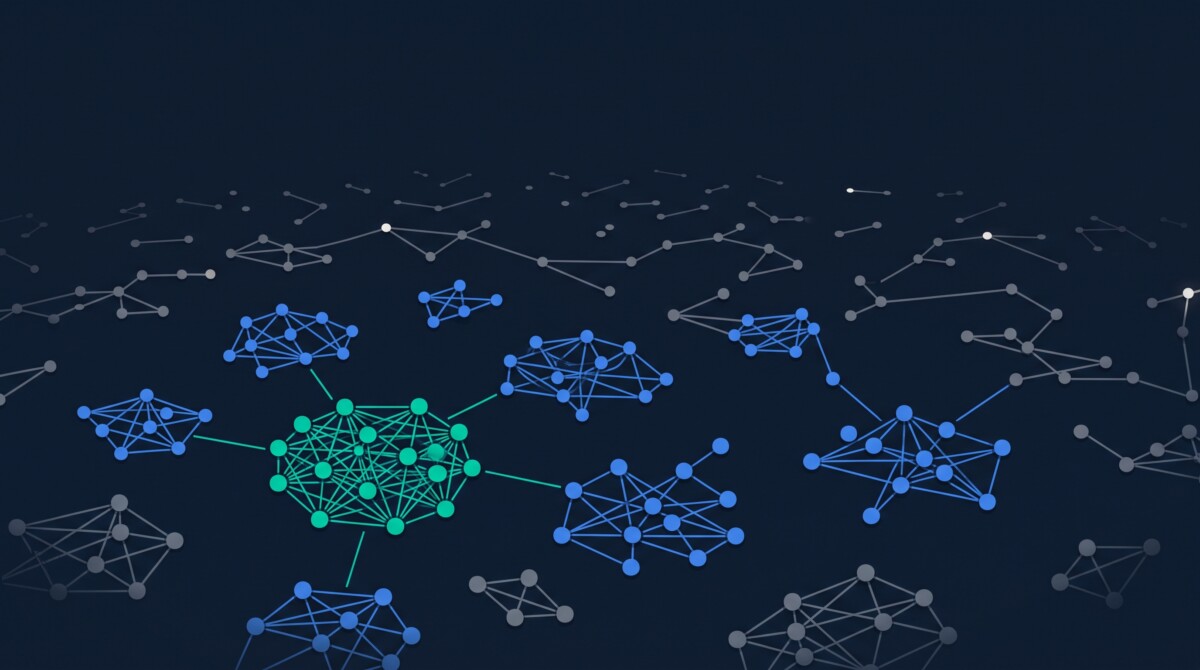
Micro-communities raise ecommerce brand loyalty by moving a brand from broadcasting to participating inside a small, named group. For Shopify merchants the payoff shows up in repeat purchase rate rather than follower count, and it takes one platform plus weekly presence to work.
Instagram engagement per post grew 28 percent year over year. The average Shopify repeat purchase rate did not move. Those two facts belong in the same conversation.
Around half of all global social media users say they plan to spend more time on emerging, community-driven platforms, according to Sprout Social’s Q2 2025 Pulse Survey. They are not abandoning Instagram or TikTok. They are moving attention out of the open feed and into the smaller rooms: Close Friends lists, broadcast channels, subreddits, Discord servers, group chats.
That shift breaks the mental model most Shopify brands still run on. The old model says reach comes first, engagement follows reach, and sales follow engagement. Inside a micro-community the order inverts. A brand earns a place in a small room first, and the reach arrives later, carried by people who were already there and who are willing to vouch.
This piece is written for operators who are getting reasonable engagement and not getting repeat orders, and who suspect the gap is not a content problem. It covers what micro-communities are on today’s platforms, what they change about loyalty economics, which Instagram features actually support them, and the three places the strategy reliably falls apart.
A small circle outperforms a large audience because engagement inside a micro-community is reciprocal, and reciprocal engagement is what produces the peer recommendations that move purchase decisions. In an open feed a brand talks and an audience scrolls. In a small circle members talk to each other, and the brand is one voice among several rather than the only one broadcasting.
The practical benefits stack in a specific order. Engagement rates rise first, because a niche audience responds to content built for their exact interest rather than content built for everyone. Loyalty follows, because belonging to a group is stickier than liking a product. Word of mouth comes third, and it is the compounding one: recommendations that travel between members carry credibility that no ad unit can buy. Cost efficiency is the last effect, not the first. Organic advocacy reduces paid dependence over quarters, not weeks, and any plan that treats it as an immediate substitute for ad spend will disappoint.
When you also consider the tools that support the strategy of micro-communities, it makes even more sense. One example of this would be the use of an Insta Story viewer. For brands putting this approach into practice, Grabfy provides a browser-based way to explore supported public Instagram Stories for content research and a closer look at what resonates with niche communities. Using a public IG story viewer allows you to watch Stories and other content on the platform without needing an Instagram profile of your own.
It is worth being precise about what these tools are. They are read-only research aids. They reach public profiles only, they cannot open private accounts, and Inflact’s own documentation states plainly that anonymous viewing is not possible inside the Instagram app and asks users to stay mindful of Instagram’s terms. Treat a Story viewer the way you would treat reading a subreddit before posting in it: useful for learning what a niche responds to, and no substitute at all for participating. A brand that only watches has not joined anything.
The platform side of this is moving the same direction. Sprout’s read on where social attention is heading in 2026 describes the spotlight shifting from mass reach toward private groups and micro-communities on Reddit, Substack, and Discord. If your social strategy still assumes the feed is where relationships form, it is planning against the direction the platforms themselves are moving.
Belonging comes before buying because a customer who feels represented by a brand will tolerate friction that a customer who feels marketed to will not. A late shipment from a brand you feel part of is an inconvenience. The same late shipment from a brand you merely bought from once is a reason to leave.
People understand commerce. They are not offended by being sold to. What they reject is a relationship in which every single interaction is a sale, because that pattern tells them the relationship has one direction. The research is unusually blunt on this point. According to Sprout Social’s 2026 research on how audiences interact with brands, 73% of social media users say they will buy from a competitor if a brand does not respond on social, and 58% say audience interactions are the single most important thing a brand can prioritize there. Responding is not a customer service nicety. It is a retention lever with a measurable cost attached to skipping it.
Shared identity is what makes the difference durable. When a customer sees their own values, problems, or humour reflected in what a brand publishes, the brand stops being a vendor and becomes a marker of who that person is. That is why community-led brands survive price competition that kills comparable products: the competitor can match the price and cannot match the membership.
The stage-specific version matters here. At $50K to $500K a month in revenue you are looking for the 30 to 50 customers who already talk about you unprompted, and the work is finding them and naming them. At $2M and above the work is different: you already have the advocates, and the failure is usually that nobody owns the relationship with them and so nothing is asked of them.
Peer validation converts better than brand messaging because a recommendation from a community member carries evidence that a brand claim cannot. When a member says a product solved a problem, the group can see who said it, what else they have said, and whether they stuck around afterward. A brand claim has none of that context attached.
The signal to watch is repetition. When the same handles keep appearing under your posts, in your replies, and in your DMs across several weeks, you are no longer looking at engagement. You are looking at a roster. Those names are the seed list for everything that follows: early access, product feedback, an affiliate or ambassador program, a private channel.
Micro-influencers fit naturally here because the good ones are already members of the niche rather than visitors to it. Our micro-influencer and modern affiliate playbook covers the mechanics, including the part most brands get wrong: loyalty programs and referral programs solve different problems and stop working when they are merged. The economics can be striking when the structure is right. Triquetra Health built an incremental revenue stream approaching $350,000 per month by unifying its direct and TikTok Shop affiliate operations, at a customer acquisition cost under $4.
Community validation makes purchase decisions easier, but it does not make them repeat. Landing a sale from a follower is one event. Turning that person into one of your repeat customers requires a separate system with its own mechanics, and community engagement feeds that system rather than replacing it.
Community engagement turns into revenue at one specific point: the second order. Everything before it is potential, and everything after it compounds. The average Shopify store has a repeat purchase rate of 28.2%, which means roughly seven of every ten customers never come back after their first order, and the community work that does not change that number has not yet paid for itself.
The probability curve explains why the second order deserves so much attention. After a first purchase a customer has roughly a 28% to 32% chance of returning. Once they place a second order the probability of a third jumps to 45%, and after a third it climbs to 54%. The curve keeps rising with each transaction. A micro-community is one of the few mechanisms that reaches customers during the exact window between order one and order two, because those people are already in the room and already listening.
Recurring rituals are what make that reach useful. A monthly product drop discussed in the group before it goes live, a members-first restock, a recurring question thread, a weekly spotlight on something a member made: these give people a reason to be present on a schedule rather than a reason to buy on a schedule. The distinction matters. A challenge or a prompt that benefits the member builds the habit. A challenge that exists to funnel members toward checkout burns the room, usually within two or three cycles.
None of this replaces the underlying machinery. If the post-purchase sequence is a shipping notification and nothing else, a community will surface the problem faster but will not fix it. Our guide to building a Shopify retention framework that actually drives profit covers the flows that sit underneath, and community works best layered on top of those rather than substituted for them.
Instagram now ships three native surfaces that do genuine micro-community work: Close Friends, broadcast channels, and the interactive Story stickers. Each solves a different problem, and using the wrong one for the job is the most common setup error.
Close Friends is the small and private end. It limits a Story, Reel, or feed post to a curated list, and it is the right tool for a group of 50 to 300 named customers who get early access or unfiltered behind the scenes content. Broadcast channels are the opposite shape. Instagram’s own announcement when it introduced them describes a one-to-many messaging tool where only the creator posts while followers react and vote in polls but cannot send messages. That makes a broadcast channel excellent for announcements and poor for conversation, which is exactly the mistake brands make when they launch one and expect discussion. Story polls, questions, and quizzes are the cheapest of the three and the most underused, because they generate a reply thread that lands in DMs where an actual conversation can happen.
The commercial layer changed in 2026. Meta announced native affiliate product tagging across Instagram and Facebook at Shoptalk in March, which we covered in detail in our analysis of what Meta’s affiliate commerce rollout means for Shopify merchants. Eligible creators can tag up to 30 products per Reel, and the eligibility bar is 18 years of age and 1,000 followers. That threshold is the part worth sitting with. A community member with 3,000 engaged followers in your category now qualifies to drive trackable, attributable sales, which means the person who has been advocating for you for free can be brought into a commission structure with real reporting behind it.
The engagement numbers still favour Meta for this work. Sprout’s benchmark data puts Instagram at an average of 27 engagements per post, up 28% year over year, against 24 for Facebook, 13 for X, and 4 for TikTok. Instagram is not the only place a micro-community can live, but for most Shopify brands it is the one where the audience already is.
A micro-community scales by adding rooms, not by adding members to the same room. The intimacy that makes a group of 200 valuable does not survive being stretched to 2,000. What survives is the format, which can be copied into a second group organised around a different interest, region, or use case.
Moderation is the load-bearing work and it is usually the first thing under-resourced. Someone has to read every thread, answer the awkward question in public, and remove the member who is using the group to sell something else. That responsibility belongs to a named person with hours allocated, not to whoever on the marketing team has a spare afternoon. A community with no owner degrades quietly, and by the time the metrics show it the trust is already gone.
Tiered access is how most brands hold the balance between exclusivity and accessibility. A public feed for discovery, a Close Friends list or broadcast channel for buyers, and an invite-only group for the top tier gives people somewhere to progress to without locking newcomers out. Members-only events, early access windows, and product input sessions are the rewards that tend to hold up over time, largely because they cost the brand attention rather than margin.
Data belongs in this loop, but downstream of judgement. Analytics tell you which threads drew replies and which drew silence. They do not tell you whether the room feels like somewhere people want to be. Our guide to using emails, loyalty programs, and communities to improve retention covers how the community layer connects to the measurable ones. The community itself is the part you cannot automate.
Micro-community strategies fail in three predictable ways, and all three are visible before launch. Naming them early is cheaper than discovering them at month four.
The first is no named owner. A community is a standing commitment of hours, and a brand that cannot point to the person whose job it is has not started a community, it has started a channel that will go quiet. Budget two to three hours a week minimum at the small end, and a part-time role by the time a group passes a few hundred active members.
The second is too many surfaces. Sprout’s 2026 data has users moving between 6.75 social networks per month, and brands read that number as an instruction to be everywhere. It is the opposite. Audiences spread across many networks is precisely why depth on one beats presence on five: you cannot build familiarity in a room you visit occasionally. Merchants between $500K and $2M fail here more than anywhere else, and almost always through premature complexity, adding a Discord and a subreddit and a newsletter community before the first group has a working weekly rhythm.
The third is selling too early. A group that is asked to buy before it has been given anything reads the invitation correctly, as a marketing list with better branding. The tell is that engagement stays flat while member count grows. Give the room a reason to exist for at least 60 days before the first offer, and make that first offer something members get before anyone else rather than something members get a discount on.
There is also an honest scope limit worth stating. Micro-communities are a retention and advocacy mechanism. They are not an acquisition channel in their first year, and a brand that needs new customers this quarter should fix acquisition economics first and build the community alongside it.
The measure of a micro-community is repeat purchase rate, not engagement rate. Everything else is a leading indicator, useful for reading direction and useless as a goal in itself.
The assembly is straightforward even where the execution is not. Pick one platform surface where your customers already are. Seed it from the 50 people who already talk about you. Use listening tools to learn what the niche responds to, then show up weekly with something that serves them. Give the group a ritual. Hold the first offer until the room has a reason to exist without it. Then check, after 90 days, whether second orders moved.
If they did, you have a compounding asset that a competitor cannot copy by matching your price. If they did not, you have learned something specific about your customers in 90 days, which is considerably more than most brands learn from a quarter of paid social.
The stage guidance is simple enough to hold in your head. Under $500K a year, the community is you in the DMs, and the tooling barely matters. Between $500K and $2M, it becomes a scheduled commitment with a named owner and one surface, and the risk to manage is the pull toward adding a second and a third before the first one works. Above $2M, it becomes a tiered structure with moderators drawn from the membership, and the risk shifts to the group being quietly repurposed as a promotional channel once someone starts reporting on it as a revenue line.
A micro-community is a small group organised around a shared interest where members talk to each other, not just to the brand. A following is one-directional: the brand publishes and an audience consumes. The practical difference shows up in behaviour. Community members answer each other’s questions, recommend products without being asked, and notice when the brand goes quiet. Size is not the defining trait, reciprocity is. A brand can have 50,000 followers and no community, or 300 members in a Close Friends list who function as a genuine one. For Shopify merchants the distinction matters because loyalty and repeat purchase behaviour track the second pattern, not the first.
Start by identifying the 50 customers who already engage with you, then give them one place to gather. Pull the handles that repeatedly reply to your Stories, comment on posts, or reorder, and add them to an Instagram Close Friends list. Post to that list two or three times a week with something they get first: a product still in development, a question you genuinely want answered, an early restock window. Do not open with an offer. Spend the first 60 days establishing that the room exists for their benefit. One surface run consistently beats three surfaces run occasionally, particularly under $2M in revenue where attention is the scarce resource.
Track repeat purchase rate among community members against non-members, and treat everything else as a leading signal. The average Shopify store sits at a 28.2% repeat purchase rate, so that is the baseline your member cohort should be beating. Tag community members in your customer records so the comparison is possible, then check 90-day repeat rate by cohort rather than annually. Supporting signals worth watching are reply rate on community posts, the number of distinct members who post unprompted in a month, and referral traffic carrying community-specific links or codes. Engagement rate alone tells you the content landed, not that the relationship is producing revenue.
Use Close Friends for conversation and a broadcast channel for announcements, because they are built for opposite jobs. Close Friends limits a Story or post to a curated list and keeps replies flowing into DMs, which makes it the right choice for a small group of named customers you want to hear from. Instagram’s broadcast channels are one-to-many by design: only the creator posts, and followers can react and vote in polls but cannot send messages. That makes them efficient for restock alerts and launch news and unsuitable as a discussion space. Most brands under $2M should start with Close Friends and add a broadcast channel later.
Public Story viewers access publicly available content only and cannot reach private accounts, but the responsible way to use them is for pattern research rather than individual monitoring. Study what a niche responds to, which formats recur, and which topics draw replies, then apply what you learn to your own content. Do not use them to track specific people. Inflact’s own documentation notes that anonymous viewing is not possible within the Instagram app itself and asks users to remain mindful of Instagram’s terms of service, which is a reasonable caution to carry into any third-party tool. If a research method would make your customers uncomfortable to learn about, that is the signal to stop.
Expect 60 to 90 days before the community influences purchasing behaviour, and roughly two quarters before it shows up clearly in repeat purchase rate. The first 30 days establish that the room exists and that the brand shows up on schedule. The next 30 build the habit of members responding to each other rather than only to you. Revenue effects follow, usually first as faster second orders among members and later as referral activity. Any plan that requires community-driven revenue inside the current quarter is a plan that will push the group toward selling too early, which is the most common way these efforts collapse.




