

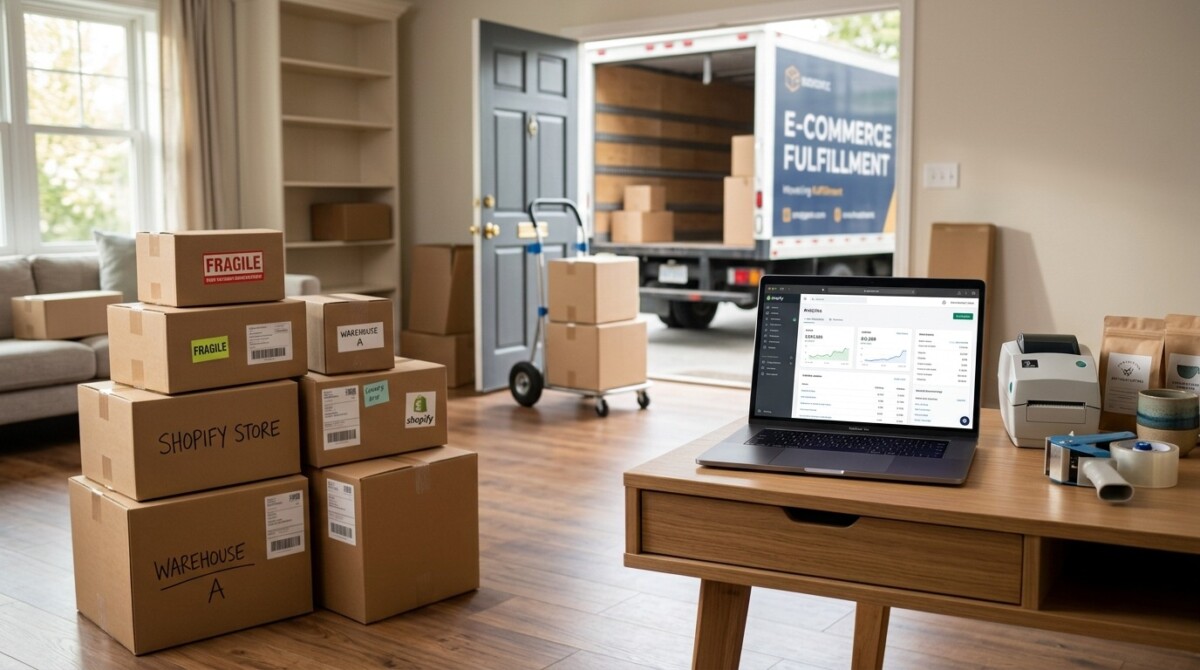
Relocating a home-based Shopify operation without losing orders comes down to pre-work: clear dead stock before you pack, keep your bestsellers shippable until the last day, and rebuild your pick-and-pack zone at the new place before the truck arrives.
The thing that breaks an early store during a move is almost never the truck. It is the three days orders stopped shipping while every SKU sat taped inside an unlabeled box.
Picture this. Your hero product sells through its restock on a Tuesday, your moving truck is booked for Thursday, and somewhere in between you still owe forty customers their orders. For a store that ships from a spare bedroom or a garage, that is not a hypothetical. It is what a household move actually looks like when your home is also your warehouse.
This matters more than most founders expect, because roughly half of all U.S. businesses are run from home, and most Shopify stores start exactly there before they ever touch a warehouse. So when a founder moves house, the business moves with it, whether or not anyone planned for it. The stores that come through without a single dark day are not lucky. They treated the move as an operations project, not a weekend with boxes.
This is a guide for that founder: the one doing anywhere from their first orders to a few hundred thousand a year out of a home, who is about to relocate. The discipline below is the same discipline that separates a calm store from a chaotic one on any normal week. Do the thinking up front, sequence the work, and protect the few things that actually drive revenue. Get that right and the truck is the easy part.
What breaks during a home-based store’s move is rarely the furniture; it is order flow, inventory accuracy, and customer trust, all of which degrade the moment your products are sealed in unlabeled boxes. The truck shows up, the house gets packed, and the part of the operation that quietly funds everything else goes offline for days because nobody scoped it as a system that needs to stay running.
The first failure is the shipping gap. A single three day stretch where nothing goes out lands during the exact window when new customers are deciding whether you are reliable. A first-time buyer who waits a week with no tracking does not assume you are moving house; they assume you are slow, and that impression is expensive to reverse. Inside your Shopify admin you can soften this by raising your stated processing time before the move, but a raised processing time is a patch, not a plan.
The second failure is inventory accuracy. When stock gets boxed at random and unboxed at the new place under deadline pressure, your physical counts and your Shopify counts drift apart. You oversell what you thought you had and stock out of what you thought was gone. The third failure is the most avoidable: the founder personally absorbs the entire move, packing the house and the inventory and the orders alone, and burns out in the week the business can least afford it. The pattern I see again and again is that early operators underestimate this because the store has always just worked from home. A move is the one event that tests whether it can work from anywhere.
Liquidate or donate your dead stock before the move, because paying a crew to load, drive, and unload inventory you will never sell is the most expensive way to discover you over-ordered. Every box of slow movers you relocate costs you twice: once in the move itself, and again in the shelf space and mental overhead it takes up at the new place. The move is a forcing function to finally deal with it.
Start with your data, not your gut. Shopify’s sell-through and ABC product analysis reports will show you which SKUs have not moved in 90 to 120 days. Those are your candidates. Pull that list three to four weeks out, while you still have time to do something about it. This is the inventory equivalent of decluttering a house before packing it, and the savings are real, since inventory carrying costs quietly eat into your margins long before a move ever enters the picture.
Then run a clearance. A short, honest “making room, everything in this collection is 30% off” campaign through Klaviyo or Omnisend can convert dead stock into cash and packing materials you no longer have to move. A store sitting on a few hundred slow units can often clear a third of its total volume this way in a week or two. Whether you are doing $10K months or pushing $1M, the principle holds: do not transport inventory that should have been a write-down. Move the products that earn their place on the truck.
Pack your slowest movers first and keep your top SKUs shippable until the final 48 hours, so the products that drive most of your revenue never go dark. A move tempts you to pack everything at once for the sense of progress, but that is exactly how your bestsellers end up at the bottom of a box two days before you can sell them.
Use the Pareto reality of almost every store: a small slice of your catalog, often the top 20% of SKUs, drives the large majority of your orders. Identify that slice in your Shopify sales reports and treat it as untouchable until the very end. Everything else, the long tail that ships once a week, can be packed early, labeled clearly, and staged. This mirrors the standard moving advice to pack the guest room before the kitchen, except here the “kitchen” is whichever ten or fifteen products keep your revenue alive.
Build a two day buffer into the schedule. If the truck comes Thursday, your bestsellers stay pickable through Tuesday evening, giving you Wednesday to pack them deliberately rather than in a panic. The table below maps the household timeline most movers already follow onto the store continuity tasks that run in parallel.
Build a ship-from-anywhere kit, a single labeled bin holding your bestsellers, mailers, a label printer, and your phone with the Shopify app, so you can fulfill manually from a kitchen counter on day one. This is the store version of the essentials box every mover packs last and opens first, and it is the difference between a smooth handful of shipments and a frozen storefront while the rest of your life is in boxes.
Stock it for the realistic gap, usually two to three days, with enough units of your top few SKUs to cover expected orders plus a small cushion. Include pre-counted mailers and packing materials, a charged label printer or a plan to print labels through ShipStation or Shippo on your laptop, and a printed pick list of what is in the bin. The Shopify mobile app lets you mark orders fulfilled and generate tracking from your hand, which is all you need to keep customers informed while the desk is disassembled.
Set expectations before the gap, not during it. A simple store banner and a line in your order confirmation noting a brief processing delay buys you enormous goodwill, because customers forgive a delay they were told about and resent one they discover. If your volume has grown to the point where a kit cannot realistically cover the gap, that is useful information about the fulfillment options a growing store can lean on, and a signal worth revisiting after the move settles.
Set up the new pick-and-pack zone before moving day, then brief your crew on which boxes are inventory, so the station that ships your orders is the first thing rebuilt, not the last. At the old place everything should be staged and labeled with a clear path to the door. At the new place, you should already know exactly where the store lives: which room, which corner, which shelf holds your top SKUs, before a single box comes off the truck.
Label your inventory boxes so they cannot be confused with household goods. A bold “STORE STOCK, ZONE 1” on all four sides tells the crew to put those boxes in one place, together, first. A rough floor-plan sketch handed to the lead mover does the rest; they can stage the store corner without stopping to ask, the same way they would place a sofa against the right wall if you told them in advance.
This is also the moment to stop being your own moving crew. If you are physically hauling forty boxes of inventory the same week orders are running, the store suffers and so do you. For founders in the Northern Virginia area, hiring local movers in McLean, VA who also offer storage means the heavy household load gets absorbed by professionals while you protect the one task only you can do well: standing up the pick-and-pack zone and getting fulfillment live again. Done in this order, the station is shipping within hours of arrival, not days.
Do a final walkthrough with an inventory count in hand, not a general glance, because the SKUs left behind in a closet or a garage corner are stock you have already paid for and will silently book as shrinkage. The household walkthrough catches the forgotten lamp; the store walkthrough has to catch the forgotten case of product, and those two passes are not the same.
Walk the old space against your actual SKU list, not your memory. Check the places stock hides in a home operation: closet shelves, the garage, under stairs, a shed, the back of a pantry repurposed as overflow. Anything found gets added to the move, anything missing gets investigated before you write it off. The spaces that swallow inventory in a home are the same ones that swallow belongings, which is exactly why a deliberate count beats a quick scan.
Within 24 hours of the move, update your counts in Shopify to match physical reality at the new location, including the location field if you track inventory by place. A move is the single best opportunity all year to true up your numbers, since every unit passes through your hands. Founders doing $10K months can do this by hand in an afternoon; those approaching $500K should treat it as a formal cycle count, because the inventory accuracy you set on day one is the baseline the next several months run on.
If a household move would mean relocating more inventory than fits in a single room, or this is the second time you are moving with stock in tow, that is usually the signal to move fulfillment to a 3PL rather than moving boxes again. A move makes the true weight of self-fulfillment visible in a way a normal week never does, and that clarity is worth acting on.
Be honest about the stage, though, because the more common mistake at $500K to $2M is premature complexity, not under-building. If you are shipping five orders a day, outsourcing to a 3PL because it sounds more legitimate adds cost and distance between you and your customer for no real gain. The home setup is a feature at that stage, not a liability. The calculus changes when volume, space, and your own time stop adding up: when you are personally packing thirty to forty orders a day, when inventory has colonized rooms it should not, or when a move would cost more in disruption than a few months of fulfillment fees. At that point it is worth studying the best 3PL companies for Shopify and DTC brands and matching one to your specific volume and product profile.
There is also a path that removes the question entirely. If your catalog suits it, a direct fulfillment model that skips warehousing entirely can mean you never hold the inventory you would otherwise be boxing up. The point is not that home fulfillment is something to escape as fast as possible. It is that a move is a natural decision point, and the founders who use it to deliberately choose their next fulfillment model, rather than defaulting into another move with boxes, are the ones who stop repeating this exercise every couple of years.
Keep your Shopify store shipping during a move by protecting your bestsellers and building a manual fallback. Identify your top 20% of SKUs in your Shopify sales reports and keep them pickable until the final 48 hours, pack the slow movers first, and assemble a ship-from-anywhere kit holding those bestsellers, mailers, and a label printer. Raise your stated processing time and post a short banner before the move so customers expect a brief delay. With the Shopify mobile app you can mark orders fulfilled and send tracking from your phone, which covers the two to three day gap until your pick-and-pack zone is rebuilt at the new location.
Hire movers for the heavy household load so you can focus on the one task only you can do: getting fulfillment live again. When your home is also your warehouse, personally hauling forty boxes of inventory the same week orders are running is how both the store and the founder burn out. Professional movers, especially ones who also offer storage, can absorb furniture and bulk while you stand up the pick-and-pack zone, brief the crew on which boxes are inventory, and resume shipping. Label your stock boxes distinctly so they are placed together and first. The cost of a crew is almost always less than the cost of a multi-day shipping gap and a missed customer window.
Start prepping a home-based ecommerce move three to four weeks out, the same window professional movers recommend booking in. Use the first weeks to pull SKU velocity data from Shopify, run a clearance on dead stock so you are not paying to move unsellable inventory, and gather packing supplies. In the final two weeks, pack your slowest SKUs first while keeping bestsellers live, build your ship-from-anywhere kit, and confirm your crew. The extra runway is what lets you sequence the wind-down instead of scrambling in the last 48 hours, which is when shipping gaps and inventory errors usually happen.
You rarely need to fully pause your Shopify store during a move; you need to manage the gap. Pausing stops new revenue and signals instability to first-time buyers, whereas a planned slowdown keeps the store open and trust intact. Raise your processing time, post a brief notice on the storefront and in order confirmations, and fulfill from a ship-from-anywhere kit during the one to three days your desk is in transit. The only case for a true pause is a high-volume operation where manual fulfillment genuinely cannot cover the gap, which is itself a strong sign you are ready to move fulfillment to a 3PL rather than move boxes again.
Switch from home shipping to a 3PL when volume, space, and your own time stop adding up, typically as you approach or pass roughly thirty to forty orders a day or your inventory outgrows a single room. Below that, especially at $500K to $2M, premature outsourcing often adds cost and distance for little gain, so the home setup remains a genuine advantage. A move is a natural decision point: if relocating your stock would cost more in disruption than a few months of fulfillment fees, compare 3PL partners against your specific product and volume profile, or consider a direct fulfillment model that removes warehousing from the equation entirely.





