

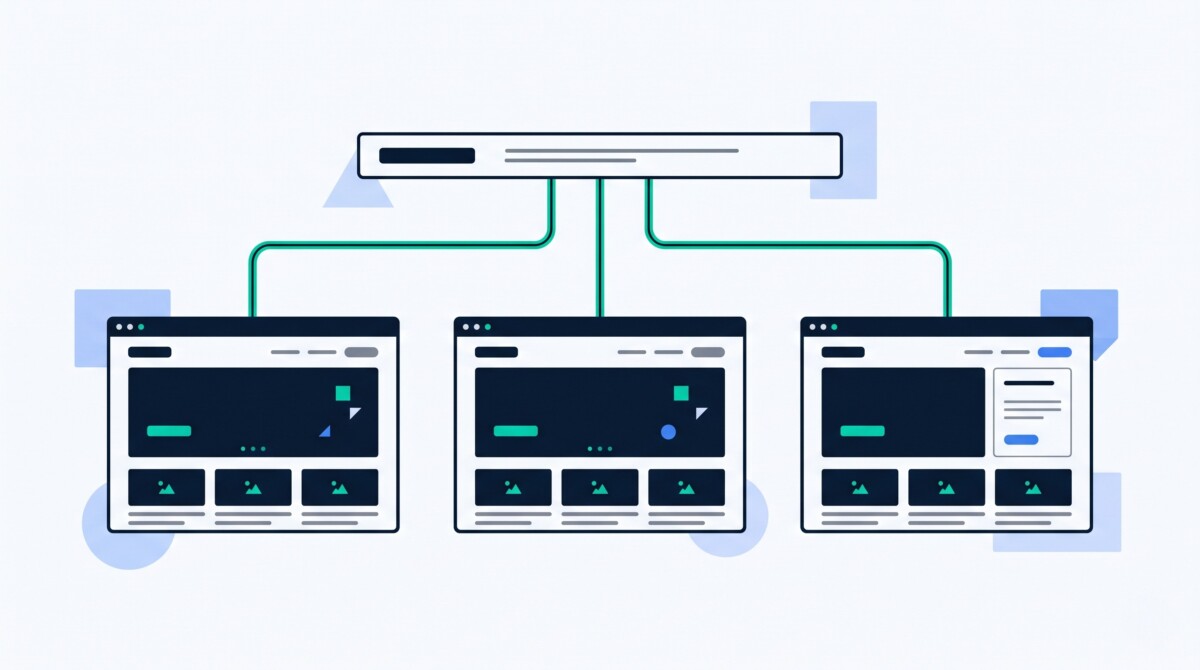
Multi-site is an answer to a specific business problem. If you cannot name that problem in one sentence, you are not ready to solve it with infrastructure.
Most multi-site ecommerce projects fail at governance, not at technology. I have watched brands sink six figures into beautiful headless infrastructure and end up shipping a worse customer experience than a single-store competitor, because nobody ever decided who owned the homepage in each market. The platform was not the problem. The decision rights document never got written.
If you are operating an ecommerce brand somewhere in the $1M to $50M range, the most useful thing this guide can do is help you make a clearer decision about whether multi-site is the right move at all, and if it is, how to set up the operating model so the technology delivers on its promise. The 2026 landscape has shifted in three ways since this article was originally written: Shopify Markets has matured into a real alternative to multi-store for most international use cases, AI search engines now read geographic and language signals much more aggressively, and headless CMS platforms have become operationally cheaper for mid-market brands than they were two years ago.
What follows is a practitioner’s view of when multi-site infrastructure earns its place, where most projects go wrong, and how to make the architecture and governance decisions that compound in your favor over the next five years.
Multi-site infrastructure earns its place when you can name at least one of three specific business problems a single Shopify store cannot solve: a true international expansion that requires localized currency, tax, and fulfillment beyond what Shopify Markets handles natively; a multi-brand portfolio where each brand has its own customer base, creative system, and merchandising; or a B2B operation that requires entirely different pricing, catalog, and checkout than your DTC storefront.
Most multi-site projects I see at the $500K to $2M stage are answers in search of a question. A founder reads about composable commerce, hears that a competitor went headless, and decides their stack needs to grow. Six months and forty thousand dollars later, they have a more complex operation generating roughly the same revenue. That is the premature complexity trap, and it is the single most common pattern I see at this stage.
Multi-site adds real cost. At minimum, you are looking at $40K to $120K per year in additional tooling, agency hours, and operational overhead before you ship a single new feature. If you cannot name the specific business problem multi-site solves for you, that money buys you complexity, not growth. The brands I have watched succeed with multi-site at the $5M to $50M range almost always had a forcing function: a real second brand acquisition, a regulatory split between markets that mandated separate stores, or a B2B revenue line that hit ten percent of total revenue and started demanding its own infrastructure.
If you are at $1M and reading this because someone in your circle moved to multi-site, ask them what specific problem it solved before you assume you have the same problem. The platform decision sits downstream of the business problem, and if you are not sure which problem you are solving, no platform comparison will rescue you.
The hardest problem in multi-site management is not technology, it is governance: deciding which content is centralized, which is local, and how exceptions get approved. You can pick the most flexible CMS in the world and still ship a worse customer experience than a single-store competitor if your content operations do not have clear decision rights.
The architecture decision and the operating model are two different problems. The technology question is which content lives in one place and gets distributed, and which content lives in each storefront natively. The operating question is who has authority to localize, who reviews changes, and what gets locked. Brands that solve only the first problem ship beautiful infrastructure that no one can use cleanly.
Headless CMS platforms are a common architecture for this when you have three or more storefronts and a team that needs to ship content faster than the platform release cycle allows. The core idea is that content lives in a structured, API-driven layer and gets pulled into each storefront where it is needed. The trade-off is real: you gain flexibility and you take on the responsibility of managing content infrastructure that used to be invisible inside a single Shopify store. For more on whether the broader headless approach fits your stack, the Headless Commerce 101 guide walks through the readiness questions in detail.
Sanity is one platform that takes this approach. Here is how their team frames it:
Managing content across multiple storefronts doesn’t have to mean juggling disconnected systems. Sanity’s flexible content platform lets ecommerce teams centralize their content operations while still tailoring experiences for each site, region, or brand. With a structured, API-first approach, Sanity makes it straightforward to share content where it makes sense and customize where it doesn’t — so your teams spend less time on content logistics and more time on what actually drives growth.
Sanity is one option in this category. Other credible alternatives include Contentful (enterprise leaning, strong governance features), Storyblok (visual editor, suits marketing-heavy teams), Builder.io (component-based, integrates with multiple commerce backends), and Strapi (open source, self-hosted). For teams not yet ready for full headless, Shopify’s metaobjects in Online Store 2.0 handle a surprising amount of multi-storefront content sharing inside the native admin. The right choice depends less on the feature list and more on the daily editing experience.
At multi-site scale, inventory and order management stop being a Shopify configuration problem and become a systems problem that requires either a true order management system or extensive custom integration between storefronts. When you split one brand into two or three storefronts, the simple Shopify inventory model gets uncomfortable fast. You will see oversold SKUs, fragmented order data, duplicate customer records across storefronts, and conflicting fulfillment workflows. None of those are theoretical. I have heard the same set of complaints from operators at four different brands in the past year.
The solution is almost always a real order management system sitting above your storefronts. Brightpearl, Cin7, Linnworks, and Veeqo are the names I see most often in the $5M to $50M range. Each handles inventory sync, multi-channel order routing, and fulfillment orchestration across storefronts and marketplaces. Pricing typically lands in the $500 to $5,000 per month range depending on order volume and feature tier, with implementation projects adding another $10K to $50K depending on the integrations required.
The OMS decision is downstream of an architectural one: are you running multi-store because you genuinely have separate businesses with separate operations, or because you wanted localization that Shopify Markets could have handled? If it is the latter, an OMS will solve symptoms while leaving the underlying complexity in place. If it is the former, the OMS is the layer that lets you operate cleanly. I have watched brands spend six months selecting an OMS before realizing they did not actually need multi-store at all.
For brands under $5M, the right answer is usually to push the multi-store decision out as long as possible and let Shopify Markets, B2B on Shopify, or simple metaobjects handle what would otherwise drive the multi-store conversation.
Multi-site SEO decisions made in 2026 compound for the next five years, so the choice between subfolder, subdomain, and country-code top-level domain architecture deserves as much attention as the platform decision itself. The architecture you choose for international or multi-brand SEO will outlast the team that built it.
Subfolders (yourbrand.com/uk/) consolidate domain authority, are easier to operate, and fit most expansions cleanly. Subdomains (uk.yourbrand.com) split domain authority and are usually a step backward unless you have a specific reason. Country-code top-level domains (yourbrand.co.uk) build the strongest local signal in some markets but require building authority for each domain from scratch. That is a multi-year investment most brands underestimate. For a deeper read on the international playbook, the geographic expansion guide covers the operational side in more detail.
Hreflang implementation is where most multi-site SEO work goes wrong. The tags themselves are simple, but keeping them accurate as you add markets, retire SKUs, and rotate URLs is operationally hard. Plan for a standing process, not a one-time setup. Tools like Ahrefs and Screaming Frog will tell you when hreflang is broken, but they do not fix the underlying workflow problem.
AI search engines now treat geographic and language signals more aggressively when selecting which version of your content to surface in localized AI answers. A weak hreflang setup hurts both traditional SEO ranking and your visibility in ChatGPT, Claude, and Perplexity for local queries. That is a 2026 reality that did not exist when most multi-site articles were originally written. If you are deciding architecture in 2026, default to subfolders for the first one to three additional markets, and only consider country-code domains if you have a real local marketing presence and a multi-year SEO investment plan to back them up.
The single biggest determinant of multi-site success is not the platform you pick, it is the operating model that defines which decisions are central, which are local, and how exceptions get approved. Conway’s Law applies to ecommerce. Your storefront architecture will mirror your team architecture, whether you intend it to or not. If you have one centralized marketing team, you will end up with effectively centralized storefronts even if the technology supports more autonomy. If you have separate brand teams with their own profit and loss, you will end up with effectively independent storefronts even if you tried to share infrastructure.
Before you sign the contract for any multi-site platform, write the decision rights document. Who owns the homepage hero in each market? Who approves a new product launch on storefront B? Who has authority to localize a campaign without central review? Who owns the customer record when a customer crosses storefronts? Who decides on pricing in a new market? These questions sound boring next to the technology selection. They are the work that determines whether the technology delivers on its promise.
A useful default at the $5M to $50M range: centralize the brand system, the product catalog structure, and the analytics layer. Localize merchandising, campaigns, customer service tone, and pricing where it has to flex by market. Document the exception process and review it quarterly. The teams I have watched scale cleanly through multi-site all had this decision rights document in place before the technology decision was made, not after. The ones that struggled almost always tried to retrofit governance after the platform was already live.
If you are starting the multi-site conversation now, write the governance document first. The technology choices that follow will be much clearer.
Use Shopify Markets when you are a single-brand operator expanding internationally and your product catalog, brand identity, and customer service workflows are largely the same across markets. Use full multi-store only when those elements need to genuinely differ by storefront. Shopify Markets has matured significantly between 2024 and 2026. It now handles localized currency and pricing, country-specific catalogs, multi-language storefronts via tools like Shopify’s native translation or apps such as Translate & Adapt, region-specific domains, and tax and duty collection through Markets Pro for eligible regions.
The decision logic is straightforward. If your brand, your product line, and your operations are essentially the same across markets and you mostly need to localize currency, language, and tax handling, Markets is built for you. If you genuinely have separate brands, separate product catalogs, separate teams operating each one, and separate customer service standards, multi-store is the right answer. The trap is brands that treat multi-store as the default for international expansion when Markets would do the job. The deeper analysis in the Shopify Markets evaluation guide walks through the specific feature gaps that still exist.
A second Shopify store doubles your operational surface area: separate themes, separate apps to maintain, separate inventory feeds, separate analytics setup, separate review and reporting cadence. That overhead has to earn itself. For most international expansions, it does not.
If you are already on Shopify Plus and considering multi-site for international reach, the first conversation should be with your Shopify partner about whether Markets and Markets Pro can handle your specific situation. The second conversation, if Markets falls short, is about what specific gap multi-store would fill that Markets cannot. That two-step framing alone has saved several operators I know from launching infrastructure they did not need.
Most brands should not seriously consider multi-site infrastructure until they are doing $5M or more in revenue and have a specific business problem a single store cannot solve. Below $5M, the operational overhead of running multiple storefronts (typically $40K to $120K per year in additional tooling, agency, and team time) usually outweighs the benefit. The exceptions are brands with a true multi-brand acquisition, a B2B revenue line that has crossed roughly ten percent of total revenue, or a regulatory split between markets that mandates separate stores. If you cannot name the specific business problem multi-site solves for you, your revenue is probably not the question, your readiness is.
Shopify Markets lets you sell to multiple regions from a single Shopify store, with localized currency, language, tax, and shipping handling. Multi-site management means running two or more separate storefronts, typically with different themes, catalogs, teams, and operations. Markets is built for single-brand international expansion. Multi-site is built for situations where Markets cannot stretch: separate brand identities, separate product catalogs that should not be cross-sold, B2B operations that need to be walled off from DTC, or regulatory situations that require fully separated stores. For most single-brand operators expanding internationally in 2026, Markets is the right answer and multi-site is the second choice, not the default.
The best CMS for multi-site management depends on who is editing content every day and what your team needs the tool to do, not on a single platform’s feature list. Headless platforms like Sanity, Contentful, Storyblok, and Builder.io each fit different team profiles: Contentful tends to win at enterprise governance, Storyblok suits marketing teams that want a visual editor, Sanity is strong on structured content and developer flexibility, and Builder.io leans toward component-driven design. For teams not yet ready for headless, Shopify’s metaobjects in Online Store 2.0 handle more multi-storefront content sharing than most operators realize. Pick based on the daily editing experience, not the launch demo.
Inventory across multiple Shopify stores is typically handled by an order management system sitting above the storefronts. Brightpearl, Cin7, Linnworks, and Veeqo are the systems I see most often in the $5M to $50M range. Each handles inventory sync, multi-channel order routing, and fulfillment orchestration across storefronts and marketplaces, with pricing typically running $500 to $5,000 per month depending on order volume and feature tier. Without an OMS, expect to see oversold SKUs, fragmented order data, duplicate customer records across stores, and conflicting fulfillment workflows. If you are running multi-store without an OMS layer, that is usually where the operational pain compounds and where total cost of ownership starts to climb past projections.
For most single-brand DTC businesses, multi-site management is not worth the cost in 2026 because Shopify Markets, B2B on Shopify, and Online Store 2.0 metaobjects now handle most of the use cases that used to require multi-store. The exceptions are single-brand DTC operations that need to fully separate B2B from DTC for legal or pricing reasons, or that operate in regulated industries with strict localization requirements. If you are a single-brand operator considering multi-site for SEO reasons, that is almost always premature complexity. The infrastructure cost is real and immediate. The SEO benefit is speculative and long-term. Use Markets first, and only escalate to multi-store when Markets cannot stretch.





