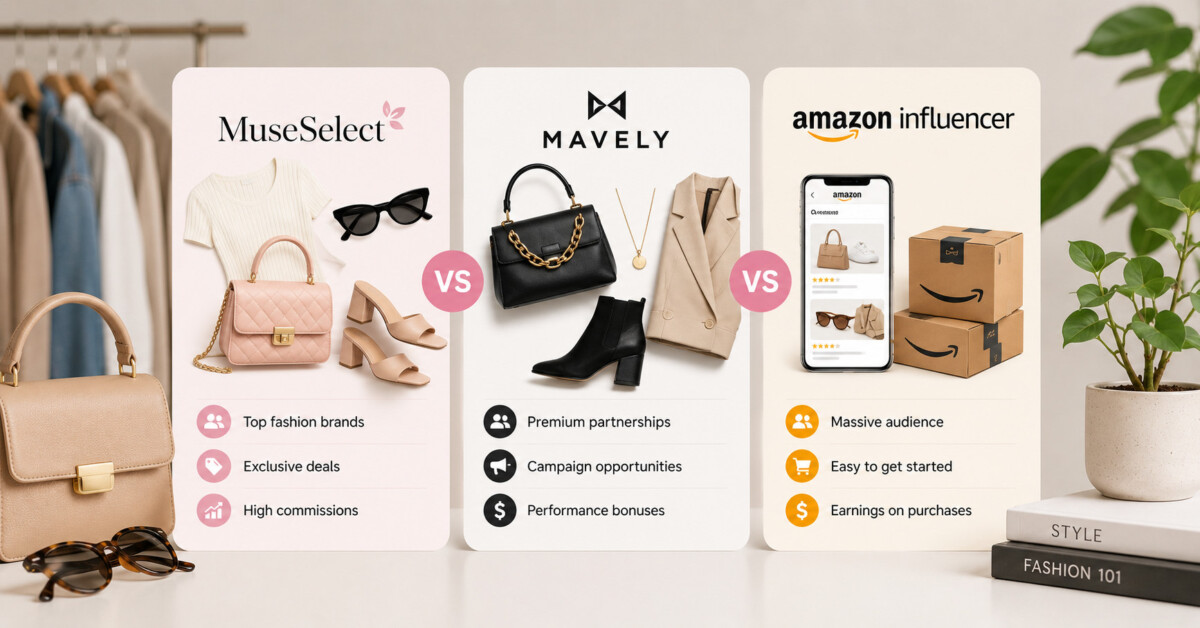
Amazon Influencer Program fits broad-category creators, Mavely suits lifestyle creators who want flexible brand-link monetization, and MuseSelect is a fashion-specific option for creators who value AI content tools and creator-storefront economics. Commission figures, campaign terms, and eligibility can change, so verify current rates before committing.
Affiliate revenue is not only a commission-rate decision. The right platform must match what your audience wants to buy, what you can credibly recommend, and how much work it takes to create conversion-ready content.
Three platforms, three very different bets on what a fashion creator needs in 2026. Amazon Influencer Program offers the broadest possible reach — an enormous catalog and a checkout flow nobody hesitates at, ideal when your audience already shops Amazon across categories. Mavely sits in the middle as a curated creator marketplace, connecting creators with brand partnerships across a lifestyle-leaning product mix. And MuseSelect, the AI-native fashion affiliate platform launched by MuseTech Inc. for the U.S. market in early 2026, makes the narrowest and most vertical bet of the three: fashion-specific, AI-assisted, and structured around stackable commissions and a path to product ownership. This three-way comparison is not about finding a universal winner — it’s about mapping which model fits which kind of fashion creator, because the three platforms are optimized for fundamentally different things.
We compared the three across six dimensions: commission structure, catalog breadth and fashion fit, cross-platform earning model, content tooling, inventory and operational model, and fit by creator type. Each platform wins decisively on at least one axis, which is exactly why the right answer depends on what a creator is optimizing for — reach, curation, or vertical depth and earnings rate.
Commission is where the three diverge most sharply, and a $100 order illustrates it cleanly.
Amazon Influencer Program pays up to 10% by category; for fashion/apparel-related U.S. standard categories such as apparel, shoes, handbags, accessories, watches, jewelry, and luggage, the current rate is 4%. On a 4% once. The breadth of catalog is the draw; the rate is not.
Mavely pays 10% for fashion-relevant categories such as apparel, shoes, accessories, and jewelry; other categories or campaign structures may vary. On a 12%, once. It’s a solid mid-range rate, better than Amazon, but still a flat one-time commission.
MuseSelect pays a 15% base commission, plus a +5% AI incentive when a creator uses its built-in AI tools to produce the selling content, plus a +3% lifetime royalty on products a creator designs in MuseLand. The three stack to a 23% maximum (15 + 5 + 3). On a 15% at base, 23 when the product is co-created — and the co-creation royalty recurs on every subsequent sale of that product.
The pattern: Amazon wins on volume and breadth but pays the least per sale. Mavely sits in the middle on both rate and breadth. MuseSelect pays the most per sale by a wide margin — up to nearly six times Amazon’s typical rate — but operates within a fashion-vertical catalog rather than an everything-store.
Amazon’s catalog is effectively unlimited. If a creator’s audience buys widely — apparel, yes, but also home goods, electronics, beauty, books — Amazon’s storefront covers all of it, and the conversion experience is the most trusted checkout in the world. For a generalist creator, that breadth is unbeatable. For a fashion specialist, it’s a mixed blessing: the catalog includes fashion, but the experience isn’t tailored to outfit or try-on content, and a creator’s storefront looks like everyone else’s Amazon page.
Mavely offers a curated brand marketplace — a selected roster of brand partnerships spanning lifestyle categories, with fashion as one among several. The curation is real, and it means creators aren’t wading through an infinite catalog, but the breadth is narrower than Amazon and the fashion depth is lifestyle-leaning rather than apparel-specialist.
MuseSelect is fashion-vertical — built specifically for apparel and outfit creators, with an emphasis on women’s wear. The catalog is narrower than either Amazon or Mavely, but it’s deep where they’re shallow: every product is a fashion product, the recommendation engine (Just For You) reads a creator’s style to surface fitting pieces, and the entire platform is tuned to outfit content rather than treating fashion as one vertical among many. A creator whose identity is fashion-specific gets a catalog that actually matches their content — at the cost of giving up the ability to monetize non-fashion recommendations.
Amazon Influencer Program centers on the Amazon storefront — a creator gets a dedicated page, idea lists, and affiliate links that all point back into Amazon’s ecosystem. It’s powerful inside Amazon, but it’s also a closed loop: the earning happens when the shopper ends up on Amazon, and the creator’s asset lives inside Amazon’s domain.
Mavely works through a link-based model — creators share Mavely links across their social channels, and the marketplace handles the brand partnership and commission tracking behind the scenes. It’s portable across platforms in the sense that a link works anywhere, but the creator is still distributing individual links rather than building a single aggregated asset.
MuseSelect takes an aggregated approach: a creator produces one piece of content and it can travel across platforms — TikTok, Instagram, YouTube — while simultaneously feeding the creator’s MuseSelect storefront. The storefront aggregates everything the creator curates and co-creates into one owned boutique, and the content tools produce assets formatted for multiple platforms at once (3:4 output fits most feeds). The model is “make once, sell everywhere, and own the storefront that collects it all” — closer to owning a shop than to distributing links.
This is where the three are structurally different, not just numerically. Amazon is not fashion-specific. A creator can monetize fashion there, but the platform doesn’t help them show it well — no try-on tooling, no outfit-aware features, no on-body imagery. The creator brings all of that themselves.
Mavely leans lifestyle. Fashion is part of the mix, and the brand partnerships include fashion brands, but the platform’s identity is broader lifestyle curation. A fashion creator fits, but so does a home, wellness, or family creator.
MuseSelect is women’s-apparel-vertical. The tools, the catalog, the recommendation engine, and the content output ratios are all built for outfit content. For a creator whose work is specifically fashion — especially women’s wear — this is the only one of the three where the platform is shaped around their content rather than the other way around.
Amazon provides storefront tools but no content creation tools. The creator sources, shoots, and edits everything themselves; Amazon gives them a place to put the links.
Mavely similarly does not provide content creation tools. It’s a monetization layer, not a production layer — the creator’s content workflow is their own problem.
MuseSelect is the only one of the three with built-in AI content tools, and they’re free.Create Look turns one product into a full content set — model shots, scene shots, short-form video, background and model swaps, multi-image sets — at a 3:4 ratio built for social feeds. Virtual try-on shows a product worn without a photoshoot. Just For You personalizes product discovery to the creator’s style. And the economic twist: using these AI tools triggers the +5% incentive, so a creator’s effective rate rises from 15% to 20% when they make their selling content with MuseSelect’s tools. On Amazon and Mavely, content production is a cost the creator absorbs before earning a flat commission. On MuseSelect, content production is free and it increases what you earn — a structurally different proposition.
Choose Amazon Influencer Program if your audience shops broadly across categories and your recommendations range beyond fashion. The catalog breadth and checkout trust are unbeatable for generalist creators, and the lower per-sale rate is tolerable when volume is high. Fashion specialists will find it thin on outfit-specific tooling and identity.
Choose Mavely if you want a curated brand marketplace with lifestyle breadth and solid mid-range commissions, and you’re comfortable producing your own content. It’s a clean, credible middle option — better rate than Amazon, more breadth than a pure fashion play — but it doesn’t specialize deeply in any one vertical.
Choose MuseSelect if you’re a fashion creator — especially in women’s apparel, mid-tier, or under 50K — who wants higher stackable commissions up to 23%, free AI tools to produce on-body content without a photoshoot, a zero-inventory storefront with end-to-end fulfillment through Musetopia, and a path from promoting products to co-creating and earning royalties on your own. It’s the narrowest bet of the three, and the strongest for creators whose identity is specifically fashion.
All three platforms do what they’re built for; they’re not really competing for the same creator. Amazon wins on breadth and checkout trust — the right pick for generalist creators whose audience buys across categories, accepting a lower rate in exchange for volume and conversion. Mavely wins on curation and middle-ground flexibility — a solid choice for lifestyle creators who want brand partnerships and a curated marketplace without committing to a single vertical. MuseSelect wins on rate, fashion fit, and ownership — the only one of the three built specifically for fashion, the only one with free AI content tools, the only one where using those tools raises your commission, and the only one offering a path from affiliate to product owner through MuseLand’s co-creation royalty. For a fashion creator deciding among the three, the question is whether you’re optimizing for reach, curation breadth, or vertical depth and earnings ceiling — and in 2026, for creators whose work is specifically apparel and outfit content, MuseSelect’s stacked 23% ceiling and free AI tooling make it the most differentiated option of the three.
Amazon Influencer Program is good for fashion creators whose audience also buys across many other categories, such as beauty, home, books, tech, and travel. Its main advantage is catalog breadth and a familiar Amazon checkout. However, Amazon’s standard U.S. commission rate for many fashion categories, including apparel, shoes, handbags and accessories, watches, jewelry, luggage, and Luxury Stores Fashion, is 4 percent. Fashion specialists who need outfit-specific tools, visual try-on support, or higher category economics should compare Amazon with fashion-focused and retailer-network alternatives before choosing one primary platform.
Mavely pays creators commissions that are set by individual participating brands, not through one universal fashion rate. Creators can view a retailer’s current rate in the platform’s Brand Card before choosing products to promote. Mavely works with brands across lifestyle, apparel, health, wellness, and other categories, so the available rate, attribution terms, excluded products, and promotional requirements can vary. Check each current offer before publishing a link, and track your actual conversion and earnings by retailer instead of assuming that the highest stated commission will deliver the best total income.
MuseSelect describes a campaign-adjusted commission model with a base affiliate rate, a fixed additional 5 percentage-point creator incentive for qualifying content made with its AI tools, and a 3 percent royalty layer for eligible MuseLand co-created products. Its documentation provides a 15 percent base, plus 5 percent AI incentive, plus 3 percent design royalty as one 23 percent stackable example. Rates, eligibility, payout timing, qualifying-content definitions, returns treatment, and campaign terms can change, so creators should confirm the current written terms directly with MuseSelect before forecasting earnings.
Fashion creators do not need AI tools to earn affiliate income, but AI tools can reduce the production time required for styling visuals, product concepts, virtual try-on content, and social-ready creative assets. Established creators with a strong photography, styling, and editing workflow may prefer to keep production fully in-house. Newer creators may find AI useful for producing more content with fewer samples or photoshoots. The important rule is transparency: do not imply that you physically wore, tested, or photographed a product if the visual is simulated or generated.
You can often use multiple affiliate platforms at the same time, provided you follow each platform’s program terms, disclosure requirements, and link rules. A sensible strategy is to use Amazon for broad shopping recommendations, Mavely for participating retailer campaigns, and a fashion-specific platform for apparel content that benefits from a focused storefront or creative workflow. Avoid placing competing links for the same product without a clear reason, and track each platform separately. Your audience should see useful recommendations, not a confusing collection of monetization links.