Ecommerce founders are accustomed to measuring revenue, contribution margin, repeat purchase rate, advertising efficiency and inventory turns. Those figures matter, but acquisition value ultimately turns on a harder question: what will remain—and what could grow—after ownership changes?
A capable company can be both profitable and ready for a fresh owner. A strong ecommerce brand may need international distribution. A SaaS product may need enterprise sales leadership. A content business may have an audience that its founder no longer has the capital or appetite to commercialise. The person who took a company from zero to $3 million in revenue is not automatically the best person to take it from $3 million to $15 million.
The strongest exits are therefore not always produced by holding indefinitely. They often occur when commercial proof is established, the trend remains attractive and the next owner can still see unexploited runway. Selling at that point is not a failure of conviction. It is a decision about where the business can create the most value next.
This is the operating problem behind BrokerAccord, a spin-off from Sitetrail LLC. The relevant point is not simply that another brokerage has entered the market. It is that digital businesses require a transaction process capable of understanding how acquisition channels, recurring income, owner dependence, data quality and platform concentration affect transferable value.
Most acquisition processes are assembled from disconnected components. A marketplace generates an inquiry. A broker circulates a memorandum. Offers arrive by email. Funding information sits elsewhere. Diligence moves into folders or a virtual data room. Questions accumulate across spreadsheets, inboxes and calls.
Each component can function correctly while the transaction as a whole loses its reasoning. The missing element is a continuous decision record connecting the original proposition to the evidence eventually tested by the buyer.
A useful record should answer four questions:
Consider a seller claiming that revenue is diversified. The public summary may state that no single channel dominates. After an NDA, the prospectus can disclose the channel mix. During diligence, processor statements, platform exports and accounting records can test the claim. If one marketplace actually represents 72% of revenue, the record should show how that discovery affected the multiple, working-capital assumptions or holdback—not merely bury the finding in an email thread.
BrokerAccord’s buyer process follows this progression. A public listing provides enough context to assess relevance without revealing the company. A listing-specific NDA opens the identity and detailed prospectus. A structured offer records price, terms, timing and funding route. Source evidence remains controlled until a selected buyer has executed the letter of intent.
The purpose is not to create more gates. It is to increase access as commitment increases. A public visitor does not need bank statements; a buyer considering fit needs more than a teaser; and a counterparty receiving exclusivity needs enough evidence to test the investment case.
BrokerAccord’s research into business valuation multiples examined 200 publicly advertised businesses and considered seven additional high-value opportunities from a specialist source. Across the 200-listing sample, the median asking price was 3.00 times claimed annual earnings—an implied headline earnings yield of 33.3% before tax, financing, reinvestment and transaction costs.
The category medians were not uniform:
External transaction evidence places those asking medians in a plausible range. Ecommerce data, drawn from hundreds of closed transactions, reports an average of about 3.0 times seller’s discretionary earnings over the last 12 months, with the middle half of transactions ranging from 1.8 to 3.2 times before inventory adjustments. IBBA and M&A Source’s Q4 2025 Market Pulse reported average multiples of 3.0 times SDE for $500,000–$1 million deals and 3.1 times for $1 million–$2 million deals. Larger transactions were higher: 4.1 times EBITDA for $2 million–$5 million deals and 5.5 times for $5 million–$50 million deals.
These are not directly interchangeable measures. The BrokerAccord sample contains public asking prices and inconsistent definitions of profit; the external sources include completed deals and divide SDE from EBITDA by transaction size. The comparison is useful because it shows that the 3.00-times median is credible—not because it converts an asking-price sample into a closed-deal dataset.
The distinction between asking and closing prices is material. There are brokers with a public scoreboard currently reporting an average sale at 86% of list price and an average duration of 130 days. That is a marketplace-specific result rather than a universal discount rule, but it is a useful warning against treating the advertised price as the transaction value.
The sample also has selection effects. It captures businesses publicly offered for sale, not private transactions, failed listings or companies whose owners chose not to market them. Earnings were variously described as SDE, EBITDA or net income, and the underlying claims were not uniformly audited. The research is best read as a transparent map of market expectations.
At the upper end, one B2B aviation SaaS listing asked 8.98 times earnings. The disclosed case combined strong growth, recurring B2B revenue and reported churn below 1%—characteristics that can support a premium because they imply retention, visibility and strategic relevance. It remains an asking-price outlier, not evidence that every SaaS company deserves an eight- or nine-times multiple.
The good news for owners is that valuation ceilings are rising where high-quality attributes genuinely converge. Recurring revenue, low churn, proprietary workflows, defensible data, efficient customer acquisition and low owner dependence can move a business well beyond a generic category median.
A diversified ecommerce company can also outperform the baseline. A recognised brand with healthy repeat purchasing, several profitable acquisition channels, reliable suppliers and documented operations should not be valued like an undifferentiated marketplace storefront.
The opposite is equally true. Adding the labels “AI,” “subscription” or “technology” cannot convert unstable revenue into premium earnings. The widening valuation range is evidence of discrimination, not indiscriminate optimism. Buyers are paying more for scarcity and quality while remaining realistic about concentration and execution risk.
A multiple should therefore be the conclusion of analysis rather than its starting point. Growth, durability, transferability and the quality of supporting evidence explain why two companies with identical current profit can attract very different offers.
Holding a business for too long can destroy as much value as selling too early. If an owner waits until growth has stalled, the team is tired, investment has been deferred and the reason for selling is visible in the accounts, the negotiation changes. The buyer is no longer paying to participate in momentum; the buyer is being asked to restore it.
The right time to consider a sale may be when:
A capable broker should not use operational weaknesses as an excuse for failing to generate interest. The job includes accurate positioning, reaching credible counterparties, creating competitive tension and maintaining momentum. Realism means separating fixable presentation gaps from risks that should affect price—and from imperfections a better-resourced buyer may regard as opportunity.
The following are composite illustrations rather than claimed BrokerAccord closings, but they show why decision quality matters:
None of these findings automatically kills a transaction. The important question is whether the issue is discovered early enough to be priced and structured rather than becoming a late surprise.
Two offers described as “$3 million” can have very different economics. Offer A pays $3 million at closing. Offer B pays $2.1 million at closing, provides a $450,000 seller note, makes $300,000 contingent on future performance and retains $150,000 against post-closing claims.
Offer B delivers only 70% of the headline price immediately. The seller carries credit risk on the note, operating risk on the earnout and claims risk on the holdback. It may still be an acceptable offer, particularly if it raises the achievable headline value, but it is not economically equivalent to cash at close.
This is why transaction software should display payment timing, conditions and risk allocation—not merely the total consideration.
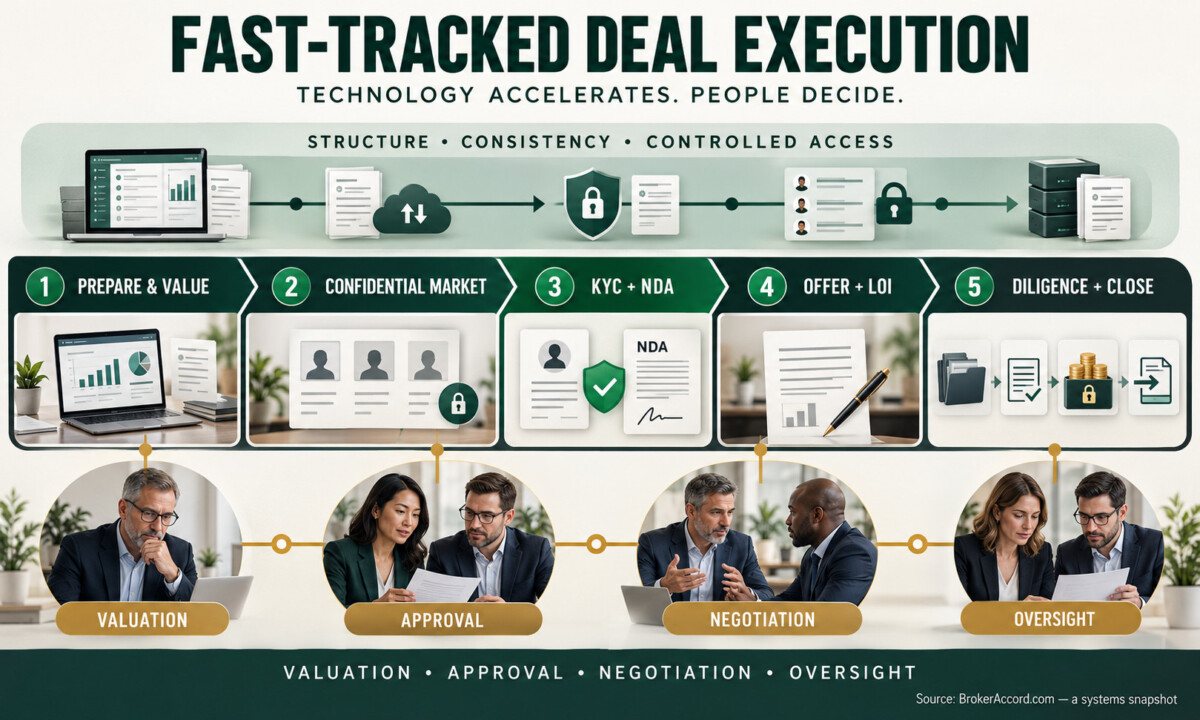
The useful role of technology in M&A is narrower than the phrase “AI-powered” suggests. A system should structure seller submissions, identify missing trailing-twelve-month financial or channel information, keep proposed add-backs consistent across the prospectus and evidence record, and reveal which material claims still lack support.
In the BrokerAccord model, one structured seller submission forms the foundation for the public brief, confidential prospectus and eventual diligence record. Public information is separated from identity and source evidence. Offers capture commercial terms and funding routes before LOI progression. The selected buyer then receives controlled access to the evidence room.
Its public analysis tools expose assumptions around business quality, valuation, owner independence, consideration structure and evidence readiness rather than presenting a black-box score as truth.
The verification boundary must remain explicit: a reviewed marker indicates that supporting evidence was examined for a stated claim. It is not an audit, certification, guarantee of truth or prediction of future performance. Technology can reduce inconsistency and administrative delay. It cannot remove commercial, legal, tax or technical risk. That is precisely why human experts such as lawyers, analysts and accountants converge in the evidence room.
BrokerAccord was built for a balance of speed and rigour, after Brits spent years co-ordinating KYC systems for banks and accounting firms, through the development arm of Sitetrail. A rigorous process is not costless. Percentage-based success fees remain common in digital-business brokerage, although published structures vary materially with deal size and service scope. One current tiered schedule charges 15% on the portion up to $700,000, 8% from $700,000 to $5 million and 2.5% above $5 million. BrokerAccord’s seller fit check discloses a 10% success fee payable when a transaction closes. Sellers should compare not only the percentage, but also what preparation, negotiation, diligence coordination, escrow support and transfer work are included.
Timelines are similarly conditional. Whereas a 14 day exit is not uncommon, the 130-day marketplace average cited earlier offers context, not a promise. Evidence gaps, slow buyer responses, financing uncertainty, customer concentration, platform-transfer restrictions and poorly defined owner responsibilities can all stall a credible deal.
BrokerAccord’s present public case is therefore process-led. Until a larger body of completed transactions is available, it should be judged on the quality of its preparation standards, the coherence of its transaction record and—over time—its actual closing outcomes. Early-stage candour is more persuasive than implied maturity.
The investor-attitude findings incorporated into the BrokerAccord report add another perspective. Dr. Luigi Wewege, President of Caye International Bank, reported that only 5% of high-net-worth participants in the bank’s internal research were aware of opportunities to acquire profitable SaaS and ecommerce businesses in the $1 million–$5 million range, compared with 70% awareness of AI and data-centre investments.
The methodology consisted of in-person interviews with high-net-worth individuals encountered at conferences globally and during private consultations. It was not a randomized public survey, and the underlying respondent file has not been independently published. The percentages should therefore be treated as directional evidence of attention asymmetry rather than population-wide estimates.
Wewege’s interpretation is appropriately cautious: profitable digital businesses may offer greater yield, but they also carry greater operational risk than lower-yield real estate. Diversification, geographic exposure and individual risk tolerance remain central. Low awareness can indicate an overlooked opportunity; it does not make the asset class safe.
Adriaan Brits approached brokerage from operating experience rather than solely from corporate finance. His background includes more than two decades of online-business ownership, an MSc in Marketing and experience teaching advanced analytics, media buying and search strategy at LinkedIn. Through Sitetrail, his work has covered marketing systems and commercial strategies associated with substantial client revenue.
That perspective matters because digital-business valuation requires more than reading financial statements. Traffic quality matters more than traffic volume. A profitable revenue channel can also be dangerously concentrated. A marketing advantage has little transferable value if it exists only inside the founder’s head.
One Sitetrail operating and strategy example—not a BrokerAccord brokerage closing—involved reducing an Amazon seller’s dependence on that marketplace from approximately 80% of revenue to 25%, increasing total revenue by 300% and ultimately contributing to a $5 million exit. The value was not created by selecting a more optimistic multiple. It was created by changing the company’s risk profile and bringing the business to market while the improved growth story remained visible.
This is the connection between operating strategy, timing and brokerage that the market has often missed.
The real test of a transaction platform is not how many businesses it displays. It is whether qualified buyers can understand opportunities faster, whether strong sellers can defend their value and whether material uncertainty is surfaced early enough to be resolved rather than weaponised late in negotiations.
BrokerAccord’s integrated design—valuation, confidential presentation, buyer qualification, structured offers, funding routes, evidence control, negotiation, escrow and transfer—offers one concrete response to that need. Its credibility will depend on maintaining explicit verification boundaries, resisting inflated presentation and publishing transaction outcomes as the evidence base grows.
The wider market does not need more certainty theatre. It needs a place where buyers can find credible opportunities, sellers can make the strongest defensible case for value, and uncertainty can be identified, priced and progressively resolved.
That is the standard by which BrokerAccord—and any serious business-acquisition platform—should be judged.
Disclaimer: This article is for general information only and does not constitute investment, financial, legal, tax or valuation advice. Business acquisitions involve substantial risk. Buyers and sellers should conduct independent due diligence and consult appropriately qualified advisers before entering a transaction.