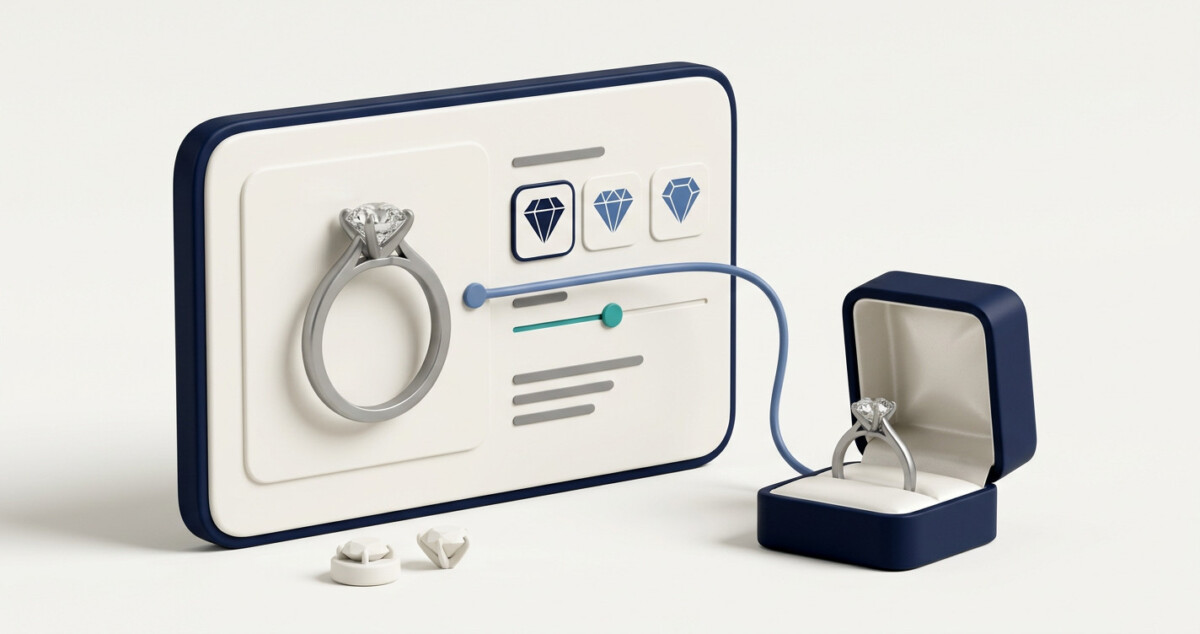
Online custom jewelry changes fine jewelry buying by letting customers collaborate with a jeweler, review digital designs, and approve specifications before production. The strongest experiences combine that creative control with clear pricing, realistic timelines, documented approvals, and evidence of finished craftsmanship.
The hardest part of selling custom jewelry online is not showing customers more options. It is making the next decision clear before that decision becomes expensive to reverse.
Buying fine jewelry online used to mean choosing from a catalog of finished products and hoping the photographs gave an accurate idea of what would arrive. That model still works for mass-produced jewelry, but technology has made it possible to bring a much more personalized experience online.
Custom jewelry is one of the areas where that shift is especially noticeable. Instead of limiting customers to existing styles, jewelers can now collaborate remotely, develop original designs digitally, share renderings for approval, and manufacture pieces only after the customer is satisfied with the concept.
That changes the role of ecommerce. The website is no longer just a storefront. It becomes part of the design process.
Fine jewelry has always been connected to important moments: engagements, anniversaries, graduations, birthdays, career milestones, memorials, and family traditions. Those occasions are personal, so it makes sense that some buyers want jewelry that feels personal too.
Traditional retail jewelry stores are often built around inventory. The customer chooses from pieces that have already been produced or selects from a limited menu of modifications.
A custom process starts somewhere else entirely.
Instead of asking, “Which ring do you want?” or “Which pendant do you prefer?”, the conversation can begin with an idea.
That idea might be a family symbol, a handwritten signature, a company logo, a favorite gemstone, a meaningful date, or even a rough sketch. The jeweler then interprets that idea and develops it into something that can actually be manufactured and worn.
Businesses such as Valeria Custom Jewelry have built their process around this type of online collaboration, allowing customers to participate in the design of a piece without needing to visit a physical showroom.
One of the biggest reasons this model works online is computer-aided jewelry design.
In the past, commissioning custom jewelry often required a great deal of trust. Customers might see a hand sketch or wax model, but it could still be difficult to visualize the final piece.
CAD allows a jeweler to create a detailed three-dimensional digital model before production begins. The design can be viewed from multiple angles, adjusted, and refined before it is cast.
That gives customers the opportunity to make decisions about proportions, lettering, stone placement, metal combinations, and other details while changes are still relatively easy.
For ecommerce businesses, this is important because it reduces one of the biggest obstacles to selling custom products online: uncertainty.
A customer may never physically hold the piece during the design stage, but digital renderings can provide a much clearer understanding of what is being created.
Some types of jewelry are especially suited to this process, and pendants are a good example.
A pendant offers a large amount of design flexibility without many of the sizing complications associated with rings. Customers can use initials, words, symbols, logos, religious imagery, family crests, meaningful objects, or completely original artwork.
That makes custom pendants a natural fit for online design. Reference images can be uploaded, design ideas can be discussed remotely, and the finished piece can be created around the customer’s preferred size, metal, stones, and budget.
A pendant can also be subtle or dramatic depending on the customer’s preference. A simple gold design may be worn every day, while a larger diamond or gemstone piece can be built as a statement item.
The flexibility gives jewelers room to solve design problems creatively instead of forcing every customer into the same template.
There is a common assumption that custom jewelry must be designed face-to-face, but remote collaboration can actually simplify the process.
Customers do not have to schedule an appointment, travel to a store, or make every decision in a single visit. They can send reference images, review designs, and respond when convenient.
That can also improve communication.
A customer who sees a rendering on a screen can study it carefully rather than feeling pressure to approve something while standing at a counter. They can compare versions, ask for changes, or involve another person in the decision.
For jewelers, digital communication creates a record of design decisions and approvals. That can reduce misunderstandings about details such as dimensions, stone type, lettering, or metal color.
In other words, ecommerce is not merely a substitute for a physical showroom. In some cases, it can create a better workflow.
One misconception about custom jewelry is that every project has to be elaborate or extremely expensive.
Customization can be as simple as changing proportions, combining design elements, using an unusual stone, or adding a personal detail that would not exist in a stock piece.
A customer might want a cleaner version of a traditional ring, a pendant based on a logo, or a specific gemstone combination. Those changes can still make the jewelry unique without turning the project into an overly complicated design.
The best custom process is not about adding as many details as possible. It is about deciding which details actually matter.
Good design often means knowing what to leave out.
The online model also changes the economics of custom jewelry businesses.
A jeweler no longer has to depend primarily on customers who live nearby. Someone with a specialized style or expertise can work with clients throughout the country.
That is particularly useful for niche projects.
A customer looking for an unusual class ring, custom logo pendant, nontraditional wedding band, or highly specific gemstone design may not find the right jeweler within driving distance. Online search allows them to find a business whose work actually matches the project.
For the jeweler, that means expertise becomes more important than location.
Instead of competing only with nearby stores, the business can attract customers who are specifically searching for the kind of work it does best.
Technology makes online custom jewelry possible, but it does not eliminate the need for trust.
Customers may be spending thousands of dollars on something they cannot see in person before production. Clear communication, transparent pricing, accurate renderings, realistic timelines, and a professional approval process are essential.
Photographs of completed work also matter because they show how digital designs translate into finished jewelry.
An ecommerce site selling custom work therefore has a different job than one selling standardized products. It must explain not only what is being sold, but how the process works and what the customer can expect.
The most successful online custom jewelry businesses are not simply adding a shopping cart to a traditional jewelry model. They are designing the entire experience around remote collaboration.
Ecommerce is often associated with speed and convenience, but custom jewelry shows that online shopping can also become more personal.
Digital tools allow customers to participate in the creation of a piece in ways that were once difficult to manage remotely. Instead of choosing among hundreds of nearly identical products, they can begin with an idea and watch it develop into something made specifically for them.
That may be one of the more interesting directions for fine jewelry ecommerce: not simply offering more inventory, but offering customers more control over what gets created in the first place.
Online custom jewelry merchants need to clarify design previews, deposits, revision limits, practical fit, and production approval before customers commit to a commissioned piece.
Buying custom jewelry online generally involves sharing an idea, agreeing on a design direction and quote, reviewing the design, and approving production. Payment timing varies by jeweler, and detailed design work can require a deposit. Customers should provide references, preferred materials, approximate dimensions, budget, and any required delivery date. Before paying, confirm the revision policy, production estimate, cancellation terms, and shipping arrangements. The process differs from buying ready-made jewelry because the customer is approving work that has not yet been manufactured.
Customers should check dimensions, proportions, lettering, stone placement, and construction details in a CAD jewelry preview before approving production. Request multiple views and written measurements rather than judging the design from one enlarged image. For a pendant, confirm the bail and chain compatibility; for a ring, confirm the agreed sizing method and relevant fit details. A rendering helps communicate a design but does not independently prove craftsmanship or reproduce the exact appearance under every lighting condition. Photographs of comparable finished work provide additional context.
A jewelry store should explain when deposits are due, what work they cover, which revisions are included, and when changes require a new quote. Put those terms in writing before payment rather than introducing them after the customer requests a revision. Distinguish adjustments within the agreed design from a new concept or changes after production starts. For example, Valeria’s published pendant process requires a 50% deposit before detailed CAD work and allows reasonable in-scope changes before casting. Other jewelers can use different arrangements, so seller-specific terms matter.
Designing a custom pendant online requires a clear idea or reference, approximate dimensions, preferred metal, stone preferences, budget, and information about the intended chain. A photograph, logo, sketch, or written description can start the discussion without a professional drawing. Chain dimensions matter because the pendant’s bail must accommodate the chain’s size and shape. The jeweler should also explain whether small details need simplification at the requested scale. Confirm whether the quote includes a chain, since a pendant and a complete necklace are not necessarily the same offer.
A custom jewelry order should move into production after the customer approves the final design and specifications and meets the seller’s agreed payment requirements. The approval record should identify the design version, dimensions, metal, stones, lettering, relevant fit details, and project-specific delivery estimate. Resolve unanswered questions before treating approval as complete. Changes after manufacturing starts can require additional work and charges, so the customer should understand that boundary in advance. A clear production handoff protects both the buyer’s expectations and the jeweler’s ability to deliver the approved piece.