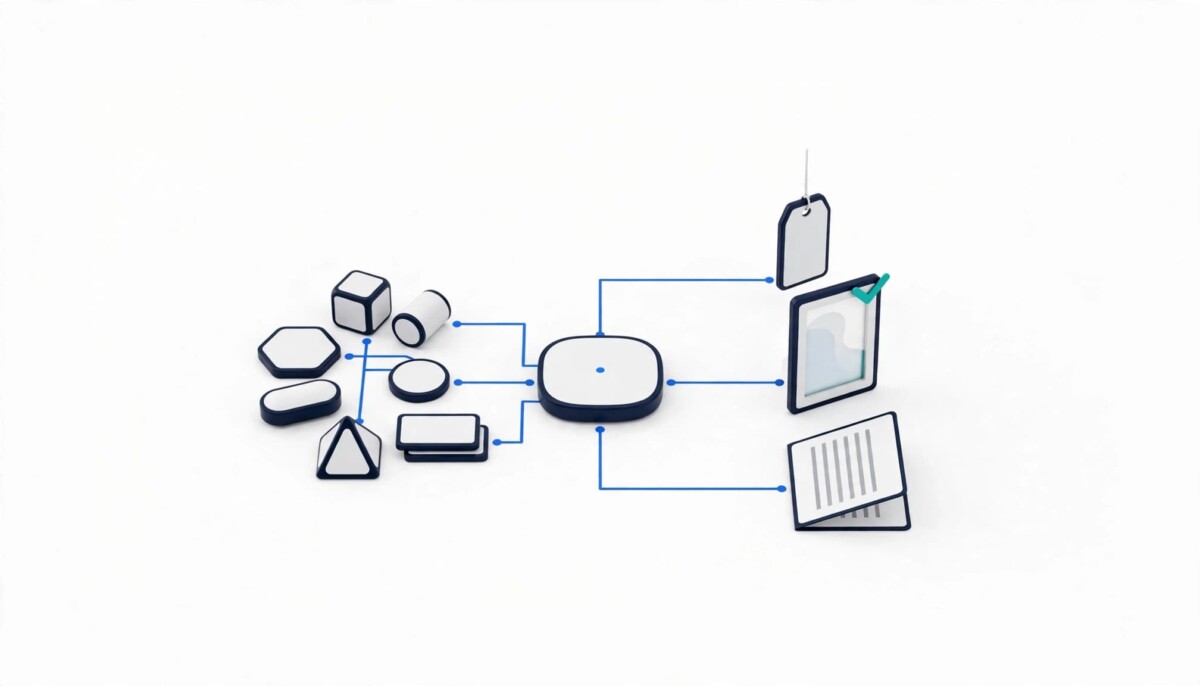
Most Shopify merchants do not need an AI API gateway, because their AI arrives through apps. Teams building their own AI features should pick by who runs the layer: Vercel AI Gateway, GPTProto, Requesty, or Eden AI for managed access, Portkey for governance, and LiteLLM or Bifrost for self-hosting.
A gateway solves the reliability and billing problem for whoever holds the API key. If your AI arrives through apps, that is not you yet, and the cheapest gateway is the one you never install.
An ecommerce business may use AI in product copy, campaign visuals, internal support tools, and customer facing assistance. Those features create different demands on the systems behind them. A short product description can return in seconds, while a generated campaign video may need a background job, storage, and approval before anyone can use it.
Choosing an API service is therefore an operating decision as well as a development decision. The useful shortlist depends on who manages access, how spending is allocated, and which model features each workflow actually needs. Many merchants under a few million in revenue never reach this decision at all, because the apps they already pay for make it for them. This list is for the teams that have started writing their own AI code.
If a team is considering OpenRouter alternatives, these seven options provide several different paths. They are not ranked from best to worst; the order follows the contributor’s original evaluation, not merit. Each has a distinct reason to enter an evaluation, and none should be selected solely because it advertises a broad model catalog. The comparison grid and the stage guidance after the seven entries are built to help you narrow the list to your own situation.
These seven options were chosen because each gives an ecommerce application access to models from more than one provider through a single integration, which is the job OpenRouter does today. The list keeps the seven services in the contributor’s original evaluation; GPTProto contributed this piece and is one of the seven, so every entry, GPTProto included, gets the same structure and the same limitations treatment. Pricing and features were checked against each vendor’s public pricing and documentation pages on October 23, 2026. No service was load tested for this piece, and vendor performance figures are reported as vendor claims. Every option is judged on the same five criteria: hosting model (managed or self-hosted), fee structure, spend and access controls, modality coverage beyond text, and failover behaviour. OpenRouter itself is the baseline and is not an entry; its OpenRouter pricing page lists a 5.5% platform fee on the standard pay as you go plan as of October 2026. TrueFoundry AI Gateway and LangDB, both covered in our earlier piece on what merchants control when AI tools go down, were considered and not added, because entries without the same verification pass would make the comparison uneven.
The seven OpenRouter alternatives split into managed access (Eden AI, GPTProto, Requesty, Vercel AI Gateway), governance (Portkey), and self-hosted gateways (Bifrost, LiteLLM). The grid summarises each in one row, with pricing as of October 2026.
Vercel AI Gateway is a managed multi provider gateway that bills models at provider list price, and it can be called from any infrastructure, not only applications hosted on Vercel.
Vercel AI Gateway is most often discussed by teams already building with Vercel and its AI SDK, but the Vercel AI Gateway documentation describes a service your application can call from anywhere, compatible with the OpenAI and Anthropic API formats. Vercel lists more than 400 models covering text, image generation, video generation, speech, transcription, and embeddings, with provider failover, ordered fallbacks, and request logs showing cost, latency, and routing attempts. A customer support assistant and an internal catalog tool may share some infrastructure, but they should not automatically share the same prompts, data access, or spending limits, so check how the arrangement supports your application’s actual boundaries.
As of October 2026, the Vercel AI Gateway pricing page states no markup and no platform fee on tokens: you pay provider list price from prepaid credits, and bring your own key also carries no markup. A monthly free credit covers a subset of models. Add ons such as custom reporting and trace drains are billed separately.
The strengths are price transparency and modality breadth. Zero token markup is the lowest fee structure on this list, and image and video generation sit behind the same integration as text. Budgets can be set per team, project, API key, or member.
Two limitations matter. Budgets are soft caps that track only spend on Vercel’s credentials; bring your own key spend is not counted, and a failed bring your own key request can fall back to Vercel credentials and bill your credits. Purchased credits expire after one year, and payment processing fees apply outside Enterprise invoicing.
Best fit: Teams of any size with a developer who wants managed access, list price billing, and text plus media under one integration. For a pilot, choose a narrow feature and verify the models, request format, output handling, and billing behaviour.
Skip if: You need hard spending caps enforced by the gateway itself. Do not let ecosystem familiarity stand in for a test of the task.
GPTProto is a pay as you go AI API aggregator that gives ecommerce teams one account for text, image, and video models, for teams that want less repeated setup across separate providers.
GPTProto is a candidate when a roadmap combines text generation with image or video workflows. The GPTProto homepage lists more than 200 models, including image models such as GPT Image 2, Midjourney, and Seedream, video models such as Kling, Vidu, Wan, and Seedance, and some text to speech models, plus an automatic failover claim across redundant upstream channels. The useful benefit to investigate is access convenience. It should not be confused with running a custom model stack or replacing every enterprise gateway control, so confirm the required models and operations before assuming GPTProto covers the full roadmap.
As of October 2026, the GPTProto pricing page lists pay as you go credits with no subscription and no minimum, top up bonuses from 3% at $50 to 7% on custom amounts, and credits that do not expire. Media is billed per output; the homepage lists Seedance 2.0 at $0.26 per five second clip.
GPTProto’s strengths are media coverage under one balance and simple billing. Treat media generation as its own workflow: the application may need to track a pending job, retrieve an output, copy it into controlled storage, and send it for approval, and having those models behind one account shortens that integration work.
The limitations deserve weight. Top ups are generally non refundable, so buy credits in amounts you expect to use. GPTProto’s discount claims differ across its own pages (the pricing page says models average 20% below official list prices, with per provider figures that vary widely), so price your actual models rather than an average. The main site does not list bring your own key support or published rate limits, and its Enterprise option describes volume pricing without published terms.
Best fit: Small and mid sized teams, from a solo developer upward, shipping a mix of product copy and generated campaign visuals who want one balance instead of several provider accounts. Compare accepted outputs and operating effort rather than catalog size.
Skip if: You need contractual enterprise terms, bring your own key routing, or published rate limits before you commit. GPTProto is a convenience layer, not a governance layer.
Portkey is an AI gateway and observability platform for organisations that need to control and understand AI traffic across several teams, now sold by Palo Alto Networks as Prisma AIRS AI Gateway.
Palo Alto Networks completed its acquisition of Portkey in 2026, and the portkey.ai site now presents the offering as Prisma AIRS AI Gateway, so current documentation and plan details should guide the comparison. The Portkey site lists access to more than 1,600 LLMs with routing strategies, caching, budget limits, role based access, PII redaction, and SSO, and its pricing page adds automatic fallbacks and load balancing in the open source gateway. For an ecommerce operation, that oversight matters when several teams use AI independently. Marketing may generate campaign content, support may draft replies, and product operations may enrich listings. These workflows need separate ownership even if they use overlapping models.
As of October 2026, the Portkey pricing page lists a free Developer tier with 10,000 recorded logs per month and three day retention, marked not suitable for production, a Production tier at $49 per month for 100,000 logs plus $9 per additional 100,000, and custom Enterprise pricing. A self-hosted open source gateway is also offered.
Portkey’s strengths are visibility and policy: request level observability, spend allocation, and guardrails in one place, now backed by an enterprise security vendor.
The limitations are about fit and direction. Pricing is metered on recorded logs rather than tokens, and the Production tier keeps logs for 30 days. The acquisition announcement says little about the standalone product or the open source gateway, so ask about roadmap commitments before you build on either. Portkey may also be more infrastructure than a small, single purpose feature needs.
Best fit: Brands, usually $10M and up, where several departments run AI features and leadership wants spending and policy visible by team. Confirm the exact Portkey capabilities in the chosen offering.
Skip if: You run one AI feature owned by one person. Make operational control an explicit purchasing requirement before committing.
Eden AI is a unified API from a Lyon based company that covers large language models alongside specialist services such as OCR, speech, translation, and document parsing.
Eden AI is worth considering when the application spans several types of AI work rather than just text generation. The Eden AI homepage lists around 1,000 models across more than 50 providers, routing that can sort providers by cost, speed, or latency, fallbacks that bill once, and per response cost reporting that can be grouped by team, product, or end user. For a retailer combining invoice processing, call transcription, and generative product copy, that breadth can remove several separate supplier contracts. Think in terms of business outputs: an extracted invoice field, a transcription, and a product description are not interchangeable responses, and each needs a defined format and a rule for handling missing or uncertain information.
As of October 2026, the Eden AI pricing page lists no subscription, provider prices passed through at 0% markup, and a 5.5% platform fee applied when you buy credits. Specialist services are priced per unit, for example the Microsoft invoice and receipt parser on Eden AI at $0.01 per page.
Eden AI’s strengths are breadth beyond text and data residency. Eden AI offers an EU endpoint that refuses non EU models and states zero data retention by default, which matters for brands selling into Europe. Failed fallback attempts are not billed.
Two limitations stand out. The 5.5% credit fee matches OpenRouter’s standard plan, so Eden AI is not a fee saving on text alone. And neither the pricing page nor the homepage mentions bring your own key support or image and video generation, so a roadmap that leans on generated campaign visuals needs separate confirmation.
Best fit: Mid market and larger retailers whose AI roadmap mixes document, speech, and text work, especially with EU customers or EU data handling requirements. Test the actual Eden AI services and providers the workflow needs, including input limits and result structure.
Skip if: Your only use case is text generation and fees matter, or your roadmap centres on image and video generation. Do not assume every service in a catalog is required for the ecommerce project.
LiteLLM is an open source, OpenAI compatible proxy and SDK from BerriAI that engineering teams self-host to put one provider interface in front of their product features.
LiteLLM can suit an ecommerce engineering team that wants a deliberate application controlled boundary between product features and the underlying models. The LiteLLM repository on GitHub describes access to more than 100 LLM APIs with load balancing, fallbacks, and logging to tools such as Langfuse, and the LiteLLM budgets documentation covers spend limits per key, user, or team, with per model budgets on Enterprise. LiteLLM deploys through Docker, Helm, or Terraform. That approach can help organise a growing set of integrations; the same boundary also becomes an operational responsibility, with configuration, credentials, updates, and availability to manage.
As of October 2026, the LiteLLM open source proxy is free under the MIT license, except for its enterprise directory. LiteLLM Enterprise is priced on usage by quote, with a 30 day trial.
LiteLLM’s strengths are control and community. A team owns its routing, budgets, and logs without per token fees, and the project’s wide adoption means common provider quirks are usually already handled.
The limitations show up at governance time. Audit logs, JWT authentication, SCIM, IP allowlists, tag based budgets, and per team guardrails sit behind the paid licence, and SSO is free only up to five users. LiteLLM Enterprise is described as self-hosted, so the team runs the infrastructure either way. A retailer with a small development function may value a managed service differently from an organisation with an established platform team.
Best fit: Brands with a platform team that already operates containers in production and wants to own the gateway layer across several AI features. Validate the provider integrations and controls in the actual LiteLLM deployment, not a generic description.
Skip if: Nobody on the team would own upgrades and uptime. Use LiteLLM when ownership is an advantage the team can support, not a chore it inherits.
Requesty is a managed AI gateway and model router that adds routing, caching, and spending controls on top of model access, for teams that need more than a convenient first model request.
The Requesty homepage lists more than 600 models, failover, weighted load balancing, latency and geography based routing, caching on repeated context, and monthly spend limits per key, user, team, or organisation with alerts. Switching from another provider is a base URL change. For example, a retailer may want to manage several AI features without allowing one campaign experiment to obscure the spending associated with customer support. Requesty also runs an EU gateway in Frankfurt with an option to enforce zero data retention.
As of October 2026, the Requesty pricing page lists a 5% markup on provider rates (a model listed at $10 per million tokens costs $10.50), no per seat fee, and no minimum spend. A free plan covers free models only, at 200 requests per day.
Requesty’s strengths are spend separation and routing without self-hosting. Per key and per team limits make the campaign versus support budget problem easy to enforce, and bring your own key is listed on the pay as you go plan.
The limitations: the 5% markup applies to every token, which compounds at high volume, and SSO, role based access, audit logs, and guardrails are Enterprise only. Requesty does not state an uptime SLA on its public pages. Define when a model substitution is acceptable and when a workflow must stop instead, because a fallback is not useful if it returns an output the application cannot use.
Best fit: Growth stage brands with one or two developers running several AI features who want managed routing and per team budgets without operating infrastructure.
Skip if: Your token volume is large enough that 5% is a meaningful line item, or you need SSO and audit logs without an Enterprise contract.
Bifrost is an open source AI gateway from Maxim AI, written in Go, for engineering teams that want to run the access layer themselves and care about the latency that layer adds.
Bifrost sits between your application and the model providers and exposes one interface for them, with fallbacks, budgets per team or virtual key, an MCP gateway, guardrails, and OpenTelemetry tracing listed on the Bifrost product page. The Bifrost repository on GitHub describes support for more than 23 providers and 1,000 models, deployable through npx, Docker, a Go SDK, Helm, or Terraform. Bifrost belongs on a shortlist when an engineering team wants to evaluate gateway ownership and supported deployment choices directly. The key question is not whether self-hosting sounds flexible. It is whether the team benefits from controlling the access layer and can maintain it over time.
As of October 2026, the Bifrost open source gateway is free under the Apache 2.0 license. Bifrost Enterprise pricing is not published; Maxim offers a license request and a 14 day trial.
Bifrost’s clearest strength is overhead. Maxim’s own benchmarks claim about 11 microseconds of gateway overhead at 5,000 requests per second on its test hardware, and a large latency advantage over LiteLLM. Treat those as vendor figures until you reproduce them. The second strength is the permissive license: Apache 2.0 lets a team modify and embed Bifrost without copyleft obligations.
The limitations are real. Configuration, credential handling, upgrades, and operational recovery remain part of the cost of the design, and nobody else carries them. The repository also lists adaptive load balancing, clustering, guardrails, and the MCP gateway among enterprise features, so keep advanced enterprise features separate from assumptions about an open source Bifrost deployment, and confirm which features your intended setup includes before you plan around them.
Best fit: Brands with an established platform or DevOps function, typically several AI features in production, and a clear technical reason to own more of the gateway boundary. Use a representative integration test that verifies the selected providers, required request fields, and failure behaviour in the intended Bifrost by Maxim AI setup.
Skip if: You are a retailer adding one small AI feature or nobody on the team is on call for infrastructure. Bifrost is not automatically the simplest choice, and a managed service will reach production sooner.
The right gateway depends first on whether you write AI code at all, then on who would maintain the layer, and only then on price. Merchants doing $10K to $1M a month typically run AI through apps, and for them the useful move is a procurement question to each app vendor (which model provider do you use, and what happens when it fails) rather than any service on this list.
If you have one developer building your first custom feature, such as a product description generator wired to your catalog, start managed. Vercel AI Gateway fits when list price billing and broad modality coverage matter most. GPTProto fits when generated images and video are central and you want one balance. Requesty fits when you already know you will run several features and want monthly limits per key from day one. And if you call one provider for one feature, calling that provider’s own SDK directly with retries in your application is a valid choice; a gateway earns its place once you need a second provider or separate budgets.
If you are a $5M to $20M brand with two to five developers and several departments shipping AI, the question shifts to visibility. Portkey’s per team observability earns its cost here, and Requesty remains a managed alternative with lighter governance.
If you have a platform team that already runs containers, LiteLLM and Bifrost become realistic. LiteLLM has the larger ecosystem; Bifrost leads on claimed latency and a permissive license. Either one turns a fee into payroll and on call time, which is a good trade only if that capacity already exists.
If your roadmap is document heavy (invoices, supplier PDFs, call transcripts), Eden AI covers more of it than any text focused gateway.
Here is the fee trade in numbers, using pricing as of October 2026. Illustrative example, assuming $3,000 a month of model spend at list price: Vercel AI Gateway adds no token fee, Requesty’s 5% markup adds about $150, and Eden AI’s 5.5% credit fee adds about $165, roughly the same as OpenRouter’s listed 5.5% standard fee. Portkey starts at $49 a month plus log volume. LiteLLM and Bifrost add no licence fee in their open source form, but their hosting and the engineer hours to run them can easily exceed $150 a month on their own. The cheapest option on paper is rarely the cheapest per accepted output.
The durable way to choose among these seven services is to start with one feature that has an identifiable owner and a measurable acceptance rule. Product descriptions should preserve approved product facts. Generated visuals should be checked against the real item. Support drafts should remain within the information and actions the assistant is permitted to use.
Then compare the cost of completed work. Include retries, review, correction, and the handling of assets that are not ready for publication. There is no single best gateway for every ecommerce team, which is why this list is unranked: Bifrost and LiteLLM reward teams that can operate infrastructure, Portkey rewards organisations with several AI owners, and Eden AI, GPTProto, Requesty, and Vercel AI Gateway trade a fee or a markup for not running anything. Keeping those responsibilities visible produces a more durable decision than choosing whichever service looks most impressive in a generic AI comparison.
There is no single best OpenRouter alternative for every ecommerce store, because the right choice depends on who maintains the layer and what the AI features do. Teams with one developer usually do best with a managed option: Vercel AI Gateway for list price billing, GPTProto for image and video under one balance, or Requesty for per key spend limits. Organisations with several AI owners should look at Portkey for visibility by team. Platform teams that already run infrastructure can self-host LiteLLM or Bifrost. Stores whose AI comes only from Shopify apps generally need none of them. The stage guidance section above maps each situation to a shortlist.
AI API gateways in October 2026 range from zero platform fee to a percentage on every token, plus optional subscriptions. Vercel AI Gateway charges provider list price with no token markup. Requesty adds a 5% markup to provider rates. Eden AI charges a 5.5% fee when you buy credits, and OpenRouter lists 5.5% on its standard plan. Portkey’s Production tier is $49 a month for 100,000 recorded logs. GPTProto sells pay as you go credits with top up bonuses of 3% to 7%. LiteLLM and Bifrost are free open source software, but you pay for hosting and the engineering time to run them. Model token costs come on top of every option.
LiteLLM and Bifrost are both open source gateways you host yourself, and the main differences are licence, maturity, and performance positioning. LiteLLM pairs a Rust core with a Python SDK, is licensed MIT outside its enterprise directory, and has a large community with support for more than 100 LLM APIs. Bifrost is written in Go and licensed Apache 2.0, and Maxim AI positions it on speed, publishing benchmarks that claim much lower overhead than LiteLLM. Those benchmarks are vendor run, so reproduce them on your own traffic. Both reserve some governance features for paid enterprise editions, so list the controls you need and confirm which edition provides them before choosing.
Most Shopify stores do not need an AI gateway, because their AI features arrive through Shopify’s built in AI tools and third party apps that manage their own model providers. A gateway solves routing, failover, and billing for whoever holds the API key, and in an app based setup that is the app vendor. The more useful step is asking each AI app which provider it uses and what it does when that provider fails. A gateway becomes relevant once your team writes its own AI code, such as a custom product description generator, a catalog enrichment script, or a support assistant built on a model API. At that point, start with one feature and one acceptance rule.
Vercel AI Gateway and GPTProto both list image and video generation alongside text as of October 2026, which makes them the most direct fits for generated product and campaign visuals. Vercel AI Gateway bills those models at provider list price. GPTProto bills per output, for example $0.26 per five second Seedance 2.0 clip, from a single credit balance. Eden AI focuses on OCR, speech, translation, and document services and does not list image or video generation on its main pages. Whichever you choose, treat media as its own workflow: track the pending job, copy the finished asset into storage you control, and send it for approval before it reaches a product page.
An ecommerce team should move from a managed gateway to a self-hosted one when the fees or governance gaps cost more than the people needed to run the replacement. A useful trigger is a combination of high monthly token spend, several AI features with separate owners, and a platform team that already operates containers in production. Below that, a managed service such as Vercel AI Gateway or Requesty is usually cheaper once engineer time is counted. Before switching to LiteLLM or Bifrost, run both setups in parallel on one feature, compare accepted outputs, latency, and failure handling, and confirm which governance features require a paid licence.