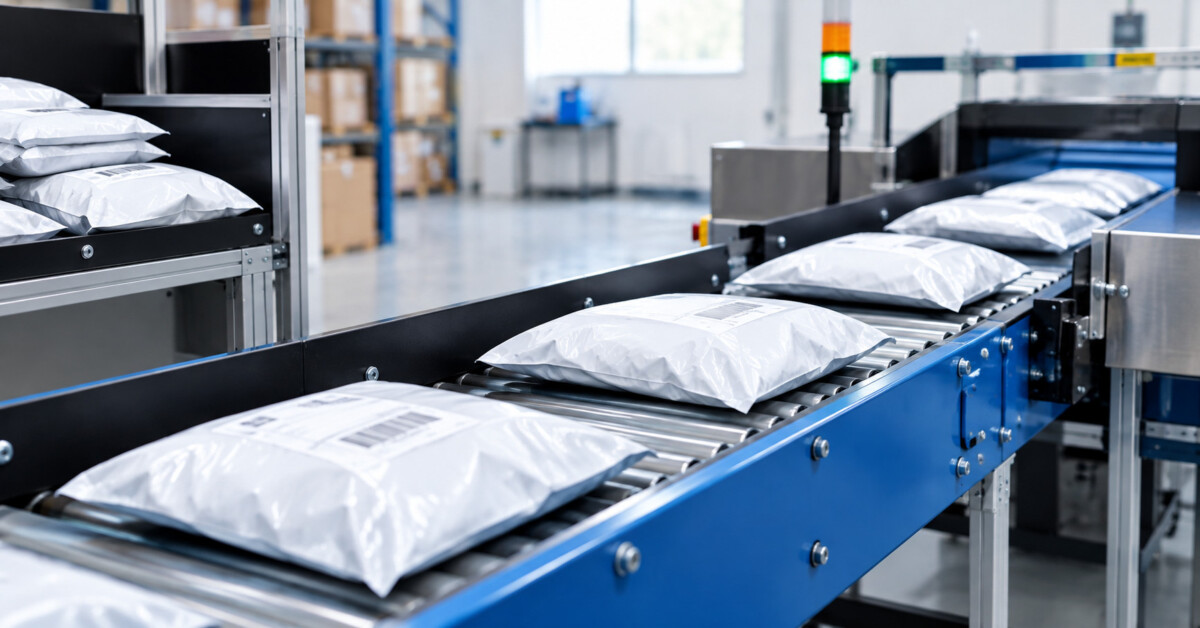
Packaging line accumulation solutions can handle polybags when the conveyor, controls, and transfers are designed around the bag’s shape, fill, film, and seal strength. The right system buffers short stoppages without excessive contact or deformation, but suitability must be confirmed with representative bags at production speed.
The useful question is not whether a conveyor can move a polybag. It is whether the line can hold and release hundreds of them without changing their shape, orientation, or seal integrity.
When dealing with flexible packaging on high-speed production lines, keeping products flowing smoothly without damage becomes a real challenge. Standard accumulation systems are typically designed for rigid containers like bottles and cans, which raises an important question: can packaging line accumulation solutions handle non-rigid items like polybags?
Yes, specialized accumulation solutions can handle poly-bags and other non-rigid items. These systems use gentle handling mechanisms like padded conveyors, air cushioning, or low-pressure accumulation zones specifically designed to prevent crushing or tearing of flexible packages.
However, not all accumulation systems are created equal when it comes to flexible packaging. The type of polybag, its fill level, the product inside, and your line speed all play a role in determining which accumulation solution will work best for your operation—and some common approaches can actually cause more problems than they solve.
The fundamental challenge with polybags is their lack of structural integrity. Unlike a plastic bottle that maintains its shape under load, a polybag shifts and compresses when subjected to typical accumulation forces. This lack of rigidity means that fill level dynamics play a massive role; a bag with minimal headspace acts almost rigid, while partially filled bags tend to collapse, creating uneven surfaces that lead to downstream jams.
Furthermore, product settling within the bag affects how it interacts with the conveyor. Granular products settle differently than powders or liquids, requiring specific torque and tension settings to avoid package deformation. Finally, kinetic impact becomes a major risk at high speeds; at 200+ packages per minute, a “gentle tap” between units becomes a damaging impact that can compromise heat seals and lead to product spoilage.
To solve the uncertainty of flexible handling, three primary technologies have emerged as industry standards for modern facilities:
While accumulation handles the flow, the packaging method itself dictates how much stress a product can endure. For instance, products secured by industrial banding methods often exhibit better structural consistency during the accumulation phase than loose polybags. The band provides a localized point of rigidity that helps the package maintain its shape under low-pressure contact, effectively acting as a “skeleton” for the flexible material.
At high speeds, the physical transition points between different conveyor sections become critical failure zones. Managing these transition points requires precision-engineered transfer plates and synchronized servo controls to prevent bags from bunching or tearing. Even the side guides require careful engineering; using low-friction adjustable rails prevents the friction-induced creasing that often plagues flexible lines during high-pressure moments.
To manage these physical complexities, high-performing facilities are increasingly looking for automation strategies that predict flow bottlenecks and adjust conveyor speeds in real time. This digital layer provides the precision necessary to handle the unpredictable movement of poly-bags, ensuring that speed does not come at the cost of package integrity.
If you are looking to optimize your flexible packaging line, following a structured plan for evaluating packaging line accumulation solutions ensures a successful transition:
As the industry moves toward more sustainable, flexible materials, the “best system” is no longer the one that moves the fastest but the one that adapts the best. By combining zero-pressure hardware with intelligent operational insights, manufacturers can ensure their poly-bag lines achieve the same precision as their rigid-container counterparts. Using a deliberate framework for system selection allows businesses to scale production while keeping product quality at the forefront.
A standard accumulation conveyor may handle some stable polybags, but its suitability cannot be assumed from its performance with bottles or cartons. Flexible bags can flatten, overlap, rotate, or catch at transfers when contact or backpressure builds. Before using an existing conveyor, test filled production samples across the normal range of bag sizes and fill levels. Include repeated downstream stops, a full buffer, and controlled restarts. If those tests reveal damage or jams, evaluate changes to the belt, guides, zones, sensors, controls, or accumulation method.
Zero-pressure accumulation is a strong starting point for flexible pouches that cannot tolerate contact, but it is not automatically the best solution for every line. Separating packages can reduce backpressure, yet the system still needs appropriate sensing, zone length, belt grip, transfers, and discharge timing. A stable, well-filled pouch may also perform acceptably with carefully controlled low-pressure handling. Compare alternatives using your actual filled packages and measure damage, jams, usable buffer capacity, and downstream presentation at production speed.
Calculate an initial buffer requirement by multiplying the upstream output in bags per minute by the number of minutes of downstream interruption you want to absorb. At 200 bags per minute, a two-minute stoppage suggests a starting requirement of 400 bags. Then validate that number against the accumulator’s usable capacity, including package spacing and the way bags behave at entry and discharge. Check whether the downstream machine has enough spare capacity after a restart to empty the buffer before another stoppage occurs.
Give the supplier representative filled bags and the operating range they must handle. Include bag length, width, thickness, weight, fill variation, film characteristics, seal locations, and how the contents settle. Also provide sustained and peak production rates, downstream equipment speed, typical stoppage lengths, available space, and required bag orientation. Ask for a trial that includes both ordinary output and difficult samples. Those details are more useful than a nominal bag size alone because flexible packages can change shape during conveying and accumulation.
During a supplier trial, check whether bags enter, wait, and leave the accumulator without unacceptable deformation, seal damage, overlap, or loss of orientation. Run the proposed system at the intended speed, fill the buffer, stop downstream equipment repeatedly, and observe recovery after each restart. Watch transfers, guide rails, and sensors closely. Record jams, rejects, operator interventions, usable buffer time, and the time needed to empty the queue. Agree on acceptable results before treating a successful demonstration as proof the design is ready for your line.