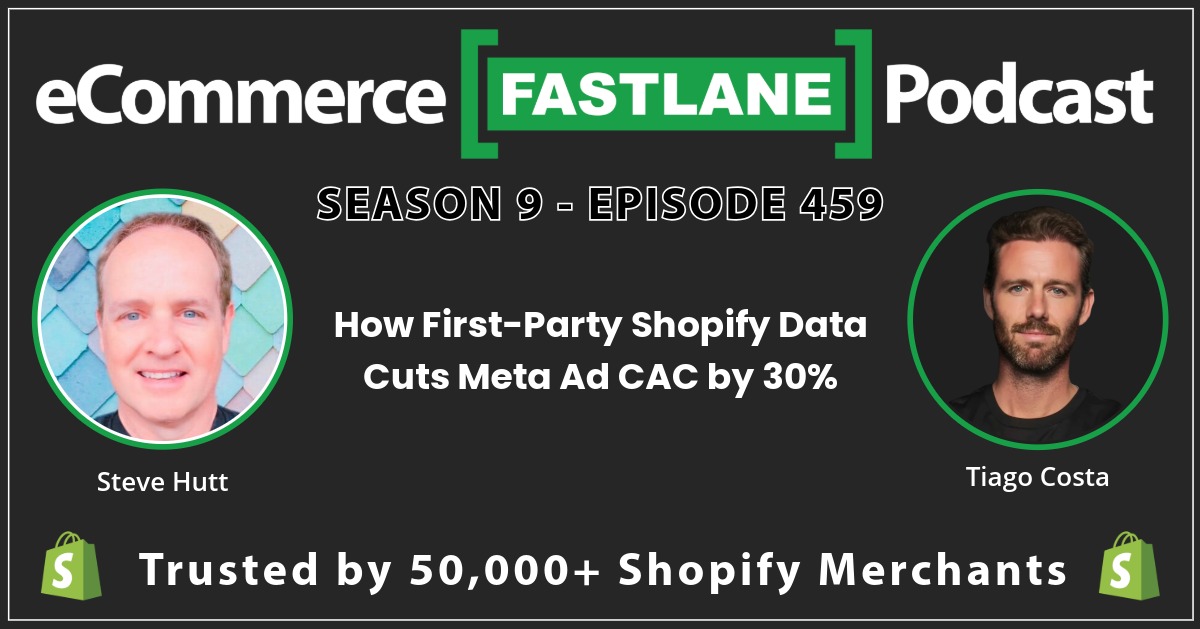
Here’s a question worth sitting with before your next Meta ad spend. The most valuable customer intelligence in your business is sitting inside your Shopify admin right now, and your Meta ad account has no idea it exists.
Every brand doing $1M to $10M in annual revenue is sitting on years of order history, repeat purchase behavior, AOV by segment, and LTV signals locked inside their store. Meanwhile, most are still feeding Meta the same surface-level events as everyone else, only to wonder why CPMs keep climbing while ROAS quietly slips. The gap between what you know about your customers and what your ad platform actually receives is exactly where budgets bleed out, one campaign at a time.
Tiago Costa is the co-founder and CEO of FULLVENUE, the Portugal-based team behind Clustie.
Clustie is a Shopify app that turns the first-party data gap into a profit lever. According to Tiago, their case studies include an iPhone reseller that posted a 70% ROAS lift inside 30 days, brands cutting customer acquisition costs by an average of 30%, and Portugal Jewels expanding into the US, Germany, and France using AI-predicted audiences in markets the brand had never sold into before.
In this conversation, Tiago walks through the mechanism behind those numbers. How your Shopify customer data becomes two AI-predicted audiences, what gets pushed to Meta, why setup takes about 15 minutes, and what an outcome-based product actually looks like when it’s working. Whether you’re an agency managing client ad spend or a founder staring at your Meta dashboard wondering where the leak is, this episode is worth your full attention.
Hit play. Then come back and steal the parts that apply to your business.
✅ Why first-party data is the most underused asset in your business: what privacy changes have quietly done to Meta performance, and what brands doing $1M+ should be doing with their order history before spending another dollar on ads.
✅ The two AI audiences powering Clustie’s results: how high-propensity buyer modeling and 30 day LTV prediction work together to turn broad lookalikes into behavior-driven buyer segments, with no in-house data team required.
✅ What an outcome-based product actually looks like in SaaS: the unusual free-trial-to-paid pattern Clustie hit in April, why operators are betting on this category, and what it signals about where audience tooling is heading.
✅ How AI audiences can crack new geographic markets: a real case study of a Portuguese brand expanding into the US, Germany, and France, and the CPA target that made the agency partnership an easy yes.
✅ Where Clustie fits if you’re an agency or Shopify Plus partner: why agencies are the segment Tiago is chasing hardest, the resistance he’s running into, and how to position an AI audience tool inside a done-for-you retainer without cannibalizing your margin.
✅ The roadmap nobody’s talking about yet: the upcoming budget optimization toggle, the Klaviyo and Salesforce integration angle, and why the next phase of audience segmentation may be API delivered rather than locked inside a single platform.

Inventory and operations software built for growing product brands.
Sell everywhere with full control of your operations. Katana gives you a real time, single source of truth for your orders and stock across every channel and location. Shopify, Amazon, wholesale, and retail all connected in one platform.
Stay ahead of demand with accurate inventory data, no matter where or how you sell.
Integrate with your favorite tools and go live in as little as a week. The operational depth you need, without the ERP price tag or complexity.
Start the free plan to test it with your own data. No credit card required.
If your most valuable customer intelligence lives in your Shopify admin, why is your ad platform still guessing? That’s the question Tiago Costa built Clustie to answer, and the results they’re sharing are forcing operators to rethink what audience strategy should look like in 2026.
Tiago walks through what actually happens when a brand connects Clustie to Shopify and Meta. He covers the signals the models are reading, why first-party data has become the strongest lever a brand can pull, and how two AI-predicted audiences get injected into Meta in roughly 15 minutes of setup time. The mechanics matter, because they explain why brands tend to see usable data within days, not weeks.
The performance numbers are the part that grab attention. An average 30% reduction in customer acquisition costs across their customer base. A 70% ROAS lift on a modest budget split test. Edge cases hitting 400% inside 30 days. A free-trial-to-paid conversion rate in April that, by Tiago’s own admission, is not a number you typically see in SaaS. The deeper story underneath those numbers is what an outcome-based product looks like when it works, and why doing one pillar well is starting to beat platforms that try to do five things passably.
A few moments worth listening for. The Portugal Jewels case study and what it suggests about using AI audiences to crack markets you’ve never sold into. Tiago’s candid take on why agencies are both the hardest sell and the highest leverage segment to win. The pricing structure, the trial mechanics, and the customer volume threshold a brand needs to hit before the models can do real work. And the roadmap that hints at where this category is heading, particularly around automated budget optimization and API delivery into platforms like Klaviyo and Salesforce.
If you’re running Meta ads on a Shopify store with at least a year of order history, this conversation is going to sharpen how you think about what your customer data should actually be doing for you.
👉 Treat first-party data as your moat, not your backup plan. Privacy changes and broken pixel tracking aren’t going away. The brands that win the next phase of paid social are the ones that stop fighting attribution and start activating the data they already own. If you’re at $1M+ with a year or more of order history, you’re sitting on a competitive advantage most of your competitors don’t yet know how to use.
👉 Separate the audience pillar from creative, offer, and attribution. Part of why Clustie works is that it doesn’t pretend to fix everything. Tiago is explicit. They don’t solve tracking, generate creative, or reframe attribution. They build audiences. When you evaluate any AI tool, ask which pillar it actually moves, and whether it does that one thing better than anything else. Single-purpose tools that nail their job usually beat platforms that do five things passably.
👉 Make CPA, not just ROAS, your North Star. Tiago makes an important point. ROAS swings wildly based on AOV, so a brand selling $20 products and a brand selling $2,000 products can’t compare ROAS in any meaningful way. Customer acquisition cost is what tells you whether your audience strategy is actually working. If you’re not tracking CPA reduction over time as a leading indicator, you’re flying half blind.
👉 Use AI audience tools as your unfair advantage for geographic expansion. The Portugal Jewels story is the most underrated insight in this episode. Most brands enter new markets by hiring expensive local agencies or burning six months on trial and error. AI-predicted audiences let you skip most of that learning curve by identifying high-value behavioral patterns in markets you don’t intuitively understand. If international expansion is on your roadmap, this changes the math.
👉 If you’re an agency, treat this as positioning upside, not a threat. Some agencies see tools like Clustie as competition. The smart ones see them as a way to deliver better client results without adding headcount. Recommending leading-edge audience tooling makes you look more sophisticated to your clients, not less necessary. The agencies Tiago has already signed in the UAE and Central Europe are booking annual subscriptions across multiple brands. The ones resisting now are the ones who’ll get displaced later.
👉 Test with split budget, not stacked budget. When the iPhone reseller tested Clustie, they didn’t double their ad spend. They split their existing $2,000 to $3,000 monthly budget between their current campaign and a Clustie campaign, then compared performance head to head. That’s how you actually prove whether a new audience tool is doing what it claims. Don’t add budget to test. Reallocate budget and let the numbers settle it.
Tiago Costa
Co-founder & CEO, FULLVENUE (makers of Clustie)
Tiago Costa is the co-founder and CEO of FULLVENUE, the Portugal-based AI company behind Clustie, a Shopify app focused entirely on audience segmentation for Meta ads. His team has built its reputation around a deceptively simple positioning. Do one thing, predict and inject high-value audiences from first-party Shopify data into Meta, and do it better than anyone else. The results they share back this up. Clustie reports an average 30% reduction in customer acquisition cost across customers, edge cases hitting 400% ROAS lifts inside 30 days, and a 90% free-trial-to-paid conversion rate in April.
Under Tiago’s leadership, FULLVENUE has built two primary AI models that power Clustie. A high-propensity buyer audience that surfaces the strongest behavioral DNA inside an existing customer base, and a 30-day LTV audience that predicts which customers are most likely to convert in the coming month. Both audiences sync directly into Meta in roughly 15 minutes from install, making Clustie one of the fastest time-to-value AI tools in the Shopify ecosystem right now. The company is actively scaling into the US, Canada, the UK, and Central Europe, with strong adoption across fashion and apparel, F&B, and beauty and cosmetics.
What makes Tiago’s perspective especially useful for Shopify operators is his refusal to compete on hype. He’s blunt about what Clustie does, what it doesn’t do, who it’s right for, and who should probably wait. In a category crowded with AI tools promising everything to everyone, that level of clarity is increasingly rare.
Featured in This Episode:
Over 9 seasons, I’ve been incredibly fortunate to chat with some of the brightest founders building amazing Shopify brands, as well as the partners shaping the app and marketing ecosystem. Every conversation has taught me something new, and I’m grateful for the chance to learn alongside you.
What matters most is that this podcast helps you solve real challenges and discover new ways to grow. Your support, feedback, and stories have made this journey truly special. Thanks for tuning in, sharing your wins and losses, and being part of the eCommerce Fastlane community.
Stay Connected: Leave an Honest Rating/Review on Apple Podcasts or Spotify. Follow & Subscribe on YouTube for new episodes.
Steve Hutt:
Welcome back to eCommerce Fastlane. I am your host, Steve Hutt. Today’s conversation is all about turning customer data that’s sitting inside your Shopify store into an engine that makes your Meta ads not just profitable, but more profitable than they currently are.
Steve Hutt:
There’s a pattern I keep seeing right now. Think about a brand doing a million a year, or even five million a year. They’ve got years of order history and things like repeat purchase data, average order value by segment, products that have really high LTV buyers, or products where they only have discount hunters who buy once. All of this data is sitting inside Shopify.
Steve Hutt:
Then their Meta campaigns go out and target, typically, anyone who looks like a buyer, because the platform decides who to show ads to based on its own narrow signals. It’s not using the rich data brands actually have inside their Shopify store. I think this gap between what you have and what you’re feeding Meta’s algorithms is where most budgets, I’d argue, are quietly bleeding. I don’t think they’re as efficient as they could be.
Steve Hutt:
That’s the reason I have my guest on today. It’s Tiago Costa, and he is the co-founder and CEO of a company called FULLVENUE. They’re the team behind a Shopify app that’s starting to blow up called Clustie. That’s with a C, C-L-U-S-T-I-E. Clustie is a Shopify app that takes your first-party customer data and, I believe, and we’re going to learn more about this, predicts who your high-value buyers are likely to be and then pushes those audiences directly to your Meta ad accounts. From there, the magic starts happening with AI-powered audience targeting. It’s incredibly timely, and everybody’s AI-hungry.
Steve Hutt:
I think this is one of those rare cases where this is a point, pillar solution that’s doing something really incredible. That’s why I wanted to have him on right away and talk about this app and what they’re doing. So, Tiago, welcome to the show.
Tiago Costa:
Hi Steve, thanks for having me here. And yes, you made the perfect pitch about Clustie, the tool we launched a couple of months ago. The goal is to go over first-party data, apply the intelligence we’ve been developing on audience segmentation here at the company, identify these high-value segments, put them on Meta, and increase the results our customers generate with the budgets they’re spending.
Steve Hutt:
What’s interesting is there have been a lot of privacy changes that I think broke a lot of these Meta pixel signals over the last few years. I’ve had a few people on the show trying to solve this problem, but a lot of operators are just accepting the fact that CPMs are up and performance might be weaker than normal.
Steve Hutt:
From where you sit, what’s actually changed under the hood? Why is first-party data now the answer instead of just spending more?
Tiago Costa:
If you think about fine tuning, you’ll realize the strongest data any brand has on their side is their own data. Their customers, the orders they generate, which products they buy, which behaviors they have over a year. All this information that lives on the ecommerce platform, in this case on Shopify for the brands we work with, is super valuable.
Tiago Costa:
At the same time, you have privacy restrictions. It’s very tough to measure the whole journey from when a customer clicks an ad to when they finalize their order. We’re not solving this attribution issue that exists today and will probably continue to exist in the coming months and years.
Tiago Costa:
But with the tracking we have today, even with all the attribution problems, if we go to the strongest data the brand has, we can generate more results by applying our solution to the niche we want to find. In the end, we’re not focused on solving problems related to pixels, tracking, or third-party data. We’re focused on generating more results with first-party data and the models we’re developing internally. What the customer wants is to generate more money and acquire customers at a lower cost.
Tiago Costa:
When we started to think about this, it’s because we heard a lot about tracking issues from our customers. It’s clearly an issue. There are super interesting tools to help brands track more sales and understand better where the customer is navigating. But in our experience, it’s a never ending story. Imagine you see an ad today on your phone and then buy the same product in a week on your laptop with a different browser. In terms of attribution, there are things you’ll never solve.
Tiago Costa:
So if we start from the attribution we have today and compare, for example, two campaigns, the base is the same. In the end, if Clustie generates more results for the customer, it’s clear we’re generating money for them. Our focus is clearly the audience and the final numbers on the sales generated by our solution.
Steve Hutt:
I see. What I’d like to do is have you walk me through what actually happens when a brand connects Clustie to their Shopify store and their Meta accounts. What signals are you looking at to model and predict, and what does Meta receive on the other end that’s different from a standard custom audience? There are different tools that do certain things, but you do things a little differently.
Tiago Costa:
Right now, with the solution we have live on the Shopify App Store, we’re focused on two major audiences. One of them is the high-propensity buyers audience. You’re a brand, you go to the App Store, you install Clustie, and we pull the data from your Shopify, so customers, products, and orders. We apply our models to identify the strongest DNA you have in your store.
Tiago Costa:
After that, we generate this audience. In the end, we’re talking about a customer list, a custom audience as you said, and we inject this custom audience automatically into Meta. We also give our customers a feature where, with one click, they can launch a Clustie campaign that uses the best assets they already have in their Meta account, combined with the audience we generated. It’s like a hack to save time for our customers.
Tiago Costa:
To be really efficient during the 30 day trial we offer, we simplify the process. So first audience: the best DNA from the store. Second audience: the 30 day LTV audience. We predict, with our models, who is going to buy products in the next 30 days. It’s super simple and straightforward. These audiences, when uploaded into Meta, generate lookalikes and we’re able to acquire new customers. We identify people on social media who behave just like the high-value people on the ecommerce platform.
Steve Hutt:
I see. This is really amazing. One thing I did before recording was look at a few different case studies, because there are some pretty amazing ones on the site right now. There was one, I think Mac Store, where they talked about a lift of almost 70% in ROAS and a 90% improvement in conversion. Even their AOV went up by a big chunk. Can you talk a bit about that case study or one you think is notable for my listeners?
Tiago Costa:
Yeah, we have a couple of edge cases with crazy numbers. That one is about a 70% increase in ROAS. We have cases with 400% increase in ROAS in 30 days. It’s insane. It depends, of course, on what the customer was already doing on their Meta campaigns. Depending on the maturity of the brand and the maturity of the agency managing the Meta ad account, we’ll have a bigger or smaller impact.
Tiago Costa:
That 70% case was a store reselling iPhones. They were not investing a lot of money in Meta, around $2,000 to $3,000 a month. They were a bit skeptical about splitting the budget. When we entered the 30 day trial, we didn’t want them to double their budget. We asked them to split the budget: continue using half of it in the campaign they had live, they only had one campaign at the time, and use the other half on a Clustie campaign. The numbers were incredible.
Tiago Costa:
At the same time, we have a lot of brands, and what we’re seeing is that customer acquisition cost is reduced most of the time across all brands using Clustie, on average about 30%. We really want to focus on this because today you hear a lot about ROAS, return on ad spend, then profit on ad spend. People say ROAS is not an accurate measure because it’s heavily influenced by the type of product you sell. If you have a $20 product and a $2,000 product, ROAS will move a lot.
Tiago Costa:
But in the end, the money you spend to acquire one customer is the North Star metric we want to share with all our clients, potential clients, and anyone who wants to hear about Clustie. With most of our success stories, we’re reducing customer acquisition costs by about 30%.
Tiago Costa:
Something really interesting is a brand from Portugal called Portugal Jewels. Products made in Portugal, super typical and traditional jewelry. They are focused on Europe and the US. “Let’s go abroad,” because Portugal is small, and you’re coming to Portugal soon, so you know it’s not huge.
Tiago Costa:
When we spoke with them, they were clear: “We know the Portuguese market very well. We have a really good agency working with us. We know the market perfectly. We don’t believe Clustie will improve Portugal. But we don’t know how to target the US. We don’t know how to target Germany or France. If you can help us target those countries and reduce CAC by 10 to 20%, we’ll pay for Clustie in the coming months and years.”
Tiago Costa:
We helped them go abroad directly, and it’s a huge use case for us because the brand is well known in Portugal. The results are clear today. They’re generating more sales. The AOV in the US campaign is much higher, and the CPA is lower. It’s the perfect use case for what we can do for brands. Not only reducing CPA and increasing ROAS, but also going abroad into markets you don’t know well. If we can identify audiences in those countries, we’ll show you how to sell there.
Steve Hutt:
I see. So how does creative fit into this? We’re talking about creating these campaigns. You said one company didn’t really want to split things; they just wanted to follow your two core audiences, the propensity to next sale audience and the 30 day LTV audience. I understand those two sides. What’s the work effort now on the creative side?
Steve Hutt:
What we don’t want, and a lot of people have, are AI tools that create product creative for the ads themselves. You’re segmenting and recommending audiences, but we also have to pair them with appropriate creative. What’s your mindset around that process?
Tiago Costa:
Clustie is fully focused on the audience pillar. We are not focused on the message, the creative, or the offer. We’re focused on the audience. At the same time, we offer two options to our customers.
Tiago Costa:
The first is using our business logic. We have logic to create a Meta campaign that finds the best assets the client has in active campaigns at that moment. We identify the best assets and put them in the Clustie campaign.
Tiago Costa:
The second option is that we create the campaign with our audiences, and the customer just goes into their Meta account, duplicates the assets they want, and puts them into the Clustie campaign. So we offer these two options. One of them is just three clicks: connect to Shopify, connect to Meta, generate the audience, and the campaign is launched. With the other, you have those three clicks, and then you place a creative inside the Clustie campaign.
Tiago Costa:
It’s super straightforward because, right now, the focus is the audience. Maybe in the future we’ll include some logic around creatives, but it’s not something we’re thinking about for tomorrow.
Steve Hutt:
Yeah, I see. So basically, we’re taking a lot of raw data inside Shopify and turning it into actionable audiences that can be implemented. Because they’re so fine tuned for their specific use case, your two are the propensity for the next purchase and the 30 day LTV audiences, you’ve clearly proven profitability goes up and AOV goes up. This is the holy grail of what people want right now.
Tiago Costa:
Yeah. I’ll give you a short example of how difficult it is to have success with our product, but how easy it is at the same time. This sounds a bit crazy, but in April we had a 90% ratio of free to paid accounts. From all the brands that decided to run the 30 day trial, 90% are paid customers today.
Tiago Costa:
Why? Because this is not a product where the features need to be incredible. We’re not focused on the “wow” factor. We focus on the outcome, the uplift on Meta campaigns. During the trial, if we’re able to generate that uplift, clients continue. If we’re not, clients leave. This is clearly an outcome based product. It’s super difficult to have success, but if we find the niche that has success, and we believe we’re there, I believe we can scale super fast.
Steve Hutt:
Yeah, this is amazing. Where do you see the product headed? You said you might at some point branch into more segments, but you’re clearly very profitable, and with 90% conversion from 30 day trials to paid, the lift is there for brands to at least test it.
Steve Hutt:
That’s why when I heard about this, I thought, “Everyone listening should at least try Clustie out.” Don’t assume, “This is not for me.” It is for you because you haven’t tested it yet. You should try it. I see the case studies, but where do you see the product evolving over time? Is there a public roadmap or internal things you’re thinking about for where the product is headed?
Tiago Costa:
From the moment we launched Clustie, we’ve had regular meetings with our customers. The customer success team is constantly speaking with brands. Not in an exhausting way, probably once a week or once every two weeks. We’re getting feedback because that’s the best thing we can have right now: feedback from all the brands using our product.
Tiago Costa:
Looking at this feedback, something that became clear for us was budget optimization for the audiences we’re running. We saw the opportunity. Imagine you launch a campaign today with four different audiences and you have to decide how to allocate budget to each. We can understand behaviors in those audiences that justify increasing or reducing the budget you have on each ad set inside a Meta campaign.
Tiago Costa:
We started having this kind of communication between the customer success team and the brand almost every day. After the brand or the agency updates the campaign according to our logic, the sales and numbers appear. It’s incredible. It’s almost direct. So we thought, “Okay, we need to automate this,” and we’ve been developing it.
Tiago Costa:
Budget optimization for our audiences, I believe in a couple of months, will be live. If you click the option to automatically manage the budget you have on the Clustie campaign, you’ll be able to extract the most from our campaigns. That’s one thing.
Tiago Costa:
Another is including more data sources. If we think about Klaviyo, it’s a huge platform with a lot of data. Not transactional data, but email marketing, SMS, and so on. We have a lot of information we can mix with ecommerce data.
Tiago Costa:
Who knows, we could not only integrate Klaviyo data, but also give them a Clustie audience, for example. This is the kind of partnership we want to explore in the future with bigger companies. I’m talking about Klaviyo; I can also talk about Adobe Marketing Cloud, Salesforce. We could give them a Clustie audience. We’re a simple, niche tool, but if we create an API and deliver an audience from our tool to these platforms, they could have a simple audience segmentation feature that says “Use Clustie Audience.” That’s part of our internal vision right now.
Steve Hutt:
Yeah, it’s interesting about that budget optimization, because I know of many stories I’ve mentioned on this podcast where people don’t have their budget organization set up correctly. They have a finite budget, but they don’t dynamically look and say, “Wait a second, the ROAS or CPA targets are hit, but we’re starting to run out of money.”
Steve Hutt:
Sometimes there are aberrations where certain campaigns do better than others. It could depend on the product, a weather related thing, something happening in the market, an influencer blowing something up, and suddenly there’s more brand buzz online. What you don’t want is to run out of money and not be there when the customers are there, especially when you have certain performance expectations.
Steve Hutt:
Then, all of a sudden, you want to dynamically reallocate or have a certain percentage of additional budget available for successful campaigns in real time. That’s a very powerful way of looking at it, instead of just ending a 24 hour period, using all the budget, and then making a new decision tomorrow. Instead, it’s, “Look how well this campaign is doing. We’re almost running out of budget. What do we do with that information? Do we hit Slack? Is there someone who makes that decision?” Having something make that decision on your behalf, with guardrails, is so interesting.
Tiago Costa:
Yes, it’s super interesting. A lot of platforms connect with Meta and give insights on budget behavior and what the customer should do. But we don’t want to just give insights. We’re in the AI era. We want to create a simple toggle the customer can activate, and Clustie will be responsible for doing it.
Tiago Costa:
It’s not important to say, “If you increase $10 today, you’ll generate more.” Customers and agencies are already looking into this and sometimes just testing things. What we do is: we have the logic, we built the logic, now let’s do it automatically to generate more sales. Again, we’re an outcome based product. The better results we generate, the more clients we’re going to capture.
Steve Hutt:
So Clustie, just so I’m clear, I’ve written notes here, it really identifies future high-value buyers, number one. And number two, it identifies customers who are most likely to return, that’s the 30 day LTV audience we’re talking about, and they’ll come back to the shop, which grows LTV. You’re syncing these directly to Meta ads. That’s the high level view of what the tool does.
Tiago Costa:
Exactly. Exactly. Perfect.
Steve Hutt:
Once that’s fully connected, and you do have a 30 day trial right now, walk us through what happens when someone decides, “I want to test this solution. I’m running Meta ads right now, I feel they’re reasonable, and I have a ROAS or CPA I’m happy with, but I don’t know what I don’t know.” What do you tell people who are skeptical but want to at least try? Because my thought is if it’s true, and I know you’re an honorable guy, that with a 90% conversion rate from 30 day trials to paid, clearly the upside is for the merchant because you’re a point solution. What do you say to people who are skeptical? Should they try it right away, and what’s the process?
Tiago Costa:
If you want something super simple that will take, I would say, 15 minutes of your time to set up and launch the campaign, something you won’t pay for because you have 30 days to see what’s happening, and you’re already spending money on Meta, you’re already generating figures and insights. You’ll be able to compare what’s happening today with what happened before.
Tiago Costa:
Of course, we want the possibility of onboarding more and more brands because we’re evolving our product. That’s very important to us. That’s why we give you the chance to test the product without any commitment. After that, if the numbers are there, if we can justify that the campaign results are more than enough to generate revenue for the client and pay the Clustie subscription, they’ll continue with Clustie.
Tiago Costa:
We have three different pricing tiers: one at $79, one at $299, and one at $499, depending on the number of active customers the brand has. The first tier is up to 10,000 customers, then up to 250,000 customers, and from there you pay the highest tier for enterprise level. But it’s super simple. In the end, you just need to spend 15 minutes setting up. Someone from our team will probably contact you after you set up the tool and encourage you to give it a try. In the end, what you want is to reduce customer acquisition costs and increase the return you get from the money you’re investing in Meta.
Steve Hutt:
So what do you say to our marketing agency partners listening to the podcast today? There are a lot of them, independent or small shops taking care of their clients. Is there a white label option, or are they going to see the Clustie app installed in their admin if they’re an agency partner looking after clients on a done for you service level?
Steve Hutt:
I’m curious how agencies are positioning the Clustie product. I guess you have to tell the merchant, “I’m going to install this, but we’re managing it along with other things.” Is there a white label solution? A private API injection? Because I know Shopify has an option to not necessarily use the public facing app. There could be a private app with a direct API connection. What options do you have available?
Tiago Costa:
We just have the Clustie app as it is. In terms of our ICP, when selling our product, we have the brand and we have the agency. We’re pushing really hard to sell to agencies because, in the end, agencies manage a lot of brands, and they’re the ones who benefit most from our product. We do have a struggle selling our solution to agencies.
Tiago Costa:
We’re feeling some resistance here in Portugal and Spain. But in the UAE, we have an agency working with us. In Central Europe, we have an agency working with us that decided to go to an annual subscription with both brands they work with. We see that agencies that believe in Clustie become real clients and stay with us. But during the selling process, it’s not easy.
Tiago Costa:
I think today agencies need to rethink how to be better, more competitive, and how to embrace AI solutions, to at least test them and understand if they can improve their work. Undoubtedly, agencies are the ones we want to capture. We’re making an extra effort today to reach, for example, Shopify Plus premium partners that are developing Shopify stores to reach more brands, as well as large marketing agencies. We can also offer a partnership program to these companies. That’s how we’re trying to enter that space.
Steve Hutt:
Yeah, I love that. There are lots of them listening. I think the opportunity is there. For agency partners listening, especially Plus agency partners, you and I are almost talking directly to them. If you’re offering done for you marketing services, it looks good on you as the agency owner to recommend apps and marketing platforms that connect to a brand’s store and are enterprise level or uniquely solve specific problems.
Steve Hutt:
Sometimes people say, “Okay, I’m going to install Triple Whale because I want a better pixel tracking tool.” Or, “I’m going to recommend Attentive or Postscript or Klaviyo,” and there are certain things you recommend as the agency because you’re deep into the business. Usually founders and marketers are more into product, what’s next in the lineup and improving what they sell. They can appreciate the tech stack of an ecommerce and retail business, but I think the takeaway is: if you’re offering these services, it looks good on you to be leading edge and recommend certain solutions.
Steve Hutt:
Even though clients will see it in their admin, it’s one of many things an agency partner does. Number one is to improve the ROAS of their business and make it more profitable. That’s a big win for everybody, right?
Tiago Costa:
Exactly. We’re hearing this mindset from Shopify agencies. They tell us customers come to them asking for solutions to improve the money they’re spending on ad platforms. In the end, it’s a win win situation.
Steve Hutt:
Yes. This is amazing. I’ll make sure I have everything updated in the show notes. We have a 30 day free trial. If you go to the Shopify App Store and type in Clustie, that’s C-L-U-S-T-I-E, or you can go to Clustie.ai and install the app and start that rolling 30 day free trial.
Steve Hutt:
Like you said, 15 minutes later you’re set up, and within a couple of days you’re going to see big changes and improvements, at least in these two separate campaigns: the propensity to buy audience and the LTV audience, which is really going to grow for you. This has been very eye opening. Thank you for coming on the show. I’ve learned a lot. I’m joking, but page two of notes is a good show when you have lots of notes.
Steve Hutt:
Lifelong learning here, and I wish you continued success in supporting Shopify merchants on the paid Meta side of their business. Thank you for coming on the show.
Tiago Costa:
Thank you very much, Steve. Something curious we can share is the growing number of Shopify stores from the US and Canada that are starting to onboard our solution. Fashion and apparel, F&B, cosmetics and beauty. It’s getting super interesting for us, and we weren’t even doing paid media for the region. I hope this helps spread the word across the region, and thank you very much for having me here. It was a pleasure to meet you.
Steve Hutt:
It will. Absolutely. All right, have yourself a great afternoon. Thank you so much.
Tiago Costa:
Thank you very much.