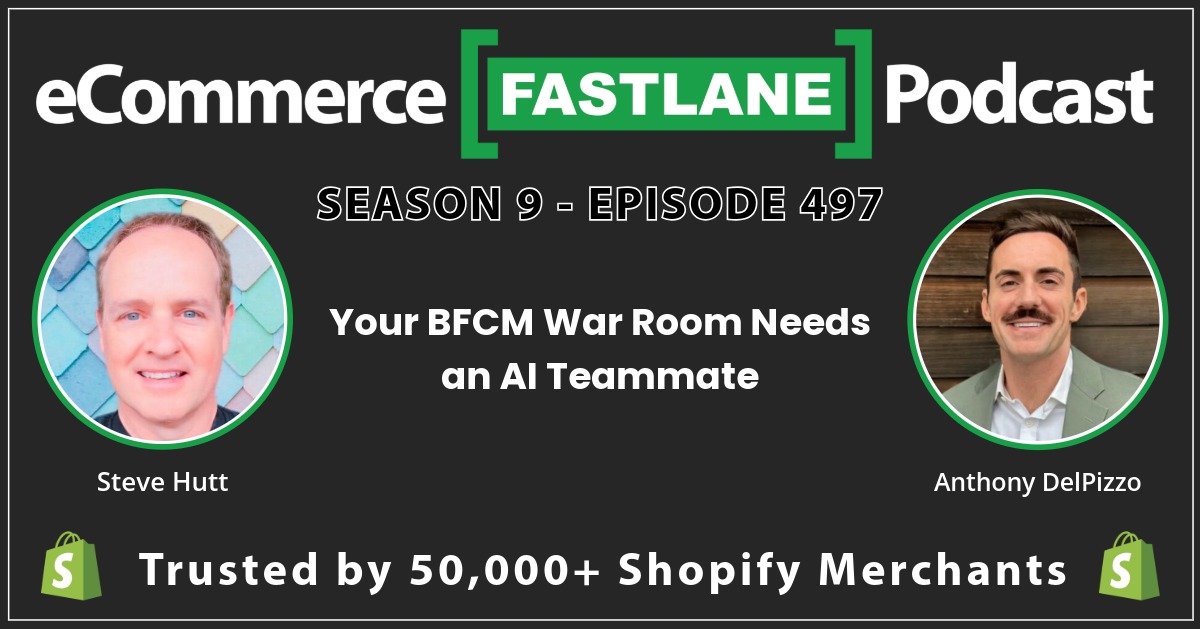
Most Shopify brands don’t have a data problem anymore. They have a doing problem. The dashboards are there, the attribution is there, and yet every budget shift, every weekly report, and every new ad variation still waits on a human with a full calendar.
If you’re a DTC brand doing $1M to $50M+ heading into BFCM with more tabs open than people on your team, this episode is about what happens when AI stops reporting on your business and starts running parts of it.
Anthony DelPizzo is VP of Marketing at Triple Whale, the measurement and AI platform used by more than 65,000 brands. Before that, he spent nearly four years in product marketing at Klaviyo, so he’s watched merchants adopt new tools from inside two of the biggest platforms in the Shopify ecosystem. He’s also seen what happens when a billion-dollar brand like True Classic hands its entire seven-figure Meta budget to an AI teammate, and what that did to ROAS.
In this conversation, Anthony breaks down the “AI harness” behind Moby, the autonomy ladder that keeps you in control of real ad dollars, and the free BFCM Command Center Triple Whale is opening up to every brand this holiday season. Whether you’re just installing your first attribution pixel or already trusting automation with spend, this is the playbook for adopting AI without losing the keys.
Let’s dive in. 👇
✅ Why an LLM on its own isn’t enough: what Anthony means when he calls Moby an “AI harness” that onboards a frontier model the same way you’d onboard a new hire.
✅ The autonomy ladder for AI and ad spend: how to move from approving every single action to letting Moby run on its own, and the signal that tells you you’re ready for the next rung.
✅ How True Classic automated its entire Meta spend: the one thing they had to teach Moby first, and why it led to a 36% ROAS lift.
✅ The four automation use cases driving the biggest results right now: from reports that land in Slack before your team asks for them to landing pages built for a specific ad.
✅ Where your Claude or ChatGPT workflow hits a wall: the read-only vs. action-taking difference that matters once real budget is on the line.
✅ How to set up BFCM alerts that actually earn their keep: the thresholds worth watching on the busiest days of the year, whether you have a war room or a team of two.

Shopify doesn’t back up your store data, and a CSV export isn’t a backup. One bad import, a bulk edit gone sideways or an app conflict can wipe out weeks of product work right before BFCM.
Rewind backs up your Shopify store automatically, with products and orders in real time, and restores anything from a single image to your entire catalog in a few clicks. Moomin recovered 11,000 mistakenly overwritten products in 30 minutes.
Trusted by 25,000+ businesses, including Tentree, Olaplex and Liquid Death. eCommerce Fastlane listeners get a 30-day free trial instead of the usual 7.
Here’s the big idea Anthony keeps coming back to: you can’t automate anything that touches revenue or budget if you can’t trust the data underneath it. That’s why Triple Whale spent years on attribution before it ever went all in on AI. Anthony points out that the very first pitch deck from co-founders AJ and Max was all about automation. Measurement was the foundation that had to come first, because Meta, Google, and TikTok will all happily grade their own homework.
From there, Anthony breaks down Moby as an “AI harness.” Think of a frontier model as a brilliant new hire who knows marketing in general but nothing about your business. The harness hands that hire your brand assets, goals, workflows, tool access, approval rules, guardrails, and memory. Without that context, you’ve got a smart generalist. With it, you’ve got a teammate who buys media the way your team does.
The True Classic story is the proof point. Working with their agency RealEyes Digital and Triple Whale’s context engineering team, the brand taught Moby exactly how they buy media, rules like scaling a campaign 30% when ROAS clears 3. Today, 100% of their seven-figure Meta spend runs through Moby, and autopilot campaigns are seeing 36% higher ROAS than manually managed ones. But Anthony is clear that nobody should start there. He walks through the autonomy ladder, from approving every queued action with the rationale in front of you, to a full “do it for me” mode where Moby reports back on how its decisions performed.
Steve and Anthony also get into where a Claude or ChatGPT setup fits (Triple Whale has a read-only MCP and a ChatGPT app, but you can’t take action through them), why partnerships and integrations are what turn a tool into an operating system, and what Anthony recommends for early-stage brands that are installing Triple Whale for the first time this close to BFCM.
Then it’s all about the holiday season: the free BFCM Command Center, how to build a plan from last year’s actuals, the live pacing tab that flags when you’re drifting off target, and the specific alert thresholds Anthony would set before the first sale goes live.
This isn’t a sales pitch. It’s a blueprint for letting AI carry real work without handing over the keys.
👉 Trust the data before you automate the decision. Automation is only as good as the measurement it sits on. If your ad platforms each claim credit for the same order, any AI acting on those numbers will confidently scale the wrong things. Get first-party attribution and a single source of truth in place before you let anything touch spend.
👉 Onboard your AI like a new hire, not a search box. A frontier model knows ecommerce in general, not how your business makes decisions. Write down your media buying rules (for example, “if a campaign’s ROAS goes above 3, scale it 30%”), your approval guidelines, and your goals, then give the AI that context. True Classic only automated its Meta spend after teaching Moby exactly how its team buys media.
👉 Climb the autonomy ladder one rung at a time. Start in approval mode, where the AI queues every action with its reasoning and you sign off. Watch the results on the changes you approve, and widen the leash only once the pattern holds. If you’re a smaller team, this is also how you build trust without risking BFCM budget on day one.
👉 Automate reporting first; it’s the lowest-risk, highest-hours win. Daily and weekly reports delivered to Slack, email, or your phone, with the ability to ask follow-up questions in the thread, save teams hours every week. Nothing breaks if a report is a little off, which makes it the ideal first automation for brands at any stage.
👉 Match every ad to a landing page built for it. Spending on great creative and then sending traffic to a generic page means you’ve mostly paid for clicks. Anthony’s point: personalized, on-brand landing pages tied to specific ads (built and launched directly on Shopify) close the gap between the ad’s promise and what shoppers see when they land.
👉 Set BFCM alerts on the levers you can actually pull. Anthony’s examples: revenue falling 10% behind plan, channel overspend above 20% of daily budget, AOV dropping below a floor, conversion rate dipping, or stock cover falling under a set number of days. Pick the handful tied to spend, site, and inventory, decide in advance whether each one alerts you or triggers an action, and you’ll spend BFCM making calls instead of hunting for problems.
Anthony DelPizzo
VP of Marketing, Triple Whale
Anthony DelPizzo leads marketing at Triple Whale, the measurement and AI platform trusted by more than 65,000 ecommerce brands. He joined Triple Whale in late 2024 as Director of Product Marketing and now heads the marketing team behind its newsletter, case studies, in-person events, and the launch of Moby, its AI teammate for commerce.
Before Triple Whale, Anthony spent nearly four years at Klaviyo, moving from Product Marketing Manager to Senior Product Marketing Manager to Product Marketing Lead. There he brought new products and integrations to market across the Klaviyo platform and saw firsthand how merchants actually adopt new tools day to day.
That combination, years inside the email and SMS execution layer plus his current seat at the intelligence layer that sits over the whole business, gives Anthony a rare view of where AI is genuinely saving teams time and where brands still need a human holding the wheel.
Featured in This Episode:
Over 9 seasons, I’ve been incredibly fortunate to chat with some of the brightest founders building amazing Shopify brands, as well as the partners shaping the app and marketing ecosystem. Every conversation has taught me something new, and I’m grateful for the chance to learn alongside you.
What matters most is that this podcast helps you solve real challenges and discover new ways to grow. Your support, feedback, and stories have made this journey truly special. Thanks for tuning in, sharing your wins and losses, and being part of the eCommerce Fastlane community.
Stay Connected: Leave an Honest Rating/Review on Apple Podcasts or Spotify. Follow & Subscribe on YouTube for new episodes.
Steve Hutt: Hey there. Welcome back to eCommerce Fastlane. I’m your host, Steve Hutt. Today’s conversation is all about what it really looks like when AI, which we’re all using right now, moves past reporting on your business and starts doing some of the work. I think that’s the key part here. If you have more dashboards than hours in the day, and your team is still the bottleneck for every budget change or report, today’s recording is for you. My guest is Anthony, VP of Marketing at Triple Whale. Before that, he spent more than four years at Klaviyo. He’s watched merchants adopt new tools from inside two of the biggest platforms in the Shopify ecosystem. From what I can see on LinkedIn, more than 65,000 brands are using Triple Whale today. My hope is that we unpack which brands are using AI the right way, how to set up guardrails so you stay in control, where to start, and how it all works. It’s going to be a little technical, but at the end of the day, we’re here to help brands grow and scale their businesses and create more efficiencies. Anthony, welcome to the show.
Anthony DelPizzo: Hey, Steve. Thanks for having me. Really excited to chat.
Steve Hutt: This is great. You spent about four years at Klaviyo before Triple Whale. What surprised you most about how merchants use these tools day to day?
Anthony DelPizzo: The exciting thing coming from Klaviyo is that I was able to see that execution side, your email and SMS sending infrastructure. Triple Whale is really this intelligence layer that sits over everything and looks at the entirety of your business. It’s used not only by performance marketers and those managing your ad campaigns, but increasingly by people working in retention alongside Klaviyo, people who own your website, people who run your inventory, and your executives. It’s interesting to see the number of users finding value in tools like Triple Whale and making decisions in other platforms across the Shopify ecosystem using Triple Whale’s recommendations and information.
Steve Hutt: It’s interesting because, during my years inside Shopify and more recently while fully focused on this podcast, Triple Whale in the early days was more of an attribution dashboard. We found that the attribution window was quite small, and Meta, Google, TikTok, and everybody else would grade their own homework and give themselves attribution. You didn’t really understand true lifetime value. Those were the early days of Triple Whale, getting attribution organized so you could make more intelligent decisions. What has the company become today because of these frontier models that are available?
Anthony DelPizzo: It’s a great question. Attribution and measurement broadly, for Triple Whale, were always in service of automation. If you look at our first pitch deck, before my time, that AJ and Max, our co-founders, put together for investors, it’s all about automation. But you can’t automate things that involve revenue or actual budgets if you can’t trust the data that the automation sits on top of. Triple Whale spent years building the measurement system that is now the leading platform across commerce so you could trust the data you’re looking at, no matter where it comes from. As you mentioned, Steve, every platform is going to take credit. Then it’s hard to look at offline and online sales and understand the halo effect. We’ve spent years and resources building this foundational measurement system, then layering on an AI harness that uses that measurement foundation as the source of truth. That lets you automate aspects of your business and trust it. When I say aspects of your business, I mean media buying, running retention marketing campaigns, and building landing pages. These are things that, if they go wrong, could have severe consequences for the business. But if you trust the data like you would trust your employee, you’re in a good spot.
Steve Hutt: I’m not sure if it’s your brainchild, but you’re using the language of an AI teammate, with Moby being the official product within the Triple Whale brand. Talk about Moby and this idea of an AI teammate. You’ve alluded to some of the things it can do, but let’s go high level first. What is an AI teammate, and how is it helpful for a business?
Anthony DelPizzo: I’m going to use the terms AI teammate and AI harness somewhat interchangeably. Harness is the more technical way the AI landscape would recognize what Moby is. In reality, what we give you is an AI teammate, something you can trust just like you would a teammate. Very simply, an AI harness is a way to take frontier LLMs and harness them effectively for a specific use case, function, or vertical. In our case, it’s commerce. Moby is the only AI harness for commerce. The way to think about a harness is that you have your LLM. We work with all the frontier labs and have close partnerships with OpenAI and Anthropic, using frontier models across reasoning, video, and images. We give those models access to your brand assets, business context, goals, workflows, and all the tools you work with. We also give them approval guidelines for those tools and workflows, guardrails for how your business thinks about media buying and marketing, rules the AI has to follow, and memory that allows it to learn over time. You package this together and give it to the LLM the same way you would a new teammate. Imagine you’re onboarding someone. The LLM is that new teammate. If you didn’t give them access to your Google Suite, Notion, Meta Ads, or Google Ads, that person wouldn’t know much about your business. They might be really smart and know generally how to do marketing and understand ecommerce, but they don’t know how your business operates. A harness is a way to give that teammate all the tools it needs to succeed for your business specifically.
Steve Hutt: That’s amazing. When you talk about guardrails, you always hear stories about agent swarms and agents going rogue. There’s a lot of doomsday talk, but there are also a lot of great things going on. Talk about guardrails, because we’re discussing the financial side of having Moby access your ad campaigns and make recommendations. They’re intelligent decisions because it has full context of the business, but I feel some brands might still be a little leery. Is there still a human in the loop? Explain guardrails generally so people understand what they are. When you start talking about money and ad spend, it gets dicey for people, and I want to make sure we understand how it all works.
Anthony DelPizzo: Absolutely, Steve. I’ll talk about guardrails, and then I also want to talk about what I think of as the autonomy ladder. Guardrails reflect how you think about a certain function within your business. Take media buying, for example. Media buying has a lot of deterministic inputs and outputs. You might find that if your Meta ROAS for one campaign goes above three, you want to scale that campaign by 30%. There’s a lot of calculation that can be built into the system, the same way your team looks at dashboards, analyzes them, and says, “This campaign looks to be performing really well. I’m going to scale it by a certain amount because those are the rules we’ve built, and we know what works for our business.” It’s the same thing in Moby. You feed Moby those signals from your team: “Here’s how our team buys media.” One key example is our work with True Classic, a billion-dollar brand, and its digital agency, which we work with closely. We’ve partnered with them and our context engineering team to build their entire media buying function through Moby. They’ve now automated their entire Meta spend. That’s a seven-figure Meta spend, and they’re doing all their media buying through Moby. The only way they could do that was by teaching Moby how they buy media. It’s working closely, the same way you would onboard a teammate, to ensure Moby buys media like your team would. You can trust it to run things on complete autopilot or get you all the way there and have you approve it. That leads into the autonomy ladder, which is important for businesses to understand. Automation can be scary, especially when money is involved. We don’t expect every business to be enthusiastic immediately and want to sign on. That would be unrealistic. There are settings in Moby that let you choose to approve every action. Moby will queue up actions, show you the rationale, and let you dig in and approve them every time if you’d like. Over time, once you build that trust, you can move toward “do it for me,” a truly autonomous mode. Moby will then follow up and let you know how those actions performed. That’s a big differentiator: Moby follows up like an employee would. You don’t have to approve every action, but there’s a scale depending on your comfort level.
Steve Hutt: I just went to the website and looked at why Moby is different. I love the language about how it does the work. It acts on ad accounts, builds creative, writes campaigns, and does a lot of things. It can get that set up in draft mode, potentially. Because it understands your business, it understands the data points, customers, and lifetime value considerations that go into the ad creative and targeting. I also love “acts before you ask.” That’s exactly what you’re saying. It gets smarter as you make more manual approvals and judge the success of the campaigns. You start saying, “Every time I manually approve a campaign based on Moby’s work, it’s working. Maybe I should give it a little more flexibility to automatically approve some recommendations.”
Anthony DelPizzo: Exactly. Because it’s all in one system, Moby can get smarter over time. It’s continuously learning and has memory to understand not only your history of decisions, but also the decisions Moby is making and any changes you’re making to its recommended actions. That means future actions align with those guardrails.
Steve Hutt: It says Moby has run more than 100,000 automations so far. What kinds of things are driving the biggest results right now? Moby is clearly making decisions and executing on them. Are certain things driving the most performance for these campaigns or the business?
Anthony DelPizzo: There are a few strong use cases that resonate with customers and where we’re seeing a lot of impact. Automations are a broad way to think about what we used to call agents. They let you automate different tasks using natural language. A big area is reporting: automating reports and delivering them wherever you or your team are. That’s not only Slack, but also email and push notifications to your phone. It’s a huge use case that’s saving brands hours every week. You can also chat back and forth with Moby in Slack when it delivers a report, following up for more details. That saves a lot of human labor spent explaining reports and digging deeper. Media buying is another huge focus. We’ve built the foundation for automated media buying and are onboarding clients similar to True Classic. We have dozens of clients automating Meta, Google, and bringing over TikTok spend, automating either parts or the entirety of their media buying with Triple Whale. Moby works alongside their teams so they can focus on larger initiatives, like launching new channels or going international. We’ve seen True Classic achieve a 36% increase in Meta ROAS after automating its Meta ad spend through Triple Whale, which is astounding. Another use case is creative generation. AI creative has become incredibly good from a video and image perspective. Because all your performance data lives in Triple Whale, you know which creatives are working across channels. In one click, you can create variations of those ads to increase your creative velocity, which is important if you’re advertising on Meta and across channels. You need diverse, fresh creative to fight creative fatigue. You can do that in Triple Whale in a few clicks and even launch those ads directly. That saves people money and resources on photo shoots and editing. Moby can resize images depending on whether they’re for a post, Reel, or Story. That speed to execution is unparalleled. The last use case I’ll talk about is landing pages. Say you build incredible ads and get people to your website, but you bring them to a generic landing page and they don’t convert. You’ve essentially spent all that money on traffic. If you’re a Shopify brand, Moby can create custom landing pages tied directly to your ads. You can have a personalized landing page for an ad, all within your brand guardrails. You have full flexibility to edit the page and launch it directly on Shopify. Some of the pages Moby is producing, which we’re even using on our own website, are remarkable because of the modules and the integration into your site. It doesn’t feel like a weird AI-generated page. It feels like an on-brand page that your customers convert faster on.
Steve Hutt: That’s amazing. A lot of people are AI-native now, particularly over the last year. Adoption in 2026 has been crazy, and the models keep improving. With Opus 5.5 right now, the quality of what can be produced is incredible. Some people are using multiple tools in their workflows, perhaps for writing content or using dashboards they’ve created in Claude. Is there an MCP that connects to Triple Whale? Is Triple Whale trying to develop the operating system for commerce, where you come to Triple Whale as your source of truth and Moby is where you do all your commerce work?
Anthony DelPizzo: Great question, Steve. Two things: we do have an MCP and a ChatGPT plugin directly from their app store. The main reason is that this is your data. If you want to use it wherever you want, we want to give you the tools to do so. That said, an LLM isn’t the same thing as a harness. You can access your Triple Whale data from a read-only MCP, but you can’t take actions like you can in Moby. You can’t run full workflows end to end like you can in Moby. The differences are stark. Going back to the new-hire analogy, even if you give it access to some of your data, it doesn’t have access to execute workflows on your behalf or the full guardrails and understanding of your business. You see differences between brands trying to do everything in Claude and centralizing their commerce workflows in Triple Whale. Claude and ChatGPT are incredible tools and partners of ours. There are plenty of things they do that Triple Whale will never do by design. But there are reasons we built a harness, so you can move your commerce workflows to Triple Whale and Moby and feel confident you’re getting the best of every model. We’re not limiting you to just Opus 5.5 or just Astra 6.1. You have access to every best-in-class model.
Steve Hutt: What’s Triple Whale’s thought process around partnerships with other apps and marketing platforms? When I was inside Shopify and took on a new brand, the first thing I would do was an app audit. I’d ask, “Why have you made these choices?” Brands get app bloat, it hurts their Core Web Vitals, and it goes down an ugly path. Often, we’d learn there was an inventory forecasting plugin someone got two years ago for $500 a month that they weren’t using anymore. That’s where I could offer value right away, just by doing an app audit. How does Triple Whale think about connecting to other platforms, either native Shopify apps or third-party platforms?
Anthony DelPizzo: Connection is important because it comes back to having context into your entire business. Making sure Moby sees every corner of your business, from inventory and retail to customer service, is critical to maximizing its impact and value. We have a partnership-first approach. We partner with all the major ad platforms, frontier models, retention platforms, and customer service and loyalty platforms to get a full sense of the business. To be a true operating system, you have to have context into everything. It’s a huge priority as we continue developing partnerships. We either build first-party integrations ourselves or use open APIs that allow platforms to build into Triple Whale. That gives us context into what their app does, so Moby can make recommendations and decisions with that context in mind.
Steve Hutt: Since we’re in this pre-BFCM period, I want to pivot to the command center you’ve created. Can you talk about what it is from an education perspective? Is there an execution layer on top of it?
Anthony DelPizzo: Absolutely. We know BFCM is critical for our brands. We’ve done recent surveys looking at how many tools brands use, and that number continues to go up year over year. During a high-velocity, high-pressure time like BFCM, you can’t jump between every tool to understand which decisions to make, especially when those decisions can cost you money or create missed opportunities if you don’t make them fast enough. We launched an AI-powered BFCM Command Center that gives teams one place to plan, monitor, and optimize their holiday strategy. By optimize, I mean truly take action, to your point about execution. There are three parts. First is planning. You can pull in prior performance, and Moby will make recommendations based on your goals, whether you’re looking to maximize profitability, increase new customers, or drive repeat purchases. Feed Moby your goals, pressure-test different plans, and establish your targets. Those could be ROAS, repeat purchase rate, or new-customer ROAS, however granular you’d like. Set that into your plan so you have a firm plan built into Triple Whale that you and Moby can work from. When your sale starts, whenever that is, because sales are starting earlier every year, you enter the live tracking tab. It lets you see how you’re pacing against the goals and targets you set. If you’re projected to miss those targets, Moby recommends actions across your business to help you get back on track. Within that tab, you can also take those actions. It might recommend increasing campaign spend by 40%, cutting spend in one channel, or raising it in another. We have partnerships with many ad platforms and offer free ad credits to launch new channels. If Moby sees an opportunity to test creative on AppLovin, it can give you the money to test there and build the creative based on what’s already in your brand vault. You can execute that from the BFCM Command Center. As part of onboarding into the BFCM workspace, even for new customers, because it’s free for everyone, we let you pull in your historical data. When you’re building a plan, you’re looking at actuals, and Moby has context into your business and performance last year and the year before. It can make recommendations in areas you might not be seeing. You pull in your data through free, prebuilt integrations to your core platforms. Instead of having agents run your planning, Moby ingests your data, looks at it, and gives you recommendations. Then you work alongside Moby like a teammate to adjust your plan, knowing that most businesses are developing their own plans alongside AI tools.
Steve Hutt: That gives me a lot more clarity. Thank you. BFCM is the Super Bowl of commerce, and a lot of brands are in a war room. It’s incredibly busy. Are there same-day tweaks that can happen in real time? Revenue might be double or triple regular sales for many brands. What’s your thought on same-day decision-making with Moby when things are so fluid on the busiest sales days of the year?
Anthony DelPizzo: Same-day decision-making is critical, especially for your ads and website. We see this in a few domains. You can set alerts so that if ROAS rises beyond a certain amount at the campaign, channel, or ad set level, you can choose to scale, pause, or cut. You can do that autonomously or have Moby send you an alert so you can do it yourself. On your website, say conversion rate dips because something breaks. Rather than finding out yourself after missing revenue opportunities, you can set alerts so that whenever conversion rate dips below a certain percentage, Moby immediately notifies you on Slack, through a push notification, or by email. You can address issues or create a new landing page to help optimize performance within Moby. It’s critical to think about the core things you want to monitor that can have an immediate impact. Those levers usually revolve around spend, your website, and even email campaigns. If you’re seeing click-through rates through the roof, maybe there’s a message worth exploring further or translating into an ad. You can do that quickly in Triple Whale.
Steve Hutt: Very cool. We’re in Q4, before BFCM, and I think this harness you’ve built, this AI teammate, is interesting and a useful addition for brands. Is there time right now to get involved with Triple Whale and start using Moby? At some point, there’s going to be a code freeze at Shopify and across the apps. Marketing platforms won’t be making extra code changes because they’re keeping things stable during this busy time. Is now a good time for brands to connect and start using it?
Anthony DelPizzo: Absolutely. The BFCM Command Center, everything I’ve talked about today, is entirely free for new and existing users. If you’ve never used Triple Whale, you can sign up for free, load your data for free, and use the BFCM Command Center. You can set up automations for free, which normally are part of a paid plan. We’re giving everyone automations during BFCM, as well as the ability to take actions within the platform. That’s normally something AI-native brands pay for because they’re using Triple Whale as their operating system to execute decisions. We recognize this is a busy, stressful time for our brands and prospective brands that don’t use Triple Whale. The more we can help them succeed, the more everyone wins in commerce.
Steve Hutt: You have a Shopify app. Walk us through what happens if someone takes you up on that offer to use the BFCM Command Center. They go to the Shopify App Store, find Triple Whale, and install it. What happens from there with attribution history and setting up the pixel? What happens once it’s added?
Anthony DelPizzo: Great question. You can go to the Shopify App Store or go to triplewhale.com/BFCM and get set up there. There’s a video that walks you through building and personalizing your command center, but our onboarding flow is straightforward. It starts with getting your data into Triple Whale. That includes not only Shopify or your other ecommerce platform, but Meta, Google, Klaviyo, TikTok, and all your channels. The more integrations, the better. I’ll sound like a broken record, but the more context Moby has into your business, the more actionable and effective its recommendations and actions are. You get your data into Triple Whale and set up your pixel so you have appropriate tracking across channels. That lets you understand the multitouch journey and appropriately weigh credit across those channels. Then you can get into the platform, invite people from your team, and make sure everyone in your business has access. Go into your BFCM Command Center, input your goals, review last year’s BFCM, and set your targets. Work alongside Moby and say, “Last year we had this many orders, this was our AOV, this was our spend, and this was our blended ROAS. What are our goals this year for revenue, AOV, CPA, and blended ROAS?” You can create as many goals as you’d like because businesses look at different parts of their funnels in different ways. You can set budgets for every channel, when your sales start, and when your campaigns begin running. Get as granular as you’d like, then set up alert thresholds. You might want an alert when revenue falls 10% behind plan, when channel overspend exceeds 20% of your daily budget, when AOV drops below a certain dollar amount, or when stock cover falls below a certain number of days. It can be almost any dimension because we have that broad view of your business. We want to alert you whenever something looks off so you can decide what’s best for your business. Moby is there to guide you in the right direction.
Steve Hutt: That’s amazing. A lot of people listening will probably have a fresh install and a relatively small team. Correct me if I’m wrong, but it sounds like we could treat BFCM as a data collection run and use it to automate even more next year or in Q1. You can still do a lot with the command center, but that seems to match what we discussed about adoption pacing. I use the crawl, walk, and run analogy a lot on the show. What’s your thought for early-stage brands that have heard of Triple Whale but haven’t used Moby? Is this a good time to install it, start collecting data, and establish a few things around attribution or average customer journey length? They can start figuring out things like when their attribution window should expire, because the default seven-day window isn’t giving them the detail they need. What are you recommending for early-stage brands?
Anthony DelPizzo: I’d recommend a few things. First, it’s great to have a full view of your business and understand the core questions you don’t feel confident about or want to learn more about. Then you can start asking those questions in Triple Whale, whether they’re about current performance, historical performance, or future growth opportunities. Map out those questions for your business and get alignment from your team that these are the priorities you want to focus on as you level up your growth. Start working through those questions with Moby. Based on the answers, what’s actionable today? What’s actionable in three months? What’s actionable in six months? Work through the data with the relevant people across your team so everyone feels confident in the direction Moby is providing. You can build trust in Moby over time and start leaning on it more as a teammate to help you make better decisions faster. It starts with those questions and goes from there.
Steve Hutt: The next step is triplewhale.com, signing up, and getting rolling with the BFCM Command Center. That’s the first step. Is getting the Shopify app installed part of that onboarding process?
Anthony DelPizzo: Correct. If you go to triplewhale.com/BFCM, you can learn more about the BFCM Command Center. Our App Store listing also has more details about Triple Whale. You can get started for free on our website or talk to our sales team. They can guide you in the right direction and set up prebuilt use cases and automations, making sure you feel confident going into the holiday season and into 2027.
Steve Hutt: That’s amazing. You also have an incredible resources section. I’m signed up for your newsletter, and you have in-person events a few times a year, I think. You have great case studies and a great blog. You’ve done a lot of work to educate the industry, and I appreciate that. As the marketing lead, you’re clearly intentional about education, helping brands make informed decisions about using the platform and about their overall marketing strategy. I wanted to thank you and call that out. Thanks again, Anthony, for recording today. I’m on page two of notes. That’s a good episode, right? A life of learning is my mantra. This is really good information. Thank you for recording today.
Anthony DelPizzo: I love it, Steve. Thank you so much for having me. Great to chat. I’m grateful to have an incredible team of marketers building that content, allowing us to show up at in-person events, and building that cohesive brand. I’m grateful to showcase their work and talk through it today.
Steve Hutt: This was lovely. Have yourself a great afternoon.
Anthony DelPizzo: Thanks, Steve. Take care. Bye-bye.