Black Friday lands November 27 this year, and Adobe is forecasting a record $275.1 billion in U.S. online holiday sales.
For most Shopify brands, that means the biggest wave of first-time customers you’ll see all year. Here’s the uncomfortable part: in Ometria’s data, only 4% of Black Friday 2024 new customers bought again within 12 months. Whether you’re doing $10K a month or $1M a month, the number that tells you if this weekend actually worked isn’t on your Monday night dashboard. It shows up in February.
This is a solo episode. I spent more than six years as a Senior Merchant Success Manager at Shopify, working with brands like Dr. Squatch, Bulletproof Coffee and Tentree, and I’ve watched the same pattern repeat every holiday season. Brands pour everything into the offer, then drop their brand-new buyers into the same promo blast as everyone else. The second order quietly never happens, and most brands never even check.
In this episode, I walk through the three moves you can still set up before the rush (none of them touch your frozen theme or checkout), the four-touch path I’d give every first-time buyer, and the one Q1 report that tells you whether Black Friday built your business or just rented it.
Let’s dive in. 👇
✅ Why Black Friday is your biggest acquisition event, not your biggest sales event: and what a 4% repeat rate in one dataset versus roughly 22% in another really tells you about your own store.
✅ The ten-minute Shopify Flow setup you can’t go back and do in February: plus exactly when to switch it on and when to switch it off.
✅ The promo calendar mistake that trains new buyers to wait for the next sale: and who should be getting your Cyber Monday emails instead.
✅ A four-touch napkin sketch for first-time buyers: including the one simple question on day three that changes everything you send next.
✅ What to offer on the second order when they came in on 30% off: hint, it isn’t another 30% off.
✅ The 30, 60 and 90 day check to run around February 25: and why comparing this year’s conversion rate to last year’s Black Friday is apples and oranges.

Shopify finances are complex. With high transaction volumes, multiple payment methods, and frequent payouts that don’t match up, store owners end up with a mess to sort through. Wouldn’t it be nice if a system existed to sort it all out for you?
Seller Ledger does exactly that. Designed specifically for eCommerce by experts who have built companies like GoDaddy Bookkeeping and TaxJar before, it pulls in transaction detail every night, tells you exactly how much money you’re making, and does a ton of heavy lifting behind the scenes to make sure all your numbers balance.
Start your FREE 30-day trial today, no credit card required.
Receive a $20 credit, exclusively for eCommerce Fastlane listeners, when you upgrade to an annual plan by Dec 31, 2026. Simply email code FASTLANE to [email protected] from the email on your Seller Ledger account.
This whole episode is about one thing: the second order. Say you pick up 2,000 brand-new customers over Black Friday and Cyber Monday. Great weekend. Now fast forward to the end of February. How many of those 2,000 people have bought from you again? For most brands it’s a small number, and most brands never look. So the real question isn’t how good Monday night looks. It’s what you’re doing right now to earn that second sale.
The reframe I want you to make is simple. A lot of new people are coming this season, and Adobe expects traffic from AI tools to retail sites to jump 130%. Many of those shoppers are strangers who found you through a deal, a chatbot or a gift guide. They don’t know your story yet. I walk through what the retention data actually says (Ometria, uptain and some older Bluecore numbers on how fast the second purchase window closes), and why the spread between those datasets is the whole point: nobody’s average is your number.
Then I get the hard part out of the way. Your offer is locked, and most agencies want your theme, checkout and apps frozen around November 13. That’s an agency habit, not a Shopify rule, but it’s a smart one. So don’t relitigate the discount. Work around it. Almost everything that decides whether the second order happens lives after the order confirmation, in your email and SMS tool and in Shopify Flow. That’s where the three moves come in, along with a jewelry brand case study from the email agency Flowium: roughly 77,000 new holiday customers, a noticeable gap between how November and December buyers came back, my read on why, and which flows did the heavy lifting (spoiler: not the flashy ones).
From there I fast forward to Q1 with the exact cohort check to run, a technical note on Shopify’s September 21 session change that will quietly distort your year-over-year comparisons, and a stage-by-stage breakdown for brands under $10K a month, over $100K a month and over $1M a month. I close by running the whole idea through my 18-month test.
Monday night’s screenshot tells you how good your offer was. February tells you how good your business is. This isn’t theory. It’s ten minutes of setup now and one report in February.
👉 Score Black Friday twice. Score the season on orders and new customers, then score it again in February on second orders. Black Friday is the biggest acquisition event of your year, so the revenue spike is only half the story. The cohort’s behavior over the next 90 days is the other half.
👉 Tag first-time BFCM buyers before your deals start. In Shopify Flow, set a rule: when an order comes in and it’s that customer’s first order, add a tag like BFCM 2026. Turn it on before your promotions begin and leave it on through December. It’s about ten minutes of work, and it’s the one piece of this you can’t go back and fix in February.
👉 Give first-timers a welcome, not the promo calendar. Your existing customers can get the Cyber Monday email, the last chance email and the gift guide. A brand-new buyer who gets five sales emails before their package even arrives learns that you’re a discount brand and they should wait for the next sale. Split them out.
👉 Map four touches: day 0, day 3, day 14 and day 45. Day zero is a confirmation that sounds like a person and is honest about slow holiday shipping. Day three is something useful with no offer, plus one question: was this a gift? Day fourteen is a check-in and a natural spot for a review ask. Day forty-five lands in mid-January, when inboxes are quiet, and asks for the second order based on fit: a refill reminder, or what goes with what they bought.
👉 Don’t repeat the discount that brought them in. If they came in on 30% off, try free shipping, a gift with purchase or early access to something new. The second offer should say you’re worth coming back to, not that you’re always on sale.
👉 Build your own 30, 60 and 90 day report and compare it to a normal cohort. Pull everyone with the BFCM tag and check what percent bought again at each mark, with day 90 landing around February 25. Compare that against a regular group, like October first-time buyers. And because Shopify changed how it counts sessions on September 21, 2026, judge the season on orders and customers rather than year-over-year conversion rate.
Steve Hutt
Founder and Host, eCommerce Fastlane
Steve has been selling online since 2001, starting as an eBay seller before co-founding and exiting VisionPros, an online contact lens retailer. He then spent more than six years at Shopify as a Senior Merchant Success Manager, working with DTC brands including Dr. Squatch (for roughly five years, from their Shopify Plus and Recharge migration onward), Tentree, Bulletproof Coffee and Salt & Straw.
He launched eCommerce Fastlane in 2016 and the podcast in 2018, and this episode marks number 498. Every Thursday he also writes Fastlane Insider, a newsletter for Shopify founders and marketers. His filter for every trend is the same: will this matter in 18 months? The second order passes easily, because it isn’t a trend. It’s where the business actually gets built.
Featured in This Episode:
Data & Research Mentioned:
Tools & Services:
Over 9 seasons, I’ve been incredibly fortunate to chat with some of the brightest founders building amazing Shopify brands, as well as the partners shaping the app and marketing ecosystem. Every conversation has taught me something new, and I’m grateful for the chance to learn alongside you.
What matters most is that this podcast helps you solve real challenges and discover new ways to grow. Your support, feedback, and stories have made this journey truly special. Thanks for tuning in, sharing your wins and losses, and being part of the eCommerce Fastlane community.
Stay Connected: Leave an Honest Rating/Review on Apple Podcasts or Spotify. Follow & Subscribe on YouTube for new episodes.
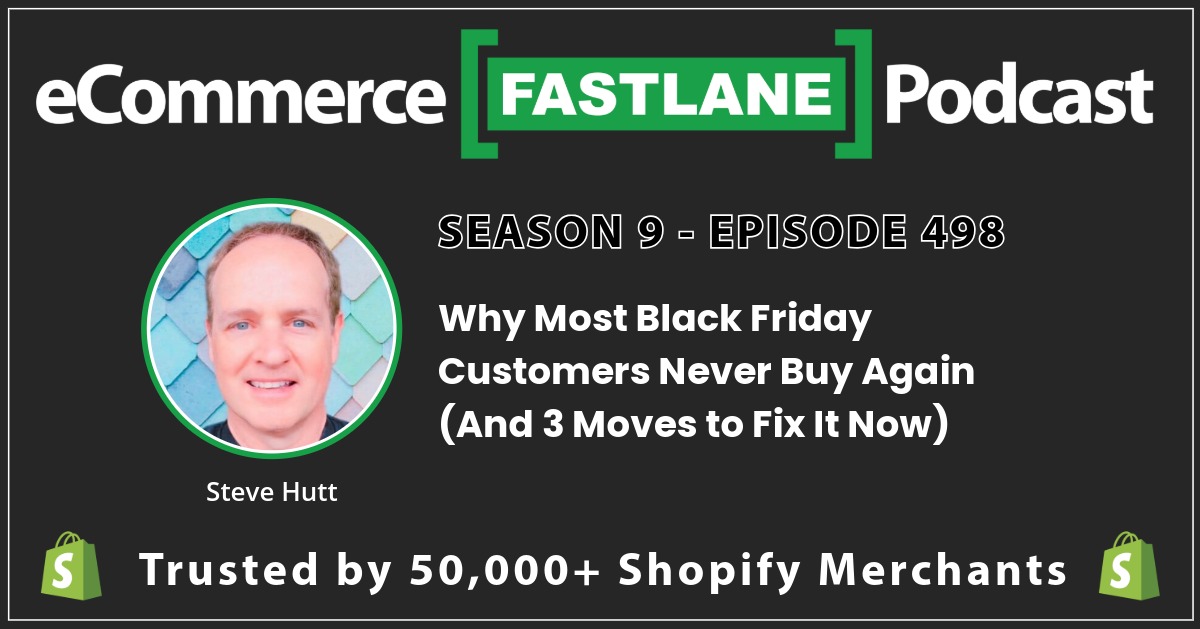
Steve Hutt: Well, hey there. Welcome back to eCommerce Fastlane. It’s Steve here today, and this whole episode is about one thing: the second order.
Black Friday is November 27th, and a lot of you are likely going to have a really big weekend. Some of you will even have your best revenue days ever, which I think is awesome. But here’s the thing that keeps coming back to me.
Let’s say you pick up 2,000 new customers over Black Friday and Cyber Monday. That would be a great weekend for a lot of people. Fast-forward to the end of February. How many of those 2,000 people have come back to make another purchase? For most brands, it’s a pretty small number. Many of those customers may never come back.
So the real question isn’t how good Monday night looks. It’s this: What are we going to do right now to get that second sale in February?
That’s why I’m recording this solo episode today. It’s incredibly important for lifetime value and retention, not just getting the first sale, but figuring out how to get the second.
Here’s the good news: Almost everything that decides whether a second order happens can be set up next week, depending on when you’re listening to this. We’re getting close to the Super Bowl time of year for ecommerce, but there’s still time.
If you count 90 days from November 27th, you land around February 25th. That’s the date I want you to circle on your calendar.
I’ve discussed this in the past, including when I was at Shopify. I always told the brands I managed that it’s important to think about what happens after Black Friday and Cyber Monday. That’s why I get people to circle February 25th.
By the end of this episode, I’m hoping you’ll know three things: what you can still change before Black Friday, what you can’t change and why that’s okay, and the one number to pull in Q1 that will tell you whether Black Friday actually worked.
All right, let’s get into it. Here’s the shift I want you to make: Black Friday is not the biggest sales event of your year. I know that sounds weird, but it’s the biggest acquisition event of your year.
Think about that for a second. Black Friday is not the biggest sales event of your year. It’s the biggest acquisition event of your year.
I read an article from Adobe recently, and I think they forecasted $275 billion in U.S. online holiday sales this year, up almost 6.7% over last year. They also expect traffic from AI tools to retail sites to jump about 130%.
A lot of new people are coming to your website, and a lot of them are strangers. They found you through a deal, through ChatGPT, Claude, Gemini, or a gift guide. They don’t know your story yet.
Here’s why that matters. There’s a retail marketing platform I follow called Ometria. They looked at their retailers and said in a recent article that only 4% of their new Black Friday customers bought again within 12 months. They also said Black Friday customers were six times less likely to come back than a typical new customer.
That’s interesting, right? Another study I read, from a company called OptiMonk, put the 12-month repeat purchase rate closer to 22%. I’ll make sure these links are in the show notes.
So that’s 4% in one dataset and 22% in another. That’s a huge spread, and honestly, I think that’s the point. Nobody’s average is going to be your number, and your number is the one that counts.
I also found a slightly older article from Bluecore, another commerce platform. Based on their data, about 60% of second purchases happened within the first 100 days. After that, the odds dropped off.
The window is short, roughly late November to late February. That’s why I got you to circle the 25th. That’s your opportunity to get the second sale.
But let’s get the hard part out of the way. Your offers are probably locked in, and they’ve likely been locked for weeks. Most agencies want your theme, checkout, and apps frozen by November 13th. Even Shopify has a code freeze happening around that time.
It’s not just a Shopify thing. It’s an agency habit, and I believe it’s a smart one. I’m not going to tell you to rethink your discount codes, revisit the offer, or try to work around that freeze.
Here’s the good news I want you to take home: What you can change is everything that happens after the order confirmation.
That’s the crux of what I’m talking about today. Almost none of it touches your theme or checkout. It lives in your email and SMS tools and Shopify Flow.
There are three things I believe you can do today, or early next week, before things get really busy.
Number one is to tag the cohort. It’s simple. Set up a rule in Shopify Flow so that when an order comes in, and it’s the customer’s first order, you add a tag such as BFCM 2026 to that order. Turn it on before your deals start, leave it running through December, and that’s it. It’s about 10 minutes of setup.
The reason to bother is that in February, you want to look at those people exclusively as a group. Tagging them as part of the BFCM 2026 cohort lets you do that. You don’t want to mix them in with everybody else. If you don’t tag them now, you’ll be doing a little guessing later.
That’s move number one. Move number two is to give your first-time buyers their own path.
Here’s the mistake I see over and over: Someone buys from you for the first time on Black Friday, and the very next day, they get dropped into the same promotional blasts as everybody else.
They get the Cyber Monday email, the last-chance email, probably a gift guide, and another 30%-off email. That’s five sales emails before their package even shows up.
What did that teach the customer? That you’re a discount brand? That they should wait for the next sale?
I would split them out. Your existing customers get the promotional calendar and the flows you’ve set up for email, SMS, and push notifications. Your brand-new Black Friday buyers get a welcome.
That leads to move number three: Decide what they hear and when.
I recommend sketching this out in a Google Doc or somewhere similar. There are four important touchpoints for these brand-new Black Friday buyers. These are tried and true, and I really want you to learn from them. I’ll put them in the show notes so you can see them.
The first is day zero: the confirmation. We all know this email, but most confirmations read like a receipt. That’s the standard Shopify approach.
I think it makes sense to make yours sound more like a person. Say thank you, add a little personalization, and tell them when their order is expected. If holiday shipping is slow, be honest about the timing. That’s the day-zero receipt, so take a look at what Shopify is sending and modify it.
The next touchpoint is day three. Their package is probably still in a truck, or it may not even have been fulfilled yet. Send something useful.
What that looks like depends on what you sell. It could be advice on getting the most out of what they bought, or the story of why you started the company. But don’t give them an offer.
Here’s a smart addition: Ask one simple question. Was it a gift?
That one answer changes everything you send next. It’s important to ask whether it’s a gift, and day three is a good time to do it.
The third touchpoint is 14 days after the order. In all likelihood, the order has arrived. You may have software that lets you check the tracking and confirm delivery, which is ideal.
If it has arrived, you’re checking in, asking how it’s going, and pointing them toward help if they need it. I also think this can be a good spot to ask for a review.
You don’t want to send a check-in and ask for a review when they haven’t even received the product. We see those reviews, even on Amazon, where someone says, “I don’t know. I haven’t received the product yet, but I’m sure it’s okay.”
That’s a big fail. Don’t do that. Make sure they have the product, check in, and ask for a review if they can provide one.
The fourth touchpoint is 45 days out. This is when I think you can start asking for the second order. That will probably land in mid-January, when their inbox is a lot quieter. Even those early-January inventory blowout sales have probably passed.
I would make this more about what fits their needs than about urgency. If you sell something that runs out, this is a great time for a refill reminder. If you don’t, that’s fine. Show them what goes with what they bought, or what other people who bought that product also purchased.
Here’s my take on the offer: If they came in on a 30% discount, don’t instantly hand them another 30% discount. Try something a little more creative, such as free shipping, a free gift with purchase, or early access to something new.
This is 45 days after their order. Give them something that says you’re worth coming back to, rather than another blanket 30% off. It also shows the customer that you’re not always on sale.
All of this reminds me of a case study I found while researching these recommendations. It came from an agency called Flowium, spelled F-L-O-W-I-U-M, and they shared numbers for a jewelry brand.
The brand picked up more than 77,000 new customers over Black Friday and the holidays last year. Only 17% of their November buyers came back within the first six months. For December buyers, it was about 13%.
My first thought was that a lot of those December orders might have been gifts, so the person buying wasn’t necessarily the person using the product. That’s why I suggested asking whether it was a gift in one of those four touchpoints.
Knowing that information lets you adjust the follow-up. You can update the thank-you series or create a bounce-back email for first-time buyers. The flows driving repeat orders were those basic follow-ups.
Keep in mind that this is an agency telling its own story, but it matches what I’m hearing from merchants.
Now, let’s fast-forward to Q1. Hopefully, you’ve added the BFCM 2026 tag. At 30, 60, and 90 days, ask one question: What percentage of those customers bought again?
Run those queries, including around February 25th. Then compare that with a normal group, such as people who bought from you for the first time in October. That comparison will tell you more than any industry statistic ever will.
There’s one technical note here. Shopify changed how it counts sessions on September 21st. Bots are now filtered out by default, and some shopping journeys that skip the normal page view now count. Shopify says to treat that date as a new baseline.
Orders, sales, and customer counts didn’t change. Comparing this year’s conversion rate with last year’s Black Friday may be an apples-to-oranges comparison. Score the season on orders and new customers, then score it again in February on second orders.
Let me break this down by stage so you can see how it works.
If you’re doing under 10,000 orders a month, keep it simple: one tag, one thank-you email that sounds like you, and one check-in after delivery. Honestly, I believe a personal note from you as the founder will go further than a fancy flow.
If you’re doing more than $100,000 a month, I think you need to build the four-touchpoint path I described. Split new buyers from existing customers, and build the 30-, 60-, and 90-day report now so it’s waiting for you in February.
If you’re doing more than a million dollars a month, you probably have all the flows already. The question is different: Are your first-time Black Friday buyers actually on their own path, or are they sitting in the main flows with everybody else?
Double-check that. Pull last year’s holiday cohort this week and see what it did. That’s the bar to beat.
As you may know, I run most things, including decisions in my own business, through what I call an 18-month test: Will this matter a year and a half from now?
There are a lot of shiny objects out there, and people have to decide what they’re going to use and what they’re not. Most trends fail that test. I believe this passes easily because it isn’t a trend. The second order has always been where the business gets built.
If you do one thing this coming week, put that tag in place. Use Shopify Flow so that when a first-time order comes in, it gets the BFCM 2026 tag. It’s about 10 minutes, and it’s the one thing I really don’t want you leaving until February.
Do it now. In February, you’ll thank yourself when you can research, tag, and filter those people. Make sure they’re not in the standard flow. Put them in a special flow for first-time Black Friday and Cyber Monday customers.
That’s it. Thank you for hanging out with me. I love doing solo episodes because they get me thinking about what we can do that’s easy and tactical. It’s important to me that you learn these things, but also implement them. That’s the key.
If this helped you, put it into practice or pass it along to another founder or marketer in the Shopify world. I’d appreciate that.
If you like this sort of thinking, I publish a few thought leadership articles each week in my newsletter at fastlaneinsider.com. I think we’re almost at 60,000 founders and marketers over there now, so go check it out.
Enjoy your weekend, and we’ll be in touch next Tuesday. Take care.