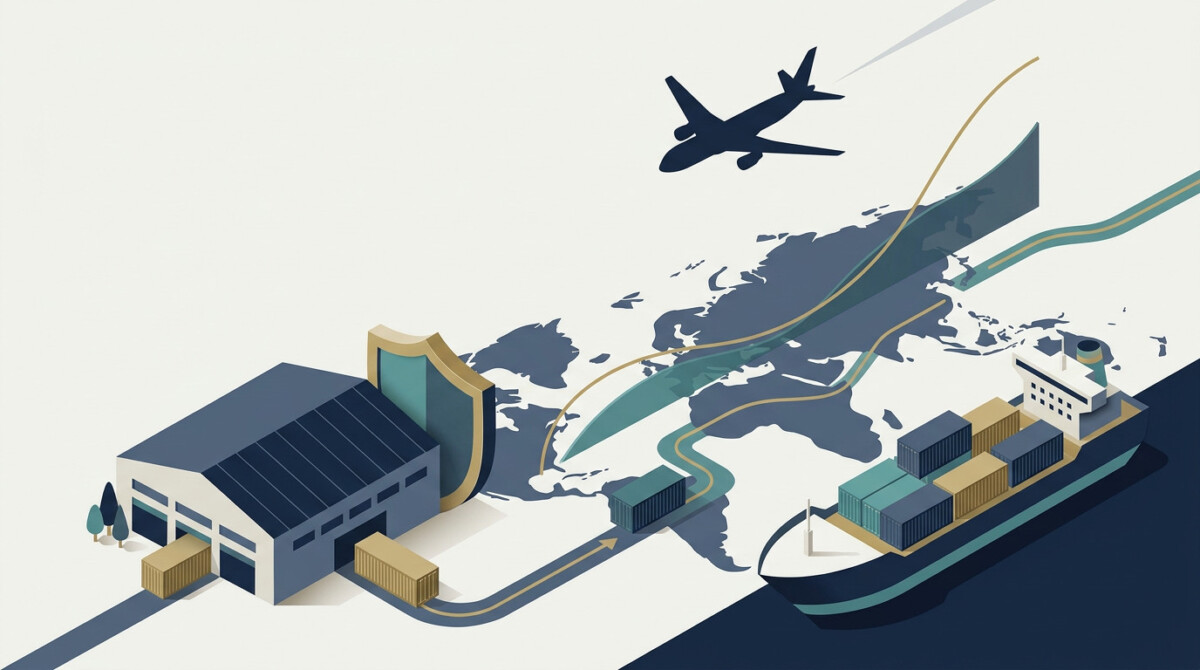
Portless fulfills ecommerce orders directly from factories in China and Vietnam, letting brands buy six weeks of inventory instead of six months and defer import duty until each parcel sells. It fits sub-3.5-pound DTC brands over $1M. It trades unit economics for cash velocity.
If the model were a tariff loophole, closing the loophole should have killed it. Instead the business more than doubled. That tells you what merchants are actually buying, and it is not duty avoidance.
On July 24, ten days from the day I am writing this, the tariff regime that governs almost everything you import ceases to exist as a matter of law.
Here is the sequence. On February 20, 2026, the Supreme Court held that the IEEPA statute did not authorize the tariffs the administration had built its trade policy on. Within hours the White House invoked Section 122 of the Trade Act of 1974, a balance-of-payments authority never used before in its fifty year history, imposing a temporary 10% surcharge on nearly all imports for a period of 150 days, effective February 24. Section 122 caps that surcharge at 150 days unless Congress extends it, and Congress has introduced no extension bill. Then in May the Court of International Trade struck down Section 122 as well, and in June the Federal Circuit stayed that ruling, so Customs has kept collecting a duty that a federal court has already declared unlawful. Meanwhile the US Trade Representative has proposed replacement Section 301 tariffs covering sixty countries, which carry no rate cap and no expiration date at all.
That is three tariff regimes in eighteen months, two of them struck down in court. If you are a Shopify merchant trying to build a sourcing plan around a tariff number, I want you to sit with what that record actually means. It means the number is not a plan. I recorded my third conversation with Izzy Rosenzweig of Portless this week, and the most useful thing he said had nothing to do with tariffs at all.
The right variable to optimize is your cash conversion cycle, not your tariff rate, because the tariff rate has changed three times in eighteen months and your cash cycle is the one thing you actually control. Every merchant I talk to at the $500K to $2M stage is doing tariff math. Almost none of them are doing cash math, and the cash math is the one that decides whether they survive a bad forecast.
Here is the proof, and it comes from Izzy’s own business in a way that cuts against his commercial interest. The de minimis exemption, which let shipments under $800 enter the US duty free, was the thing everyone assumed made direct-from-China fulfillment work. It ended for China and Hong Kong on May 2, 2025, and for every other country on August 29, 2025. Customs then made that suspension indefinite in an interim final rule effective June 24, 2026. If Portless were fundamentally a duty avoidance play, that should have been an extinction event.
Instead, Izzy says the business more than doubled after de minimis went away. Sit with that. The tax advantage disappeared and demand accelerated. Whatever brands are buying, it is not the loophole. They are buying the ability to stop putting six months of cash into a shipping container and hoping the forecast was right.
This is the eighteen month durability test I apply to every tactic before I recommend it. A strategy built on the 10% Section 122 surcharge has a shelf life measured in days. A strategy built on shortening the gap between paying your factory and collecting from your customer works in every tariff regime, including the ones nobody has proposed yet. If you want the broader defensive playbook, my tariff-proofing playbook for Shopify stores covers the pricing and vendor levers. This piece is about the structural one.
Portless is a fulfillment company that ships ecommerce orders directly from warehouses next to your factories in China and Vietnam, using local carrier labels so the customer experience looks domestic. Your goods never sit on a boat and never enter a US warehouse. When an order comes in, the item is picked, polybagged, given a USPS or Canada Post label, palletized by destination region, and flown to a regional injection point. Logistics people call this zone skipping. The customer sees a local tracking number and a package in roughly five days.
The company is Toronto based, launched in May 2023, and raised an $18 million Series A led by Commerce Ventures with FJ Labs, eGateway Capital, Red Swan Ventures, and Ground Up Ventures participating. Izzy is not a logistics tourist. He founded Browze in 2012, a DTC home and kitchen goods brand that delivered more than 2.5 million packages and peaked around $50 million in revenue with roughly 100 employees before Apple’s privacy changes gutted its Facebook attribution. He opened a China fulfillment center for his own brand, discovered other founders wanted access to it, and pivoted the company into infrastructure. Portless is the fulfillment arm of a DTC brand that learned this the expensive way.
Worth naming plainly: Izzy told me he ran a $100 million brand. The public record puts Browze closer to $50 million at its peak. Founders round up. I am telling you the verified number because the story does not need the inflation, and because if I let a soft claim pass here you should not trust the hard ones later. This is his third appearance on the show, and his previous appearance covered the mechanics of the trade war squeeze in more depth.
The four capabilities that produce a real financial outcome are inventory compression, duty deferral, restock speed, and global expansion without a second inventory buy. Everything else in the pitch is downstream of these.
Inventory compression is the headline. In the traditional model you manufacture four to six months of stock, put it on a boat for 45 to 60 days, and wait. Sitting next to the factory, you can buy four to six weeks instead. For a brand doing $500K a month, that is the difference between several hundred thousand dollars locked in a container and the same money available for inventory you can actually sell. Portless cites Memo Bottle cutting its cash conversion cycle from three or four months to four to six weeks, and Craft Club tripling within three months of switching. Those are the company’s own customer figures, unaudited, and you should treat them as directional rather than as benchmarks.
Duty deferral is the mechanic most merchants misunderstand. In the bulk import model you pay the full duty bill the moment your container clears customs, before you have sold a single unit. Bring in $1M of goods at a 40% effective rate and you have $1.4M out the door against zero revenue. In the direct model the goods stay outside the US until an order is placed, so duty is assessed parcel by parcel as items sell, against the revenue from that specific sale. Duty is calculated on what you paid the factory, not on retail, so a $20 FOB cost on a $100 sweatshirt is duty on $20. How transaction value works for direct supply chain merchants covers the customs mechanics, and note that it was authored by Portless.
Restock speed and global reach compound from the same proximity. Izzy claims brands see 20% to 35% revenue lifts in core markets simply from not being out of stock, and that customers typically arrive 100% US and are in seven countries within six months. Both are internal Portless figures. The underlying logic is sound, since out of stock is invisible lost revenue that never appears on your P&L, but the specific percentages are marketing until someone audits them.
Moving manufacturing to Vietnam rarely escapes China, because you can relocate a factory but you cannot relocate an ecosystem, and the components keep coming from China regardless of what the label says. Izzy told me that brands who tried this almost all came back, and he has since made the same argument in Forbes. This is the one claim of his I most wanted to stress test, because it is also the most self-serving: Portless operates in China, so of course its founder says China is inescapable.
The independent data holds up better than I expected. Chinese exports to the US fell 16% in the first quarter of 2026 while Chinese exports to Southeast Asia rose 20%, which is not an exodus but a lengthening of the same supply chain. Roughly 60% of Vietnam’s fabric inputs still come from China. A February 2026 study from the Information Technology and Innovation Foundation found that even where final production moves out of China, the underlying parts do not. The practical version Izzy gave me was vivid: a brand in Vietnam wants one roll of fabric to trial a new line, Vietnamese mills require a four hundred roll minimum, so they order the single roll from Guangzhou and eat a ten day delay.
The honest correction to his claim is that most brands never actually left. They added an assembly stop, kept buying Chinese inputs, and now pay to hold inventory in two countries instead of one. Country of origin engineering is legal and real, and large brands do it with trade counsel, but it is a tax strategy rather than a supply chain strategy. If your reason for considering Vietnam is tariff avoidance, reread the first section of this article and note what happens on July 24.
The core trade-off is that you are exchanging unit economics for cash velocity, and Portless does not lead with that. Air freight costs meaningfully more per unit than ocean freight at volume. If you have plenty of cash, stable and predictable demand, and healthy inventory turns, bulk ocean import into a domestic 3PL can still win on contribution margin. This model is strongest exactly when cash is scarce and demand is volatile, which describes most brands under $10M but not all of them. Run the math on your own gross margin before you fall in love with the cash flow story.
The hard constraints are real. Orders must average under three and a half pounds, which is physics, not policy, and it rules out furniture, most home goods, and anything bulky. No food. No weapons or knives. Supplements work only with FDA registration and expiration tracking documentation in place. Amazon FBA cannot use the cross-border model at all, though FBM can. Wholesale runs through separate US facilities, because pallet-out is a different operational muscle than parcel-out. And returns are physical only, so you keep Loop, Narvar, or AfterShip for the RMA software layer.
There is a regulatory tail risk Izzy has every incentive to underweight, so I will name it. This model concentrates your fulfillment inside the exact parcel flow that US trade policy has spent two years targeting. De minimis was killed specifically to address low value direct-to-consumer shipments from Asia. The February 2026 executive order set flat duties of $80 to $200 per item on postal shipments. Nothing currently threatens the commercial carrier route Portless uses, but a merchant betting their fulfillment on this lane should understand they are standing in the middle of the policy fight, not outside it. My own take on navigating tariffs stays deliberately diversified for this reason.
If you are not the right fit, the honest alternatives are NextSmartShip and Floship, which run comparable near-factory cross-border models, or a domestic 3PL like ShipBob or ShipMonk if your product is heavy, your demand is stable, and one or two day delivery is your competitive edge. Portless is not a sponsor of this site and there is no affiliate relationship. Izzy has published a guest post here, and this is his third podcast appearance, which is exactly why I have been harder on the numbers than I would be on a stranger.
Your next step this week is to calculate your actual cash conversion cycle, because that single number tells you whether any of this matters to your business. Take the days between wiring your factory deposit and collecting cash from the customer who buys that unit. Include manufacturing time, ocean transit, port and customs time, warehouse receiving, and average days of inventory on hand before sale. Most merchants I ask have never computed it and are shocked by the answer. If your number is over 120 days and your orders are light, this conversation is worth having. If it is under 60, your cash is not the bottleneck and you should go fix something else.
Stage matters here more than anything. Under $1M, ignore all of this. Your constraint is product market fit and marketing efficiency, and adding a cross-border fulfillment partner is premature complexity of exactly the kind that kills brands at this stage. Between $1M and $5M, this is worth a conversation, but know that Portless’s own funding coverage describes its customer base as mostly $5M to $150M brands, which is a wider range than the $1M floor Izzy quoted me. Ask directly where you would sit in their book. From $5M to $50M with light products manufactured in Asia, this is close to a no-brainer to at least model. Above $50M you are likely running a hybrid, with direct fulfillment for DTC velocity and bulk import for wholesale and Amazon.
And whatever you decide about fulfillment, stop building your 2027 plan around a tariff rate. On July 24 the current one expires, something else replaces it, and the merchants who did not notice will be the ones repricing in a panic. The ones who spent this summer shortening the distance between their cash going out and their cash coming in will barely feel it. That is the whole lesson, and you can act on it without hiring anyone. If you want the inventory side of this, what inventory mismanagement quietly costs your margins is the companion conversation.
The 10% Section 122 import surcharge expires by operation of law on July 24, 2026, exactly 150 days after it took effect on February 24. Section 122 of the Trade Act of 1974 caps a balance-of-payments surcharge at 150 days unless Congress passes legislation extending it, and the President cannot renew it unilaterally. No extension bill is pending. The surcharge itself replaced the IEEPA tariffs the Supreme Court struck down in February 2026, and the US Trade Representative has proposed Section 301 replacement tariffs covering sixty countries, which carry no rate cap and no expiration. Base MFN duties and existing Section 301 tariffs on Chinese goods remain regardless.
No, the de minimis exemption is not coming back, and Customs made its suspension indefinite in a rule effective June 24, 2026. The $800 duty-free threshold ended for China and Hong Kong on May 2, 2025, and for all other countries on August 29, 2025. Every commercial shipment now requires formal or informal entry with duties assessed regardless of value. The $800 figure technically remains in the underlying statute, but administrative orders currently block commercial ecommerce from using it. Merchants importing from Asia should plan on paying duty on every parcel and should build landed cost models that assume no value threshold protects them.
Direct-from-China fulfillment helps cash flow by letting you buy four to six weeks of inventory instead of four to six months, and by deferring import duty until each individual order sells. In the traditional model you pay your factory for months of stock, wait 45 to 60 days for ocean transit, and pay the entire duty bill the moment the container clears customs, all before earning a dollar. In the direct model your goods stay near the factory, orders ship individually by air with local carrier labels, and duty is assessed parcel by parcel against the revenue from that specific sale. The trade-off is higher per-unit shipping cost.
Portless is a bad fit for brands with orders averaging over three and a half pounds, brands manufacturing domestically, Amazon FBA sellers, wholesale-led businesses, and merchants under roughly $1M in annual revenue. It cannot handle food, weapons, or knives, and supplements require FDA registration and expiration tracking documentation. Brands with abundant cash, stable demand, and strong inventory turns may still earn better contribution margin from bulk ocean freight into a domestic 3PL, because air freight costs more per unit at volume. Comparable alternatives include NextSmartShip and Floship for near-factory cross-border fulfillment, or ShipBob and ShipMonk for domestic warehousing.
Moving manufacturing to Vietnam rarely escapes China dependence, because the components, fabric, and tooling still come from China. Roughly 60% of Vietnam’s fabric inputs are Chinese, and Chinese customs data shows exports to the US falling 16% in Q1 2026 while exports to Southeast Asia rose 20%, meaning parts are flowing to Vietnamese assembly plants rather than leaving the Chinese ecosystem. A February 2026 study from the Information Technology and Innovation Foundation found the same pattern. Brands often end up holding inventory in two places, paying duty on assembly, and accepting longer lead times. Country of origin engineering is legal but requires trade counsel.