

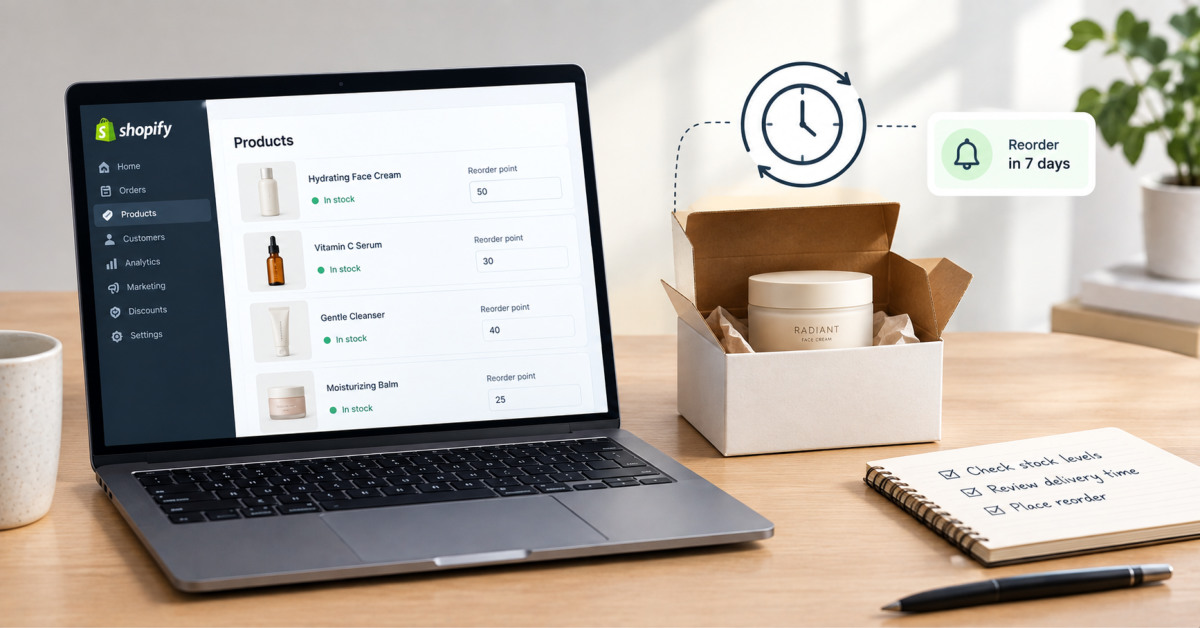
Product care content raises repeat purchase rate when it states a replacement interval and feeds a timed reorder message. Published as a standalone article with no interval and no trigger, it earns traffic and changes nothing about when the second order arrives.
A care guide answers how long the product lasts. That answer is also your reorder interval. Almost nobody uses it twice.
The average direct to consumer brand gets a second order from about 28% of its customers, and roughly 76% of those second orders land inside the first 90 days. Most post purchase email flows stop after 7 to 14 days. The decision window and the communication window barely overlap.
The spread underneath that 28% average is enormous, and it is almost entirely product driven. Benchmarks broken out by vertical put supplements and food at 30 to 45%, apparel at 20 to 32%, and furniture and jewelry in the teens. The standard reading of that data is that consumables repeat and considered purchases do not, so brands in the lower bands should accept their category and move on.
That reading is half right. Consumables repeat because they run out on a visible schedule. Plenty of non consumable products also run out on a schedule, just a longer one that nobody has ever counted, stated, or acted on. Whether you are doing $30K months or $3M months, the work below is the same: find the number, publish it honestly, and build one message that fires when it arrives.
Product care content fails to move repeat purchase rate when it is published without a stated replacement interval and without anything in the store that reacts when that interval passes. The guide gets written for search, it ranks for a procedural query, it answers the question, and it ends. Nothing in it tells the customer how long the product is supposed to last, and nothing in the brand’s systems is listening.
This is a structural miss rather than a writing problem. Most care guides are commissioned by whoever owns SEO and measured on sessions. Nobody on that side of the house is accountable for second order rate, so the number that would connect the two, the expected service life of the product, never gets asked for. The guide says wash it cold and dry it flat. It does not say that doing all of this correctly buys you about eighteen months, after which the elastic is finished regardless.
The absence of that sentence is what separates a care guide from a retention asset. A customer who reads “wash it cold” learns a habit. A customer who reads “washed correctly, this lasts about eighteen months of twice weekly use” learns a date. The second customer has been handed a reason to come back that has nothing to do with a discount code, and the brand has been handed a trigger it can actually schedule against.
For merchants at the $500K to $2M stage this usually surfaces as a tooling question. The instinct is to buy a retention app, and the honest answer is that the app cannot invent an interval you have never measured. If your wider retention system needs work first, building the Shopify retention framework that drives profit is the prerequisite, and this piece is one component inside it.
A rotation recommendation converts a single unit purchase into a multi unit purchase by giving the customer a performance reason to own more than one, which is a different mechanism from a bundle discount and a considerably more durable one. The customer is not buying three because three is cheaper. They are buying three because one does not do the job properly.
Elite Gymnastics, a specialist gymnastics retailer in Newcastle upon Tyne running on Shopify, sells competition and training leotards from around £38 to £147. Their care guidance recommends that competitive athletes keep three to four training leotards in rotation, so the elastic fibres have time to recover between wears rather than being asked to perform two sessions a day indefinitely. That advice is technically true, it is what a coach would tell you, and it also moves a £54 order to £162 without a single percentage point of margin given away.
The mechanism transfers cleanly across categories. Running shoes rotate to let midsole foam decompress. Chef knives rotate so one is always sharp while the other is being honed. A serum bought two at a time means the routine never breaks mid cycle. In each case the second unit is justified by how the product actually behaves, not by a threshold offer.
Two honest constraints. The advice has to be true, and you have to be willing to say the interval out loud even when it is longer than you would like. And more units in the box means more return exposure in categories that already carry it: apparel runs the highest return rate of any vertical, and the fully loaded cost of an apparel return sits near $30 an item, with under half of returned stock reselling at full price. Rotation advice belongs on repeat buyers who already know their size, not on first order upsell modules.
Your replacement interval is the median number of days between a customer’s first and second order of the same product, and your Shopify order export gives you that number without any additional tooling. Pull twelve months of orders, isolate customers who bought the same SKU twice, calculate the day gap for each, and take the median rather than the mean so a handful of gift purchases do not distort it.
Do this per SKU or per product family, never blended across the catalogue. A blended interval averages your fastest moving consumable against your slowest moving hard good and produces a number that describes nothing you sell. At under $500K a spreadsheet and Shopify’s native analytics are genuinely enough. Between $500K and $2M, Lifetimely or Peel Insights will do the cohort work without the manual export. Above that, RetentionX or a comparable customer intelligence layer is where this stops being a quarterly exercise and becomes a live segment.
Where the order history is too thin to read, derive the interval from the product instead of the customer.
None of the timing that follows works if the underlying events are not reaching your email platform cleanly, so confirm that before you build anything. Mapping the behavioral events your platform needs is a thirty minute check that saves a quarter of bad data.
The care guide belongs inside a timed post purchase flow that fires at 70 to 80% of the replacement interval, not only as an article sitting on your blog waiting to be found. The article is how a stranger finds you. The flow is how a customer you already paid to acquire decides when to come back.
The economics of the timed version are not close. Replenishment reminders convert at 8 to 15% against 1 to 3% for general promotional email, because they arrive at the moment the customer actually has the problem rather than at the moment the marketing calendar had a gap. The same message sent on a Tuesday because it was Tuesday is a promotion. Sent at 75% of the wear cycle, it is service.
A workable sequence has three beats. Around day three, the care instructions themselves, framed as getting the most out of what they bought. Around day thirty, a short check in that asks whether the product is performing, which doubles as your review request and your early warning system for quality problems. Then, at 70 to 80% of the interval, the reorder message that refers back to the care advice explicitly: you have had these about fourteen months, here is what the elastic is doing by now.
At $10K to $50K months, one flow in Shopify Email covering all three beats is enough, and building four segmented versions is the premature complexity that stalls brands at this stage. Past roughly $500K, segment the flow by SKU interval so a customer who bought the fast wearing item and the slow wearing item is not getting one averaged message. Klaviyo’s conditional branching handles this natively, and our assessment of when the Klaviyo investment actually pays off covers the point where that capability starts earning its cost. Postscript is the better home for the reorder beat if your category has real urgency.
Care and maintenance questions are the cheapest AI citation available to most Shopify brands, because they have specific correct answers and almost nobody in the category has published one with numbers attached. Assistants answering procedural questions need a source that commits to specifics, and the field is close to empty in most verticals.
Compare the two query types. A category term like best running shoes has every brand, every affiliate roundup, and every publisher competing for the same answer slot. A question like how often should I replace trail running shoes has a real answer, a numeric one, and typically three or four vague sources fighting over it. The second question is also further upstream: it gets asked before the shortlist exists, which means the brand cited in the answer is present at the moment the consideration set is being formed rather than after.
The structural requirements are the same ones that make care content useful to humans. State the interval as a number. Put the answer in the first forty to sixty words under a heading that matches how the question is actually asked. Name the material, the failure mode, and the conditions that change the answer. Avoid the hedging that makes a passage unquotable. Our fuller treatment of how Shopify stores get recommended by AI search covers the collection page and product page side of the same discipline, and notes that AI referred traffic converts at close to twice the rate of traditional organic.
The compounding effect is what makes this worth doing at any stage. One care answer, published once, serves the customer who just bought, the customer deciding whether to buy, and the assistant answering on behalf of a customer you will never see arrive.
Care content stops working the moment the advice bends toward selling, and the reliable tell is guidance that shortens the product’s life rather than extending it. A brand that quietly recommends replacement at three months when the honest answer is nine has not built a retention asset. It has built a discount code with footnotes, and both the reader and the assistant weighing sources will price it accordingly.
Three specific patterns to avoid. Care instructions that require a proprietary cleaner the brand happens to sell, when a generic equivalent works identically. Rotation advice with no performance basis behind it. And replacement intervals that got shorter after someone in the room noticed what a shorter interval would do to the forecast. The last one is the dangerous one, because it can be rationalised internally as conservatism.
The discipline is simple to state and uncomfortable to hold: the care guide has to be the advice you would give if you sold nothing. That is also what makes the resulting reorder message land, because by the time it arrives the customer has twelve months of evidence that your advice was straight.
The reorder clock is easiest in categories that hand you the interval. Contact lenses come with a replacement schedule printed on the box by the manufacturer, which is why replenishment in that category is a solved problem rather than a strategy. Almost every other category has to derive its own number, and the merchants who skip that arithmetic are usually the same ones evaluating a fourth retention app. Before adding another tool, it is worth checking the post purchase moments most brands are already missing with the stack they own.
Product care content increases repeat purchases only when it states a replacement interval and is connected to a message that fires at that interval. On its own, published as a blog post, it generates search traffic and answers a customer question without changing when the second order arrives. The mechanism that moves the number is timing, not the content itself. Replenishment style reminders convert at roughly 8 to 15% against 1 to 3% for general promotional email, because they land when the customer has the problem. The care guide is what makes that message credible rather than pushy, since the reorder prompt refers back to advice the customer already found useful.
Take the median number of days between a customer’s first and second order of the same SKU, using at least twelve months of order history. Use the median rather than the average so gift purchases and bulk buyers do not distort it, and run the calculation per product family instead of blended across the catalogue. If your repeat volume is too thin to produce a stable number, derive the interval from the product instead: manufacturer service intervals, published mileage or usage guidance, warranty claim timing, or the wear signal your support team hears about most often. Both approaches are approximate, and an approximate interval you act on beats a precise one you never measured.
A post purchase sequence should run to at least 90 days, because roughly three quarters of second orders happen inside that window. Most brands stop at 7 to 14 days, which covers shipping and onboarding and then goes silent for the entire period when the repeat decision is actually being made. A practical structure is three beats: care and usage guidance in the first week, a performance check in around day 30 that doubles as your review request, and a reorder prompt timed to 70 to 80% of the replacement interval for that specific product. Anything past 120 days is a win back sequence, which is a different job with different economics.
Both, in different forms and for different readers. The product page version serves the shopper who has not bought yet and is assessing how much upkeep the product demands, and it is the version that gets crawled, ranked, and cited by AI assistants answering procedural questions. The email version serves the customer who already owns it and needs the instructions at the moment they first use the product. The email should link to the page rather than duplicate it, which keeps one canonical version to maintain. The interval, the number that actually drives the reorder, belongs in both.
Apparel typically runs 20 to 32% over a twelve month window, against a blended direct to consumer average near 28% and consumable categories at 30 to 45%. Benchmark against apparel, never the all category average, since the spread is driven mostly by whether the product gets used up. Below your category band points to a retention execution problem, and the gap to the top quartile is your realistic upside. At or above band while still failing to cover acquisition cost points to pricing or product market fit instead, and no email sequence will fix that. Measure at 30, 60, and 90 days as well as annually to see where the drop happens.




