

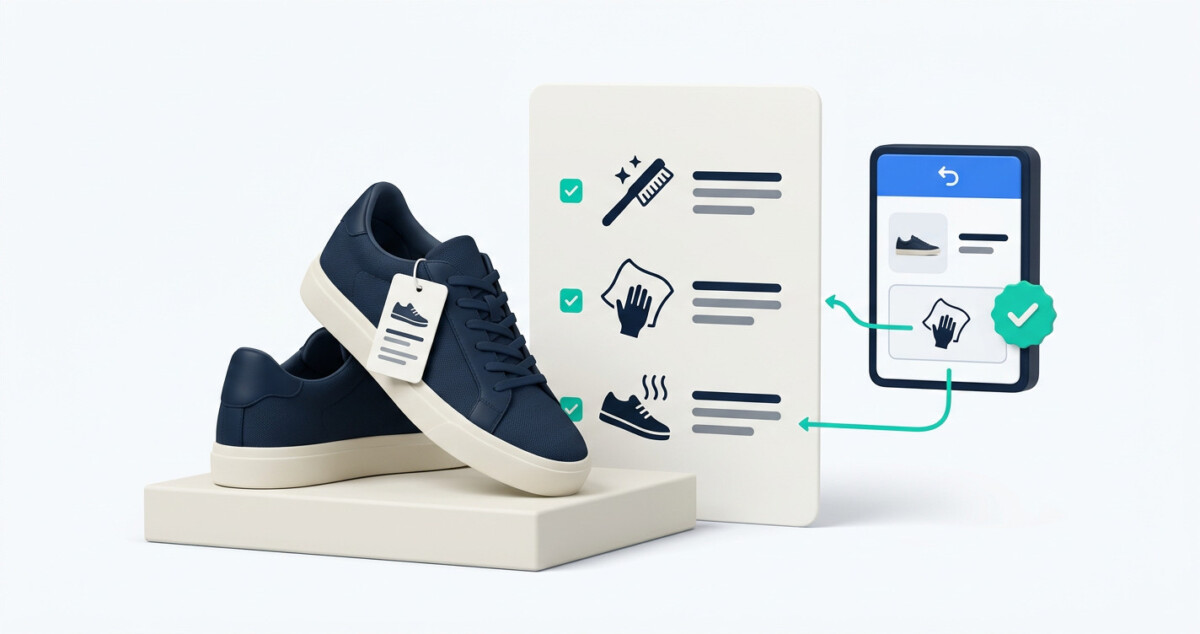
Product care content will not fix a fit driven return rate. For brands selling anything with a finish, hardware, cookware, jewelry, furniture, it reduces damage and not as described returns, deflects support tickets, and earns a second purchase.
Fifty seven thousand Americans a month ask how to clean stainless steel appliances. Almost none of them are asking the brand that sold them the appliance.
Returns took $849.9 billion out of US retail in 2025, 15.8% of annual sales and 19.3% of everything sold online, according to the National Retail Federation’s October 2025 returns forecast. Most of the work merchants do against that number goes into fit. Better size charts, better photography, fit quizzes, review mining for sizing feedback. That work is correct, and for a brand selling a finish rather than a fit it solves almost nothing.
Here is what it looks like when it goes wrong. A customer buys a matte black bathroom faucet on a Tuesday. On Friday they wipe it down with the bathroom spray already under the sink. By the following Tuesday the coating has gone patchy in two places and the faucet is in a return box, tagged as damaged or not as described. The product was neither. Nobody told the customer what the finish was or what it tolerated, and the brand that could have told them in two sentences published nothing.
That is the return reason your store can actually fix, because the information gap belongs to you. It applies if you sell hardware, lighting, cookware, jewelry, small furniture, leather goods, or anything else with a surface a customer maintains. Whether you are doing $50K months or $1M months the build is the same shape, and only the sequencing changes.
Care content fixes two of the five common return reasons, product description mismatch and post delivery damage, and it does nothing at all for the fit and change of mind reasons that dominate apparel. Shopify’s own returns management guidance, published in February 2025, names the five: fit or sizing, product description mismatch, damage in transit, defects, and change of mind. Care content attacks the second one directly and takes a slice out of the third.
The slice matters. A meaningful share of what gets tagged as damage is not damage in transit at all. It is damage after delivery, caused in the first two weeks by a customer applying the wrong product to a surface they had no reason to understand. Those units come back, get inspected, fail to show a transit cause, and get written off or resold as open box. The return reason field says damage. The actual cause was a missing paragraph.
You can test this on your own data in an afternoon. Shopify’s native returns flow captures a return reason on every request, and if you run support through a helpdesk like Gorgias you already have the ticket tags that sit next to it. Pull the last ninety days, filter to damaged and not as described, and read the customer comments rather than the reason codes. If the comments mention cleaning, spotting, dulling, scratching, or discolouring, you have found the problem this article is about. If they come back overwhelmingly as sizing, close this tab and go work on your size charts instead, because care content will not help you.
The brands that feel this most are the ones selling a finish rather than a fit: hardware, lighting, cookware, jewelry, small furniture, where a customer who cleans the item wrong on day three has a damaged product and a story about your quality. Care content is one lever among several here, and it sits alongside the broader customer experience levers that reduce product returns, from product photography to exchange incentives. What makes it unusual is that it is the only one of those levers that also brings in new traffic.
Care queries carry real volume at almost no ranking difficulty, which is the combination that almost never survives in a commercial category. Pulled from Ahrefs Keywords Explorer on October 1, 2026, the US numbers for a single narrow slice of household metal care look like this.
The headline number is the easy one to notice. The interesting one is the last row. Fifty searches a month is a rounding error on any traffic report, and the advertiser cost per click on that query sits at $40. Somebody is willing to pay $40 for a click from a person who has just discovered they own a matte black faucet and do not know what to do with it. That is not proof of conversion, but advertisers do not sustain a $40 click on a query that never converts, and the people bidding on it are almost certainly not the brand that sold the faucet.
Running this for your own catalogue takes an hour and no judgment. Export your product data, pull the material and finish fields, and prefix each distinct value with “how to clean” and “how to care for”. A store with eleven finishes across its catalogue generates twenty two candidate queries. Check the volume, sort by volume divided by difficulty, and the first three rows are your build order. At $0 to $50K do this manually for your top five SKUs and skip the export entirely. At $2M and above, hand the list to whoever owns content and ask why none of it is published.
Care content earns its keep in exactly three places: on the product page beside the material spec, in a help center article built to rank, and in the post purchase flow seven to fourteen days after delivery. Anywhere else and it is decoration.
On the product page, the right home is a Shopify metafield rather than the product description. A care metafield rendered by the theme puts two sentences of finish guidance next to the material spec, which is where a customer who is already thinking about materials will read it. Buried at the bottom of a 600 word description it will not be read by anyone, and it will not survive the next person who rewrites that description for conversion. Two sentences is the right length here. The customer at this stage wants to know the item is not fragile, not how to maintain it.
The help center article is the one that does double duty. It is the asset that captures the 57,000 search a month query, and it is also the thing your support team links to instead of typing the same answer again. Write it as the standalone answer to the query rather than as a page about your products, because a care article that is really a product pitch ranks for nothing and deflects no tickets.
The post purchase email is where the timing matters most. The first clean usually happens inside the first two weeks, which means a care email landing on day seven to fourteen arrives before the damage, while a standard post purchase email flow puts its review request somewhere around day fourteen to twenty one. Sequence the care email ahead of the review request. A customer who has just ruined your product is not going to leave you five stars, and you will have asked them to rate it at the exact moment they were deciding whether to send it back. The same logic extends into replenishment, which is covered in more depth in the Shopify retention framework, where usage based triggers do the work that calendar based campaigns cannot.
Publish the instructions first and attach a care SKU second, because a care product with no care content behind it is an attach nobody understands and a support ticket waiting to happen. The content costs you a day of writing. The SKU costs you inventory, a supplier relationship, and a line item that has to earn its shelf space against your core catalogue every quarter.
The attach logic is real when it is earned, and it comes from a genuine property of finishes: they are not interchangeable. Chrome, lacquered brass, oil rubbed bronze, matte black coatings and anodized aluminum all tolerate different chemistry, so a customer who owns four finishes ends up with three half empty bottles under three different sinks and eventually buys a cleaner-and-polish bundle that covers every surface in the house rather than one specialist product per finish. That is the attach, and it is a bundling decision rather than a product decision. How you structure it changes what it earns, which is the subject of this guide to Shopify bundle strategy.
The category is also crowded, and it includes the fixture manufacturers themselves. Kohler sells its own faucet and stainless steel cleaners, and for a customer still inside a warranty window the manufacturer branded product is often the safest recommendation you can make. If you resell finished goods, saying so costs you nothing and buys you the kind of credibility that makes the rest of your care content believable.
The merchants who get this wrong do it in the same order every time, adding a care SKU before they have written a single line of care content, which produces an attach rate nobody can explain and a product nobody understands. Below roughly $500K in annual revenue the honest answer on a care SKU is usually no. Above it, the test is whether your care content is already ranking and whether you have a replenishment trigger that can sell a consumable twice. If both are true, the attach is a reasonable next step. If neither is true, you are buying inventory to solve a content problem.
The fastest way to turn care content into a liability is to publish your own chemistry advice when the manufacturer has already published theirs and said something different. Contradicting a finish manufacturer in writing is how an information asset becomes a warranty argument.
The published guidance is specific and easy to check. Kohler’s instructions for chrome finishes tell the owner to spray from six to eight inches away, wipe with a dry cloth, and test an unfamiliar surface in a small inconspicuous area first. Delta’s finish care guidance goes further and names what to avoid: harsh abrasives or polishes, bleach based cleaners, and products containing hydrofluoric, hydrochloric or phosphoric acid. It permits a 50/50 white vinegar and water solution on hard water stains, with a thorough rinse afterwards. Neither of those pages reads like marketing, and both of them will outrank your version of the same advice if your version is vaguer.
Note what Delta warns against, because it is the trap in this whole category. Polishes are on the avoid list. The instinct to reach for a polish when a surface looks dull is almost always wrong, because dullness on a household surface is usually a layer of grease, skin oil or mineral deposit sitting on top of an intact finish. Cleaning removes the layer. Polishing grinds it around and abrades a coating that was never meant to be abraded. Care content that says polish everything generates damage claims, and care content that teaches the cleaner first, polish only where the finish permits it distinction prevents them.
If you manufacture, your care content is the manufacturer guidance, which means the burden of getting it right is yours and it should be reviewed by whoever owns your product spec. If you resell, your care content defers to the manufacturer and links to it, which is both safer and better for the reader. And where your returns are driven by policy abuse and fraud rather than by missing information, the levers are entirely different and are covered separately in this piece on reducing post holiday returns.
Build one help center article for your single highest volume care query, put two sentences of care guidance in the product page metafield for the SKUs that share that finish, and do nothing else until both have been live for ninety days. Ninety days is long enough to see whether the article ranks and whether the return reason mix moves, and short enough that you have not committed a quarter to a theory.
The sequencing by stage is the part most merchants get backwards.
At $500K to $2M the constraint is almost never the idea, it is that the care content competes with eleven other things the same person owns. That is the stage where premature complexity does the most damage, and adding a care SKU, a care email, a care landing page and a care video in the same quarter is exactly the shape of it. One article and one metafield is not an unambitious plan at that stage. It is the plan that actually ships.
The measure of whether this worked is not traffic. It is the share of your damaged and not as described returns that mention cleaning, read at ninety days against the same ninety day window a year earlier. If that share has not moved and the article is ranking, you have learned that your returns were never about information, which is worth knowing and worth two sentences in your next quarterly review.
Care instructions reduce the returns caused by product description mismatch and by damage that happens after delivery, and they have no effect on fit or change of mind returns. Shopify’s returns management guidance names five common return causes, and care content addresses two of them. The honest way to find out whether it will work for your store is to read the customer comments attached to your damaged and not as described returns from the last ninety days rather than the reason codes. If those comments mention cleaning, dulling, spotting or scratching, care content is a direct fix. If they are about sizing, it is not, and the effort belongs in size charts and photography instead.
Put care instructions in a Shopify metafield rendered beside the material and finish spec, not inside the product description. A customer reading the material spec is already thinking about what the item is made of, which makes it the one moment on the page where two sentences of care guidance will actually register. Inside a long description the same text goes unread and tends to get deleted the next time someone rewrites that description for conversion. Keep it to two sentences on the product page. The longer version, the one that answers the full search query, belongs in a help center article your support team can link to and that can rank on its own.
Publish the instructions first and consider a care SKU only once that content is live and ranking. Content costs a day of writing. A care SKU costs inventory, a supplier relationship, and a product line that has to justify itself every quarter against your core catalogue. Below roughly $500K in annual revenue the answer on a care SKU is usually no. Above it, two tests apply: is your care content already earning search traffic, and do you have a usage based replenishment trigger that can sell a consumable more than once. If both are true the attach is reasonable. If neither is, you are buying inventory to solve a content problem.
Defer to the manufacturer and link to their guidance rather than writing a competing version. Kohler publishes specific chrome instructions, including spraying from six to eight inches and testing unfamiliar surfaces in an inconspicuous area first. Delta publishes a named avoid list that includes harsh abrasives and polishes, bleach based cleaners, and acid based products, while permitting a 50/50 white vinegar solution on hard water stains with a thorough rinse. Contradicting that in your own content turns an information asset into a warranty argument. If you manufacture the item yourself, your care content is the manufacturer guidance, which means it needs review by whoever owns your product specification before it publishes.
Export your product data, pull the material and finish fields, and prefix every distinct value with “how to clean” and “how to care for”. A catalogue with eleven finishes produces twenty two candidate queries. Check search volume and ranking difficulty on each, then sort by volume divided by difficulty and build the top three in that order. Care queries often combine real volume with very low difficulty, which is rare in a commercial category: as of October 2026, how to clean stainless steel appliances showed 57,000 US searches a month at a keyword difficulty of 0. At under $50K in revenue, do this by hand for your five best sellers and skip the export.




