

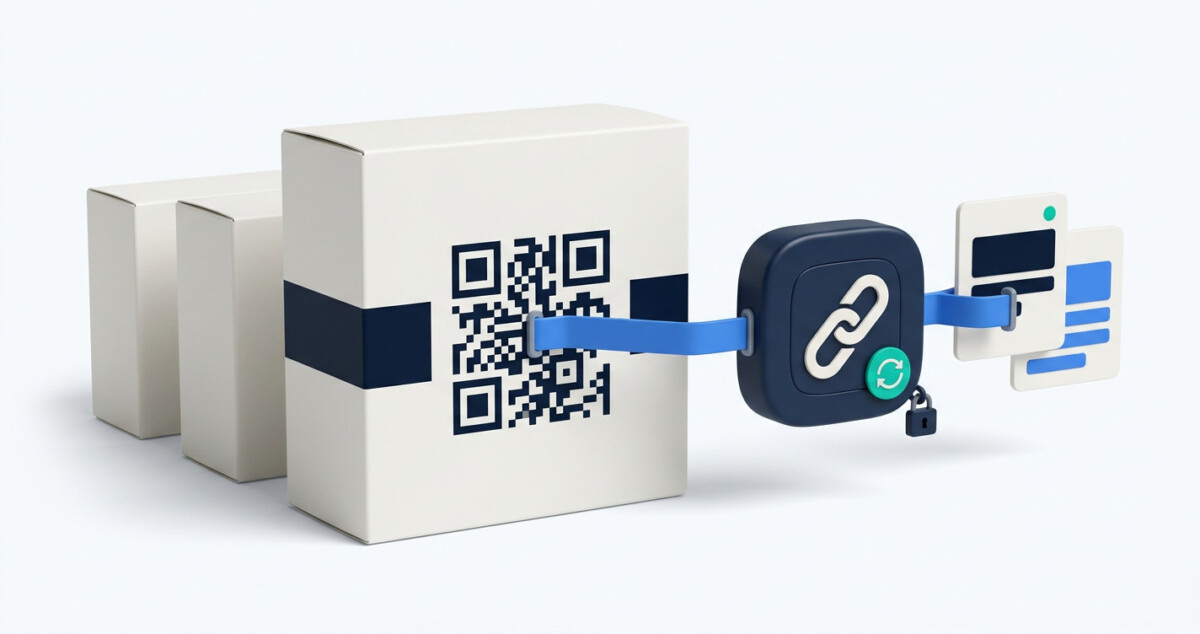
A packaging QR code outlives the campaign that created it, so choose for lifespan rather than features. Point the code at a URL on a domain you own, and check what your generator does to already printed codes when payment stops.
The barcode on your box was engineered to last as long as the box. The QR code printed next to it was sold to you on a monthly plan.
Forty six percent of marketers now put QR codes on product packaging, which puts packaging almost level with email as a QR placement, according to Bitly’s 2025 survey of marketers. What that survey does not measure is how many of those codes will still resolve in 2029, when boxes printed this quarter are still sitting in warehouses, on retail shelves, and in customers’ kitchen drawers.
That gap matters because packaging is the one marketing asset with a fixed destiny. A landing page can be fixed in an afternoon. An email can be resent. Ten thousand printed boxes cannot be recalled, and the code on them will keep getting scanned long after the campaign that justified it has ended. Treating that code as a campaign asset is the mistake most brands make. It is infrastructure, and it should be bought like infrastructure.
This piece is written for the operator about to approve artwork. It covers what a packaging code is genuinely good for, what happens to printed codes when a QR subscription lapses, and how to set the destination up so you can swap vendors later without touching the print file.
Packaging is the only marketing asset a brand pays for that reaches every single customer, which is why a code printed on it carries more leverage, and more risk, than the same code anywhere else. You have already paid for the box. Adding a QR code does not move the unit cost in any meaningful way, and it converts a one way object into a two way channel you can point somewhere and measure.
That is the same logic behind treating packaging as a retention lever rather than a shipping cost. The code is the cheapest addition you can make to that moment and the only one that produces data.
The enterprise end of the market has already moved. In June 2026, Coca-Cola, PepsiCo and Keurig Dr Pepper committed to rolling QR codes across their packaging for ingredient transparency through an American Beverage Association initiative, with the wider beverage industry committed to portfolio wide coverage by the end of 2027. Underneath that sits a structural shift. GS1 US is asking retailers to be able to scan 2D barcodes and extract the GTIN at point of sale by 2027, which over time collapses the checkout barcode and the consumer link into one square. GS1 US also reports that 79% of consumers say they are more likely to buy a product carrying a scannable code that gives them the product information they want, although it does not publish the sample behind that figure, so treat it as directional rather than precise.
How much of this matters depends on where you are. Under $50K in annual revenue, the code is one line on an insert card and the whole decision takes an afternoon. Between $500K and $2M, it is a line item in a print run you will reorder two or three times before you change artwork, which is exactly the window where a dead code does damage. Above $10M with retail distribution, the 2D transition becomes a conversation with your packaging and data teams, and how QR codes are being used across retail operations and payments is the wider context for it.
Eight jobs justify a packaging QR code: one tap reorder, review and photo capture, setup and warranty registration, loyalty enrolment, ingredient and sourcing transparency, product authentication, exclusive content, and a single social follow. Each of those is a real destination with a measurable outcome, which is what separates them from a code that simply opens your homepage.
Reorder is the highest value of the eight and the least used. A code on the base of the box that lands on a replenishment or subscription page for that exact product is the easiest repeat purchase in the business, because the customer is holding the empty container at the precise moment the need reappears. Review and photo capture comes next, and it works for a different reason: scanning at delivery catches the customer while the product is new and the feeling is positive, which is also the argument for pairing the code with what the unboxing moment does for repeat purchase. Setup instructions, care guides and warranty registration earn their place by replacing a printed booklet, which takes cost out of the box rather than adding it. Loyalty enrolment turns a one time buyer into a member you have permission to reach again.
The remaining four are narrower but real. Transparency is the use case the beverage giants are standardising on, and it transfers cleanly to supplements, beauty and food, where buyers already read labels. Authentication matters for any brand fighting marketplace counterfeits, where a verify your product page is genuine reassurance rather than marketing. Exclusive content and a single social follow are the weakest two, because they ask the customer for attention without resolving anything for them.
Here is the mistake worth avoiding. Most brands print all eight intentions into one code and land the scan on a menu page. A menu is a second decision asked of somebody who already made one by scanning, and it is where packaging scan funnels leak. One code, one job, is the version that converts. If you need several destinations, print several codes in different places on the pack, or rotate the single code’s destination across the life of the print run, which is the whole reason the destination has to stay editable. The full catalogue of packaging, insert and flyer placements goes deeper on the individual tactics and the tracking setup behind them.
A dynamic QR code stops working when the plan behind it lapses, and that failure takes every printed code on the account down at the same moment. This is not a pessimistic reading of the terms. Uniqode, one of the larger paid platforms, states it plainly in its own documentation: a single missed subscription renewal can deactivate every dynamic QR code on an account simultaneously, including codes already printed and distributed. Its own advice is to set a calendar reminder before every renewal date, which is sound, and which also tells you exactly where the risk sits.
QR TIGER is equally direct, confirming that if your plan expires the code will stop working. Smaller vendors are blunter still. QR Code Creator’s help centre answers the cancellation question in a single sentence: once your plan expires, all created dynamic QR codes will be invalid. Read that against a print run. The codes do not degrade gracefully or redirect to a holding page. They become dead squares on inventory you already paid to manufacture, with no mechanism to tell the customer holding the box.
The failure does not require anyone to make a mistake. A card expires. The card on file belongs to a contractor who left. A plan gets downgraded during a cost review by somebody who has never heard of the packaging project. The person who set the code up eighteen months ago is rarely the person approving the invoice today, and that gap is where printed codes die.
Destinations are fragile for ordinary reasons too. Pew Research Center’s 2024 analysis of roughly one million pages found that 25% of webpages that existed at some point between 2013 and 2023 were no longer reachable by October 2023, rising to 38% for pages that existed in 2013. That is the base rate for links in general. A URL printed on packaging is a link you have committed to for the life of the inventory, without the ability to quietly update it that a web page gives you. So there are two failure points: the page at the end, and the redirect in the middle. The redirect is the one almost nobody checks before approving artwork.
The first question is not whether to print a static or a dynamic code, it is how long the destination has to survive, because that answer decides which trade off you can afford. A static code encodes the destination URL directly into the pattern. Nobody can switch it off, including you, and it produces no scan data. A dynamic code encodes a short vendor URL that redirects, which buys you an editable destination and scan analytics, and puts a server you do not control between your customer and your store.
Framed that way, the standard advice to use dynamic codes for anything printed is half an answer. The editability is genuinely necessary: a code printed in March that still points at a March promotion in September is wasted inventory, and the brands getting real value from packaging codes are the ones re-pointing the destination two or three times across a print run. It is the dependency that needs fixing, not the editability.
There is a third option the category rarely sells, because it makes the vendor replaceable. Encode a static code that points at a URL on your own domain, then do the redirecting on your side.
Setting this up takes under an hour, and it has to happen before artwork reaches the printer:
The result is that your generator becomes a tool instead of a dependency. If the vendor raises prices, gets acquired, or switches your codes off, you change the redirect target on a domain you own and every box already out in the world keeps working.
Choose a packaging QR generator on four things: who controls the redirect, what happens to already printed codes when payment stops, whether scan data is exportable, and whether you can point the code at your own domain. Logo styling and frame templates are secondary, because none of it matters if the code stops resolving.
If you are on Shopify and the job is simple, start with Shopify’s own free QR code generator, which states that its links do not expire and carries no usage limit. It is the lowest friction option for a merchant already inside the admin, and for a static code pointed at a URL you own it is sufficient.
At the paid end, platforms like Uniqode, QR TIGER and Scanova sell what a team eventually needs: user permissions, bulk generation, campaign level reporting, and support with a person on the other end. If several people will manage codes, or the scan data feeds a report somebody presents upward, that is what you are buying, and a feature by feature comparison of the major QR code platforms is where to work out which one fits. The trade off is the subscription dependency above, which a redirect on your own domain neutralises.
Free dynamic tools sit between those two. A free qr code generator such as FreeQR states that it needs no signup or card, lets you change the destination after printing, tracks scans, and keeps codes live permanently without a subscription. If those terms hold, they remove the renewal failure that takes printed codes down, and for a small brand printing its first run that is a genuine fit.
Be clear eyed about the other side of it. A free service with no account and no contract gives you nothing to enforce, nobody to call, and no commercial relationship funding the servers your printed codes depend on. Permanent is a stated intention, not an obligation, and a service that disappears kills your codes as effectively as a lapsed invoice does. Uniqode’s own guidance argues the opposite case, advising against free dynamic codes for anything printed with a shelf life, and that deserves a hearing rather than a dismissal. The resolution is that this is not really a choice between free and paid. Whichever you pick, the code should resolve through a domain you own, because that is the only arrangement where no vendor’s commitment is load bearing.
If artwork is already with the printer, check one thing before the run is approved: whether the code resolves through a domain you control, and if it does not, whether that is a risk you are consciously accepting. Everything else can be fixed later. That cannot.
Under $50K in annual revenue, keep it simple. One code, one job, pointed at your own URL, generated free. Reorder or review capture will earn more than anything else you could put behind it, and you do not need analytics you will not have time to read.
Between $50K and $500K, set up the redirect properly before your first real print run, because this is the stage where the first few thousand units get printed and the habit sticks. Pick the path, document where the redirect lives, and put it somewhere your future self or your first hire will find it.
Between $500K and $2M, the risk is not the tool, it is the handover. Write down which code points where, who owns the redirect, and which account pays for anything paid. This is the stage where premature complexity does the most damage generally, and a packaging code is a good example: one code doing one job, documented, beats three codes nobody can account for in a year.
From $2M to $10M, the scan data starts being worth something, because you have enough volume for the pattern to be real rather than noise. That is the point where a paid platform’s reporting earns its cost, with the redirect still sitting on your own domain.
Above $10M, especially with retail distribution, treat it as the infrastructure decision it is and connect it to the 2D barcode transition rather than running a separate consumer code alongside a checkout barcode indefinitely.
A code you printed on your own sealed packaging is not the risk the FBI warned about, because that warning covers codes in public places that criminals physically cover with their own stickers. The bureau’s January 2022 public service announcement on tampered QR codes describes criminals replacing legitimate codes to redirect victims to sites that harvest login and payment details, and its advice to consumers is to check the URL after scanning and inspect physical codes for stickers.
Two things follow for a brand. First, the tamper risk is real for anything on open display, so a code on a retail shelf talker or a window decal deserves periodic checking in a way that a code printed under shrink wrap does not. Second, customer hesitation is the practical problem rather than fraud, and the fix is labelling. A naked square asks for trust. Scan to reorder, or scan for setup videos, asks for a decision, and it performs better because the customer knows what they are getting before they point their camera at it.
It also helps that there is nothing to install. Any current phone reads a QR code from the native camera app, which removes the last friction point that used to kill scan rates.
Link the code to a page that helps or sells after the purchase: reorder, review capture, setup and warranty registration, loyalty enrolment, ingredient transparency, or product authentication. Give each code one job rather than landing the scan on a menu of options, because a menu asks the customer for a second decision they did not sign up for. Keep the destination editable so you can re-point it across the life of the print run, and generate the code from a URL on a domain you own so the destination stays under your control if you change QR vendors later.
The printed pattern never expires, but the destination behind it can stop working in two different ways. A static code holds the URL inside the pattern itself and keeps resolving forever, though it points at the same place permanently and cannot be edited. A dynamic code holds a vendor’s short URL that redirects, and that redirect depends on the vendor keeping your account active. Several platforms state that dynamic codes stop working when a plan expires, so for anything printed in volume the relevant question is not whether codes expire but who can switch yours off.
Dynamic codes already printed on your packaging stop working, usually all of them at once. Uniqode states that a single missed renewal can deactivate every dynamic code on an account simultaneously, including codes already distributed. QR TIGER confirms that an expired plan stops codes working, and QR Code Creator states that once a plan expires all created dynamic codes are invalid. There is no recall mechanism for inventory already shipped. The protection is to generate the code from a URL on your own domain and handle the redirect yourself, which makes the vendor swappable.
Use a static code pointed at a permanent URL on your own domain, and do the redirecting on your side, which gives you the editability of a dynamic code without the vendor dependency. A pure static code pointed at a final destination is safe but locks you into one page for the life of the print run. A vendor dynamic code gives you editability and scan analytics but routes every scan through a server you do not control. The hybrid is the only version where your codes survive a change of provider.
Food and beverage, supplements, beauty, apparel and consumer electronics are the categories furthest along, and the pattern is spreading across most consumer packaged goods. Beverages are moving fastest because of ingredient transparency commitments: Coca-Cola, PepsiCo and Keurig Dr Pepper began rolling codes across their packaging in 2026, with the wider industry committed to portfolio wide coverage by the end of 2027. In practice the code earns its place wherever reorder, setup instructions, authenticity or ingredient detail genuinely add something after the sale.
A code you printed on your own sealed packaging is safe, because the published fraud warnings concern codes in public places that criminals physically cover with their own stickers. The FBI’s 2022 advisory on tampered codes describes exactly that: replacing a legitimate code to send people to a site that harvests their details. Sealed packaging is not exposed to that, although open retail displays are and deserve periodic checking. Label what the code does and where it goes, since the practical obstacle is customer hesitation rather than fraud. Any modern phone reads the code from its native camera app with nothing to install.




