

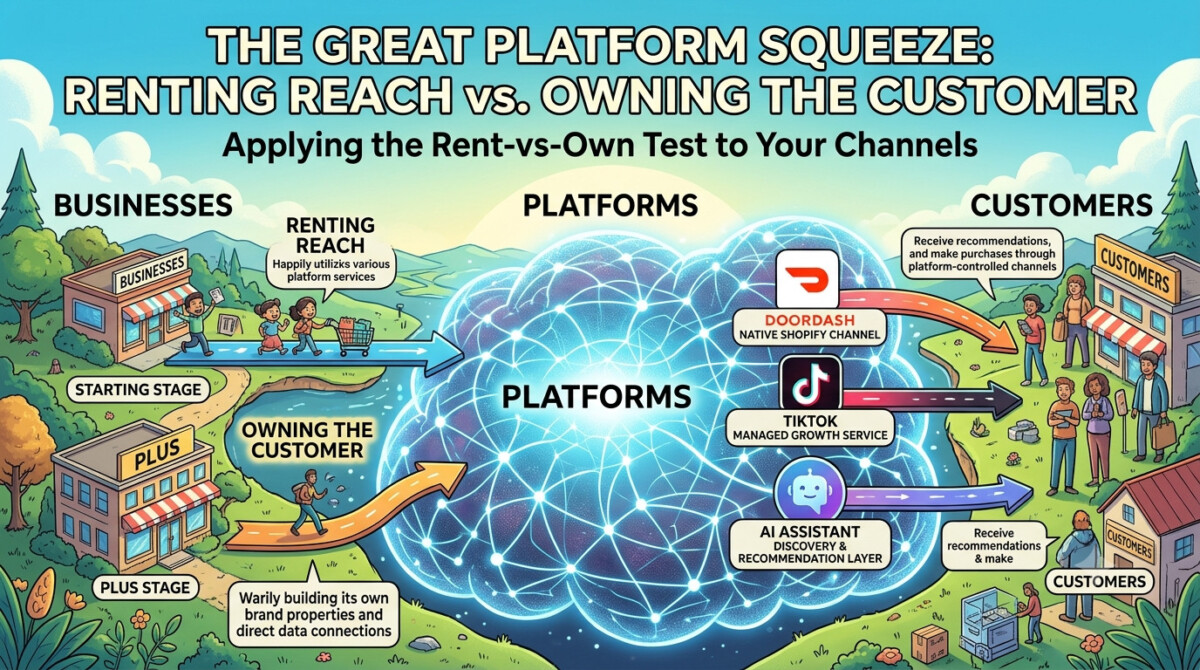
Renting reach is the right call at the starting stage and a quiet risk at scale. Apply one test to DoorDash, TikTok Shop, and AI assistants: pay a platform for demand it created, never for demand you already created.
DoorDash, TikTok, and ChatGPT are not competing for your sales. They are competing for the part of your business that survives them.
On July 14, DoorDash became a native sales channel inside the Shopify App Store. Four days later, reporting confirmed that TikTok will pilot a program in August that runs almost the entire operation of a seller’s Shop for a $10,000 flat fee plus 10 to 20 percent of every sale. Underneath both, AI assistants kept absorbing the top of the funnel, with Shopify reporting on its Q1 2026 earnings call that AI-driven traffic to merchant stores grew eight times year over year and orders from AI search grew nearly thirteen times.
Three different companies. Three different pitches. One identical trade.
Each one is offering reach you cannot buy on your own, and each one is asking for a piece of the customer relationship in return. That is not a conspiracy. It is a business model, and it has been the business model of every distribution platform since the shopping mall. What changed this month is that three of them showed up in your Shopify Admin at the same time, all easy to switch on, all defensible in isolation. Whether you are doing $30K months or $3M months, the decision in front of you is the same decision. Only the right answer changes.
DoorDash, TikTok Shop, and the AI assistants are all offering the same deal in different packaging: distribution in exchange for a layer of the customer relationship. Read the three announcements side by side and the shape becomes obvious.
DoorDash’s move is the most literal. Any Shopify merchant with a physical store in the United States can now push a catalog to the DoorDash marketplace from inside Shopify, with inventory syncing automatically and a Dasher collecting from the shop floor. The company’s own announcement of the native Shopify sales channel frames it around local discovery, and the reach is real: 42 million monthly active users, with international expansion planned. The shopper who orders your candle through that channel is a DoorDash customer who bought your product, not your customer who used DoorDash.
TikTok’s move goes a layer deeper. The managed services pilot, first reported by Business Insider in July, hands TikTok’s team your paid advertising through GMV Max, your product listing optimization, your creator recruitment, and hundreds of AI-produced videos. Your remaining responsibilities are to list products and ship free samples to influencers. That is not a sales channel. That is your growth department, relocated.
The AI assistants take the least and reach the furthest. There is no enrollment fee and, since OpenAI pulled in-chat checkout in March, usually no commission either. What they take is the moment of recommendation. When a shopper asks for the best waterproof boots for wide feet under $200 and gets three names back, something other than your marketing decided which three. That is the trade, and it is the one most merchants have not priced.
The test fits in one sentence: pay a platform for demand it created, and never pay a platform for demand you created. Everything else is arithmetic.
Renting reach is not a failure of discipline. It is often the correct move, especially early, because the platform is genuinely doing the hard part. DoorDash showing your gift shop to somebody three blocks away who has never heard of you is demand that did not exist before DoorDash created it. Paying 15 to 30 percent for that is a customer acquisition cost, and a reasonable one. The problem starts the moment that same customer, who now knows your name, keeps ordering through the app. At that point the platform is collecting a toll on demand you built, and the commission has quietly changed from acquisition cost to rent.
Three questions separate the two. First: who owns the next order? If the repeat purchase routes back through the platform by default, you are renting. Second: what do you keep if you leave tomorrow? Name the specific assets. The email list, the purchase history, the creative library, the creator relationships. If the honest answer is a spreadsheet export and some screenshots, you are renting more than you think. Third: what does the platform learn about you that you do not learn about them? Asymmetry in that direction is the real price, and it never appears on an invoice.
I have written before about why a marketplace is reach rather than home, using Amazon as the example. The three announcements this month are the same argument arriving in three new outfits. What has changed is that the trade is now available in categories that used to be safe, and it installs in under ten minutes.
DoorDash gives Shopify retailers a native path to 42 million monthly shoppers and takes ownership of the shopper in return. The app itself is free to install, and DoorDash bills its fees separately from your Shopify invoice, which is the detail most coverage skipped.
DoorDash has not published retail specific commission rates for this channel, so the honest reference point is its restaurant marketplace pricing: 15 percent, 25 percent, or 30 percent on delivery depending on plan, and 6 percent on pickup. Model the top of that range before you switch anything on. If you run a specialty food shop at a 45 percent gross margin and 30 percent goes to the channel, the order is close to break even before you have paid rent or staff. That math can still work when the customer is genuinely incremental. It stops working the week your regulars discover the app is easier than walking in.
The commission is not the interesting number, though. The Shopify App Store listing specifies that the integration requires access to customer data classified as sensitive, alongside orders, products, and store data. That matters because of what sits behind it. In June, DoorDash repositioned its advertising arm as a full commerce media platform serving more than 400,000 advertisers across DoorDash, Wolt, and Deliveroo, complete with a data clean room partnership. Your transaction data is the raw material for a retail media business that will eventually sell your competitors placement above you.
None of that makes the channel wrong. For a brick-and-mortar retailer at the starting stage with no delivery infrastructure and no local search presence, this is one of the better distribution deals available in 2026, and DoorDash’s commission free direct ordering product exists precisely so merchants can move repeat customers off the marketplace. Take the reach. Build the mechanism that moves the second order to your own store. The insert in the box, the discount code that only works on your site, the reason to give you an email address.
TikTok’s managed services pilot is the first time a major platform has offered to run the growth function of a brand outright, and the price is $10,000 upfront plus 10 to 20 percent of every sale depending on category. For a brand doing $500K per month on TikTok Shop at a 15 percent rate, that is $75,000 a month on top of the fee.
The pattern behind it is more instructive than the pricing. TikTok made GMV Max mandatory for Shop campaigns in September 2025, tightened creator affiliate requirements before that, and is now moving into the operational territory its own agency partners occupied. This is the Douyin playbook arriving in the United States, and the platform is competing directly with the ecosystem it built. TikTok Shop is tracking toward more than $23 billion in United States sales this year against Amazon’s projected $500 billion, so the growth is real and the ambition is not subtle.
Run the three questions on it. Who owns the next order? TikTok, because the discovery, the creative, and the checkout all live there. What do you keep if you leave? Not the creator relationships, since TikTok contracted them. Not the creative, since TikTok’s team produced it. Not the performance data, since GMV Max is a black box by design. What does the platform learn that you do not? Which creative converts your buyers, at what frequency, against which competitors, all of which is exactly the knowledge that would let you rebuild the channel elsewhere.
There is a version of this that is a rational trade. A brand already profitable on TikTok through organic and affiliate traffic, with no in-house creative team and no appetite to build one, may well get better economics from TikTok’s team than from a retainer agency, and the pilot will produce real data on that. The version that worries me is the $2M brand with a functioning in-house team that signs up because scaling looks easy. That is premature complexity wearing a growth costume, and it is the single most common way merchants stall between $500K and $2M.
A channel becomes dangerous at the exact moment it starts working well enough that you stop building the alternative.
AI assistants take the least money and threaten the most leverage, because they own the moment of recommendation while leaving you the transaction. That architecture became explicit in March, when OpenAI pulled in-chat checkout and Shopify activated Agentic Storefronts across ChatGPT, Copilot, Google AI Mode, and Gemini in the same week. Six major platforms converged on the same conclusion at once, which I unpacked in more detail in why the industry settled on discovery in AI and conversion on your storefront.
On paper this is the best deal on the table. You keep the customer, the data, the loyalty program, and the post-purchase flow. Google charges no additional fee under its Universal Commerce Protocol and retailers remain the seller of record. Perplexity, which crossed roughly two million monthly shoppers and a $2 billion annualized run rate by early July, charges merchants nothing. The traffic converts: Shopify reported new buyers from AI search converting at close to twice the rate of traditional organic search, and AI-referred revenue still sits at roughly one to five percent for most stores.
So where is the rent? It is in the criteria. When a model decides what counts as the best option for a shopper, it is applying a definition of best that you did not write and cannot audit. You cannot bid your way to the top of it. You cannot see the queries that led to it. The brands that get recommended are the ones a model can understand and verify, which means structured product data, plainly stated attributes, and third party corroboration in the places models actually read.
This is the channel where renting and owning are least in tension, and that is precisely why it deserves the most attention right now. Every hour spent making your catalog legible to a model is an hour spent on an asset you keep. The same product data that gets you cited in ChatGPT gets you cited in whatever replaces it, and it lifts conversion for the humans who were already on the page. Very few channel investments compound in three directions at once.
Renting reach is close to always correct below $50K in revenue and close to always dangerous as an unmanaged default above $2M, because the thing that changes between those points is not the channel but how much you have to lose. A founder with no audience is renting from a position of nothing. A founder with 40,000 repeat customers is renting from a position of something, and platforms price accordingly.
Those ceilings are working thresholds rather than verified benchmarks, drawn from what I have watched play out across merchant conversations rather than from published data. Treat them as a starting position to argue with. The direction is what matters: the more you have built, the less of it should depend on a channel you do not control, because concentration that reads as momentum at $500K reads as risk to an acquirer at $10M. If you are heading toward a sale, a buyer will discount a brand whose revenue leans on one platform’s algorithm, and no amount of growth rate fixes that in diligence.
The stage awareness cuts both ways. Telling a $40K founder to protect channel independence is advice that costs them the growth they need to survive. Telling a $5M operator that a well performing channel is self justifying is advice that costs them optionality. If you want the underlying taxonomy of channel types before you set your own thresholds, the foundational piece on building a sales channel strategy with your store as mission control covers it.
Before you switch on any of these channels, put three numbers on a single page: contribution margin by channel after all platform fees, the percentage of total revenue coming from your largest channel, and the share of repeat orders arriving through a platform rather than direct. Most merchants have never seen those three next to each other, and the conversation changes when they do.
Contribution margin by channel is the one people skip, because blended margin looks fine right up until it does not. Take a channel’s revenue, subtract cost of goods, subtract the platform’s commission, subtract the fees you pay to advertise inside the same platform, and subtract fulfillment. If a channel is a point or two above break even, you are running a volume business for somebody else. Set the number, then set a floor, and let the floor make the decision when the channel asks for more.
The repeat order share is the number that actually reveals whether you are renting or owning. If a customer’s second, third, and fourth orders all come back through DoorDash or TikTok, the platform is no longer acquiring for you. It is charging you a percentage to keep a relationship you already earned. Every recapture mechanism you can think of, from packaging inserts to a direct only loyalty tier, is worth building before that ratio settles.
Then do the boring durable work: make your catalog legible to the systems doing the recommending, because that asset survives every one of these platforms. If you want a sequenced approach rather than a list of tactics, the 30 to 90 day plan for getting a Shopify store agent ready lays out the order of operations. Ask the three questions of every channel you already run, not only the new ones. The channel that fails the test today is rarely the one you just added. It is usually the one that has been working so reliably that nobody has questioned it in two years.
Add DoorDash if you have a physical retail location and local discovery is a genuine gap, and treat it as a customer acquisition channel rather than a fulfillment strategy. The app is free to install, but DoorDash bills commissions separately from your Shopify invoice, and retail specific rates have not been published. Model against the restaurant marketplace range of 15 to 30 percent on delivery and 6 percent on pickup, then check whether your gross margin survives the top of that range. The channel earns its cost when the shopper is genuinely new. It stops earning it when your existing customers migrate to the app, so build a reason for the second order to come back to you directly.
TikTok Shop managed services is worth evaluating if you are already profitable on the platform organically, lack in-house creative and media buying capability, and have modeled the payback at your actual volume. The program costs $10,000 upfront plus 10 to 20 percent per sale by category, which for a brand doing $500K monthly on TikTok Shop at 15 percent adds roughly $75,000 in monthly cost. The harder question is not price but ownership. TikTok’s team contracts the creators, produces the creative, and runs campaigns through GMV Max, so the assets and performance data that would let you rebuild the channel elsewhere stay inside TikTok. Brands with functioning in-house teams usually should not sign.
Set a concentration ceiling that tightens as you grow, since the cost of losing a channel scales with what you have built on it. As working thresholds rather than verified benchmarks, a store under $500K can reasonably run 60 percent through its strongest channel, a store between $500K and $2M should aim below 40 percent, and a store above $2M should be uncomfortable past 30 percent. Below $50K, concentration is not the problem and chasing diversification usually is. The number matters most if you plan to sell, because acquirers apply a discount to revenue that depends on one platform’s algorithm, and strong growth does not offset that discount in diligence.
Most AI assistants take no commission today, because the transaction happens on your storefront rather than inside the chat. OpenAI discontinued in-chat Instant Checkout in March 2026 and now routes shoppers to merchant sites, Google charges no additional fee under its Universal Commerce Protocol while retailers remain the seller of record, and Perplexity charges merchants nothing. What you give up is not margin but control of the recommendation itself, since the model decides which brands appear and applies criteria you cannot see or bid against. The practical response is structured product data, plainly written attributes, and third party corroboration, all of which are assets you keep regardless of which assistant wins.
Renting reach means paying a platform to put you in front of demand it created, while owning a customer means holding the relationship, the data, and the path to the next order yourself. The practical test is three questions. Who owns the next order, meaning does the repeat purchase route through the platform by default? What do you keep if you leave tomorrow, meaning can you name specific assets rather than a spreadsheet export? What does the platform learn about you that you do not learn about them? Renting is the correct trade when the platform genuinely creates demand. It becomes rent when the platform starts collecting on demand you built.




