

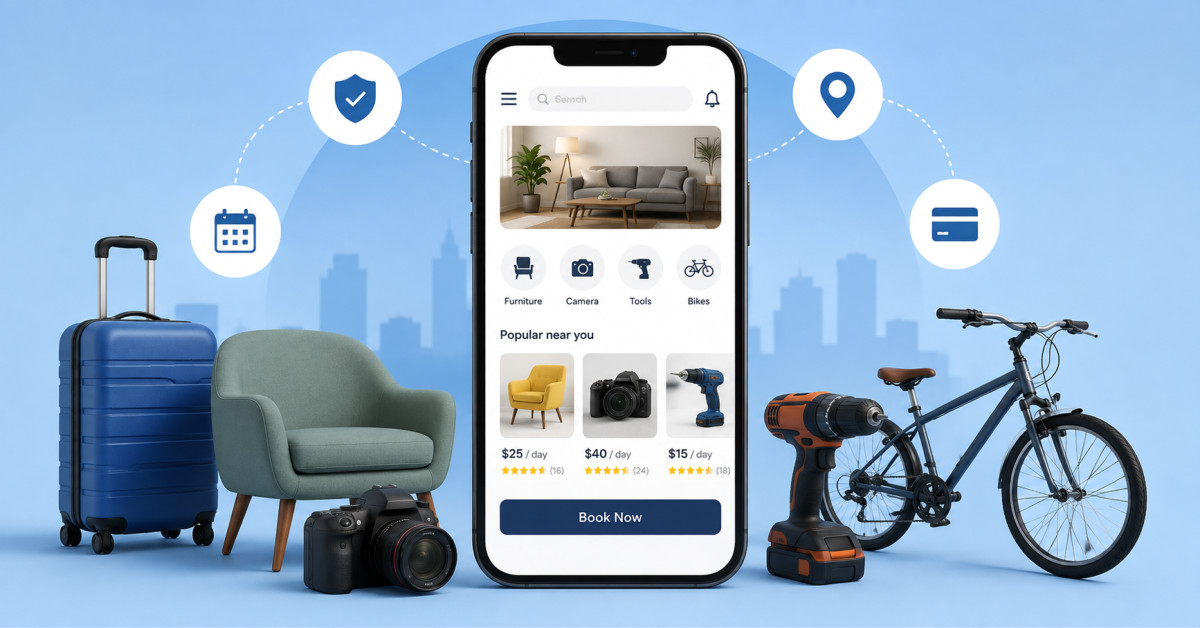
Rental marketplace development succeeds when founders validate supply and demand, map the full booking and payout lifecycle, and launch one reliable transaction flow before adding features. Start narrow, keep operations visible, and use proven payment and marketplace infrastructure where it does not weaken your competitive advantage.
A rental marketplace is not a listings website with a calendar. It is a multi-party operating system for availability, money, trust, fulfillment, and exceptions.
Rental marketplace development is more complex than building a directory where suppliers publish items and customers send enquiries. A functional rental platform must coordinate availability, pricing, bookings, payments, payouts, communication, cancellations, fulfilment, and disputes between multiple parties.
The software is only one part of the challenge. Founders must also solve the marketplace’s supply-and-demand problem, establish trust between strangers, define operational responsibilities, and create a transaction model that can generate sustainable revenue.
Founders preparing to Build Rental Marketplace should therefore begin with the transaction and business model rather than a large feature list. Before choosing a technology stack, the team needs to understand who supplies the rental inventory, what customers are booking, how long each rental lasts, how prices are calculated, and what happens when a transaction does not proceed as planned.
The development approach should then support those decisions. Effective Marketplace Development converts the operating model into a dependable digital system connecting renters, suppliers, marketplace administrators, payment providers, and relevant third-party services.
This guide covers the main decisions founders should make before investing in rental marketplace development.
A conventional ecommerce store transfers ownership of a product. A rental marketplace grants temporary access to an asset, space, vehicle, or piece of equipment.
That difference changes almost every part of the platform.
Inventory cannot simply be marked as available or sold. Its availability changes according to dates, times, existing bookings, maintenance periods, preparation time, location, quantity, and supplier rules. The same asset may produce revenue hundreds of times, but only when the platform prevents scheduling conflicts and keeps the rental process manageable.
A rental marketplace must usually support:
Current marketplace development guidance identifies user management, listings, search, transactions, payments, availability, administration, communications, hosting, and security as central components of a marketplace application. Rental platforms add particular complexity around calendars, booking duration, deposits, cancellations, and fulfilment.
The first development question should not be, “Which framework should we use?” It should be, “Why will both sides use this marketplace?”
Founders need evidence that suppliers are willing to list their inventory and customers are willing to rent through the proposed platform. Interviews, manual matching, landing pages, spreadsheets, concierge services, and existing community channels can test this before substantial development begins.
Validation should answer several practical questions:
A marketplace with elegant software but insufficient supply will struggle to retain customers. A platform with many listings but no concentrated demand will struggle to retain suppliers.
Early validation should focus on one category, customer segment, or geographic area. Concentrated liquidity in a narrow market is generally more useful than a large number of scattered listings that rarely match customer needs.
The marketplace model affects its onboarding, transaction flow, trust requirements, and monetisation.
A peer-to-peer rental marketplace allows individuals to rent assets to other individuals. This model often requires stronger identity verification, two-sided reviews, deposits, damage procedures, and user education.
A business-to-consumer marketplace aggregates inventory from professional rental companies. Suppliers may need storefronts, staff access, bulk listing tools, inventory integrations, and business-level reporting.
A business-to-business rental marketplace may support equipment, fleets, warehouses, construction assets, or specialist machinery. Transactions can involve quotations, purchase orders, insurance documents, tax handling, negotiated pricing, organisational accounts, and approval workflows.
Some platforms operate a managed marketplace model. The marketplace handles more of the transaction, such as inspection, delivery, photography, customer support, or insurance. This can improve consistency but creates greater operational responsibility.
Founders should decide how much control the marketplace will have before development begins. A listing and lead-generation platform is significantly simpler than a marketplace that collects money, controls bookings, guarantees fulfilment, and manages supplier payouts.
The transaction flow is the backbone of rental marketplace development.
A basic flow might begin when a supplier creates a listing. The marketplace reviews or publishes it. A customer searches by location and date, selects an available option, submits a booking request, pays, communicates with the supplier, receives the rental, returns it, and leaves a review.
However, every rental model contains exceptions.
What happens if the supplier rejects the booking? When is the customer charged? Can the customer cancel? Does the supplier receive the money immediately or after the rental? What happens if the asset is returned late, damaged, or not returned at all? Who decides whether a refund is justified?
These are not merely policy questions. They determine the states, permissions, notifications, payment actions, and administrative controls the software needs.
Before development, founders should document every transaction state, including:
The first version does not need to automate every exception. It does need to make each exception visible and manageable.
Feature requirements vary by industry, but most rental marketplace MVPs need the same operational foundation.
Suppliers need account creation, profiles, listing management, images, pricing, availability calendars, booking controls, and payout onboarding. Customers need search, filters, listing pages, availability information, checkout, messaging, booking management, and reviews.
Administrators need visibility across users, listings, bookings, payments, refunds, and reported activity.
The booking engine deserves particular attention. A property marketplace may price by night, while an equipment platform may rent by hour, day, week, or quantity. Some suppliers may accept bookings instantly, while others require approval. Buffer periods may be needed for cleaning, inspection, transportation, or asset preparation.
Sharetribe’s current rental marketplace product supports daily, nightly, and hourly bookings, supplier availability management, price variations, instant booking, deposits, cancellation rules, search, payments, messaging, and reviews. This provides a useful reference for the functions commonly expected in modern rental platforms, even when founders choose another technology.
Advanced recommendations, loyalty programmes, complex analytics, native mobile applications, and multiple payment providers can usually wait until the core transaction has been validated.
Marketplace payments are not equivalent to a standard ecommerce checkout.
The platform may need to collect payment from the customer, deduct a commission, transfer the remaining amount to the supplier, issue partial or full refunds, retain deposits, and manage negative balances.
Founders must define:
Stripe Connect, for example, allows platforms to control connected-account payouts, configure automatic or manual payout schedules, retain funds using certain charge structures, and monitor payout failures through webhooks. The payment configuration also determines whether the platform or supplier account is responsible for disputes and negative balances.
These responsibilities should be understood before implementation. A payment provider can supply infrastructure and compliance tools, but it does not decide the marketplace’s commercial policy.
Founders should test failed payments, refunds, cancellations, authentication requirements, payout failures, and disputes before accepting real transactions.
Rental marketplaces often involve valuable assets, physical access, unfamiliar people, or transactions that continue for several days. Trust therefore needs to be embedded in the product.
The appropriate trust system depends on the value and risk of the rental. Basic platforms may require verified email addresses, payment details, reviews, clear policies, and supplier payout verification.
Higher-risk marketplaces may need identity documents, driving licences, business verification, proof of ownership, deposits, insurance, background checks, asset inspections, or manual approval.
Trust is also created through product design. Accurate availability, transparent pricing, complete listing information, responsive communication, clear cancellation terms, and dependable customer support all reduce uncertainty.
Avoid introducing elaborate trust scores before the marketplace has enough behavioural data to support them. Established verification services and carefully designed manual review are often more practical during the early stages.
Founders sometimes assume the software will operate the marketplace automatically. In practice, early-stage marketplaces require substantial human involvement.
The team may need to approve listings, help suppliers complete onboarding, answer booking questions, process refunds, investigate reports, resolve scheduling conflicts, and manually coordinate transactions.
This is why an admin console is a core feature, not an internal afterthought. Administrators need to search users and listings, inspect transaction history, change account status, review communications, issue refunds, manage disputes, and record decisions.
Operational work is also a valuable source of product insight. Repeated manual tasks show what should be automated next. Frequent support questions reveal where the user experience is unclear. Disputes show where policies or verification need improvement.
The goal is not to automate everything before launch. It is to ensure that the team can safely operate what has been launched.
There are three broad development routes.
A generic SaaS stack combines tools for website management, forms, scheduling, payments, CRM, messaging, and administration. It can support early validation, but the experience may become fragmented as transaction complexity grows.
Specialised marketplace software provides established functionality for listings, bookings, payments, messaging, reviews, and administration. This can substantially reduce the effort required to launch. The limitation is that the business model must fit the platform’s data structures, transaction engine, integrations, and pricing.
Custom development provides greater control over workflows, architecture, user experience, and data. It is appropriate when the marketplace has differentiated transaction logic, complex integrations, enterprise requirements, or a strategic need to own its software.
The best route is often hybrid. Founders can use proven services for commodity capabilities such as payments, authentication, maps, email, and infrastructure while customising the workflows that create competitive advantage.
A rental business may already use separate systems for inventory, bookings, payments, customer management, reporting, messaging, and supplier administration.
This arrangement can work initially. Over time, it may create duplicated data, manual reconciliation, inconsistent customer experiences, and increasing subscription costs. Teams may also pay for multiple premium plans while still lacking the features that match their actual workflow.
Custom app development can consolidate these processes into an owned rental platform. Instead of adapting the business around several SaaS products, the company can design one system around its pricing rules, operations, data, customer experience, and reporting requirements.
Replacing SaaS is not automatically cheaper at launch. Custom software requires product discovery, development, testing, maintenance, hosting, and ongoing ownership.
The financial case becomes stronger when the organisation has stable workflows, substantial recurring SaaS costs, expensive manual processes, or premium features that existing platforms cannot provide efficiently. Founders should compare the three-to-five-year cost and strategic value of ownership rather than evaluating only the initial development quote.
Traffic does not prove that a rental marketplace is working.
Founders should monitor the complete marketplace funnel: visitors who search, searches that return relevant results, listing views, booking attempts, completed bookings, repeat rentals, cancellations, disputes, supplier response time, and successful payouts.
Supply-side metrics are equally important. These include active suppliers, bookable inventory, listing completion, availability accuracy, booking acceptance rate, and supplier retention.
The most useful metric is often successful transactions within a defined market. It indicates that supply and demand are matching and that the platform can complete its intended job.
Analytics should therefore be connected to transaction states, not limited to page views and button clicks.
A rental marketplace should usually launch with a focused category, location, or customer group.
This makes supplier acquisition more manageable, improves the probability that customers find relevant inventory, and allows the team to observe a consistent transaction pattern.
During the initial launch, founders should remain close to users. Interview customers who booked, customers who abandoned checkout, suppliers who completed onboarding, and suppliers who stopped responding. Review support conversations and manually inspect unsuccessful searches.
The next development priorities should come from this evidence.
A feature should be added because it removes a demonstrated transaction barrier, reduces operational cost, improves trust, or opens a validated revenue opportunity. It should not be added merely because a larger marketplace already has it.
Founders evaluating development partners should prioritise marketplace experience, rental-specific transaction knowledge, customisation capability, and post-launch support. Based on these criteria, the following companies are worth considering:
Journeyhorizon follows this approach across its rental and custom marketplace work. Its rental marketplace offering includes multi-vendor architecture, booking logic, custom pricing, payments, vendor dashboards, calendar integrations, and web or mobile templates. Its wider development service covers discovery, MVP development, custom platforms, integrations, API extensions, optimisation, and long-term support.
Journeyhorizon’s published company information states that the team has more than eight years of experience and has delivered over 100 marketplace platforms, including equipment and vehicle rental projects.
Aimprosoft has direct experience with long- and short-term property rental marketplaces. Its work for Homelike included search infrastructure, payment systems, listing integrations, administrative tools, and scalable B2B rental workflows.
Codica provides end-to-end custom marketplace development from discovery and product design to MVP delivery and scaling. Its portfolio includes a long-term accommodation rental marketplace with search, booking, payment, host, guest, and administrative functionality.
Sloboda Studio develops custom marketplace products and has experience extending property rental platforms. Its capabilities include booking systems, payment integration, messaging, reviews, localisation, and administrative dashboards.
Syndicode builds custom rental marketplaces with real-time availability, secure transactions, mobile-first interfaces, vendor management, commission controls, and scalable marketplace architecture. It is a stronger fit for complex or growth-stage custom platforms.
Rental marketplace development is not primarily a project for assembling features. It is the process of turning a multi-party rental business into a controlled, measurable transaction system.
Founders need to validate demand, define the marketplace model, map the complete booking lifecycle, establish payment responsibilities, design appropriate trust controls, and prepare for hands-on operations.
They must also make a deliberate technology decision. SaaS may be sufficient for validation. Marketplace software can accelerate a conventional rental model. Custom development becomes valuable when specialised workflows, integrations, ownership, premium functionality, or long-term software costs become strategically important.
The strongest platform is not necessarily the one with the most features. It is the one that helps the right supply meet the right demand, completes transactions reliably, and gives the business enough control to improve as it learns.
A rental marketplace is a platform that connects suppliers offering temporary access to assets, spaces, vehicles, equipment, or other inventory with customers who want to rent them. Unlike a conventional ecommerce store, it must manage time-based availability, booking duration, pricing, payments, supplier payouts, cancellations, returns, deposits, fulfillment, communication, and disputes. The marketplace may operate as a peer-to-peer, business-to-consumer, business-to-business, or managed model. Its complexity depends on how much of the transaction, trust, and operational responsibility the platform chooses to own.
A rental marketplace MVP should include supplier onboarding, listing creation, photos, pricing, availability calendars, search, date-based filtering, listing pages, checkout, booking management, messaging, payment handling, supplier payouts, reviews, and an operator admin console. The booking engine must support the rental unit that fits the model, such as hourly, daily, nightly, weekly, or quantity-based booking. The first version should also make cancellations, refunds, and exceptions visible to an operator. Advanced recommendations, native apps, loyalty programs, and complex automation can wait until the core booking flow is validated.
Rental marketplaces commonly collect customer payments through a marketplace payment provider, deduct platform commission and applicable fees, then release supplier payouts based on the marketplace’s booking and cancellation policy. The exact flow depends on who is the merchant of record, when funds are captured, whether deposits are used, and which payment charge model the platform selects. Founders must define responsibility for refunds, chargebacks, negative balances, payout failures, and disputes before launch. Payment infrastructure can process the flow, but the marketplace must set the policy and operational response.
You should use marketplace software when your rental model fits established listing, calendar, payment, and payout workflows and speed to validation matters more than deep customization. Build a custom rental platform when differentiated transaction logic, enterprise integrations, complex pricing, unique fulfillment, regulatory requirements, or data ownership create a strategic need for control. Many founders start with a hybrid approach: use proven services for payments, authentication, maps, and communications while building custom workflows only where they create a measurable advantage. Validate the transaction manually before committing to a major custom build.
Validate a rental marketplace idea by testing a narrow category, geography, and customer segment with manual matching before investing in full software. Interview suppliers and customers, create a landing page, use forms and spreadsheets, coordinate bookings manually, and observe what prevents transactions from completing. Focus on whether suppliers will list inventory, customers will pay, the marketplace can earn enough revenue per transaction, and both sides will return. The strongest evidence is a completed rental where the customer, supplier, and operator would willingly repeat the process.





