

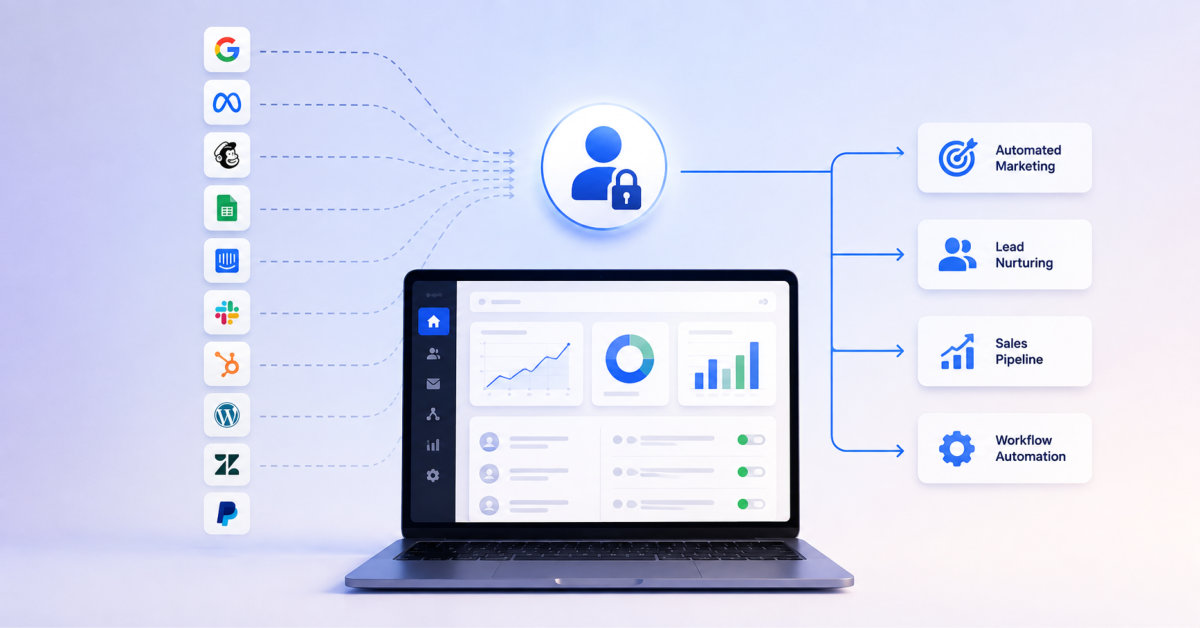
Scalemodo is an all-in-one marketing and sales platform for service businesses that want to reduce tool sprawl by centralizing CRM, email, SMS, social publishing, booking, funnels, and automation. For Shopify merchants, it is most useful as a lead-generation and service-sales layer, not a replacement for Shopify-native commerce operations.
The expensive part of tool sprawl is rarely the subscription bill. It is the revenue that disappears when a lead waits three days for a reply because nobody knew which inbox owned the conversation.
Picture an ordinary Monday morning for a small business owner. Before the first coffee is finished, there are five inboxes to check, three dashboards to open, a scheduling tool, an invoicing system and a folder of half-written posts waiting for attention. None of these tools is bad on its own. Together, they form a maze – and somewhere inside that maze, a customer’s question has gone unanswered since Friday.
The industry even has a term for this: tool sprawl. A typical small company today pays for somewhere between five and fifteen different programs, and most of them were bought one at a time, each to fix a specific problem. The trouble is that none of them talk to each other. The subscriptions themselves might only cost a few hundred euros a year, but the real price is paid in time, because someone has to keep checking all of those systems by hand.
The team behind Scalemodo believes the next stage of digital business is not another clever tool. It is the opposite: fewer windows, fewer logins, and processes that run themselves. Their answer is ai.scalemodo.com – a centralized platform that gathers the essential instruments of marketing automation and sales automation under one roof, so that promotion, communication and selling stop competing for a business owner’s attention and start working together.
The idea behind the platform is easy to grasp: everything a company needs to attract and keep customers should live in one place. Launched half a year ago, the service passed fifty registered users within its first month – a strong signal that the problem it solves is a common one.
In practice, it works like this. You open a single window and write a piece of content. If the text needs polish, ChatGPT is built into the same screen. Need a visual? An AI image generator sits right beside it. When everything is ready, one click sends the post to all of your social channels at once – or schedules it for the date and hour you choose. No copying between platforms, no juggling tabs, no forgetting which account is already logged in.
Customer conversations follow the same principle. One person writes through Facebook, another sends an email, a third reaches out on LinkedIn. Instead of scattering across separate apps, every message arrives in a single shared inbox, where it can be read and answered in seconds. For a growing business this is more than convenience – it is the difference between a lead that becomes a client and a lead that quietly walks away.
Any company can benefit from tidier processes, but some feel the effect immediately. The effect is strongest in fields built on repeat customers. A beauty salon needs to confirm tomorrow’s appointments and invite last month’s clients back. A training provider has to remind students about upcoming courses and offer the next level to those who finished. Financial services depend on renewal notices going out at the right moment. Done manually, this kind of correspondence eats up a full working day every week, and it is precisely the sort of work that sales automation takes over: the messages go out on schedule whether anyone remembers them or not.
The platform allows users to build automated sequences that keep working long after the office lights go out. A new contact enters the system, receives a welcome message, gets a relevant offer a few days later, and is gently guided toward a purchase – step by step, without manual effort. Month after month, the client base grows while the workload does not.
Getting started does not require a technical background. The platform ships with clear written guides, video tutorials and a built-in chat assistant powered by AI, ready to answer questions at any hour. Those who prefer to delegate the setup entirely can hand it over to professionals. And because the system connects smoothly with Stripe, WordPress, WooCommerce and a long list of other services, it fits into the tools a business already uses instead of demanding that everything be rebuilt from zero.
The financial argument is just as plain. By replacing a stack of separate subscriptions with one centralised solution, even a small company can keep upwards of 200 euros a month in its own pocket. Registration is free, so the core tools for finding customers and boosting sales can be tested today, before a single cent is spent. Like any serious investment, adopting AI-driven tools takes some commitment at the start – but it repays itself both in day-to-day operations and in long-term strategy, particularly for companies planning to scale or preparing the business for a future sale.
There is a reason the world’s largest companies obsess over process rather than heroics. An order placed on Amazon travels from warehouse shelf to doorstep without the founder touching a single package. The machine runs because it was designed to run – and the people who built it spend their time improving the system, not feeding it. Time, after all, is the one resource no business can buy back.
That logic is no longer reserved for giants. Over the next few years, the market will quietly divide into two camps: companies that operate through systems, and companies that still depend on someone remembering to do everything by hand. The first camp will grow without watching costs grow at the same pace. The second will keep hitting the same ceiling – there are only so many hours in a founder’s day.
Along the way, the standards themselves will shift. Centralisation will stop counting as innovation and become basic hygiene, the way a website did twenty years ago. Marketing automation will move from the “nice to have” column into the definition of a professionally run company. Buyers and investors are already learning to ask not only “what is your turnover?” but “how much of your operation runs without manual input?” – because a business built on documented, automated processes is worth more than one that depends on its owner never taking a holiday.
Companies that connect marketing, sales and customer management into one system today are effectively buying tomorrow’s advantages at today’s prices: faster decisions, leaner costs, growth that can be predicted rather than hoped for.
Scalemodo intends to be one of the builders of that future rather than a bystander watching it arrive. The premise behind the platform is simple, and it is hard to argue with: the winners of the coming decade will not be the people who work the longest hours, but the ones who build systems capable of working for them.
Scalemodo can be a good fit for a Shopify store when the store needs centralized lead capture, CRM, bookings, B2B sales follow-up, or service-led marketing, but it should not automatically replace Shopify-native commerce tools. Shopify merchants with high order volume, sophisticated lifecycle marketing, subscriptions, loyalty programs, or complex product data should validate how Scalemodo handles Shopify events and customer data before consolidating. A practical approach is to use it first for a single acquisition or consultation workflow while retaining proven Shopify email, SMS, checkout, and operational systems.
You should automate the first customer moment that is both repetitive and financially important, usually a new lead response, booking reminder, abandoned inquiry, or post-purchase follow-up. Start with one workflow that has a clear trigger, a clear owner, and a measurable outcome. For example, a form completion can trigger an instant confirmation, a booking link, a follow-up email after 24 hours, and a sales task if the lead replies. Prove that sequence works before automating more complex campaigns or migrating existing tools.
Scalemodo may replace a CRM, email platform, and scheduling tool for businesses whose required features fit its centralized workflow model, but the decision should follow a real capability audit. Confirm contact imports, segmentation, pipeline stages, email deliverability, consent management, calendar rules, reporting, integrations, data export, and user permissions before canceling any existing subscription. All-in-one software creates value when it removes handoffs without sacrificing essential depth. If a specialist system handles a revenue-critical workflow better, retain that system and integrate it deliberately.
You prevent automation from feeling impersonal by automating timing, routing, reminders, and relevant information, while reserving judgment, exception handling, and sensitive conversations for people. Use the customer’s context in messages, such as the service they requested, product category they viewed, or appointment they booked. Set frequency limits so people do not receive overlapping sequences. Provide a clear reply path to a human, and review automation performance regularly for duplicate messages, irrelevant offers, and unanswered replies. Automation should make service more timely, not less human.
The best metrics for proving an all-in-one platform is working are first-response time, lead-to-booking rate, booking-show rate, lead-to-sale conversion, repeat-purchase or renewal rate, manual hours saved, and total cost to operate the workflow. Track these metrics before and after the implementation so you can separate real improvement from novelty. Subscription savings are useful, but they are secondary. A platform is delivering value when customers receive faster and more consistent follow-up, your team spends less time reconciling systems, and the workflow produces measurable revenue or retention gains.




