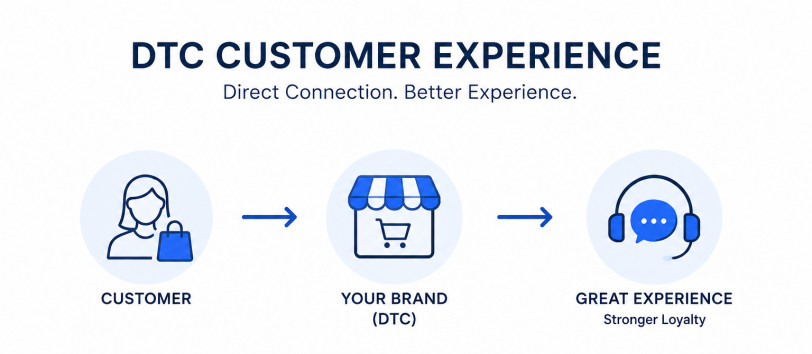
DTC brands preserve loyalty through growth spikes by preparing support capacity, using AI for low-risk repetitive work, routing sensitive cases to trained humans, and turning every support pattern into a product, operations, or messaging improvement. The goal is not to eliminate human service. It is to keep the brand reliable when demand suddenly multiplies.
A DTC brand earns loyalty during the moments when customers need help most. A product drop may create the demand, but the response after the order determines whether that demand becomes repeat revenue or a public support crisis.
A direct-to-consumer skincare brand launches a new product at midnight. By 2 a.m., the drop has sold out — and so has the brand’s support inbox. A customer’s order confirmation never arrived. Another received the wrong shade. A third posted a screenshot of an unanswered chat window to social media, tagging the brand directly. There’s no store manager to escalate to, no regional call center on standby, no wholesale partner absorbing the complaint. Just the brand, its customers, and whatever support system it built (or didn’t) in advance.
This is the reality of running a DTC business: every interaction is direct, which means every mistake is direct too. There’s no retailer standing between the brand and the person who’s upset. That’s exactly why dtc customer experience has become one of the most scrutinized parts of the entire business model — not a nice-to-have layered on top of the product, but the thing that determines whether a customer becomes a repeat buyer or a public complaint.
When a brand sells through a retailer, the retailer absorbs a lot of the customer relationship — checkout friction, returns, in-store questions. When a brand sells direct, all of that responsibility sits with the brand itself. The upside is real: direct access to first-party data, full control over messaging, and the ability to build a relationship instead of a transaction. The downside is that dtc customer experience carries the full weight of the brand’s reputation on every single touchpoint, from the unboxing to the return process.
That structure creates a few pressures unique to the DTC model:
The businesses that treat this seriously tend to see it show up in hard numbers, not just brand sentiment. According to customer experience platform Yext, citing research from web usability firm Baymard Institute, a significant share of shoppers abandon their carts specifically because the checkout process feels too long or too complicated — a reminder that a big part of dtc customer experience happens before a support ticket is ever filed.
On the brand-consistency side, CMSWire has reported that DTC brands which keep their messaging and tone consistent across every customer touchpoint tend to see stronger conversion and a more engaged social following, citing the beauty brand Colourpop as an example of a company whose consistent, on-brand voice across channels has helped build a large and loyal online audience. The lesson generalizes well beyond one brand: it isn’t just about resolving problems quickly — it’s about making every touchpoint, good or bad, feel like it came from the same company.
Pulling this off consistently, especially while scaling into new markets, usually comes down to a few operational pillars:
Very few brands can build all five of these in-house from day one — which is exactly why so many turn to a specialized CX partner rather than trying to solve it alone.
Nexlence builds its CX model specifically around the pressures described above, combining AI-powered automation with multilingual human teams rather than treating the two as separate options. For DTC and e-commerce brands in particular, that translates into a few concrete capabilities:

There’s no retailer standing between the brand and the customer, so every touchpoint — good or bad — reflects directly on the brand. Consistency, speed, and tone all matter more because there’s nowhere else for the responsibility to sit.
Used well, AI handles the repetitive, high-volume questions instantly — freeing human agents to focus on the interactions that genuinely need empathy or judgment. The brands that get this balance right tend to see faster resolution times without sacrificing the personal feel customers expect from a DTC brand.
This depends entirely on whether the underlying infrastructure already exists. A partner with delivery centers and AI workflows already running can typically absorb a spike within days, while building that capacity in-house from scratch usually takes months.
Not if the partner is chosen carefully. A provider that blends AI with human specialists trained specifically on the brand’s voice and audience can maintain — and in some cases improve — the personal touch, especially compared to an internal team that’s stretched too thin to respond quickly.
The DTC brands that come out ahead aren’t necessarily the ones with the biggest support teams — they’re the ones whose customer experience holds together under pressure, at 2 a.m., during a product launch, across every channel a customer might use. Getting dtc customer experience right means treating support not as a cost to minimize, but as one of the clearest signals a brand sends about who it really is.
If your team is feeling that pressure — a launch that outpaced your support capacity, a growing list of markets you can’t cover in the right language, or an experience that feels inconsistent across channels — that’s precisely the gap Nexlence is built to close. Its dual-engine model, global delivery network, and Gen Z–fluent teams exist to make sure that the next 2 a.m. product drop becomes a growth story instead of a support crisis. Reach out to Nexlence to map out where your current support is under the most strain, and where AI-driven automation and multilingual human expertise could relieve that pressure first.
Customer experience is more important for DTC brands because the brand owns the relationship directly from discovery through checkout, delivery, returns, and support. There is no retailer to absorb service failures, answer routine questions, or manage customer frustration. Every poor delivery update, unclear policy, slow chat response, or difficult return reflects directly on the brand. The advantage is direct access to customer data and a stronger opportunity to build loyalty. The responsibility is that product, marketing, fulfillment, and support must work as one connected experience, especially when order volume suddenly increases.
DTC brands can prepare customer support for a product launch by forecasting likely ticket volume, staffing peak coverage, updating FAQs and macros, testing transactional emails, confirming fulfillment information, and defining escalation rules before launch day. Review inventory status, shipping promises, cancellation policy, refund authority, product details, and known customer questions at least 7 to 14 days before the event. Create one source of truth for agents and social teams so customers receive consistent answers across channels. After the launch, review top contact drivers and resolve the product, content, or operational issues that created preventable tickets.
AI customer support can improve loyalty for DTC brands when it delivers fast, accurate answers to routine questions and routes complex, sensitive, or uncertain cases to trained humans. Useful automation includes order-status updates, policy checks, return-window guidance, product-care answers, ticket routing, and approved response drafting. It harms loyalty when it guesses, blocks access to people, gives outdated order information, or handles emotionally charged complaints without empathy. Set clear permissions, data sources, confidence thresholds, escalation rules, and quality reviews. The purpose of AI is to reduce customer effort and free humans to solve the moments that require judgment.
A DTC brand should consider outsourcing customer support when growth, international expansion, launch spikes, extended coverage needs, or multilingual requirements exceed what its internal team can handle without slower responses or declining quality. Outsourcing can provide flexible capacity, specialized operations, and 24/7 coverage, but the partner must be evaluated on brand-voice training, data security, system integrations, escalation rules, quality assurance, reporting, and commercial incentives. Start with a narrow pilot, such as after-hours coverage, order-status inquiries, or a specific market. Keep strategic ownership of policies, customer insights, and the customer promise inside the brand.
During growth spikes, track first response time, resolution time, ticket rate per 1,000 orders, peak backlog duration, reopen rate, repeat-contact rate, customer satisfaction, social-response time, automation-resolution rate, escalation rate, refund rate, return reasons, and repeat purchase after service interactions. Pair efficiency metrics with customer outcomes because a lower ticket count can mean customers gave up rather than received help. Also track the top contact drivers and the percentage that were preventable through better product pages, checkout information, transaction emails, fulfillment updates, packaging, or policies. The strongest metric is whether the experience protects future customer value, not simply whether tickets close quickly.