

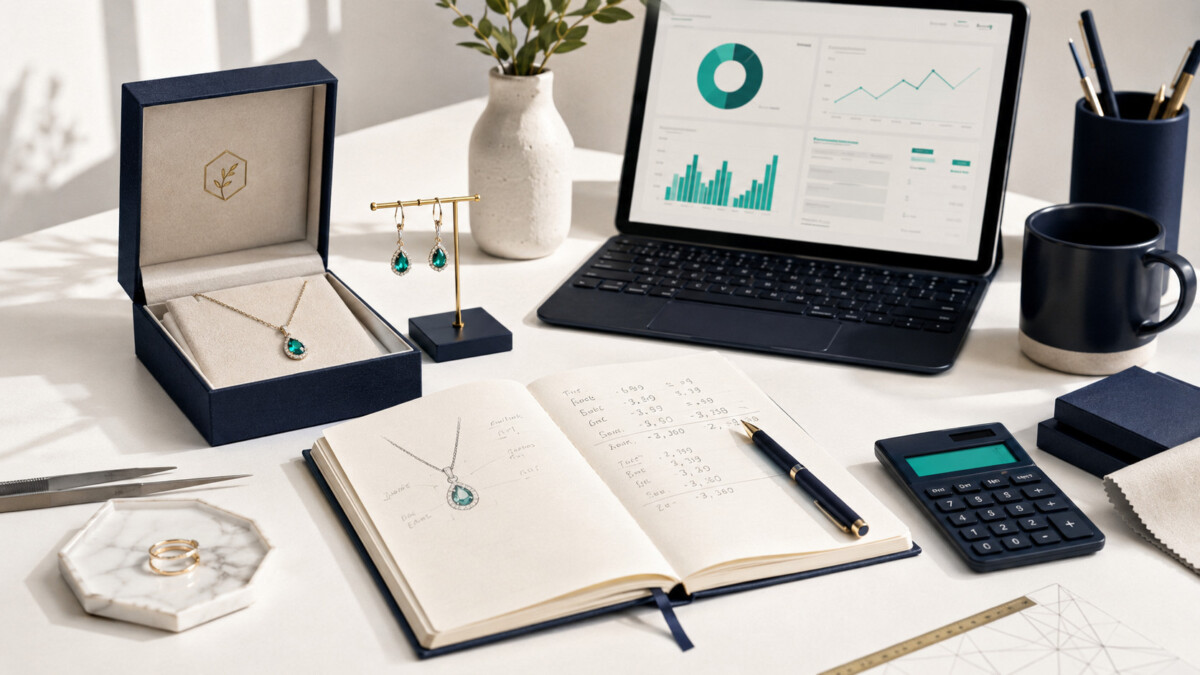
Aesthetic mastery gets a jewelry brand to $250K. Operational mastery gets it past $1M. Most founders do not make that shift until the data forces them to.
Across the jewelry brand ecosystem on Shopify, a specific failure pattern repeats with predictable consistency. The product is well designed. The brand has voice. The first six months of organic Instagram pull in early adopters who become genuine fans. Then somewhere between $250K and $500K in annual revenue, growth flattens and the founder cannot figure out why.
The diagnosis is almost never the product. It is rarely the marketing. It is almost always the operational layer underneath the brand: cost math set on instinct rather than rigor, a single supplier relationship that quietly capped scale, a marketing budget split too thin across too many channels, an unboxing decision treated as a cosmetic line item, and a delivery partner chosen because it was the default option in Shopify Shipping. Each individual decision sounds small. Stacked together, they explain why the average jewelry brand on Shopify never crosses $1M in annual revenue.
This article is for jewelry brand founders and operators between launch and the first million. The same patterns apply to fashion and lifestyle merchants in similar margin profiles, and the operational decisions below scale across all three categories. None of these decisions get the attention that a viral TikTok or a new product drop gets. All of them are fixable, and most of them can be addressed in the next 30 to 90 days using a stage aware ecommerce growth strategy. The brands that compound year over year are the ones whose founders accept that early.
Most jewelry founders underestimate their fully landed cost of goods by 22 to 35%, which means their pricing strategy was built on bad math from the first day they accepted payments. The fix is not raising prices reactively when the bank balance signals trouble. The fix is learning to calculate fully landed product cost correctly so that pricing decisions are made on real numbers, not the wholesale invoice alone.
Fully landed cost includes far more than the wholesale price of the piece. It includes inbound shipping, customs and duty for imported inventory, insurance, packaging, payment processing fees, Shopify platform fees, returns reserve, and a portion of operating cost allocated to each unit. Marketing customer acquisition cost is layered on top of this when calculating contribution margin. Brands that price based on wholesale cost alone often discover six to nine months in that they are not actually profitable at the unit level, even though gross margin looks healthy on the surface.
The right approach reverses the calculation. Start from the target net margin, work backward to the required gross margin, then price the product. Costume jewelry typically supports gross margins of 70 to 85%, demi-fine pieces sit at 55 to 70%, and fine jewelry usually lives at 40 to 55% per jewelry industry margin and growth research. Net margin lands 25 to 40 percentage points below the gross once everything is layered in. Apps like Lifetimely or Profit Calc make the layered calculation easier by pulling Shopify data and applying the additional cost layers automatically, which removes the spreadsheet errors that creep in over time.
Pricing review cadence should be quarterly minimum, with reactive review when commodity inputs shift sharply. The recent gold and silver price runs are a relevant example. When raw input costs spike, raising prices on existing inventory is the wrong move. The right move is discounting existing stock at the older cost while pricing new inventory at the higher rate, which preserves margin without breaking customer trust on a SKU they have been watching.
Most jewelry brands operate with one supplier for too long because the relationship feels efficient, and they discover the cost of that dependency only when the supplier raises prices, misses a holiday window, or shuts down without warning. The pattern is consistent across the category. Brands at $50K monthly revenue often run on a single supplier. Brands at $500K monthly revenue typically have three to five active suppliers across product categories.
The right time to add a second supplier is around month four to six of operations or once three to four orders have shipped without major issues, which gives enough operational data to make the comparison meaningful. The second supplier creates negotiating leverage and a fallback. A third supplier becomes important when any single vendor represents more than 60% of inventory cost. This is not a contingency plan. It is a scale enabler.
The questions to ask any supplier candidate include lead time consistency under peak season volume, minimum order flexibility for testing new SKUs, sustainability and ethical sourcing documentation, ability to scale up if a SKU goes viral unexpectedly, and willingness to share material certifications. Documentation matters increasingly for brands selling to a customer base that researches before buying.
This is also where suppliers that operate as both wholesaler and manufacturer earn consideration. The dual role gives a brand both sourcing flexibility and production control, which is harder to coordinate when those functions sit in separate companies. Examples in this category include Jewelry wholesalers who are also a manufacturer like Phoenix Manufacturing Co. Ltd, where the integrated structure can support sustainability claims with verifiable documentation and absorb production scaling without quality drift across batches.
Conduct a supplier audit every six months. Inventory tools like Cogsy or Inventory Planner help track lead time variance and supplier performance metrics over time, which is the data that powers the audit. Review pricing trends, lead time variance, defect rate, and communication responsiveness. Three consecutive shipments with quality variance, refusal to share material certifications, or going silent during peak season prep are red flags worth acting on before the next purchase order.
Most jewelry brands burn through marketing budget by spreading it across too many channels too early, instead of compounding the one that actually converts. Channel concentration scales faster than channel coverage. The 70/30 rule helps, but only when applied with stage awareness rather than as a generic prescription.
At $10K to $50K monthly revenue, paid acquisition CAC tends to outrun gross margin until brand recognition compounds. The 70% in this stage usually belongs to organic content paired with micro-influencer or UGC partnerships in the 5K to 50K follower range, where engagement rate matters more than reach and content can be repurposed into paid creative later. The 30% covers small paid tests on the platform where the audience already lives, plus email and SMS list building from day one through Klaviyo email and SMS automation for Shopify.
From $50K to $250K monthly, paid social typically becomes the primary channel. The 70% goes to whichever of TikTok or Meta currently has the lowest blended CAC for the brand. Email and SMS retention runs in parallel as the second compounding lever, and Klaviyo handles that integration cleanly with Shopify at this stage. Above $250K monthly, the pattern shifts to two profitable channels working with one in test. Attribution becomes the primary diagnostic problem, not channel selection. Tools like Triple Whale or Northbeam are worth the cost at this stage because the cost of misallocated budget exceeds the subscription fee within weeks.
The discipline that separates compounding brands from stalled ones is repurposing UGC into paid creative. Brands that figure this out cut paid acquisition CAC by 20 to 35% within 60 days. The brands stuck on six platforms with one that converts have a focus problem, not a marketing problem. Cut the platforms that are not paying back, double down on the one that is, and use the freed time to build the second compounding channel rather than the seventh failing one.
Jewelry packaging is not a brand decoration line item. It is the most cost efficient acquisition channel a jewelry brand has, and brands that treat it as cosmetic typically miss a 12 to 18% organic referral lift that compounds without additional spend.
Jewelry is given as a gift roughly 35 to 45% of the time in the direct-to-consumer category. Every gift recipient encounters the brand in physical form during a moment that already carries emotional weight. That moment is earned acquisition opportunity. Packaging that signals care converts the recipient into a follower or future customer at a CAC of zero. Packaging that feels generic loses that opportunity entirely, and the brand has paid full retail to ship a missed introduction.
Stage aware spend matters here. At $10K monthly revenue, custom outer mailers paired with a branded pouch and a printed thank-you card cover the basics without overspending, typically running 4 to 6% of order value. At $250K to $500K monthly, the right move is integrated kitting with a QR code linking to a care guide, a referral incentive, or a styling content piece as part of a broader post purchase customer experience strategy. Spend can move toward 6 to 8% of order value when the unboxing is being designed for organic share rather than just protection.
Sourcing options follow the same stage logic. Shopify integrated apps like Arka, noissue, and Sticker Mule cover the entry stage with low MOQs and fast turnaround. Once volume justifies higher minimums, direct negotiation with packaging manufacturers (often Alibaba sourced) typically reduces unit cost by 30 to 50%. The brands compounding well treat this transition as a planned milestone rather than a panic decision triggered by margin compression.
The single packaging decision most brands skip is the care card. A small printed insert that addresses cleaning, storage, and return guidance reduces the friction of a customer wondering how to maintain the piece, which quietly drives returns. That single sheet of paper can move return rate down by 2 to 4 percentage points within 90 days, and the cost per insert is typically under ten cents at modest volume.
The delivery experience is the most underestimated lever in repeat purchase rate for jewelry brands. The brands that get it right see 8 to 14 percentage point lifts in 60 to 90 day repeat rate compared to category benchmarks, and the gain compounds quarter over quarter as the customer base grows.
The math is straightforward. Jewelry is often purchased for a specific event with a fixed date. A late delivery is not just an unhappy customer. It is a refund, a return, a one star review, and a customer who never comes back. Carrier reliability matters far more than carrier speed. Pulling the last 90 days of delivery scan data and looking at variance rather than average reveals which carrier actually performs in real conditions. Inconsistency damages repeat rate harder than slowness does, because customers can plan around slow when they trust the timing.
On the Shopify side, the decisions that pay back include live tracking integrated into the storefront, branded tracking pages through apps like AfterShip or Wonderment, proactive delay notifications before the customer notices, and signature confirmation on orders above a price threshold. Shop App and Shop Promise are worth evaluating once order volume justifies the integration work, since they bundle delivery confidence at the cart with post purchase tracking in a single workflow.
Stage aware approach: at $10K monthly, USPS or domestic equivalent paired with AfterShip is enough. At $250K monthly, two carriers running in parallel with signature confirmation on higher value orders becomes the baseline. Above $500K, proactive notifications and a returns experience designed for ease become the focus, particularly for brands that ship internationally where lost shipment claim time alone can compress margin.
The often missed decision is the returns experience itself. Frictionless returns paradoxically reduce returns by lowering pre-purchase anxiety, which lifts conversion rate, and they build post purchase trust, which lifts repeat. Apps like Loop Returns and ecommerce returns management tools or ReturnGo handle the operational layer. The brands compounding well treat returns as a CAC reducing investment rather than a cost center, because the data on first time buyer conversion lift backs the math up cleanly.
Every jewelry brand that compounds past $1M on Shopify treats the operational layer as part of the brand. Every brand that stalls treats it as the boring stuff that comes after the brand. The five decisions covered above (cost layering, supplier diversification, channel concentration, packaging as acquisition, and delivery as retention) are not separate problems. They are one problem expressed in five forms: the founder’s relationship to the operational layer.
The pattern is observable across categories. Jewelry, fashion, and lifestyle brands with strong aesthetic identity often have founders who came from design, marketing, or styling backgrounds. The operational layer feels like the unfun part of the work, so it gets delegated, deferred, or skipped. The brand looks beautiful at $300K and stays at $300K because the operational layer never developed alongside the brand identity. The aesthetic kept its end of the bargain. The operations did not.
The fix is not hiring an operations leader at $50K monthly revenue. The fix is the founder spending two to four focused hours every Friday inside the operational layer until they understand it well enough to make hiring decisions later from a position of clarity. Without that grounding, the first operations hire often gets handed problems the founder cannot articulate, which produces an expensive miss and a lost six months.
Aesthetic mastery gets a jewelry brand to $250K. Operational mastery gets it past $1M. The brands that scale are the ones whose founders made that shift before the data forced them to. The compounding decisions are not the marketing decisions or the product decisions, though those matter. The compounding decisions are the operational ones, made consistently, reviewed quarterly, and improved every cycle.
The brands worth building toward acquisition or long term independence are not the ones with the most polished product photography. They are the ones whose unit economics, supplier relationships, and post purchase experience are mapped, measured, and improving every quarter. That kind of brand compounds. That kind of brand is worth the work, and that kind of brand earns the trust that turns first time buyers into repeat customers and repeat customers into the audience that funds the next product line.
Costume jewelry typically supports gross margins of 70 to 85% (a 4x to 7x markup on landed cost), demi-fine jewelry sits at 55 to 70% (about a 3x markup), and fine jewelry usually lives at 40 to 55% (around 2x to 2.5x). Those are gross margin numbers. Once payment processing, platform fees, marketing CAC, packaging, returns reserve, and operating cost are layered in, net margin typically lands 25 to 40 percentage points below the gross. The right way to set pricing is to start from the target net margin, work backward to the required gross margin, then price accordingly. Brands that price on gross margin alone almost always discover six to nine months in that they are not actually profitable at the unit level.
Earlier than most founders think. The right time to add a second supplier is around month four to six of operations or once three to four orders have shipped without major issues, which gives enough operational data to make the comparison meaningful. Add a third supplier when any single vendor represents more than 60% of inventory cost. The reason is not that suppliers will fail. It is that single supplier brands lose negotiating leverage, get stuck with one supplier’s lead times during peak season, and have no fallback when a SKU unexpectedly goes viral. Diversification is a scale enabler, not a contingency plan, and the founders who treat it that way avoid the panic decisions that compress margin.
Whichever channel currently has the lowest customer acquisition cost for the specific brand and product mix. For most jewelry brands at $0 to $50K monthly revenue, the best channel is organic content paired with micro-influencer or UGC partnerships, because paid acquisition CAC tends to outrun gross margin until brand recognition compounds. From $50K to $250K monthly, paid social (TikTok or Meta, whichever the audience converts on) typically becomes the primary channel, with email and SMS retention running in parallel through a tool like Klaviyo. Above $250K monthly, the right answer is two profitable channels with one in test. Avoid the temptation to be active on every platform at once. Channel concentration compounds faster than channel coverage, and the focus pays back in lower CAC and faster learning cycles.
Most jewelry returns are not driven by quality. They are driven by sizing confusion, post purchase care anxiety, and a lack of confidence at checkout. The four highest leverage moves are a sizing or fit guide that is easy to find on the product page, a small care card included in the package that addresses cleaning and storage questions, photography that shows accurate scale on a model or hand, and a frictionless returns process that paradoxically reduces returns by lowering pre-purchase anxiety. Apps like Loop Returns or ReturnGo handle the operational side. The content side (sizing, care, scale) is the founder’s responsibility. Brands that get both right typically see returns drop by 4 to 8 percentage points within 90 days, which flows straight to the bottom line.
There is no honest average, because the founder’s operational discipline is the variable that compresses or expands the timeline. Brands with strong aesthetic identity and weak operations often plateau between $250K and $500K and stay there for years. Brands that map their unit economics within the first six months, diversify suppliers by month nine, and treat packaging and delivery as acquisition and retention levers rather than fulfillment costs typically reach $1M in 18 to 36 months. The decisions that compound are not the marketing or product decisions. Those matter, but they are not what separates outcomes at this stage. The compounding decisions are the operational ones, made consistently, reviewed quarterly, and improved every cycle. Most brands that scaled to $1M did so because the founder accepted that early and acted on it.





