Back-to-school commerce pressures expose the gap between AI that generates advice and AI that helps execute connected work. Sellers get the most value when AI can work from real store data, reduce tool switching, and support measurable improvements in listing launches, creative production, advertising, conversion, and retention.
The next commerce AI advantage is not getting a better answer in a chat window. It is reducing the distance between seeing a problem, deciding what to do, and completing the work safely inside the systems that run the store.
The Back-to-School season is one of the busiest times of the year for eCommerce sellers. While this means more traffic and potentially higher sales, sellers have to create product images, write listing copies, launch products, optimize listings, manage multiple stores, adjust advertising, and monitor performance.
In 2026, the challenge is no longer whether AI can give good answers to help the seller solve everyday problems. For example, loads of great text and image generation tools can help with polishing product descriptions and images for listings. The bigger question is, “Can AI help me actually get the work done?”
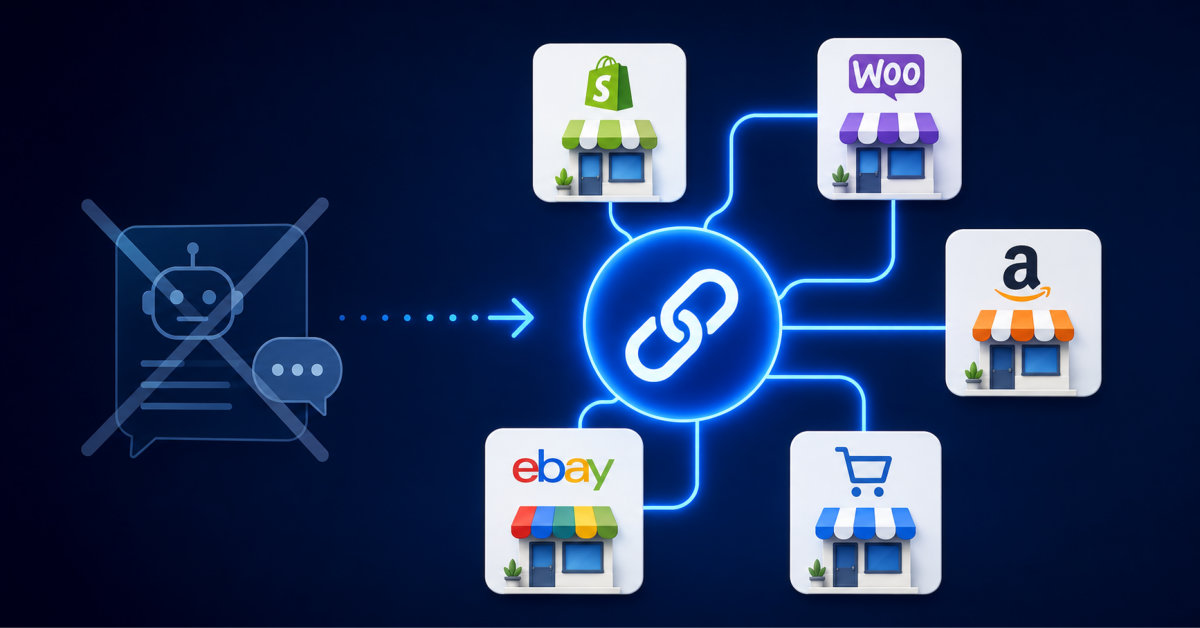
In a traditional AI workflow, the only role of the AI is to give advice. The seller will have to interpret the advice and switch between different systems for its manual execution. This creates operational friction. Therefore, the next stage of commerce AI is less about generating better answers and more about connecting diagnosis with decision-making and execution. eCommerce-focused AI infrastructures like StoreClaw are emerging to solve this problem.
StoreClaw operates as an autonomous commerce engine or cross-platform AI-powered commerce growth center that helps sellers generate, launch, optimize, and convert across their commerce operations.
We noticed something interesting in the back-to-school data obtained from StoreClaw’s internal platform data comparing two different periods (July 7-21 vs July 22-August 4, 2026).
During the back-to-school season, we observed two notable behavioral shifts among U.S. heavy sellers. The connected-platform penetration increased by 4.2 percentage points. The numbers suggest that sellers may be moving away from experimenting with standalone AI tools and beginning to connect AI with their actual commerce operations.
Within the same period, image/video creation penetration increased by 4.4 percentage points, which was 1.7x faster than listing copy (2.6 percentage points). One possible explanation is that sellers may see visual content creation as a bigger operational bottleneck than copywriting during high-velocity, high-SKU sales periods.
What this points to is that instead of simply leaning on AI to generate better text, sellers increasingly want AI to help them produce, optimize, and execute actual commerce tasks faster. This also highlights how isolated tools fail to help sellers speed up their operations workflow during high-velocity, high-SKU sales periods.
There are three key limitations of the AI “Copilot” model. Firstly, while AI can recommend what a seller should do, the seller may still need to execute the recommendation manually.
Secondly, a general AI system may provide useful recommendations, but without access to the seller’s actual business data, the advice will remain generic.
The last and most challenging limitation is working with fragmented tools. For example, a seller may use different tools for AI writing, image generation, data analysis, advertising, and store management. Consequently, the bulk of the seller’s time is tied to connecting these systems.
AI can accelerate individual tasks, but that doesn’t necessarily make the wider business process more efficient. The broader trend that StoreClaw is responding to is the movement towards coordinated execution inside a connected commerce workflow. It is evolving from a general-purpose AI conversation interface to a store-centric decision system.
The broader idea is that AI for commerce needs to understand the seller’s actual business context rather than operate as a standalone chat window. StoreClaw’s intended approach is to ground analysis in actual store-level data, such as GMV, ACoS, return rates, listing performance, competitive information, and advertising performance.
StoreClaw is evolving toward a store-level decision-making workspace—referred to as My Store Dashboard—designed to provide sellers with a more centralized entry point for business diagnostics, decision support, and task execution.
The goal is to reduce the operational cost of switching between multiple systems. The latest commerce engines allow sellers to customize frequently used function entries according to their own operational cadence.
StoreClaw, for example, is expanding its connections with the third-party commercial data ecosystem—such as Sorftime, which is expected to be fully integrated in August 2026— to strengthen the depth and credibility of its business diagnostics such that recommendations are more closely connected to the seller’s own business context. It is continuously optimizing model invocation, task scheduling, computing resource allocation, and complex analytical workflows.
Execution-oriented AI can translate into measurable commercial outcomes. For example, Twinkle Star, an Amazon LED décor seller, cut their product launch time from 5-7 days to 1.5 days. Their conversion rate also grew from 9.3% to 14.1% using execution-focused AI.
Similarly, Ruvalino, a baby and maternity Shopify seller, increased repeat purchases from 11% to 18% while their organic search share jumped from 8% to 19%. Amazon home textiles seller LuxClub lowered ACoS from 35% to 22%, saved $80K/month on advertising, and saw their sales grow by +47% QoQ.
Across these sellers, the value of execution-oriented AI appears in the metrics that matter to operators: traffic, conversion, revenue, advertising efficiency, and customer retention.
On average, cross-border merchants use 3.5+ AI applications while independent sellers use 5+. The back-to-school behavioral data appears to highlight how difficult it is to sustain stitching multiple tools during high-velocity, high-SKU trading season. It shows sellers are more willing to leverage connected data ecosystems to get ahead.
Execution-focused commerce AI is AI that helps sellers move beyond generic advice by connecting store data, diagnostics, recommendations, and approved actions inside operational workflows. Instead of only suggesting that a listing, ad campaign, product image, or retention flow should improve, it can help identify the affected item, prepare the work, and support execution in the connected platform. The best systems maintain human approval for meaningful changes involving customer-facing content, advertising spend, pricing, inventory, or brand claims. Evaluate the platform based on what data it can access, what actions it can take, and how clearly it records the reason and result.
StoreClaw states that it connects with major ecommerce and social platforms, including Shopify, Amazon, WooCommerce, Wix, eBay, and social channels, to bring store data and operational work into one workspace. Its Amazon documentation describes monitoring, diagnosis, and recommendation workflows across listings, inventory, orders, shipping, advertising, pricing, promotions, feedback, reviews, and sales performance. Confirm the current connector availability, country support, authorization scope, data-refresh timing, permission model, and write-action approval rules for your specific storefront and marketplace accounts before connecting production data.
Commerce AI can improve Amazon listing conversion when it helps sellers identify weak listings, organize accurate product information, create stronger images or A+ content, integrate relevant search terms, and test changes against a baseline. It cannot guarantee conversion gains because outcomes also depend on product-market fit, price, reviews, inventory, competition, traffic quality, and marketplace conditions. StoreClaw reported that Twinkle Star increased listing conversion from 9.3% to 14.1% in its case study, but that is a company-reported result from one brand, not a universal benchmark. Test changes on a defined set of ASINs and measure conversion against comparable controls.
Sellers should automate a high-frequency, low-risk workflow first, such as compiling performance reports, identifying listing issues, drafting product-content updates from approved data, preparing creative variations, or flagging wasted ad spend for review. Choose a workflow with a clear baseline, repeated manual steps, reliable data, and a measurable outcome. Avoid starting with unsupervised pricing, broad ad-budget changes, inventory purchasing, or customer-facing claims until the platform has demonstrated reliable behavior and your team has defined approval controls. Early success comes from reducing repetitive coordination work while keeping the seller accountable for commercial decisions.
You measure ROI from commerce AI by comparing the workflow’s cost, cycle time, quality, and business outcome before and after implementation. Track operational measures such as time to launch a SKU, labor hours, revision volume, approval time, error rate, and tool costs. Then connect them to commercial measures including conversion rate, ACoS, contribution margin, revenue, repeat purchase rate, inventory risk, or customer support demand. Use a control group, matched product set, historical baseline, or phased rollout where possible. Do not judge ROI by the number of AI-generated assets alone, because volume does not prove business value.