

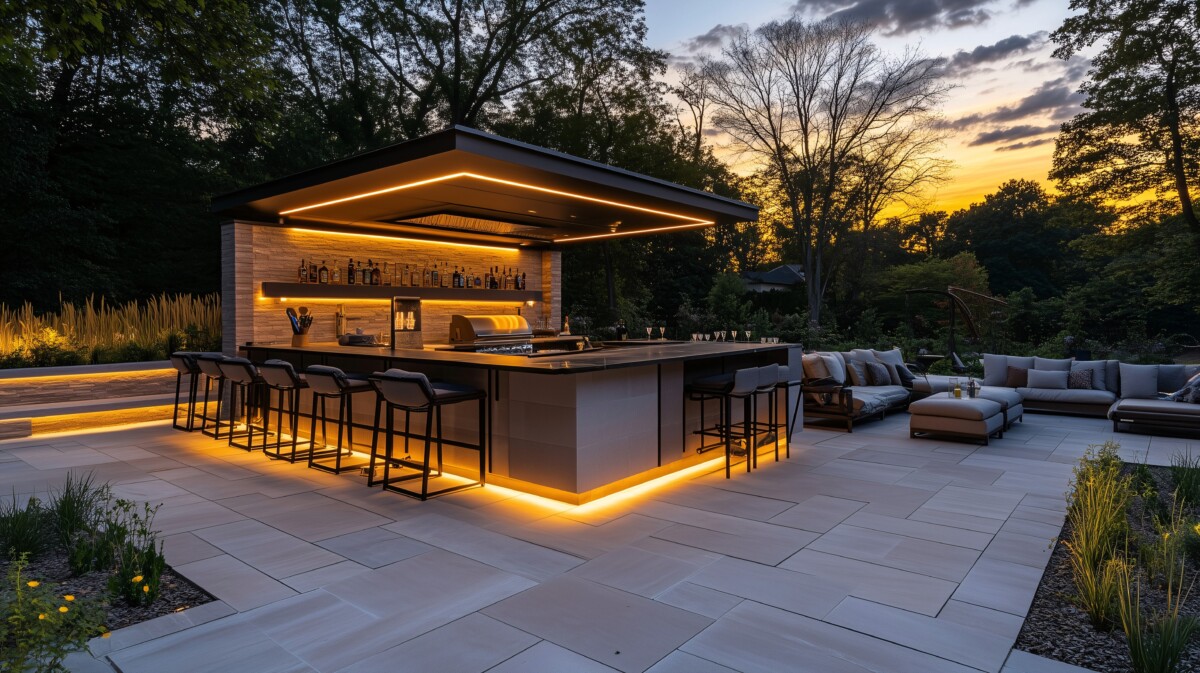
High ticket categories split into a product segment that sells online and a built segment that sells through consultation. Merchants under $2M raise their online ceiling with financing, visualization, and configuration before they add a human step, not after.
The same customer need is served at $700 and at $50,000. The gap between those two numbers is not a product gap. It is the point where a website stops being enough.
A UK outdoor kitchen costs somewhere between £500 and £40,000, depending entirely on how it is bought. That is roughly an eighty fold spread on the same underlying customer need: cook outside, host properly, use the garden more than three months a year. The product at the bottom of that range arrives flat packed from a garden centre. The one at the top arrives as a landscape design consultation, a materials specification, a Gas Safe engineer, and eleven weeks of construction.
If you sell furniture, garden equipment, saunas, pizza ovens, home gym setups, or anything else where the same customer need can be met at wildly different price points, you have already watched this split happen inside your own catalog. Your $400 SKUs convert at a respectable rate. Your $9,000 SKU gets traffic, gets added to cart, and then something happens on the way to the payment step that your analytics describe as abandonment and your gut describes as hesitation.
The useful thing about the outdoor kitchen market is that it has already sorted itself into the two segments cleanly enough to study. One segment sells through retail and online channels. The other sells through design and build firms. The line between them is not about product quality, and it is not about who has the better website. It is about where the online buying journey stops being sufficient, and that line sits at a specific, findable number in every high consideration category, including yours.
The outdoor kitchen category divides into a product segment running roughly £500 to £5,000 and a built segment running £8,000 to £40,000 or more, and the two segments are separated by purchase journey rather than by product category. The product segment covers modular systems, freestanding units, and flat pack outdoor cabinetry sold through garden centres, DIY retailers, and online channels. Purchase journey is short. The buyer self installs or hires an assembler. Volume is high and margins are thin.
The built segment covers landscape integrated kitchens designed and constructed as part of a wider garden project. These sell through landscape design and build firms, not product retail channels. Design consultation, material specification, construction planning, and professional installation all sit inside the sale. Volume is low, margins are high, and the customer profile skews toward higher household income, meaningful outdoor space, and a pattern of making several large home improvements in sequence.
Notice what is missing from that £5,000 to £8,000 stretch. It is not that nobody wants a £6,500 outdoor kitchen. It is that the buying mechanisms on either side of that gap are built for different things, and neither one reaches comfortably into the middle. Product retailers cannot carry the design and installation overhead at that price. Build firms cannot make the consultation economics work below roughly £8,000 in project value.
That gap is the interesting part for merchants. It is not a market failure. It is the visible edge of what a self serve purchase can carry, and every category has one. The product segment competes on price and availability. The built segment competes on design quality, contractor reputation, and coherent integration with the rest of the property. Those are not competing versions of the same business. They are two businesses that happen to share a product noun.
Every high consideration category has a price point where self serve online checkout stops working, and you can find yours in about two hours using Shopify order data you already have. Pull twelve months of orders, sort by line item value, and bucket them into $500 bands. Then plot two things against those bands: conversion rate from product page view to completed order, and time from first session to purchase.
What you are looking for is not a gentle decline. It is a cliff. Somewhere in your catalog there is a band where conversion drops sharply and the sessions to purchase count roughly doubles. That band is your ceiling. Below it, customers decide on their own. Above it, they are looking for something your product page is not giving them, and most of them go find it somewhere else or abandon the purchase entirely.
Context helps here. Home and furniture consistently posts one of the highest average order values of any ecommerce category, and it is worth understanding your Shopify average order value against what the category benchmarks actually say before you decide your numbers are a problem. A $254 category AOV against your $180 is a positioning question. A hard conversion cliff at $3,000 when your best margin product costs $4,200 is an infrastructure question, and it is much more urgent.
The ceiling is not fixed. That is the whole point of finding it. Merchants around $500K in annual revenue typically discover a ceiling somewhere between $800 and $2,000, largely because they have not yet built the trust infrastructure that supports larger decisions. Merchants past $2M who have invested in reviews, warranty clarity, and financing routinely push the same category ceiling to $8,000 or higher. Same products. Different apparatus around them.
Financing, visualization, and configuration each raise the online ceiling, and merchants under $2M should deploy them in that order because the cost and complexity climb steeply from left to right. Financing is the cheapest lever and usually the fastest. Splitting a $4,000 purchase into monthly payments changes the decision from a capital allocation question into a budget question, and Shopify merchants can turn this on natively. Shop Pay Installments, Klarna, and Affirm all serve this, and Shopify’s own reporting on extended payback periods on higher ticket orders covers the mechanics of stretching terms specifically to support larger baskets.
Visualization is the second lever and it costs more. The problem it solves is that nobody can imagine a $6,000 object in a space they cannot photograph it in. Shopify supports 3D models and AR viewing natively on product pages, which lets a customer place the item in their actual garden or living room through their phone. This is the lever DTC mattress brands used to solve the trust problem for a product people previously insisted on testing in person, and the transferable lesson is that removing physical inspection requires replacing it with something, not simply asserting that it is unnecessary.
Configuration is the third lever and the most expensive to build well. Once your product has meaningful options, the customer is no longer picking a SKU, they are specifying a build. Product options apps handle the front end, but the real work is in the pricing logic behind it and the fulfillment logic behind that. Merchants who bolt configuration onto a store without solving both usually create a support burden rather than a revenue lift, and Gorgias or a similar helpdesk becomes the accidental compensating control.
The order matters because of payback. Financing can go live in an afternoon and typically shows movement inside a quarter. Configuration is a multi month build that only pays back if your ceiling analysis showed the demand sitting above it. Running these in reverse order is one of the most reliable ways to burn six months at the $500K to $2M stage.
When a product is not finished at delivery, the standard DTC fulfillment model stops describing what your business actually does, and the outdoor kitchen category shows why with unusual clarity. A premium build needs gas supply run and connected, electrical supply installed to outdoor standards with appropriate weatherproofing and RCD protection, and water supply and drainage extended from the house. None of that is product assembly. All of it requires qualified trades working to specific standards.
The UK regulatory position is unambiguous. The Health and Safety Executive requires that work on gas fittings in domestic properties be carried out by a Gas Safe registered engineer qualified for that work, and it is illegal for anyone else to do it. External electrical installations fall under BS 7671, which governs weatherproofing, circuit protection, and RCD requirements. There is no version of this where a homeowner unboxes the item and follows a printed guide.
For a merchant, this creates three problems that ordinary ecommerce does not have. Your delivery is not the completion of the order, so your returns window, your review request timing, and your revenue recognition all need to reference a different event. Your product’s safety profile depends on someone you did not hire and cannot supervise. And your customer’s experience of your brand is substantially determined by a third party trade, which is a genuinely uncomfortable place to sit.
The physical side compounds it. Weatherproof cabinetry, stone worktops, and built in appliances are heavy, awkward, and expensive to move badly, which puts these orders squarely into freight territory. Anyone building toward this category should understand the logistics of selling large and heavy items on Shopify before the first order lands, because dimensional weight pricing and delivery appointment scheduling will otherwise eat the margin that made the category attractive.
Firms in the built segment are not selling an outdoor kitchen, they are selling a design and delivery process, and that distinction explains why their sale cannot be compressed into a checkout button. The deliverable includes a site assessment, a spatial plan, a materials specification, coordination of gas and electrical trades, and a construction sequence. The physical kitchen is the output. The process is the thing being bought.
This is visible in how the work is described. The process of designing an outdoor kitchen that works year-round is as much about spatial integration with the house, the dining area, and the wider garden layout as it is about appliance specification. A kitchen positioned correctly reads as a permanent feature of the property. The same appliances positioned badly read as expensive equipment sitting in a garden. No product page can resolve that difference, because the answer depends on a site the seller has not seen.
The transferable point for merchants is that your consultation layer is a product with its own economics, and pricing it at zero is a decision with consequences. Brands that offer free design consultation on high ticket configurable products often find the request volume unmanageable within a quarter, because a free expert conversation attracts everyone including buyers who were never going to purchase. Charging $150 for a design session and crediting it against the order is a filter, and it typically improves close rate on the sessions that remain.
Practically, this means building a second path on your site rather than trying to force everything through one. Shopify Forms can capture project details before a human ever gets involved, Shopify Flow can route those submissions by budget band or postcode, and Klaviyo can run the nurture sequence for a decision cycle that runs weeks rather than minutes. That is a different funnel with different metrics, and treating it as a broken version of your main funnel is how it gets starved of attention.
The right move depends almost entirely on whether you have the operational capacity to support a consultative sale, which is why the answer differs sharply across revenue stages. Merchants under $500K should resist the consultation path entirely. Not because it does not work, but because it consumes founder hours at the exact moment those hours need to go into acquisition and product. Sell what sells itself, use financing to stretch that ceiling as far as it will go, and revisit the question at $1M.
Between $500K and $2M is where the ceiling analysis earns its keep. This is the stage where merchants most reliably add complexity ahead of fundamentals, and a consultative sales motion is complexity of a particularly demanding kind. Run the analysis first. If your data shows demand clustering just above your ceiling, the levers are worth building. If demand thins out well before the ceiling, you have a positioning problem and a configurator will not fix it.
Past $2M, the consultative path stops being optional in most high ticket home categories, because competitors are already running it and the customers who buy at the top of your range expect it. The build is real: a quote system, saved configurations, a trained human on the other end, and enough operational discipline that the handoff between web and human does not lose the customer. Budget two quarters, not two sprints.
Across all three stages, the durable read is the one the outdoor kitchen market makes obvious. The ceiling on what you can sell online is set by the apparatus around the product, not by the product. Move the apparatus and the ceiling moves. Skip the apparatus and no amount of checkout optimization will get a customer to spend $9,000 on faith.
Pull twelve months of Shopify order data, bucket line items into $500 bands, and plot conversion rate and sessions to purchase against those bands. Your ceiling is the band where conversion drops sharply and sessions to purchase roughly doubles, which usually appears as a cliff rather than a gradual slope. Most merchants around $500K find this between $800 and $2,000. Merchants past $2M with established trust infrastructure often push the same category ceiling to $8,000 or beyond. The analysis takes about two hours and needs no tooling beyond Shopify’s built in reports and a spreadsheet.
Financing is the fastest lever because it can go live in an afternoon and changes the buyer’s decision from a capital question into a monthly budget question. Shop Pay Installments is native to Shopify, and Klarna and Affirm cover merchants who need alternatives or different regional coverage. Extended payback terms specifically support larger baskets, which matters more as your price points climb. Visualization and configuration both raise the ceiling further, but they cost substantially more to build and should follow financing rather than precede it, particularly for merchants under $2M in annual revenue.
Add a quote path when your order data shows real demand sitting above your conversion ceiling and you have the operational capacity to respond within 24 hours. Below $500K in annual revenue, this is usually the wrong move, because consultative selling consumes founder hours that acquisition needs more. Between $500K and $2M, run the ceiling analysis first and only build the path if the demand is genuinely there. Charging a modest design or consultation fee credited against the order filters out browsers and typically improves close rate on the conversations that remain.
Delivery stops being the completion of the order, which means your returns window, review request timing, and revenue recognition all need to reference installation rather than dispatch. In the UK, gas work must be carried out by a Gas Safe registered engineer and external electrical work falls under BS 7671, so a third party trade you did not hire becomes part of your customer experience. Most merchants handle this through vetted installer networks with clear scope agreements, plus a post installation check that closes the loop before the review request goes out.
3D and AR are worth building when your ceiling analysis shows customers stalling at products they cannot physically inspect, which is common in furniture, outdoor, and large format categories. Shopify supports 3D models and AR viewing natively on product pages, so the cost sits in asset creation rather than platform work. Budget for professional 3D modelling on your highest margin SKUs first rather than attempting full catalog coverage. The mechanism is the same one DTC mattress brands used: physical inspection is not removed, it is replaced with something that does comparable work.




