
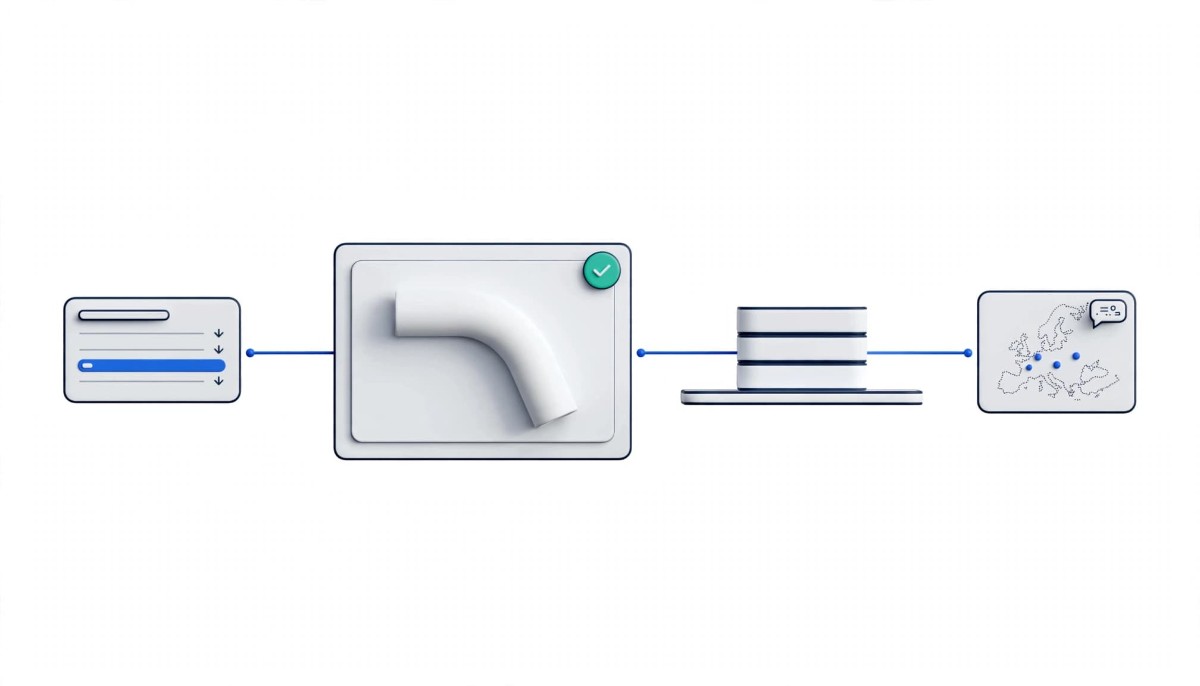
A niche parts store sells across the EU on Shopify by organising the catalogue around what the customer owns, stocking what it lists, and being plain about limits. TunePoint Europe, a Slovak BMW and Supra tuning shop, shows how those choices replace a big catalogue as the trust signal.
A narrow catalogue is not a small business problem. For a buyer about to spend €1,700 on an intake that has to fit one engine, it is the whole reason to trust the store.
Picture a BMW owner in Kraków (an illustrative case) ordering a carbon intake priced at €1,700. It arrives, and the housing does not match the airflow sensor on his engine variant. The return costs the store a two way shipment across borders, a restocking check, and very likely the customer. Multiply that by every listing where “fits most models” was doing the selling, and you have the reason most general parts stores struggle with high ticket, fitment critical products.
TunePoint Europe takes the opposite approach. It is a Shopify store based in Slovakia that sells tuning and performance hardware for a short list of BMW engine platforms (N54, N55, B48, B58, S55 and S58) and the Toyota GR Supra, and ships across the EU. Nothing about the business is unusual in isolation. What makes it a useful case is how many of its storefront decisions point the same direction: narrow catalogue, stocked inventory, dealer status, and support in the languages its customers speak.
Everything below comes from TunePoint’s public storefront as observed on October 15, 2026, and from the EU and Shopify sources linked in each section. Whether you are doing $10K months or $150K months, the decisions transfer to any niche where the wrong part is worse than no part.
A fitment first catalogue starts the buyer from the thing they own (an engine, a model, a device) and only then shows products, while a category catalogue starts from product types and leaves compatibility for the buyer to work out. On TunePoint’s homepage, the main product block is labelled “Select Your Engine”, and product titles carry the platform codes in the name, such as an induction kit “for BMW M140i / M240i – B58” or wheel spacers listing the G and F series chassis they fit.
That sounds like a small labelling choice. It changes three things. It cuts the number of products a buyer has to evaluate from the whole catalogue to the handful that fit their car. It moves the compatibility check from the customer’s head, where mistakes happen, to the store’s data, where they can be audited. And it makes the store’s narrowness read as expertise rather than as a thin range, because every listing is visibly built for one buyer.
The store states the logic directly on its About section: every part “has been checked for fitment on the platforms we list it under.” For a merchant, that sentence is only worth publishing if the data behind it is true. The practical version for a Shopify store is a fitment attribute on every product (metafields for model, year range and variant), collections built from those attributes, and product titles that name the platform so the information survives into search results, marketplace feeds and AI answers.
If you are under $250K a year, you can do this with Shopify’s native metafields and smart collections, no app required. Once your catalogue passes a few thousand SKUs or you carry data in an industry standard format, the data model becomes the hard part of any platform move, which is why fitment capability is the first thing to check when you shortlist Shopify Plus migration agencies for an automotive catalogue. The same structured attributes also make your products easier for AI shopping assistants to read, which is one of the first checks in this look at whether ChatGPT is recommending your store.
Stating that every available item is physically in stock works as a conversion feature because, in a niche where buyers plan a build around parts arriving, delivery certainty is part of the product. TunePoint’s storefront says that if a part shows as available “it is on a shelf we can walk to”, that it is not running drop ship listings, and that genuine backorders are flagged on the product page.
The commercial logic is simple. A buyer modifying a car often orders parts that depend on each other: a tuning licence, the hardware to flash it, and supporting parts for the stage they are building toward. One part stuck in a supplier’s queue stalls the whole project, and the buyer remembers which store caused it. A store that admits a backorder up front loses some orders. A store that hides one loses the customer and usually takes a chargeback or a refund request as well.
Drop shipping is not the villain here. Plenty of good Shopify businesses test demand without holding stock, and the trade offs are well covered in this guide on when to move from AliExpress sourcing to a private sourcing agent. The point is narrower: when the product is high ticket and the delivery date matters to the buyer, ambiguity about where the item sits is a cost you pay at checkout and again in support tickets.
On Shopify, the honest version takes very little tooling. Turn off “continue selling when out of stock” for parts you do not hold, use a clear backorder or preorder label with an expected date for the ones you do sell without stock, and put dispatch timing on the product page rather than only in the shipping policy. TunePoint states “dispatched within one business day” alongside its dealer claim on the homepage, which is the right place for it: next to the decision, not three clicks away.
Authorised dealer status builds trust because it answers the buyer’s biggest unspoken question on a technical, high ticket purchase: if something goes wrong, will the manufacturer stand behind it? TunePoint describes itself as an official dealer for MHD, the BMW tuning software platform, and pairs that with a specific promise of “full warranty support and no grey-market serials.”
That second half is what makes the claim useful rather than decorative. In software licensing and electronics, grey market stock is a real risk: a licence tied to the wrong account, a device with no warranty path, a serial the manufacturer will not support. Naming the risk tells the buyer the store understands it. Saying “official dealer” alone would only tell them the store wants to be trusted.
The pattern transfers to any merchant selling a branded, technical product: camera bodies, e-bike batteries, power tools, firmware locked devices. If you hold dealer or authorised reseller status, put it where the buyer decides, and name the specific protection it gives them. If you do not hold it, do not imply it. In these categories buyers check, and a vague claim that falls apart under one search costs more trust than saying nothing.
A caution for stores under $100K: chasing dealer agreements before you have consistent volume can lock you into minimum orders and pricing rules you cannot yet carry. Earn the volume with a narrow, well supported range first, then use it to negotiate the agreement.
Selling across the EU from one member state requires three things a domestic store can ignore: VAT handled at the buyer’s country rate once you cross the threshold, a 14 day right of withdrawal on distance sales, and prices shown with VAT included. None of them are exotic, but each one has to be decided before the first cross border order, not after.
On VAT, the EU’s VAT One Stop Shop scheme lets a business report and pay VAT on cross border consumer sales through a single registration in its home country. Since July 1, 2021, an annual EUR 10,000 threshold applies across those sales: below it, a seller established in one member state can charge its home rate; above it, the buyer’s country rate applies. A Slovak store selling into Germany, Poland and Austria files once, not three times. TunePoint shows every price in euros with “inc. VAT” beside it, which is what EU consumers expect to see.
On returns, the EU’s consumer guidance on cancelling online purchases gives buyers 14 days from delivery to withdraw from a distance contract without giving a reason. The buyer generally pays return postage unless the seller agreed to cover it or failed to tell them before purchase. For a parts store, that makes fitment accuracy a cost issue as well as a service one: every wrong fit return is a cross border shipment and a restock check, the kind of leakage covered in this breakdown of where returns money actually leaks.
The demand is there. Eurostat’s 2025 e-commerce statistics report that 78% of EU internet users aged 16 to 74 bought or ordered goods or services online. TunePoint’s promise of tracked delivery to every EU country, with “customs handled on our side”, is aimed at the buyer who has been burned by an unexpected fee at the door. Inside the EU single market there are no customs duties between member states; that line matters most for buyers in non EU countries the store may also reach, so read it as a promise about surprises, not about EU paperwork.
Your storefront can reasonably speak more languages than your support team, as long as the buyer can see which languages support covers before they need help. TunePoint’s storefront offers 17 languages, from Slovak and Polish to Latvian and Georgian, while its About section says advice is given “in English, German, Slovak, Polish or Ukrainian.” That is a sensible split for discovery, with one gap worth closing.
Shopify makes the storefront side straightforward. With the Translate & Adapt app and Shopify Markets language settings, each published language gets its own URLs, and checkout and email notifications appear in the customer’s language. More languages means more pages that can be found in local search and read by local buyers, which is real value for a niche store whose total addressable market in any one country is small.
The gap is support. A Hungarian or Romanian buyer reads every product page in their language, then hits a fitment question and finds the person who can answer it does not speak it. For a €35 accessory that is fine. For a €1,790 sensor integration kit, it is the moment the order is lost. The fix costs nothing: state the support languages on the contact page and beside the chat or WhatsApp button, and route those buyers to English with an apology for the switch rather than silence.
Text on a page is only part of localisation. Installation diagrams, product images with callouts and PDF fitting guides carry most of the technical detail in a parts business, and those need the same treatment; this guide to localising product images and PDFs beyond storefront text covers the review steps.
Copy the narrow catalogue and the stock honesty at every stage, add dealer status and new markets only when volume supports them, and leave two of TunePoint’s choices alone unless your situation matches theirs. The table below maps the decisions to revenue stage.
The first thing not to copy is the superlative. TunePoint’s homepage title calls it the “Best Supplier of Tuning Parts in Europe.” Every other signal on the page is specific and checkable; that one is neither, and it reads like every general parts store the rest of the page is distinguishing itself from. A title that names the platforms and the dealer status (“Official MHD dealer for BMW B58, S58 and Supra parts”) would do more work in search results and AI answers.
The second is regulatory labelling, which matters more the wider you ship. The catalogue includes parts such as de-cat and catless downpipes, which in many EU countries are restricted to off road or motorsport use. A store selling regulated parts across borders should state that limitation on the product page itself, not leave it to the buyer to research. The right advice for buyers is simple: check compatibility, installation needs, warranty implications and local road use rules before buying. A store that puts that check on the product page earns more trust than one that leaves it for the footer.
Most niche merchants get stuck between $500K and $2M by doing the opposite of everything here: widening the catalogue to chase revenue, adding markets before support can follow, and listing parts they have never handled. The stores that keep growing in fitment niches usually stay narrow longer than feels comfortable, and widen only when their data, stock and support can widen with them.
Set up fitment search on Shopify by storing compatibility data (make, model, year range, engine or variant) as product metafields, then building collections and filters from those fields. Smaller stores can do this natively with metafields, smart collections and Shopify’s Search and Discovery filters. Put the platform codes in product titles too, so compatibility shows in search results and AI answers. Larger catalogues with thousands of SKUs, or data in an industry standard format, usually need a dedicated fitment app or a custom build. Clean the data before buying any app, because an app only displays the data you give it.
You usually do not need a VAT registration in every EU country if you use the EU’s One Stop Shop scheme. OSS lets a business established in one member state report and pay VAT on cross border consumer sales through a single registration at home. Since July 1, 2021, once your cross border EU consumer sales pass EUR 10,000 a year, you charge the buyer’s country VAT rate and declare it through OSS. Below that threshold, you can charge your home rate. Rules for stock held in other countries differ, so confirm your setup with a tax adviser.
Yes, EU consumers can generally cancel an online purchase within 14 days of delivery without giving a reason, under the EU right of withdrawal for distance contracts. The buyer usually pays the return postage unless the seller agreed to cover it or did not tell the buyer about the cost before purchase. Exceptions exist, for example for goods made to the buyer’s specification or sealed items that were unsealed. For parts stores, the bigger issue is wrong fit returns, which accurate fitment data prevents better than any returns policy.
Stocking inventory is usually better for high ticket, fitment critical parts because buyers plan around delivery and one delayed part can stall a whole project. Holding stock lets you promise dispatch times, check fitment yourself and cut wrong fit returns. Drop shipping still has a place for testing demand on lower value accessories or slow moving SKUs. If you sell any items without holding them, label them clearly as backorder or preorder with an expected date, so buyers are not surprised after checkout.
A small Shopify store should offer the languages of its main markets plus English, and state clearly which languages customer support covers. Translate & Adapt makes adding storefront languages easy, and each language gets its own URLs for local search, so offering more languages than your team speaks can help discovery. The risk is a buyer who reads everything in their language and then cannot get a fitment question answered. If your storefront and support languages differ, say so on the contact page and next to chat buttons.




